Only 6% of manufacturers were already using agentic AI in an early-2025 Manufacturing Leadership Council survey cited in Deloitte's manufacturing analysis. That's a useful corrective to the impression that autonomous factories have become routine. The practical opportunity is narrower and more immediate: connect the decisions people already make between design, specifications, suppliers and production, then grant agents authority only when they can demonstrate reliable execution.
For product designers, technical designers and sourcing teams, the important question isn't whether an agent can generate a convincing answer. It's whether it can carry the right revision, material requirement and approval into the next operational step without creating a new manufacturing risk.
Table of Contents
- What Agentic AI Means in Manufacturing
- Agentic Workflows That Connect Design, Specifications and Production
- How Far Manufacturing Adoption Has Actually Gone
- How a Product Moves From Brief to Production Order
- What Agentic Workflows Look Like in Practice
- How Much Autonomy Should an Agent Have
- How to Test an Agent Before You Trust It
- Why Pilots Stall and Where to Start
What Agentic AI Means in Manufacturing
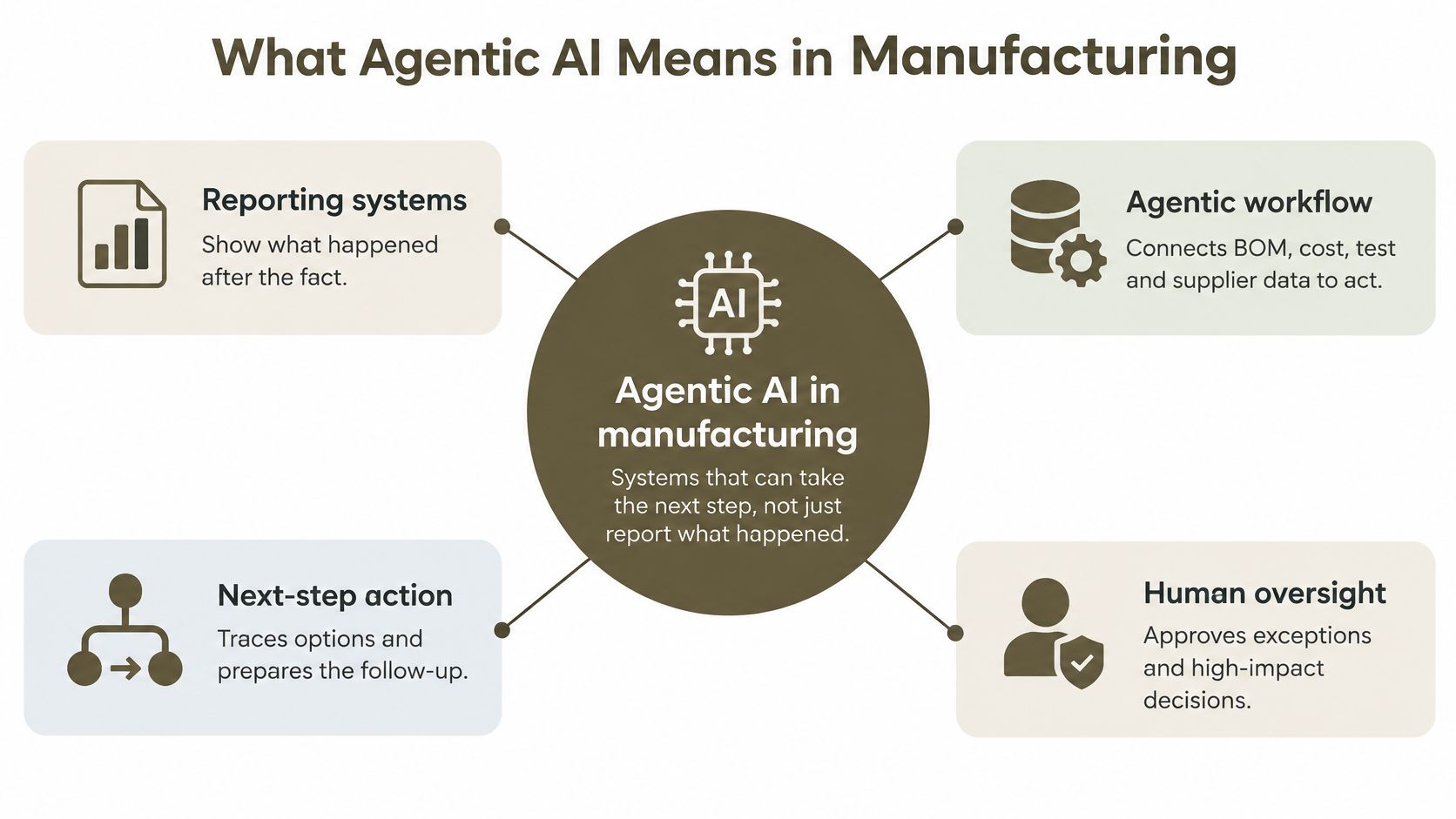
Manufacturing AI is moving beyond reporting what happened toward software that can take the next permitted step. An agent observes a product-development or production state, plans a sequence of actions, uses connected tools and checks whether the result meets the task's constraints. When the decision exceeds its authority, it should stop and escalate.
Those tools might include product lifecycle management (PLM), enterprise resource planning (ERP), email and supplier portals. The distinguishing feature isn't the interface. It's the connection between interpreting information and acting on it.
From an answer to an operational action
A generative AI tool might draft a supplier email. Robotic process automation follows a predefined script. A dashboard displays a late work order or recommends intervention.
An agentic workflow could inspect that work order, check component availability, identify feasible schedule changes and prepare the supplier message. The planner would then review the proposed sequence before anything changes in the production system.
The concept map separates these responsibilities.
Why the workflow matters more than the model
Manufacturing offers explicit constraints against which to evaluate an agent: approved materials, dimensional tolerances, supplier qualifications and release procedures. But a plausible recommendation can still be operationally wrong if it uses an obsolete drawing or overlooks a committed purchase order.
That makes the workflow, not the model, the unit of value. A useful deployment connects an input to a verified output and identifies who owns the decision between them.
Practical rule: Define the action an agent may take before choosing the model that will take it.
Treat autonomy as an operating permission rather than a product feature. A drafting task may justify broad exploration, while releasing a revised specification requires controlled records and explicit approval. The same agent can therefore have different authority at different points in a product's journey.
Agentic Workflows That Connect Design, Specifications and Production
The most useful workflow map follows the product rather than the department. A designer's material choice becomes a technical specification, then a supplier assumption, then a production instruction. Each translation creates an opportunity for an agent to assemble context, identify omissions and route a decision.
The outcomes below are targets to validate, not guaranteed improvements. Read each row across: the agent's proposed contribution only becomes useful when the required records and human checkpoint exist.
Agentic workflows that connect design, specifications and production
| Workflow | What the agent does | Data and systems it needs | Human checkpoint | Operational outcome |
|---|---|---|---|---|
| Concept and brief translation | Turns prompts, sketches, references and brand rules into multi-view concepts and variants | Brand DNA, moodboards, material library, past SKUs | Designer selects and signs off direction | More concepts evaluated before sampling |
| Design-for-manufacture review | Checks seams, tolerances, components and cost drivers against factory capability | CAD or specification rules, supplier capability profiles, cost models | Engineer approves exceptions | Fewer late redesigns and quote surprises |
| Specification and tech pack assembly | Drafts BOM, construction details, measurements, labeling and packaging specifications | PLM or PDM, material database, standards library | Technical designer verifies fit and compliance | Factory-ready pack with fewer misreads |
| Engineering change propagation | Traces changes through BOM, costing, sampling and open purchase orders | PLM, ERP, supplier comments, version history | Change board approves scope | Version drift contained |
| Supplier RFQ and sampling | Packages specifications, prepares RFQs, compares quotes and logs sample actions | Sourcing platform, supplier portal, email, sample tracker | Sourcing lead awards and approves sample | Comparable bids and cleaner sample rounds |
| Production planning and scheduling | Checks orders, capacity, materials and downtime; proposes a schedule | ERP or MRP, MES, capacity calendar, inventory | Planner approves the plan | Less firefighting and better delivery performance |
| Quality containment and CAPA | Flags defect trends, traces lots and drafts hold, rework or corrective-action records | QMS, inspection images, MES, supplier quality records | Quality manager approves disposition | Faster containment with less scrap and rework |
Read the specification handoff closely
Suppose an agent assembles a garment tech pack. It can draft the bill of materials and flag that the closure appears in the sketch but not in the component list. It shouldn't infer an approved zipper specification from visual similarity.
The technical designer must verify the component, fit requirements, construction and applicable compliance details. The agent's contribution is a reviewable package with unresolved fields exposed, not a polished document that conceals uncertainty.
The same distinction applies to design for manufacturing. A proposed construction method needs to match the intended supplier's machinery and process capability, not merely a generic manufacturing rule.
Across the map, the most consequential failures are often handoff failures:
- Lost intent: A design revision remains in an email while the factory works from the previous attachment.
- Missing requirements: A tech pack omits a component or leaves a finish ambiguous.
- Mismatched assumptions: A supplier quotes an alternative material without making the substitution obvious.
Give every workflow permissioned access, version rules and a named approver. Otherwise, the agent may distribute inconsistent information more efficiently than the team did manually.
Choose a starting row with stable inputs and a visible queue of delayed work. The most autonomous workflow isn't necessarily the most valuable first project.
How Far Manufacturing Adoption Has Actually Gone
The apparent contradiction between modest adoption and widespread agent use comes from different survey populations. A broad manufacturing survey and a survey restricted to organizations already deploying generative AI don't describe the same market.
Deloitte's analysis brings together the Manufacturing Leadership Council baseline and Google Cloud findings. The latter covered manufacturing leaders whose organizations had already deployed generative AI, making it a leading-indicator sample rather than a manufacturing-wide average.
Manufacturing agentic AI adoption and readiness in 2025 and 2026 forecasts
| Metric | Value | Sample or year | How to read it |
|---|---|---|---|
| Manufacturers already using agentic AI | 6% | Early-2025 Manufacturing Leadership Council survey cited by Deloitte | Small current base |
| Manufacturers expecting to use agentic AI within two years | 24% | Same survey | Fourfold anticipated increase, not confirmed adoption |
| Generative-AI-deployed manufacturers actively using AI agents | 56% | Google Cloud survey of 517 global manufacturing leaders | Leading-indicator sample, not a market average |
| Generative-AI-deployed manufacturers with more than ten agents launched | 37% | Same survey | Portfolios rather than isolated pilots |
| Agent use in quality control | 54% | Same survey | Quality is an early operational application |
| Agent use in production planning | 48% | Same survey | Planning is an active application |
| Agent use in supply chain and logistics | 47% | Same survey | Coordination extends beyond the factory |
| Agent use in factory and production activities | 46% | Same survey | Adoption includes production-related work |
| Expect agents to manage up to 50% of routine production decisions by 2028 | 74% | 2025 Future-Ready Manufacturing study, more than 200 respondents | Forecast, not demonstrated capability |
| Allow or plan AI-approved work orders within 12 months | 66% | Same study | Combines existing permission and planned permission |
| Operations fully AI-ready | 21% | Same study | Readiness remains limited |
| Security and governance as a scaling obstacle | 52% | Same study | Controls constrain expansion |
| Plant-level talent gap as a scaling obstacle | 47% | Same study | Local implementation skills matter |
The readiness rows come from the Future-Ready Manufacturing study discussed under autonomy below. They measure expectations and organizational constraints, not the same adoption population as the earlier rows.
What the adoption gap actually means
The Google Cloud findings support a narrower conclusion than universal deployment: digitally prepared manufacturers are building agent portfolios. They don't establish that every agent has production write access, operates without supervision or delivers a positive financial return.
Likewise, anticipated adoption is a statement of intent. Procurement, integration, validation and workforce preparation still sit between an executive's forecast and a dependable operational system.
For an individual manufacturer, a better benchmark is a workflow inventory:
- Source readiness: Can the team identify the authoritative specification, order and supplier record?
- Decision ownership: Does someone have responsibility for the outcome?
- Release discipline: Is there an explicit checkpoint before information becomes an instruction?
A manufacturer that can answer those questions has a clearer deployment path than one with an extensive collection of disconnected demonstrations. Agent count measures activity. Verified workflow coverage measures operational preparedness.
How a Product Moves From Brief to Production Order
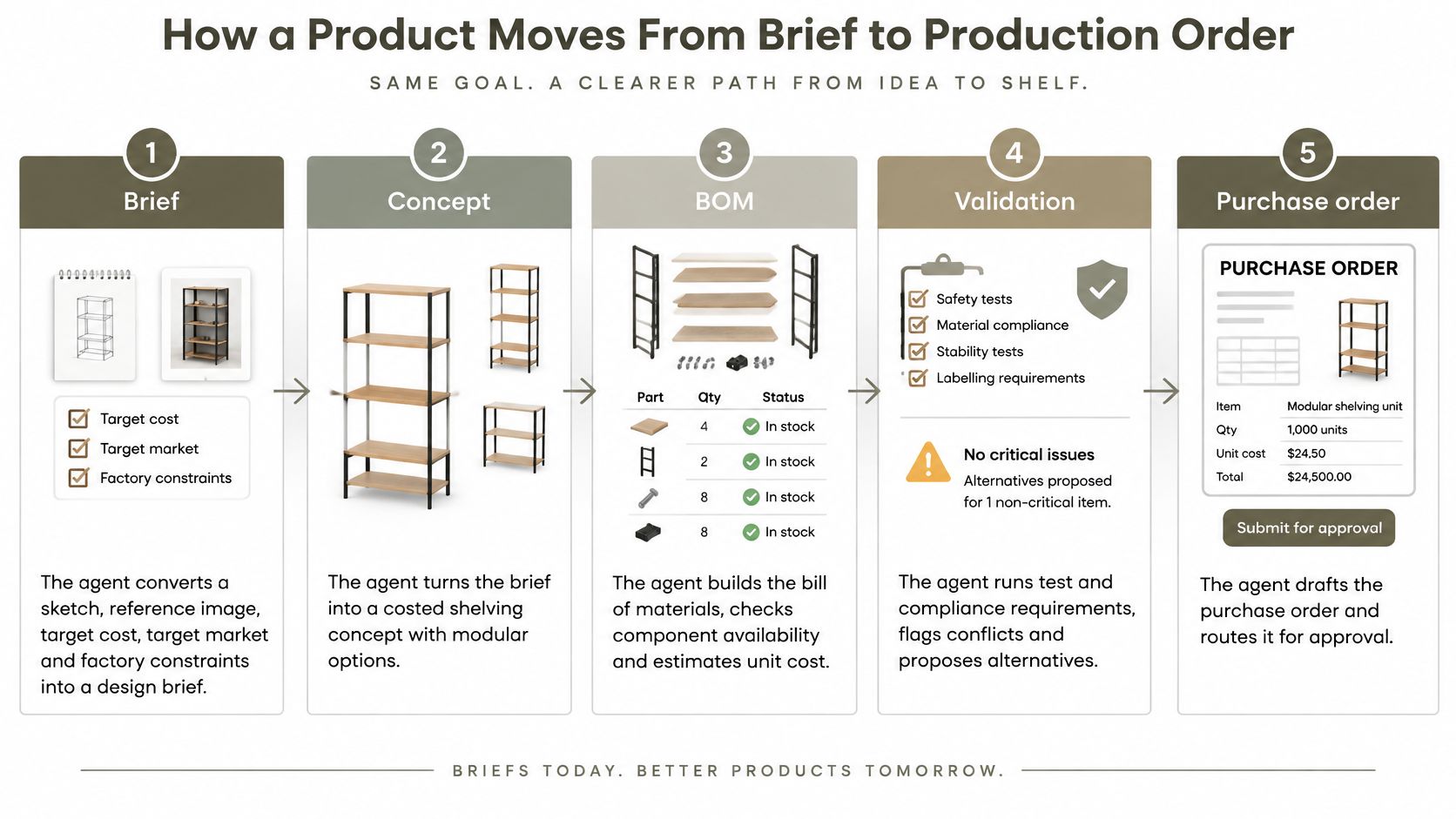
Consider a hypothetical modular shelving unit. The commercial brief requests a compact, expandable product with a target cost and a defined sales market. The challenge is to preserve that intent as the product becomes drawings, component records, supplier commitments and production instructions.
The lifecycle visual summarizes the journey; the approval gates below make it executable.
Establish the product before requesting a price
Convert the inputs into a controlled brief.
The agent organizes the sketch, reference image, target cost, intended market and factory constraints. It lists unresolved questions, such as loading requirements, wall attachment and assembly expectations, rather than inventing answers. The product lead approves the brief.Prepare concepts with explicit assumptions.
The agent develops views and material or finish variants, then screens them against the supplied capability rules. A concept that requires an unsupported joint or unavailable board thickness gets flagged. The designer selects the direction, including which assumptions still need engineering verification.Draft the technical definition.
The selected design becomes a proposed tech pack containing the BOM, dimensions, tolerances, construction, finish, packaging and test requirements. Missing values remain visibly unresolved. The technical designer and responsible engineer verify the specification, including structural and safety requirements that generated imagery cannot establish.
This sequence prevents an attractive rendering from becoming a manufacturing instruction. The agent should preserve the distinction between a design suggestion, an engineering assumption and an approved requirement.
Convert the definition into a supplier commitment
Prepare and compare the RFQ.
The agent matches the requirement to documented supplier capabilities and packages the approved revision. It compares quote assumptions, including materials, tooling, packaging and exclusions, rather than sorting only by unit price. Sourcing approves the supplier after resolving material deviations.Manage the sample against the master specification.
Sample comments link to specific components or dimensions. If the shelf support changes, the proposed update includes its effect on cost, assembly and testing, with superseded values retained in the history. The product team approves the sample against the controlled acceptance criteria.Prepare the production release.
The agent assembles purchase-order attachments, the quality-control plan and the change log from the approved records. It checks that the supplier acknowledgment names the same revision. Planning and quality sign off before release.
A sample approval is incomplete if the approved physical product and the released specification describe different things.
The operational target isn't faster text generation. It's fewer translation errors at release gates. Measure whether the team spends less time resolving conflicting attachments, repeating supplier questions or reconstructing why a sample changed.
What Agentic Workflows Look Like in Practice
The following are illustrative scenarios, not measured customer case studies. Each shows what an agent could prepare and which decision should remain with a person.
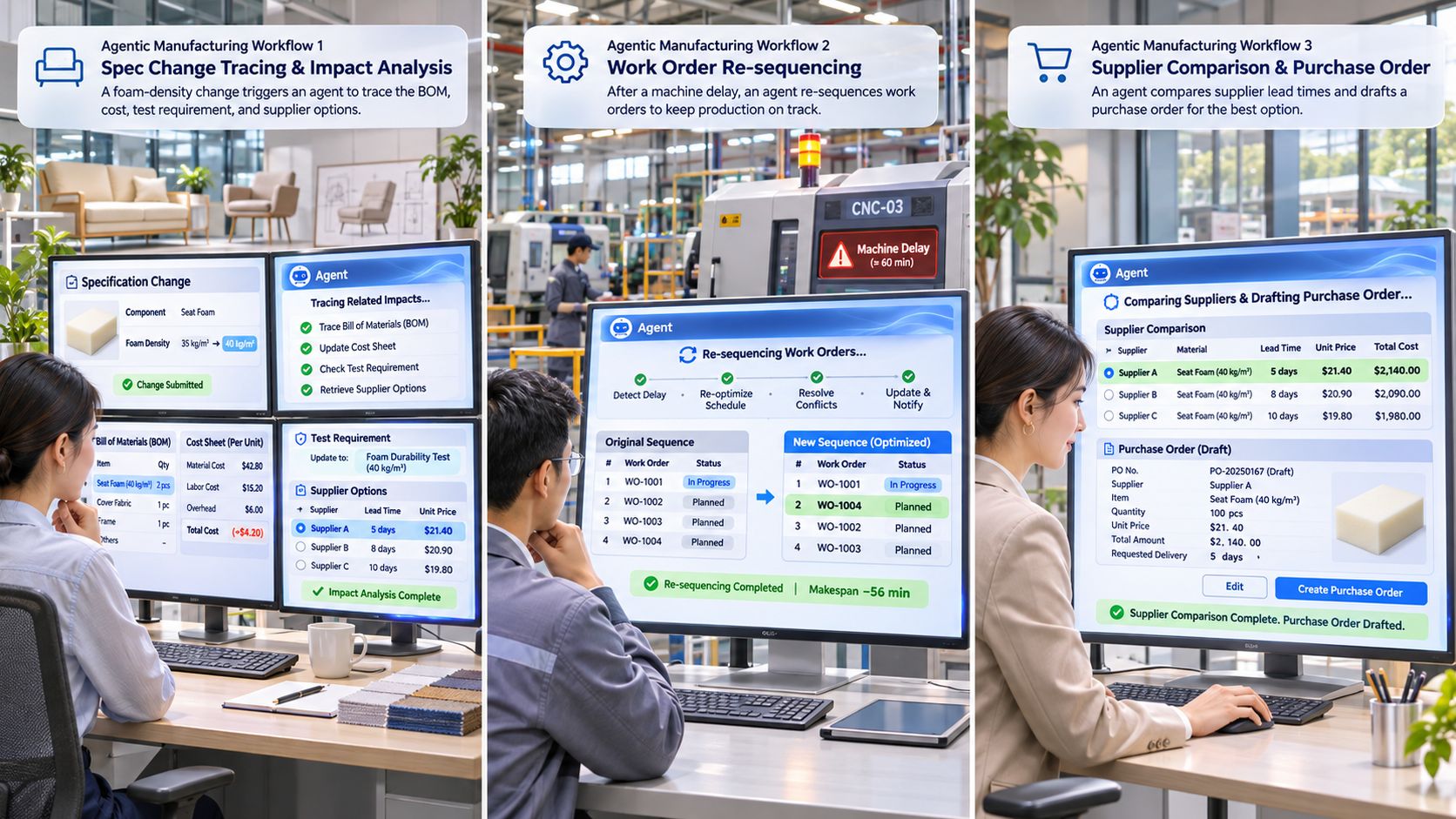
The shared operating setting is a team reviewing proposed changes across connected manufacturing records.
Furniture and electronics require different evidence
Furniture scenario. A supplier proposes changing a cushion's foam density. The agent traces the material through the BOM, cost sheet, applicable test requirements and open sample records, then prepares a change packet showing affected products and unresolved consequences.
The engineer reviews performance implications before the change board approves scope. Success would mean the board receives a complete, consistent packet sooner, not that the agent independently decides the substitute is equivalent.
Consumer electronics scenario. A quality agent flags a rising solder-defect trend and gathers inspection records, lot identifiers, supplier information and the recorded reflow profile. It drafts a containment proposal while distinguishing observed associations from a proven root cause.
The quality manager decides which lots to hold and what investigation is necessary. The agent must not label the supplier responsible because the affected boards share a component source.
The embedded video provides a separate visual reference alongside these workflow examples.
Apparel makes quote comparability visible
An apparel sourcing agent receives an approved tech pack and prepares RFQ packages for qualified factories. When replies arrive, it aligns material descriptions, minimum order quantities, test requirements and exclusions, flagging a low bid that omitted a required test.
The sourcing lead decides whether to request clarification, negotiate or award. That decision can then inform production planning without allowing a quote-comparison agent to rewrite delivery commitments.
Use a small operational scorecard across these scenarios:
- Quote turnaround: Measure from a complete RFQ release to a technically comparable response.
- Sample rounds: Count repeat rounds and record why each was required.
- Change lead time: Track from a complete change request to an approved release.
- Scrap or rework: Record downstream consequences, including work displaced to suppliers.
The common design is narrow scope, structured inputs and a human gate. The evidence of value is a changed operational result, not an impressive demonstration.
How Much Autonomy Should an Agent Have
Manufacturers' expectations exceed their declared readiness. In the 2025 Future-Ready Manufacturing study, the forecast for agents handling routine production decisions sits alongside limited self-reported AI readiness and substantial governance and skills constraints.
That combination argues for graduated decision rights, not an organization-wide autonomous mode. An agent may be competent at preparing an RFQ while remaining unqualified to approve a supplier substitution.
Four stages of agent autonomy in manufacturing
| Stage | Agent authority | Manufacturing example | Human role | Required controls |
|---|---|---|---|---|
| Recommend | Read-only analysis and suggestions | Flags a late work order and proposes a new sequence | Decides and executes | Read-only access and decision log |
| Approve | Prepares an action and waits for human approval | Drafts an engineering change, RFQ or quality hold | Reviews, edits and approves | Diff view, role-based approval and reason code |
| Supervised execution | Executes within rules while a person monitors exceptions | Re-sequences eligible orders outside protected commitments | Monitors, handles exceptions and can stop execution | Guardrails, rollback, alert thresholds and audit trail |
| Bounded automation | Runs recurring decisions within explicit limits | Reorders approved consumables within authorized limits | Audits results, adjusts limits and reviews drift | Kill switch, drift checks and periodic recertification |
The Approve stage means the human approves the prepared action. It doesn't mean the agent receives unrestricted approval authority.
Scheduling requires particularly careful boundaries. An agent shouldn't change a frozen production window merely because it can calculate a more efficient sequence; the frozen window may protect customer commitments, labor arrangements or material availability.
Match authority to the consequence of error
A mistaken draft can be rejected. A mistaken write to a live system can trigger purchasing, production or shipment before anyone notices. Evaluate the downstream action chain, not just the immediate tool call.
Use these decision criteria:
- Reversibility: Can the team undo the action without physical loss or an external commitment?
- Detectability: Will someone notice the error before another system acts on it?
- Scope: Is the agent restricted to eligible records, approved materials and defined transaction types?
- Accountability: Is a named person responsible for reviewing exceptions and maintaining the limits?
Start below the team's instinctive comfort level. Increase authority only when the agent passes acceptance tests on representative operational data and the receiving team can manage exceptions.
More autonomy may reduce waiting time, but it also increases the consequence of a bad action. Grant write access only where the agent can identify its sources, applicable constraints and escalation route.
How to Test an Agent Before You Trust It
The NIST manufacturing AI workshop agenda identifies reliability, safety, standardized performance measures and validation of agentic decisions as unresolved adoption barriers. A general accuracy score therefore isn't a sufficient release criterion for an agent that influences manufacturing.
Translate those concerns into task-specific acceptance gates. The framework below is a proposed operational test suite, not a NIST certification standard.
Acceptance tests before an agent gets decision rights
| Test | Question to answer | Evidence to require | Pass condition |
|---|---|---|---|
| Constraint compliance | Does every action obey tolerances, safety stock, approved-supplier and compliance rules? | Normal and edge-case scenario tests | No unauthorized writes or unapproved hard-limit violations |
| Escalation quality | Does it escalate when confidence, authority or data quality is insufficient? | Reviewed escalated and non-escalated cases | Every out-of-policy case reaches a human; unnecessary escalations remain within an agreed rate |
| Recovery from incorrect action | Can it detect and reverse a bad step? | Fault injection and timed rollback drill | Reversal within the agreed window without corrupted master data |
| Traceability | Can a reviewer reconstruct the input, rule, source and decision? | Quality or compliance inspection of audit records | Exportable lineage for every action |
| Human override | Can a person stop, edit and resume the workflow? | Timed stop-edit-resume drill | Stop within the agreed time; resume without version drift |
| Operational impact | Does it improve performance without transferring risk elsewhere? | Pilot compared with a comparable workflow or control group | Pre-agreed improvement with no safety incidents or hidden rework |
Make the tests difficult enough to matter
Build cases from actual failure modes. Give the agent an obsolete drawing, conflicting material descriptions, a supplier outside the approved list and a missing test requirement. Check whether it stops for the right reason rather than filling gaps with plausible assumptions.
For escalation, review cases the agent didn't escalate as carefully as those it did. An agent that asks for approval constantly may be unusable, but one that resolves ambiguous compliance requirements without oversight is unsafe.
Recovery tests should include interrupted integrations and duplicate requests. A retry must not create another purchase order, repeat a supplier instruction or overwrite a newer revision.
Release gate: A fluent explanation cannot compensate for a missing audit record or a failed stop command.
Use AI virtual product validation to organize checks and expose unresolved requirements, not to substitute generated confidence for required physical tests or engineering approval.
The strongest initial candidate is often an agent that prepares a verified engineering change packet and requests approval. It gives the team something concrete to inspect while testing source retrieval, dependency tracing and exception handling without granting direct control over factory settings.
Why Pilots Stall and Where to Start
Among manufacturers reporting limited or moderate pilot success, 51% cited data-quality problems and 43% cited integration challenges, according to RSM's manufacturing AI analysis. A capable model doesn't remove those obstacles. It may expose them when the workflow first attempts to combine incompatible records.
Treat this as an information-architecture problem before treating it as a model-selection problem. The minimum viable data layer doesn't require replacing every legacy system, but it does require agreement about which records an agent may trust.
Build the smallest dependable handoff
For each proposed action, document:
- Source and owner: Identify the authoritative record and who maintains it.
- Permission: Specify what the agent may read, draft and write.
- Version rule: Define how it detects superseded or conflicting information.
- Human checkpoint: Name the approver and the evidence they need.
- Fallback: Explain how work continues when data or integrations fail.
Then measure value at the workflow level. Include review time, exception handling, integration maintenance and downstream corrections, not just the time required to produce a draft.
The handoff from approved concept to tech pack and RFQ is a sensible first candidate. It has identifiable inputs, visible deliverables and natural review gates. Autonomous line control or commercial pricing decisions introduce consequences that are harder to contain during an initial deployment.
Our Agentic Tech Pack is a factory-ready workspace where teams and suppliers collaborate in one file. AI handles repetitive tech pack work while people focus on taste, brand and the decisions surfaced for review. We don't guarantee the accuracy, quality or suitability of AI-generated content; customers should review all generated content before production or manufacturing.
Decide whether to continue before expanding
Establish a baseline covering complete work cycles, then run a time-boxed pilot against comparable work. Set the go-or-no-go criteria before launch: acceptable review burden, improved handoff performance, reliable traceability and no uncontrolled releases.
Expand only when the team can explain both what improved and what remained under control. That's the evidence an agent needs to earn greater autonomy.
Genpire offers a shared concept-to-factory workflow, including a tech pack workspace for teams and suppliers. Visit Genpire to evaluate the approved-concept-to-specification handoff as your first bounded agentic workflow, with human review before manufacturing release.