You're choosing a fabric for a baby bodysuit, fitted basic tee, or underwear line. The supplier offers cotton interlock, but the sample feels different from the single jersey you started with, and the specification only says “soft, stable, low shrinkage.” That description isn't enough to approve production.
With cotton interlock knit fabric, the important decisions sit beneath the surface. The knitting structure, machine gauge, yarn count, loop length, finished GSM, elastane content, and laundering method all shape the final garment. A good sourcing decision connects those variables to the product's purpose rather than treating interlock as a universal quality upgrade.
Table of Contents
- What Cotton Interlock Knit Fabric Is and Why It Matters
- How Interlock Is Constructed on the Knitting Machine
- Key Performance Characteristics and How to Read Them
- Cotton Interlock Compared to Single Jersey and 1x1 Rib
- Common Uses and How to Match GSM to the Garment
- Care, Laundering, and Controlling Shrinkage in Production
- A Factory-Ready Spec Brief for Cotton Interlock
What Cotton Interlock Knit Fabric Is and Why It Matters
A baby bodysuit, fitted tee, or underwear style may look straightforward on a sketch, yet its fabric specification determines how the garment feels, fits, and holds its shape. Cotton interlock is a double-knit weft fabric formed from connected rows of loops. Two needle beds create the structure, giving the fabric a smoother, thicker, and more balanced surface than single jersey, with similar faces on both sides.
That construction suits garments worn close to the body or expected to retain a clean appearance through use. Common applications include underwear, babywear, T-shirts, polos, loungewear, and lightweight base layers. Interlock offers a stable knitted foundation while retaining the flexibility associated with looped fabric, rather than behaving like a rigid woven textile.
The fabric name alone does not define performance. Two cotton interlock qualities can respond differently because gauge, yarn count, loop length, finishing, and finished GSM change the spacing, density, handle, and dimensional stability of the cloth. Gauge describes the needle density of the machine, while loop length influences how much yarn forms each knitted loop. Together with GSM, these variables help determine whether the finished garment feels light, compact, soft, or bulky.
Practical rule: Approve cotton interlock against a complete specification, not fiber content alone. Confirm the construction and finishing details before judging a supplier sample.
Cotton forms part of a large, globally distributed fiber system. A USDA overview places cotton at approximately 25 percent of total world fiber use. The USDA Economic Research Service backgrounder also describes changes in global cotton production and mill demand. Those supply differences can affect fiber origin, spinning consistency, yarn quality, and finishing results.
For product development, “100% cotton interlock” is therefore only a starting point. A factory-ready brief should state the composition, yarn count, machine gauge, finished GSM, usable width, shrinkage limit, finishing route, and colorfastness requirements. Laundering conditions must also be specified, because washing and drying can alter dimensions and surface appearance.
Clear construction information supports a more reliable design-for-manufacturing workflow, connecting garment function with fabric choices that affect fit, artwork placement, and sewing.
How Interlock Is Constructed on the Knitting Machine
Begin with the yarn and the machine's two knitting surfaces. A circular interlock machine feeds yarn to needles arranged on two opposing needle beds, usually called a cylinder and a dial. Each bed forms its own set of loops, and the two sets lock together as the fabric develops.
The structure works like two combs facing each other. One bed creates the face-side loops, while the other creates complementary back-side loops. Their intermeshing produces a balanced double-knit fabric with connected layers, so the reverse side resembles the face more closely than the reverse of single jersey.
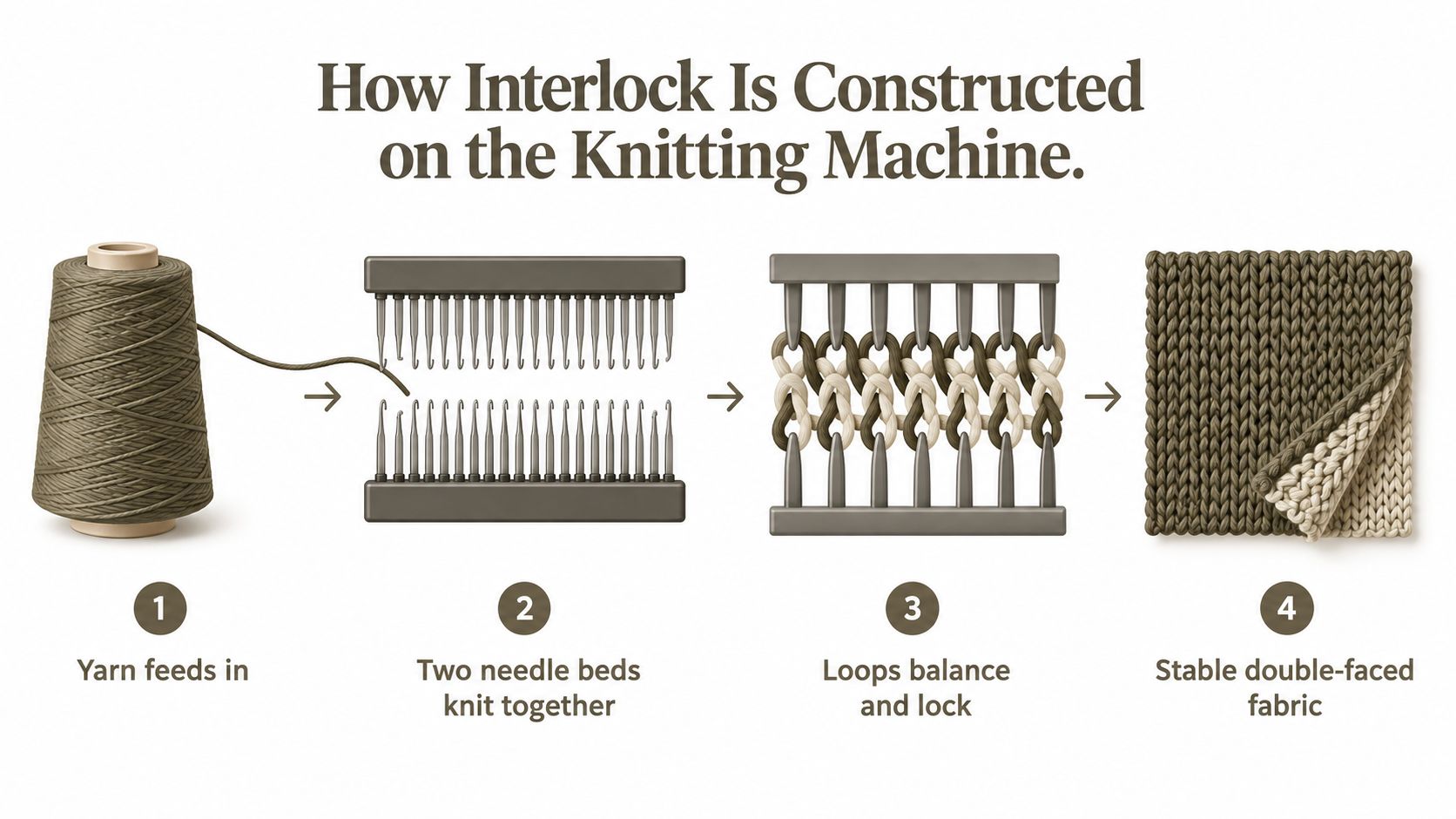
Why the two beds change the fabric
Single jersey relies on an imbalanced face and back loop system. That imbalance encourages edge curling and can contribute to twisting or sideways distortion. Interlock distributes loop formation between two connected systems, which generally helps the edges lie flatter and gives both sides a smoother, more even appearance.
The double-knit arrangement also gives interlock greater thickness and stability than single jersey. The fabric still stretches because knitted loops open under tension and close again as the tension changes. Its connected layers share that tension across the structure, helping the garment hold a cleaner shape.
This construction can suit close-fitting basics, reversible-looking products, and garments where print or seam alignment needs a stable surface. During sampling, the similar face and back also make it easier to inspect the garment from either side.
Gauge is a design variable
Machine gauge describes needle fineness and spacing. It affects compactness, stiffness, dimensional stability, and hand feel, so it belongs in the technical specification rather than remaining an unnamed machine setting.
A historical account of cotton double-knit gauge development describes traditional cotton interlock as being knitted predominantly on 20-gauge machines, with a typical weight of approximately 5 ounces per square yard, or about 170 grams per square meter. It also records the development of 18-gauge machines from the 1950s onward for double-jersey fabrics intended for semi-suiting. A historical account of cotton double-knit gauge development shows why gauge history still matters when defining the construction.
Experimental comparisons using 22-, 26-, and 30-gauge machines found that gauge and knit structure affected shrinkage, stiffness, bursting strength, and air permeability. Finer gauges produced firmer fabrics with lower shrinkage. As a result, two samples with the same nominal GSM can wear differently when their gauge and loop settings differ.
A factory specification should identify the cylinder and dial setup, gauge, yarn count, stitch density, and finishing process. Loop length also needs attention because it changes how much yarn forms each loop, influencing the final weight, openness, and response to laundering. Without these details, “cotton interlock” names a fabric family rather than a repeatable production standard.
Key Performance Characteristics and How to Read Them
A designer selecting interlock for a fitted brief, baby bodysuit, or lounge top needs more than a fabric name. Read its behavior through the relationship between structure, weight, yarn, loop length, elastane, and finish. These variables work together, so a target GSM alone cannot predict the finished garment.
What the wearer and factory will notice
Stretch and recovery begin with the knitted loops. Elastane adds controlled extension and return, which can help a close-fitting base layer resist bagging. Cotton-only interlock may still move comfortably, but the specification should state the required stretch and recovery in each direction rather than treating every interlock as equivalent.
Opacity and cover generally rise with density and weight. That can help a white baby bodysuit or printed tee appear less transparent. The trade-off is greater material consumption and a heavier garment.
Drape and hand feel depend on more than GSM. Yarn count, loop length, finishing, and gauge determine whether the fabric feels fluid, compact, plush, or firm. A dense, heavier construction can support a cleaner silhouette, while a more open loop setting may feel cooler and move more freely.
Laundering can expose differences that are invisible on the cutting table. Loop length changes how much yarn forms each loop, which affects weight, openness, thickness, and dimensional response. Experimental work reports that increasing loop length can reduce GSM, thickness, and tightness while increasing air permeability and water absorbency. The interlock construction study also connects loop length with shrinkage, spirality, bursting strength, abrasion resistance, and pilling behavior.
Use the following figures as starting references, then confirm them with fabric testing:
| Property | Typical Range | What Drives It |
|---|---|---|
| Finished weight | Approximately 180 to 260 GSM for a practical production benchmark | Yarn count, gauge, stitch density, loop length, finishing |
| Midweight reference | 220 GSM as a mid-to-heavyweight reference | Intended warmth, opacity, drape, garment structure |
| Broader interlock range | About 160 to 280 GSM | End use, climate, yarn quality, construction choices |
| Residual shrinkage | Within 3% after mechanical pre-shrinking, when verified with AATCC 135 | Relaxation, compacting, wash process, drying, production-lot variation |
| Dimensional stability | Generally stronger than single jersey among weft-knit structures | Balanced loop systems, gauge, finishing, laundering |
The practical range and pre-shrinkage benchmark appear in wholesale cotton interlock production guidance with GSM tolerances. Define GSM tolerance, usable width, wash protocol, and maximum dimensional change separately in the wale and course directions.
A tech pack should separate weight from performance. Higher GSM can improve cover and perceived substance, while reducing breathability and increasing drying time. The final choice should meet the garment's comfort, fit, and durability requirements without adding material that the product does not need.
Cotton Interlock Compared to Single Jersey and 1x1 Rib
Choosing between knit structures is easier when you start with the garment problem.
Cotton interlock is the balanced option when you need a smooth double-faced surface, low edge curl, moderate stretch, and more body than a lightweight jersey. Its connected loop systems make it useful for babywear, underwear, polos, T-shirts, loungewear, and lightweight thermals.
Single jersey is often the better choice when you want a lighter, more fluid garment with an easy drape. It can feel soft and breathable, but its one-bed construction gives it a clearer face and back and makes the edges more likely to curl. That behavior may be acceptable for a relaxed tee, but it can create problems around hems, plackets, print registration, or fitted panels.
1x1 rib is the stretch specialist. Its vertical rib columns provide useful extension and recovery, so designers commonly choose it for cuffs, neckbands, waistbands, and close-fitting components. It isn't a direct replacement for interlock when the garment needs a smooth, stable surface across the body.
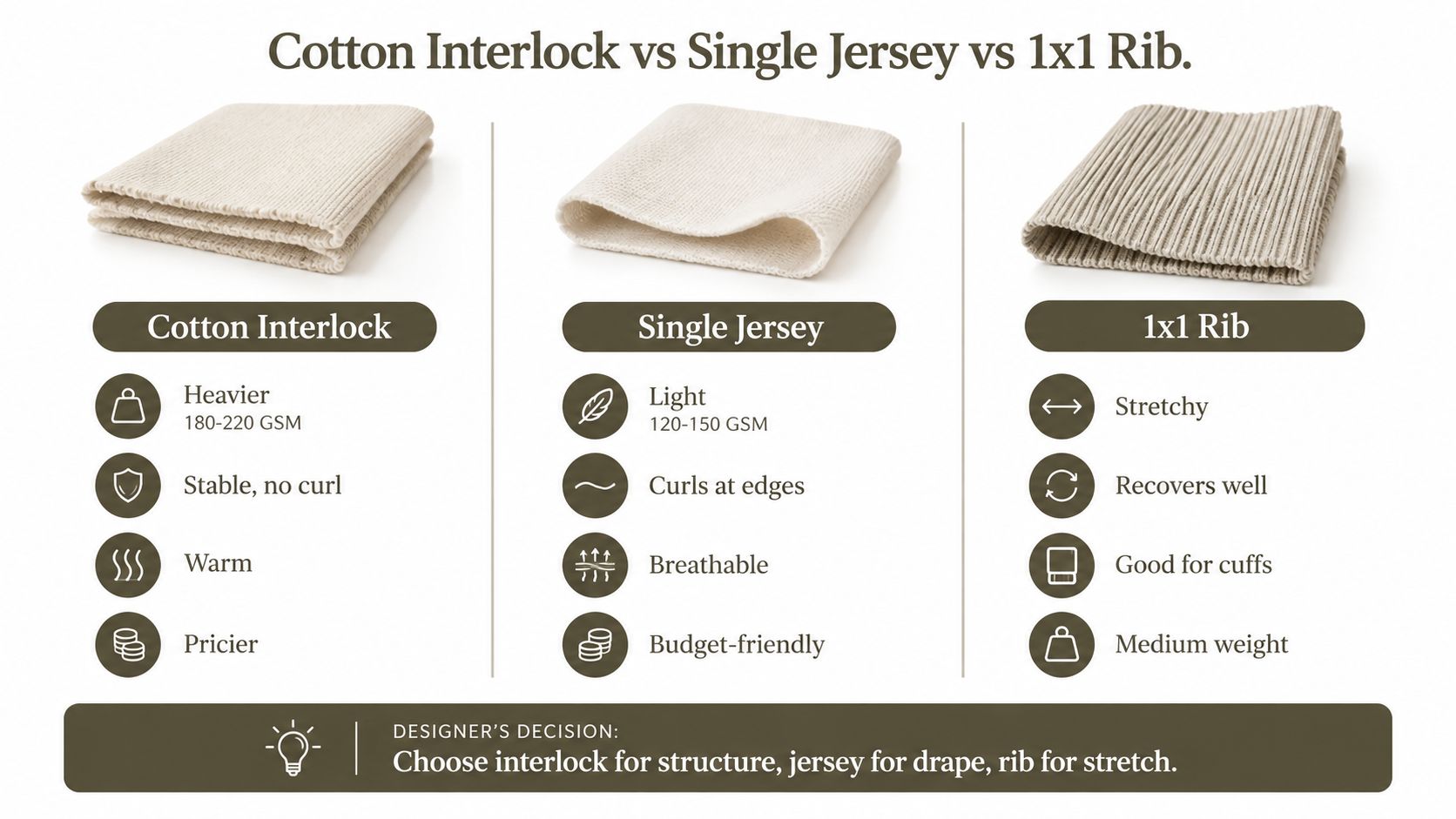
Select by the failure you want to avoid
If the main risk is a tee that feels too thin or twists after laundering, interlock may solve the problem through greater body and balance. If the design depends on soft drape, low garment weight, and easy airflow, single jersey may be more appropriate.
If the design needs a neckband to expand over the head and recover around the neckline, rib is usually the functional choice. A designer may use interlock for the garment body and rib for the trim, because the two structures solve different problems.
A published study evaluated interlock using ASTM D3736 for mass per unit area, ASTM D2594-99a for fabric growth and stretch in course and wale directions, and ASTM D6207 for dimensional stability after laundering. The study on interlock performance offers a useful testing framework for teams that need more than a subjective hand-feel approval.
Design decision: Choose interlock for structure and a clean reversible surface, single jersey for lighter drape, and rib for concentrated stretch and recovery.
Common Uses and How to Match GSM to the Garment
A baby bodysuit for a warm climate and a winter base layer may both use cotton interlock, yet they need different fabric decisions. Start with the garment's job, then set the construction, weight, and finish around that use.
Match construction to the product
- Babywear: Choose a lighter interlock when softness and comfort matter more than insulation. Check opacity, seam comfort, absorbency, wash behavior, and whether elastane changes recovery or hand feel.
- Underwear: Prioritize smooth skin contact, recovery, opacity, and dimensional stability. A moderate weight with selected elastane can work better than choosing the heaviest option.
- T-shirts: Use GSM to control body and cover, then assess drape on the finished garment. A denser fabric gives a basic tee more substance, while a more open construction can improve comfort in hot climates.
- Polos: A firmer interlock can support a cleaner silhouette and a more stable placket area. Confirm that the added body does not restrict movement.
- Loungewear: Hand feel, flexibility, and recovery often matter more than maximum weight. A soft finish can improve comfort, while excessive density can make the garment feel warm or cumbersome.
- Lightweight thermals: Assess warmth, air permeability, and moisture handling together. Higher GSM alone does not guarantee better performance when the garment must breathe.
The useful factory question is not, “What GSM should we order?” It is, “What loop system will deliver the required GSM, cover, stretch, and recovery after finishing?” Gauge sets the scale of the knitted structure, while loop length helps determine how much yarn forms each stitch. A longer loop can produce a lighter, more open fabric with greater air permeability and absorbency. A tighter loop system can increase body, cover, and resistance to deformation.
GSM is therefore a result to control, not a complete quality score. Two fabrics with the same measured weight may behave differently if their gauge, loop length, yarn, finishing, or elastane content differs. Ask the mill for the construction details and evaluate the finished fabric, not only a greige specification.
The design should also be judged on a body. on-model photography helps the team see how weight, drape, cover, and recovery affect the actual silhouette rather than relying on a flat swatch. Include artwork, seam placement, measurements, and the sample sequence in the production brief. A prototype manufacturer guide can help organize those decisions before bulk development begins.
Care, Laundering, and Controlling Shrinkage in Production
“Pre-shrunk” is not a complete quality statement. Cotton interlock can continue changing after laundering because knitted loops relax, shift shape, and respond to mechanical action. The final result depends on the wash temperature, detergent, spin, agitation, drying method, and number of cycles.
A controlled study of 100% cotton single jersey, rib, and interlock found that most post-laundering change came from loop-shape alteration rather than changes in yarn or stitch length. The study attributed 34% of the change to tumble-dryer agitation and 24% to the washing spin cycle, making mechanical action a major consideration alongside water temperature. The laundering study also indicates that fabric may approach fully relaxed dimensions only after several wash-and-dry cycles.
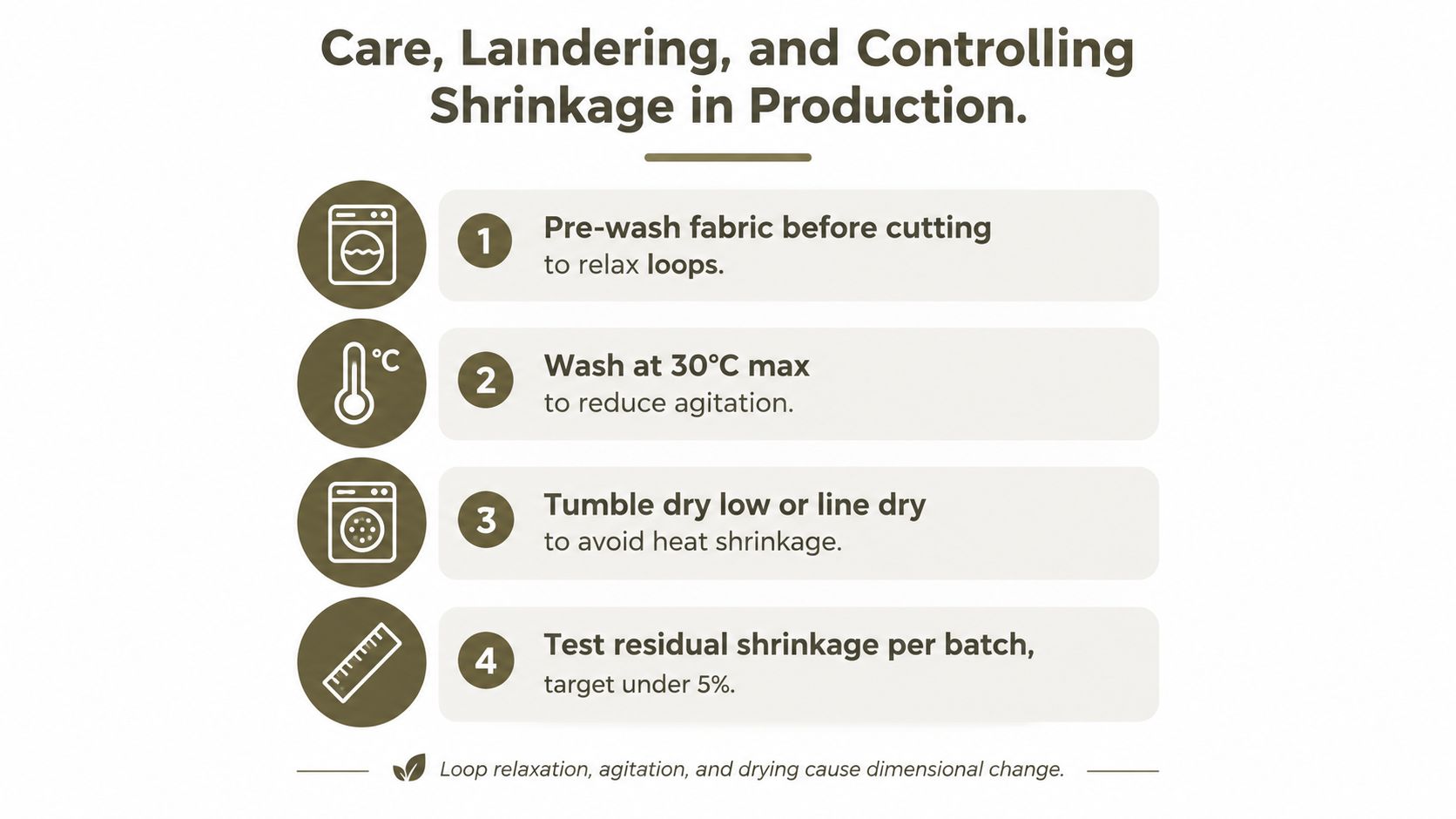
Convert laundering into a factory test
Write the laundering conditions into the tech pack. A supplier should know exactly how you'll judge dimensional stability.
- Define the wash: State temperature, detergent, load conditions, and spin speed.
- Define the dry: Specify line drying, flat drying, or tumble drying with the relevant setting.
- Define the cycles: Test more than the first wash if the garment is expected to be worn and cleaned repeatedly.
- Measure both directions: Record wale and course shrinkage, spirality, fabric width, and garment-panel measurements.
- Set the limit: Separate fabric residual shrinkage from finished-garment tolerance.
The practical guidance for cotton interlock reports residual shrinkage within 3% after mechanical pre-shrinking when verified using AATCC 135, while untreated fabric may shrink substantially more during the first wash. Cotton care washing tips can help teams explain consumer care, but factory approval still requires a controlled internal protocol.
Quality-control rule: Don't accept “low shrinkage” as a pass condition. Require the wash method, number of cycles, measurement directions, drying process, and maximum dimensional change.
This matters most for fitted basics, babywear, underwear, and printed garments. A small length change can alter fit, move a screen print relative to a seam, or disrupt size grading. Mechanical agitation and drying deserve the same attention as hot water.
A Factory-Ready Spec Brief for Cotton Interlock
A factory-ready cotton interlock brief turns a fabric idea into measurable instructions. Start with the garment's job, then connect that requirement to yarn, machine settings, finishing, and testing. A baby bodysuit, fitted top, and relaxed sweatshirt may all use interlock, but they should not share the same specification.
Include these fields
- Fiber composition: State the cotton percentage and identify elastane or any other fiber.
- Yarn count: Record the yarn specification and spinning system where relevant.
- Machine gauge: Include gauge because it influences loop size, compactness, firmness, and stability.
- Finished GSM: Set a target and tolerance, such as 220 GSM ±5%, when suitable for the product.
- Usable width: Specify the finished width after dyeing and finishing, rather than only the knitting width.
- Loop and stitch construction: Record loop length and stitch details because they affect cover, air permeability, stretch, and drape.
- Finish: Identify compacting, pre-shrinking, enzyme treatment, softening, or other required processes.
- Dimensional stability: Set separate maximum changes for wale and course directions, with the defined wash and drying method.
- Colorfastness: List tests for laundering, rubbing, perspiration, and any intended print process.
- Performance testing: Consider ASTM D3736 for mass per unit area, ASTM D2594-99a for growth and stretch, ASTM D6207 for dimensional stability, and AATCC 135 for laundering evaluation.
These fields work together. Gauge sets the machine's structural framework, while loop length helps determine how much yarn sits in each stitch. Together with yarn count, they influence GSM, handle, cover, and recovery. Finishing and laundering can then change the dimensions and feel, so approve the finished fabric rather than judging construction alone.
A tolerance turns an approved sample into a production standard. Without one, a supplier may deliver fabric that matches the name but differs in weight, width, handle, or shrinkage. State the target, acceptable range, test method, and sample condition for every property that affects fit or appearance.
Organize the document with this spec sheet essentials guide for fashion designers, then send the supplier the approved swatch, tolerance table, wash protocol, and testing requirements together.
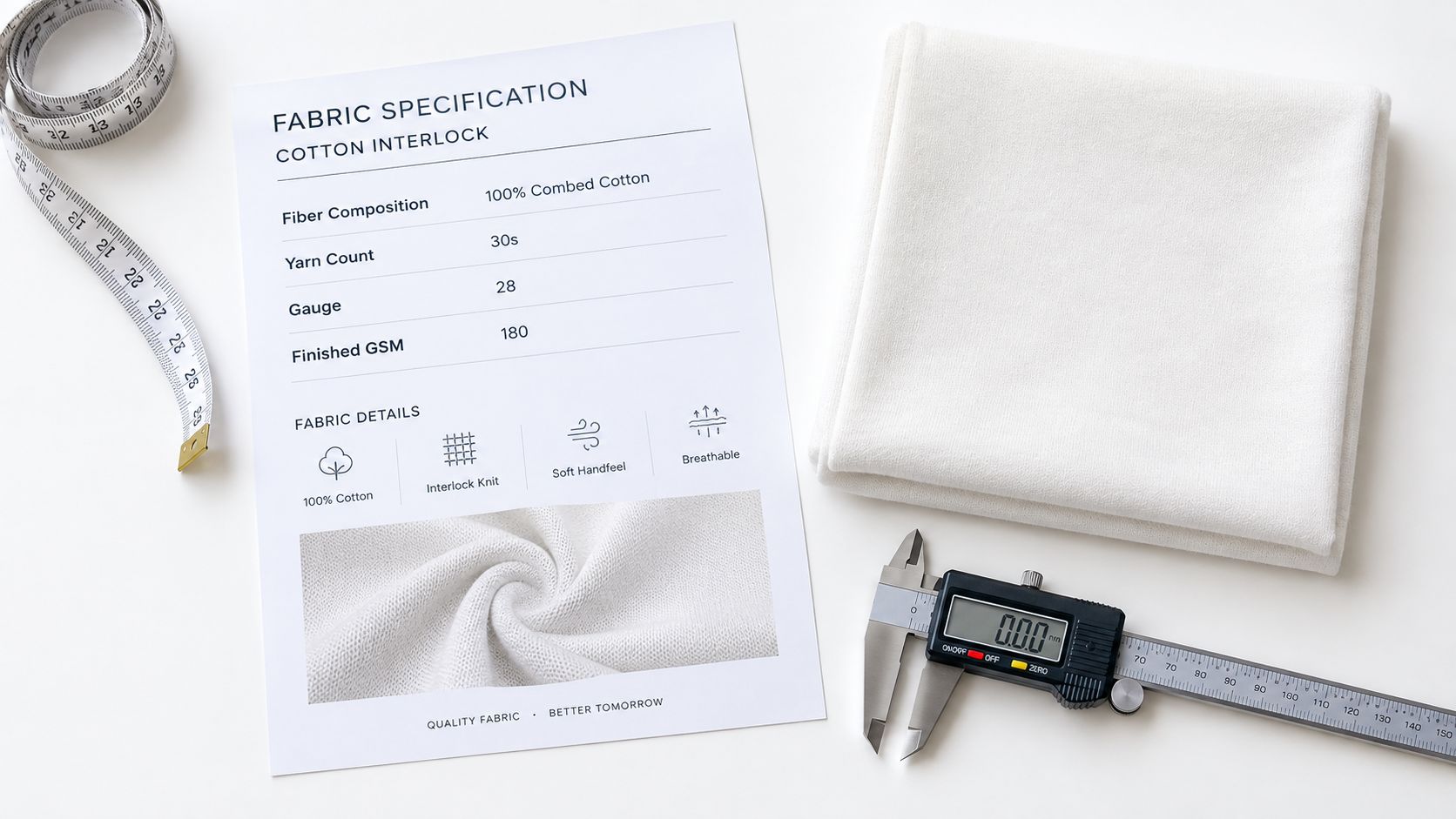
Genpire helps product teams turn fabric decisions into structured concepts, factory-ready tech packs, and production assets, including construction details for cotton interlock programs. Visit Genpire to develop specifications from the garment idea and approved swatch through supplier review.