Only 44% of respondents always or often verify supplier data, according to Oritain's 2025 survey of more than 450 fashion professionals. That's a scheduling problem, not just a sustainability problem. A designer can approve a shell fabric, a factory can quote it, and a team can announce a launch while nobody has checked whether the supplier can prove the material claim on the hangtag.
Fashion project management means getting a product from an approved idea to a sellable garment through decisions the next person can use. The strongest calendars track physical readiness and evidence readiness together. A missing material record deserves an owner and a deadline just as much as a failed fit sample.
Table of Contents
- Why a Short Trend Cannot Wait a Long Calendar
- The Critical Path from Design Approval to Shipment
- Tech Packs That Keep Sample Rounds to One or Two
- Where Integration Saves Weeks and Freight Does Not
- Compliance Evidence Before the Sample Is Cut
- One Jacket and the Weeks That Vanished
- Set the Next Drop on One Shared Path
Why a Short Trend Cannot Wait a Long Calendar
Some fashion products have a market life of only 10–12 weeks, while typical fashion-industry lead times exceeded 40 weeks, according to the benchmarks discussed in the University of Sunderland supply-chain complexity paper.
Two clocks, one calendar. A selling window measures how long customers want the product. A development lead time measures how long your team and suppliers need to deliver it. Confuse them, and you produce a well-organized schedule for a garment that arrives after its buyers have moved on.
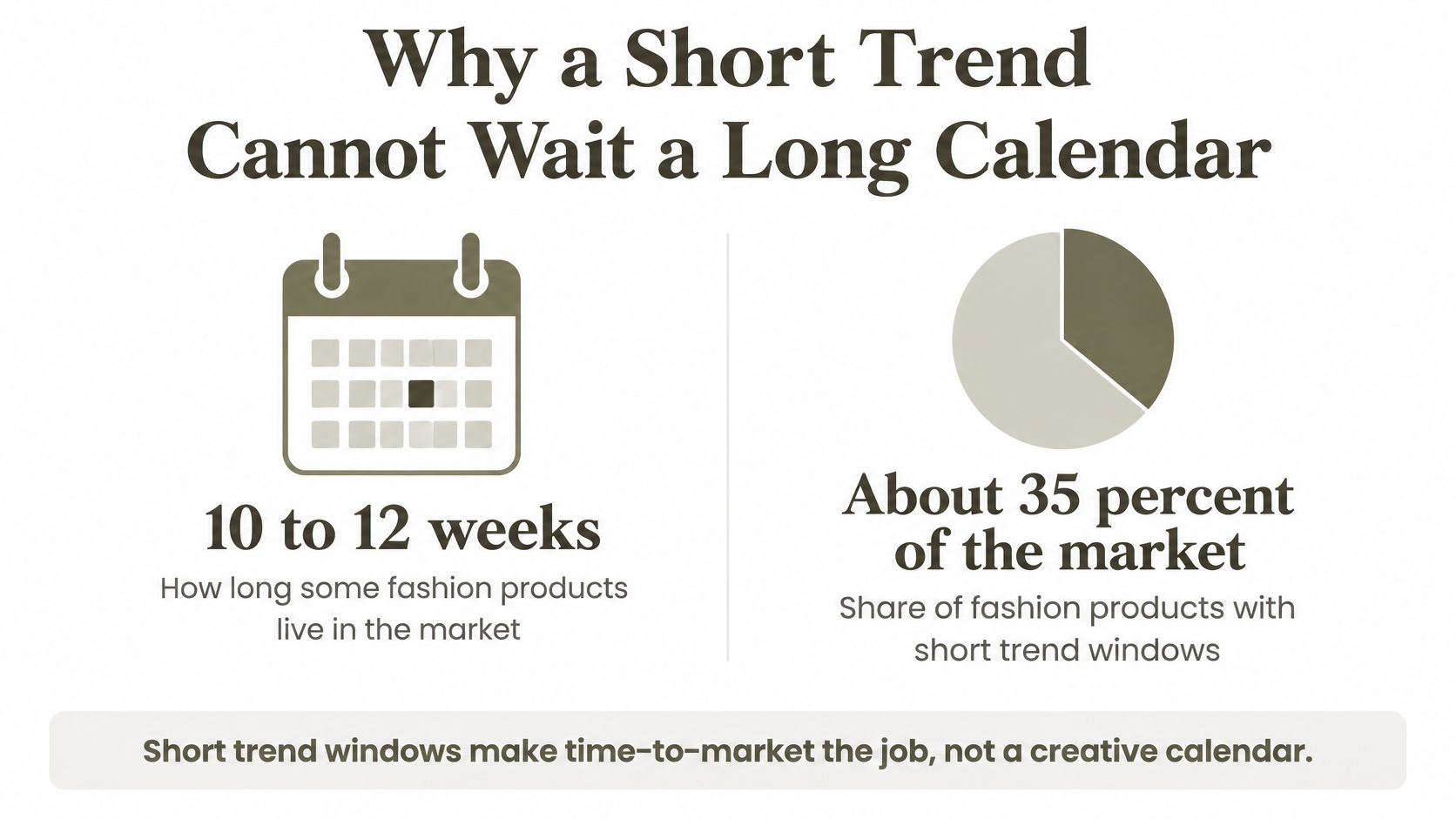
Fashion selling windows versus development lead times
The comparisons below describe different product and operating contexts, not interchangeable promises for your next collection.
| Clock | Benchmark | What it means for the plan |
|---|---|---|
| Short-life fashion products | 10–12 weeks in market | The selling window can be shorter than the calendar that fills it |
| Earlier design and preproduction decisions | Made many months before the product reaches the floor | A product can miss the season it was designed for |
| Typical fashion-industry lead time | More than 40 weeks | The default calendar is too slow for trend product |
| Top-performing companies | Compress the same stages into far less time | Speed is achievable, not theoretical |
| New in-season products | A compressed design-to-delivery path | Trend drops need a route built for a short window |
| Basic products | A longer lead time stays tolerable | Not every style needs the fast clock |
Fashion teams face a difficult combination: short product lives, volatile demand, high variety, and relatively inflexible supply processes. Customers can change preferences before a mill can change its production slot. Each added colorway or silhouette creates more material decisions, sample reviews, and approvals, even though the launch date stays fixed.
Say a buyer spots demand for a cropped utility jacket. Developing a new fabric, unfamiliar construction, and bespoke hardware puts that opportunity on a different schedule from adapting an approved block in stocked cloth. Both projects answer the same trend. They do not share the same dependencies, so they cannot share the same calendar. If the jacket carries a material claim on the hangtag, the proof gets an owner and a gate date too, because a claim that fails late can force a fabric change as surely as a failed fit.
Choose the clock before committing the style
At the brief, merchandising should identify the intended selling window and the last commercially useful arrival date. Design and sourcing should then establish what must be developed from scratch and what can be reused without compromising the product.
Reuse is a scheduling decision as much as a design one. An approved block in stocked cloth skips fabric development and often a round of fit correction. A new mill program does neither.
The project manager connects design approval, material sourcing, sampling, production, logistics, and merchandising around that date. Departmental task lists leave gaps: a designer can finish on time while sourcing still holds an unresolved fabric choice, and the cost of a late approval lands on whoever inherits the delay, not whoever caused it.
Planning rule: Start with when the garment must be available to buy, not when the team would like to finish designing it.
A replenishment basic can justify a different route from a seasonal statement piece. The first scheduling decision is therefore a product decision: which styles need speed, and which need a predictable, economical supply path?
The Critical Path from Design Approval to Shipment
Development works like a relay. Each person must hand over something usable before the next person can proceed. Finishing a sketch doesn't release a sample if the factory still lacks fabric or executable specifications.
The Kobo critical-path guide illustrates a 34–38-week plan, with sampling potentially occupying weeks 9–20, and explains how incomplete documentation or unclear feedback can add approximately 2–4 weeks per sample round. Those are illustrative scheduling benchmarks, not mandatory durations for every garment.
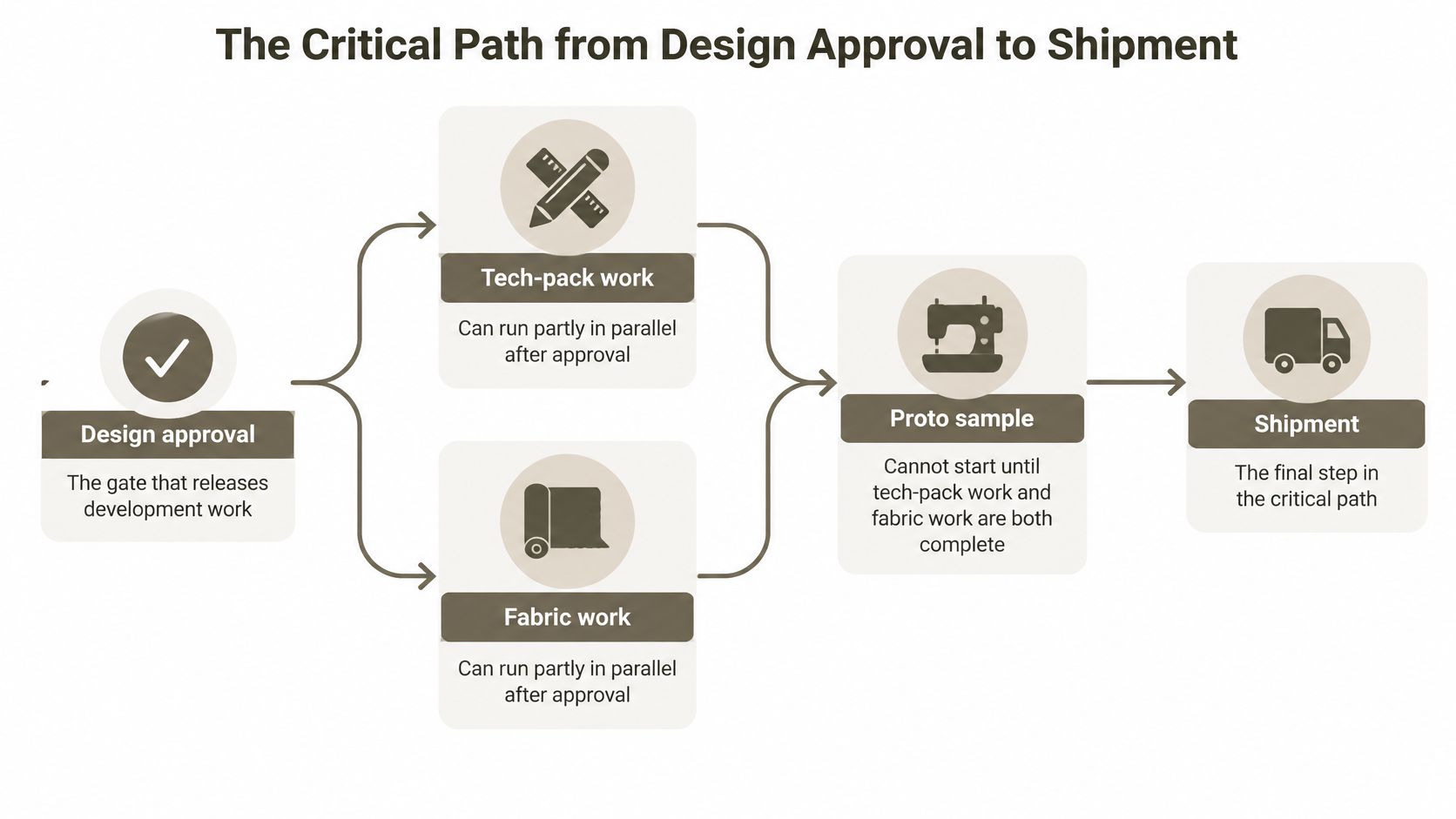
Map dependencies before assigning dates
After design approval, technical documentation and fabric development can run partly in parallel. They must converge before the proto sample starts. The bill of materials, or BOM, identifies the components the factory will use; unresolved substitutions make that handoff conditional rather than complete.
The following table applies the guide's conventional sequence. Float means the time an activity can slip without moving the delivery date; the actual amount must come from your project's dependency map.
| Gate | Cannot start until | Where it sits | Float |
|---|---|---|---|
| Design approval | Brief and commercial sign-off | Start of the path | Low; everything downstream waits |
| Tech pack and fabric development | Design approval; these can overlap | Early, partly parallel | Some, until the proto needs both |
| Proto sample | Completed specifications and available materials | Sampling window | Zero if either input delays the scheduled start |
| Fit approval | Proto in hand and clear comments | Inside the sample window | Zero when the next gate is waiting |
| Pre-production approval | Fit approval and a frozen BOM | Before bulk release | Zero on the controlling path |
| Bulk manufacturing | Signed pre-production approval | After sampling | Zero on the controlling path |
| Quality control and shipping | Finished bulk | End of the plan | Only the buffer explicitly reserved |
Bulk material commitments need their own dependency check. If a mill requires booking before final garment approval, record the commercial risk and who can authorize it. Don't assume without saying so that an early reservation and an approved bulk order mean the same thing.
Give each handoff an accountable person
Assign design approval to the design lead, with a signed silhouette and commercial brief as the exit test. Give the technical designer responsibility for verified measurements and tolerances, and the sourcing lead responsibility for confirmed material availability and a frozen BOM.
The sample coordinator owns receipt and identification of the correct proto. The technical designer signs consolidated fit comments; the production manager releases the approved pre-production package. Quality and logistics owners then confirm inspection disposition and shipment readiness.
Track planned versus actual dates, blockers, sample-round count, and approval latency. Approval latency is the elapsed time between a ready-for-review submission and a decision. It helps distinguish a factory delay from a sample sitting unanswered inside your team.
For a closer view of early handoffs, use the sketch-to-first-sample production timeline. When investigating factory-side improvements, AI for Manufacturing's documented AI wins on production lines provides a separate resource for evaluating process optimization rather than assuming faster concept generation fixes manufacturing.
Mark every current style waiting on a person rather than a machine. Escalate the approvals that control delivery before polishing creative work that doesn't.
Tech Packs That Keep Sample Rounds to One or Two
Incomplete tech packs can generate 3–5 sample revision rounds per style, compared with 1–2 rounds when documentation is complete, according to the apparel-development benchmark cited in Genpire's apparel product development guide. Its planning ranges below show why documentation belongs in the schedule rather than in the administrative cleanup.
A tech pack translates visual intent into manufacturing instructions. Think of it as a recipe card: if the ingredients are listed but the quantities and method are missing, the kitchen must improvise. A factory facing an unspecified seam finish or missing tolerance has the same problem.
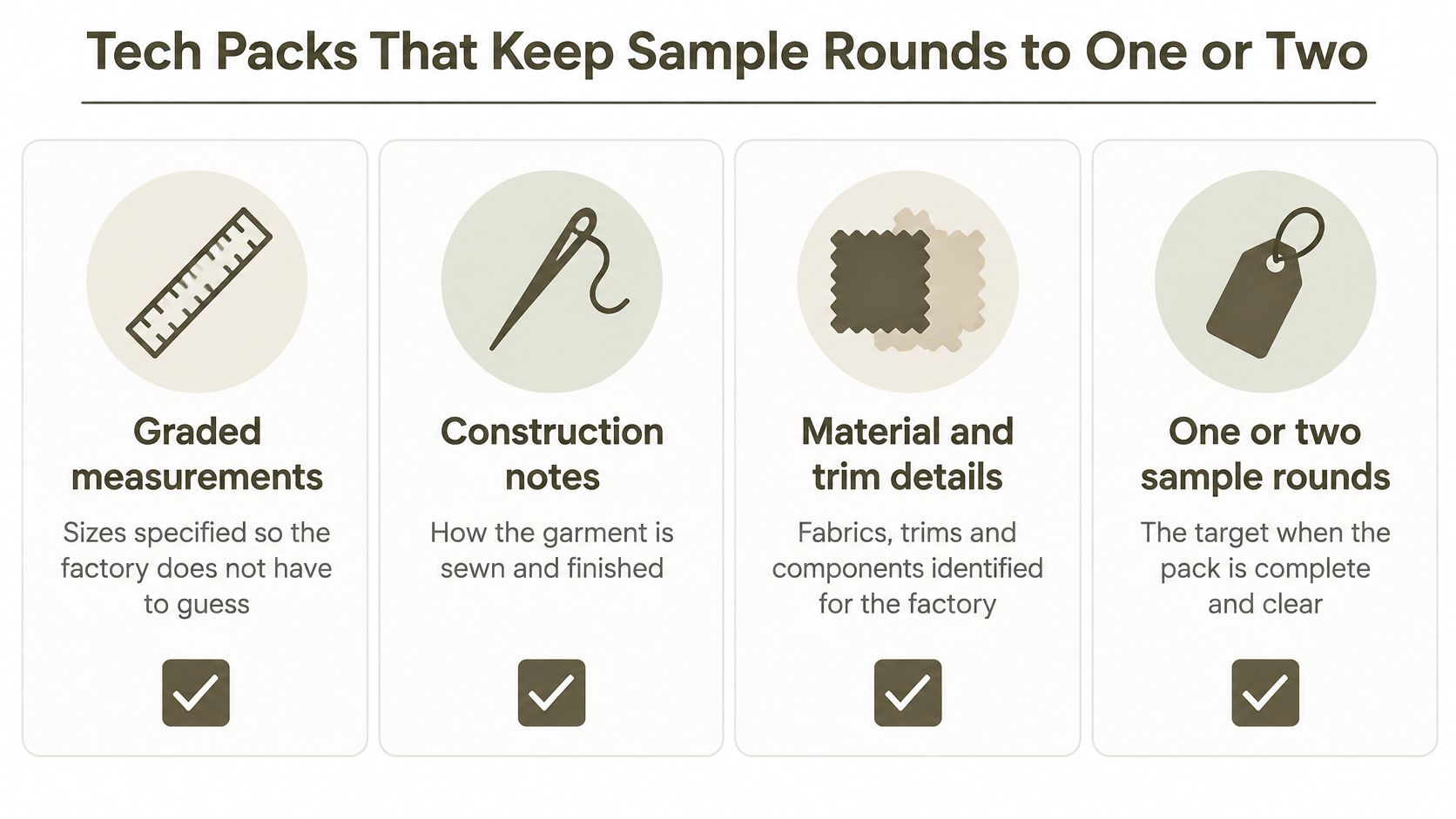
Tech pack and sampling benchmarks
| Measure | Benchmark | What it means for the plan |
|---|---|---|
| Tech-pack preparation | 1–6 weeks, depending on complexity | Schedule it before any proto request |
| Sampling across proto, fit and pre-production | 2–8 weeks | Plan the sample window as its own block |
| Sample rounds with a complete pack | 1–2 rounds per style | Use as a documentation-quality target |
| Sample rounds with an incomplete pack | 3–5 rounds per style | Documentation gaps multiply rework |
| Added time per extra round | About 2–4 weeks | A missing tolerance can become a launch delay |
These ranges shouldn't be added mechanically to the conventional calendar in another company's workflow. Product complexity, material readiness, and the scope of each sample stage determine the schedule you should agree with the factory.
A complete pack needs graded measurements, measurement tolerances, construction notes, material and trim specifications, BOM data, artwork placement, labeling, and packaging requirements. Give components consistent identifiers so a trim in the BOM can be matched to its drawing, supplier reference, and sample comment.
Review the instructions before cutting cloth
Require sign-off from design, technical design, sourcing, and the factory. Each party checks a different failure point:
- Design checks intent. Confirm that proportions, visible details, artwork, and finishes match the approved garment.
- Technical design checks execution. Specify measurement methods, tolerances, construction, and grading clearly enough to inspect the result.
- Sourcing checks components. Identify the source or approval status of every fabric, trim, and substitute.
- The factory checks interpretation. Resolve unclear operations and feasibility questions before accepting the sample request.
Use the before-you-send tech pack checklist as a review aid. Keep dated revisions and sample comments attached to the relevant version; an updated attachment in someone's inbox isn't reliable version control.
A factory question answered before cutting is a clarification. The same question answered after sewing may require another sample.
After release, monitor revision-round count and first-sample approval rate. Separate revisions caused by changed design intent from revisions caused by missing instructions, otherwise the team won't know what to fix.
The pass-fail test is practical: can the factory identify every component, construct the garment, measure it consistently, and tell which version governs the work? If not, the proto request isn't ready.
Where Integration Saves Weeks and Freight Does Not
Vertically integrated apparel companies completed their end-to-end go-to-market process in an average of 28 weeks, compared with 44 weeks for hybrid companies, making the integrated group 36% faster overall, according to McKinsey's apparel benchmark. The same benchmark placed design and development at 11 weeks versus 24 weeks, while production and logistics averaged approximately 17–18 weeks across the companies studied.
The largest contrast wasn't sewing speed. Teams operating with closer integration spent less time getting the product ready to manufacture. For a hybrid business, that makes upstream coordination a practical place to investigate before asking the factory to accept a shorter production commitment.
Separate decision time from execution time
| Workstream | What managers can improve | What still needs explicit allowance |
|---|---|---|
| Design and development | Consolidated feedback, clear decision rights, stable specifications | Material development and technical validation |
| Commercial approval | Agreed margin rules and authorized substitutions | Decisions requiring a genuine change of scope |
| Production | Readiness, capacity confirmation, timely release | Factory operations and corrective work |
| Logistics | Routing decisions and complete handoffs | Transit, clearance, and receiving |
Integration doesn't require owning every supplier. A brand can establish common records, shared milestones, and clear approval authority while working with external mills and factories. What matters operationally is whether the next person receives a complete decision or another unresolved discussion.
Consider a material change after costing. The sourcing lead needs authority to present an acceptable substitute, the technical designer must assess its effect on construction and fit, and merchandising must accept the commercial result. Without a decision owner, each department can finish its review while nobody releases the garment.
Don't count freight twice
Build transport from the actual route and purchasing terms. Identify when goods leave the factory, who controls the booking, when ownership or responsibility changes, and when the warehouse can receive them.
A combined production-and-logistics benchmark already includes logistics within its defined scope. Don't automatically add a separate ocean-transit allowance on top of it. Instead, break your supplier's quoted timeline into manufacturing, inspection, origin handling, transport, clearance, and destination receiving, then check for gaps or overlaps.
Assign the commercial interface to merchandising, the material decision to sourcing, and the shipment handoff to logistics. The project manager maintains the connected dates and escalates conflicts between those owners.
Our supply-chain management workflow provides a place to connect supplier coordination with development and delivery. The operating principle remains simple: remove avoidable decision delays, but keep physical execution time visible rather than treating it as something a faster moodboard can erase.
Compliance Evidence Before the Sample Is Cut
Compliance isn't paperwork to assemble after production. If the proposed fabric cannot support a required declaration or an advertised claim, the product may need a different material, different messaging, or a different market plan.
A 2025 industry playbook identified 171 data points across 16 U.S., U.K., EU, and national laws, including supplier emissions and deforestation-related information, as reported by Fashion Dive. That breadth makes informal evidence collection difficult to manage. A project manager needs to know which requirements apply to the product and destination, not merely whether somebody uploaded a certificate.
Open an evidence workstream at the brief
Create a claim-and-requirement register alongside the product specification. Capture material origin, recycled content, durability, carbon information, labor-related evidence, and end-of-life information where relevant to the product, intended claims, and applicable obligations.
For every entry, record:
- The requirement or claim. State exactly what must be demonstrated, without replacing a narrow statement with a broader marketing promise.
- The evidence standard. Specify the document, test, transaction record, or other substantiation the reviewer will accept.
- The verifier. Name the compliance, technical, or sourcing person authorized to accept it.
- The linked material or supplier. Attach evidence to the actual component and source, not just the collection folder.
- The failure action. Define whether missing proof triggers a hold, substitution, claim removal, or specialist review.
A supplier's presentation can help explain a material, but it shouldn't automatically qualify as evidence for a specific claim. The verifier must check scope, relevance, and whether the record applies to the material being purchased.
Establish data-complete release gates
Before sampling, confirm the evidence needed to justify developing the proposed material. Before the purchase order, verify the production source, approved specification, and required substantiation for release.
Those gates can have different exit criteria. Early development may proceed with clearly recorded open items if the responsible reviewer accepts the risk; production release requires the evidence appropriate to that commitment.
Release test: A visually approved material isn't evidence-approved until the named verifier accepts the supporting record.
Say a mill can't substantiate recycled content. Sourcing can investigate another shell, marketing can remove an optional claim if lawful, or compliance can determine that the proposed market route isn't available. None of those choices should be made by accepting an incomplete file.
For the next style, ask who verifies each claim, when that decision is due, and what happens if proof never arrives. Put the answers on the calendar.
One Jacket and the Weeks That Vanished
Consider a hypothetical outerwear drop built around a recycled-shell jacket. Merchandising wants it available during a short-lived trend, and design approves the silhouette while sourcing is still checking the shell. Everyone treats the style as progressing because the sketch, color, and target cost are agreed.
The mill's recycled-content support turns out to be a marketing slide rather than evidence the reviewer can accept. Sourcing searches for another material, but the project status still says design approved. Nobody has recorded that the approved appearance and the approved source are now different decisions.

The failed path
The replacement shell has a different handle. Technical design updates a measurement but leaves out its tolerance and doesn't check whether the intended ease still works with the new material. The factory makes a reasonable interpretation, but the proto feels tight across the back.
Fit feedback then arrives through separate messages from design, merchandising, and technical design. The factory asks which comment controls the revision. While the internal team resolves that question, production cannot confidently release the final specification.
| Visible symptom | Earlier decision that caused it |
|---|---|
| Sourcing restarts material work | Evidence wasn't accepted before committing to the shell |
| Proto doesn't match the intended fit | Material change wasn't fully translated into specifications |
| Factory waits for comments | Nobody owns the consolidated fit decision |
| Bulk booking moves | Production release remained conditional |
| Arrival misses the intended opportunity | The team kept the original launch promise after dependencies changed |
By the time the jacket is ready for bulk, the preferred mill slot is unavailable. Logistics can arrange the next feasible departure, but it can't recover time the team spent deciding which instructions were valid. Paying for faster transport may change the route without making the original delivery promise sensible.
The repaired path
Run the same jacket with evidence review attached to material selection. Sourcing presents only a substantiated option for release, and technical design checks the material's effect on the approved construction before issuing the proto package.
The BOM identifies the agreed shell and trims. A named technical designer consolidates fit comments, signs the revision, and marks superseded instructions clearly. Production receives an explicit release rather than an email thread it must interpret.
Logistics checks the intended route and capacity during planning, then confirms the booking when shipment details are ready. If a dependency moves, the project manager updates the achievable arrival date and merchandising decides whether to retain, revise, or drop the style.
The useful question after a late launch isn't whether the factory shipped late. Identify the first gate that lost its exit condition. That's where the corrective action belongs.
Set the Next Drop on One Shared Path
Choose an upcoming style and build a working release plan before requesting another sample. Keep it small enough that the factory, technical designer, sourcing lead, and merchandiser can all review the same record.
Build a plan the team can operate
- Set the commercial boundary. Record the intended in-market date and the latest useful arrival. Count backward using confirmed supplier and logistics commitments, not a borrowed industry average.
- Map the release gates. Include concept, design approval, tech pack and fabric readiness, proto, fit and pre-production approval, bulk production, and shipment.
- Name the decision-maker. Give every gate an accountable owner, a due date, and an observable exit test. Attach the evidence requirements relevant to that release.
- Control changes. Freeze the approved component list for the sample request. If a material, measurement, or claim changes, record who must reassess it before work continues.
- Set an escalation rule. Agree on the allowed sample plan with the factory. An additional revision should trigger a review of cause, cost, and delivery impact rather than an automatic reorder.
- Validate the arrival promise. Check manufacturing and transport allowances without double-counting them. If the schedule doesn't fit, change the scope, material, route, or drop date explicitly.
Keep status connected to the product
The shared record should show what was submitted, what was accepted, and what remains blocked. A status such as sample approved is useful only when everyone can identify the sample and specification that received approval.
At Genpire, we show real-time project status across tech pack drafted, RFQ sent, quote received, sample ordered, sample approved, bulk in production, and shipped. That sequence gives internal teams and factory collaborators a common reference for the work rather than separate interpretations of progress.
Use your next planning meeting to assign the style's owners and dates, attach the current specification, and identify unresolved evidence. Leave with release decisions, not just a list of people to chase.
Genpire connects concept development, tech packs, supplier collaboration, sampling, and production tracking in a continuous workflow. Visit Genpire to put your next style's specifications and manufacturing handoffs in one shared place, then build your release gates around the approvals and evidence your team needs.