Maya has a fall collection ready in her head and on her moodboard. The silhouettes are approved, the color story feels coherent, and the launch date is already on the wholesale calendar. Then she counts backward from shipment and sees the problem: the fourteen-week window is real, but the tech packs aren't finished, the factory hasn't quoted the styles, and nobody has approved a first sample.
That situation is common in apparel product development. Teams often think the delay comes from drawing, patternmaking, or sewing. In practice, weeks disappear between those activities, while someone waits for a decision, sends the wrong file, or assumes a detail that should have been documented. A strong process doesn't just make design faster. It makes every handoff more decisive.
Table of Contents
- Why Apparel Product Development Decides Who Wins the Season
- The Concept to Tech Pack Foundation
- Sampling and Fit Approval as the Real Critical Path
- Sourcing, RFQs, and Supplier Alignment
- Production Planning, QC, and Bulk Launch
- How AI Workflows Reshape Each Stage
- Common Bottlenecks and What to Do About Them
Why Apparel Product Development Decides Who Wins the Season
Maya's calendar has no empty space. She needs concept decisions first, then technical documentation, sampling, approvals, production, and freight. A realistic working plan might allocate 2 to 3 weeks for concepting, 3 to 4 weeks for tech-pack preparation and the first prototype, 4 to 6 weeks for sampling rounds, and 8 to 12 weeks for production. Those planning ranges come from common apparel workflow estimates described by Adstronaut's production timeline guide.
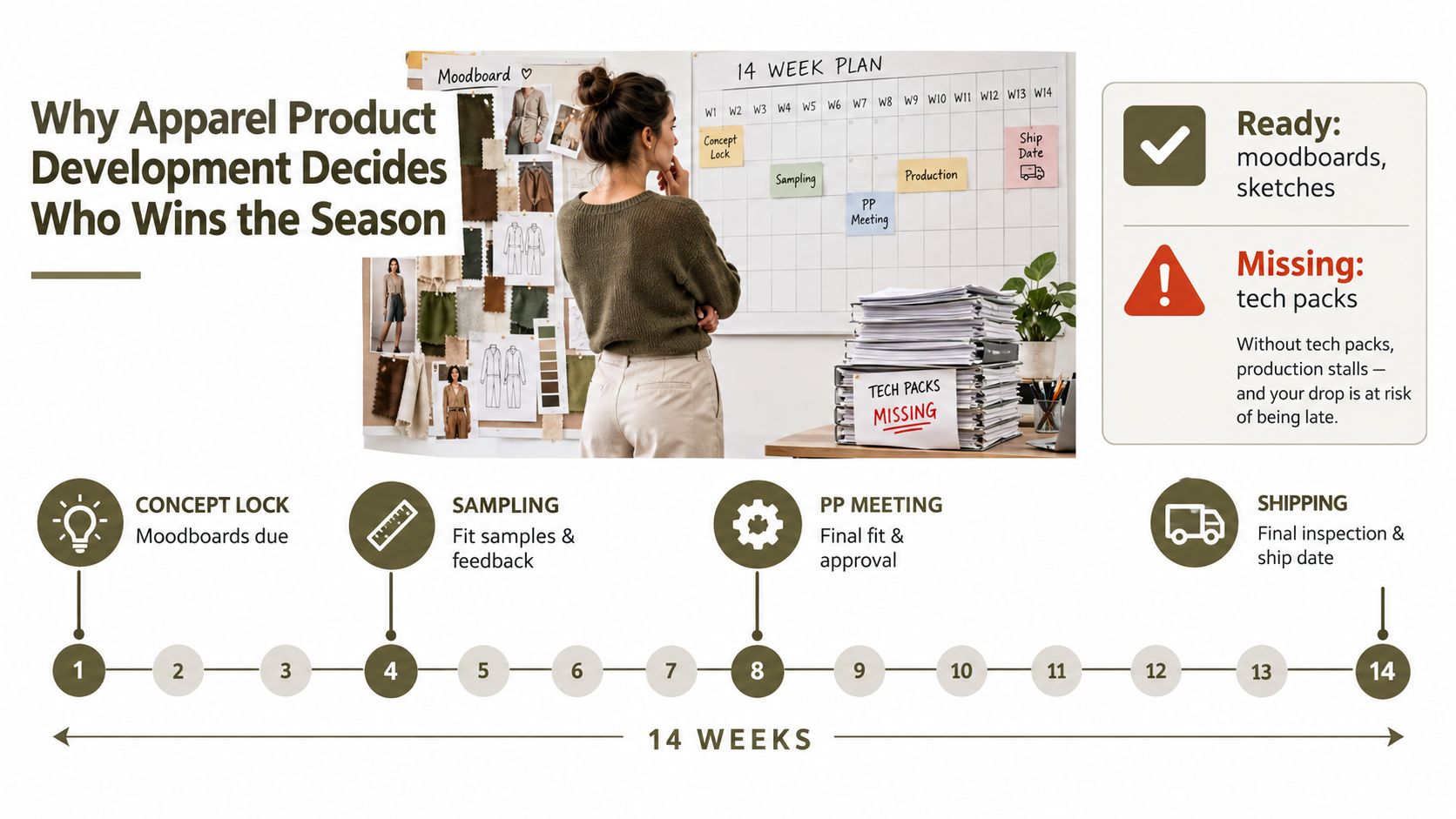
The danger isn't only that one task runs late. If Maya leaves a sleeve opening, fabric weight, or grading decision unresolved, the factory can't complete a reliable quote or sample. If she sends a revised measurement sheet after cutting has begun, the team may need to remake work that looked finished. If a trim approval sits in an inbox, production planning can stall even though the design itself is complete.
The calendar is decided upstream
Research summarized in apparel supply-chain analysis puts average total lead time at about 167 days, with product development taking 104 days, or roughly 62% of the total timeline. The same analysis reports a range of 117 to 172 calendar days depending on technology adoption, and notes that some products can take more than 24 months from initial idea to final sale. See the apparel product development timeline analysis from Genpire for those benchmarks.
A separate McKinsey study cited by Supply Chain Dive found that vertically integrated apparel companies averaged 28 weeks from development to market, compared with 44 weeks for hybrid players, making them about 36% faster overall. Design and development alone took 11 weeks for vertically integrated firms versus 24 weeks for hybrid firms, a difference of roughly 13 weeks in the early stage. The McKinsey apparel lead-time comparison shows why organizational structure and handoff control matter as much as creative output.
Senior product developer's rule: If a decision can affect fit, material, construction, or packaging, assign an owner and a due date before the design moves forward.
A brand that ships on its planned date can present to wholesale buyers, meet seasonal sell-in windows, and respond to early demand while the product is still relevant. A brand that misses the window may have a beautiful collection but no commercial moment. Development discipline is therefore a competitive lever, not administrative overhead.
The Concept to Tech Pack Foundation
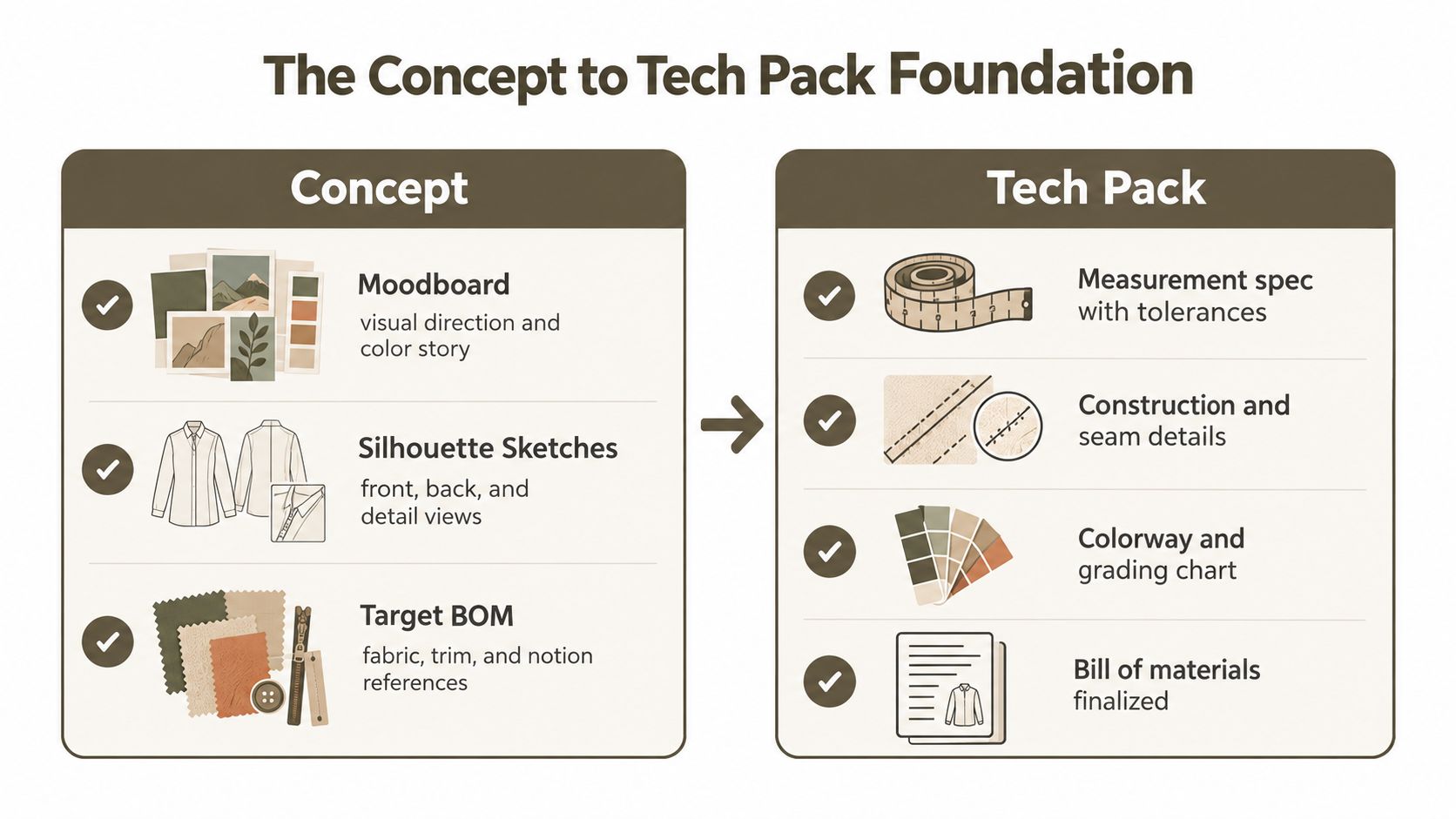
The concept stage should produce more than attractive references. It should create enough shared direction for a technical designer and factory to make the same product you can see in your head.
Start with a moodboard. It establishes visual direction, color relationships, surface character, and the customer context. Add silhouette sketches that show the front, back, side, and important details. A front view may communicate the overall shape, but it won't explain a pocket opening, collar construction, hem finish, or back yoke.
Next, create a target Bill of Materials, or BOM. List the proposed main fabric, lining, thread, labels, zippers, buttons, elastic, interlinings, packaging, and any special finishes. At this point, some supplier references may still be provisional, but the team should identify what must be sourced, tested, or approved.
Turn creative intent into factory instructions
A tech pack is the production blueprint. The tech-pack overview from Genpire is useful for founders who need to distinguish a visual design specification from a document a factory can build against.
A production-ready pack should contain at least these seven document groups:
- Technical flat sketches, including front, back, inside, and detail views where needed.
- Measurement specifications, with points of measure, size ranges, and tolerances.
- Construction instructions, covering seams, stitches, hems, reinforcements, and assembly order.
- A finalized Bill of Materials, with component descriptions, supplier or reference codes, quantities, and placement.
- Colorway information, including approved color references, contrast details, and grading requirements.
- Labeling, care, and packaging instructions, including label locations, folding, bagging, carton, and barcode requirements.
- Approval and revision records, showing the current version, open questions, sealed sample reference, and sign-off status.
Think of the tech pack as an architectural blueprint. A builder can't price a house accurately from a photograph of the exterior. The factory needs dimensions, materials, tolerances, connection details, and an understanding of which choices are fixed.
Completeness prevents avoidable sampling
Industry guidance reports that incomplete or missing tech packs often lead to 3 to 5 sample revision rounds per style, while complete packs typically reduce the process to 1 to 2 rounds. The Techpacker guide to technical packages connects that difference to clearer measurements, construction notes, materials, and trim specifications.
The factory will fill gaps with its own assumptions. Those assumptions may produce a garment that is technically sewable but wrong in proportion, fabric behavior, trim placement, or finishing. Before sending the pack, ask one practical question: could a new technician build the style without opening a separate email thread to discover the missing information?
Sampling and Fit Approval as the Real Critical Path
Sampling is where a design stops being theoretical. It also exposes whether the documentation describes a garment or merely suggests one.
Most styles move through a sequence of prototypes, fit samples, and pre-production samples. The proto sample tests silhouette and construction. The fit sample tests measurements, balance, movement, and grading on the intended fit model. The pre-production sample, often called the PP sample, confirms the final fabric, trims, colorway, construction, and finishing before bulk work begins.
A common breakdown allows 4 to 8 weeks for sampling across proto, fit, and pre-production rounds, while first-run lead times often land around 20 to 32 weeks when technical preparation and related work are included, according to Adstronaut's apparel production timeline guidance. The exact calendar depends on category, factory capacity, materials, and approval speed.
| Sample Round | Typical Lead Time | Primary Purpose | Top Cause of Rework |
|---|---|---|---|
| Proto | Initial sampling stage | Confirm silhouette, pattern interpretation, and construction approach | Missing construction detail or incorrect material assumption |
| Fit sample | Part of the sampling cycle | Evaluate balance, ease, proportions, and points of measure | Vague comments without measured changes |
| Pre-production sample | Final approval stage | Confirm bulk-ready fabric, trims, color, finishing, and workmanship | Revised specifications after cutting or incomplete trim approval |
What a useful fit comment contains
“Make it looser” isn't a production instruction. A useful comment identifies the location, the observed issue, the proposed change, and the measured delta. For example, a technical team might annotate an image, identify the side seam at the hip, record the current measurement, specify the change, and update the relevant spec row.
The approval record should also state whether the change affects the pattern, grading, construction, BOM, or cost. The factory needs one authoritative instruction, not a comment in a fitting presentation, a different number in a spreadsheet, and a third revision in an email.
Fit approval is a decision, not a conversation. The sample should leave the review with measured changes, a responsible owner, and a clear next version.
Techpacker reports that a complete tech pack can reduce typical sample revisions from 3 to 5 rounds to 1 to 2 rounds, which demonstrates why sampling performance starts before the sample room receives the package. The best way to protect the calendar is to remove ambiguity before fabric is cut.
Sourcing, RFQs, and Supplier Alignment
Sourcing works best as a decision sequence. First, define what the product requires. Then identify which supplier type can support those requirements, issue comparable requests for quotation, test materials, and confirm capacity before approving the development route.
The tech pack controls the quality of the RFQ. A factory can quote a clear measurement table, construction method, fabric composition, trim list, finishing requirement, and packaging plan. It can't compare that style reliably when the pack says “standard rib,” “premium zipper,” or “similar color” without a reference.
Choose the supplier model deliberately
A full-package manufacturer may coordinate materials, patterns, sampling, and production. That can reduce the number of separate handoffs, but the brand still needs to verify who controls each decision and which components the factory sources.
A cut-and-sew shop may be a good fit when the brand already has patterns, materials, and technical direction. It offers direct control over construction, but the founder or sourcing team must manage more upstream work.
An agent-led route can help an emerging brand find factories and materials across a network. The trade-off is another communication layer, so the brand must define how comments, approvals, and document versions move between the agent and factory.
| Supplier Type | Typical MOQ | Lead Time Impact | Best For |
|---|---|---|---|
| Full-package manufacturer | Not specified in the verified data | Can consolidate coordination when responsibilities are clear | Brands seeking one primary production partner |
| Cut-and-sew shop | Not specified in the verified data | Works efficiently when patterns and materials are already approved | Brands with strong technical control |
| Agent-led sourcing | Not specified in the verified data | Adds a communication layer that requires disciplined approvals | Founders needing supplier discovery and coordination |
The plan notes mention MOQ ranges, but those figures aren't included in the verified data, so treat minimums as supplier-specific rather than assuming a universal threshold. Ask each factory to state MOQ by style, color, fabric, and component, because a low style minimum may still carry a higher color or material minimum.
Make the quote comparable
Send the same RFQ template to every candidate. Include the style code, target quantity, size range, fabric details, construction requirements, trims, testing needs, packaging, requested sample stages, and quote assumptions. Record the date sent, questions received, quote date, price validity, capacity window, and exclusions.
Evaluate more than unit cost. Check shade-band consistency, lab-dip responsiveness, fabric testing, production capacity, communication latency across time zones, and the factory's ability to maintain the approved construction. The manufacturer-finding guide from Genpire can help founders structure that search instead of treating sourcing as a list of anonymous vendors.
Production Planning, QC, and Bulk Launch
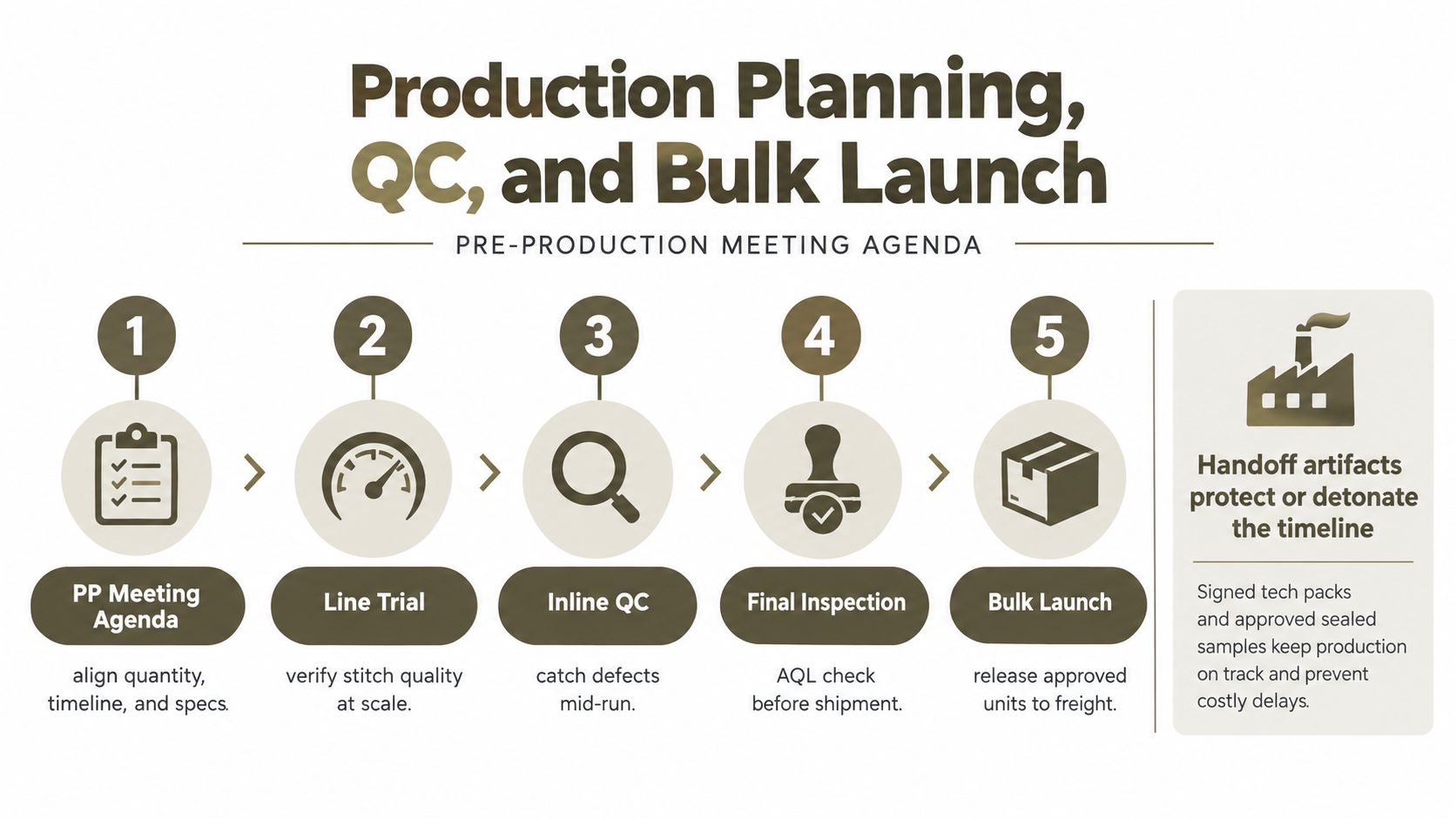
Bulk production tests whether the earlier artifacts agree with one another. The sealed sample, approved tech pack, BOM, purchase order, packaging instructions, and inspection plan should all describe the same product.
The pre-production meeting is the last practical moment to expose contradictions before the line starts. Confirm the quantity, delivery window, approved measurements, tolerances, fabric and trim references, construction details, labeling, packaging, and escalation process. The team should also agree on how top-of-production output will be reviewed and which person can approve or reject it.
Find the delay before final inspection
Many production delays start with a small mismatch. The bulk dye lot may not match the approved lab dip. Knit shrinkage may fall outside the agreed tolerance. A label or packaging change may arrive after the cut ticket has been released. Each issue forces the team to decide whether to accept, correct, rework, or replace the affected units.
A practical quality plan places checks inside the run, not only at the end. Inline checks around the 30% and 70% production points can reveal recurring sewing, measurement, or finishing problems while the factory still has time to correct them. Final random inspection then confirms whether the completed order meets the agreed standard.
Many mid-size brands negotiate AQL 2.5 with a general inspection level II for final inspection. Because inspection standards and commercial requirements vary, document the agreed plan in the purchase and quality documents rather than relying on an informal factory habit.
A QC gate is useful only when someone has authority to act on its result. Assign the decision owner before production begins.
For brands exploring smaller runs or more hands-on manufacturing relationships, this resource on craftsmanship and small batch fashion offers helpful context for comparing production philosophies.
The launch-week handoff
Before releasing approved goods to freight, verify shipment documentation, carton counts, carton markings, packing lists, commercial invoices, labels, and destination instructions. Match the physical cartons to the approved packing plan and make sure logistics has the final quantity and delivery information.
Production planning isn't finished when garments pass inspection. The launch succeeds when the right goods, documents, and carton information move together.
How AI Workflows Reshape Each Stage
AI is most useful when it preserves decisions across the product journey. Generating a faster sketch won't solve a late trim approval if the approved trim still lives in an email thread. A workspace becomes valuable when the same product record carries the concept, measurements, BOM, supplier questions, sample comments, and approval status forward.
One source for brand and product decisions
A Brand DNA record can hold the fit preferences, fabric direction, finish language, palette, and visual references that guide a collection. The team can reuse those decisions in a concept brief, technical sketch, tech pack, and supplier brief rather than retyping them into separate tools.
An agentic tech-pack workflow can begin with a sketch or reference image, draft a multi-view concept, propose construction details, build a BOM, and prepare measurement tables. It can flag ambiguity. If a drawing suggests a pocket but doesn't define its opening, placement, or construction, the system should surface the question before the factory interprets it.
The human technical designer still owns fit validation, material approval, construction judgment, and final sign-off. AI can organize the work and expose missing information, but the sealed sample remains the physical reference for bulk production.
Replace floating files with governed collaboration
Supplier-facing access should reveal the relevant style, measurements, tolerances, approval status, and comments without exposing unrelated brand information. A factory shouldn't need to search through a long email chain to discover which PDF is current.
Genpire is one example of an AI-driven workspace that connects concept creation with structured tech packs, BOMs, measurement information, production assets, exports, and supplier collaboration through view-only seats. Its AI product development workflow from concept to factory-ready output illustrates this connected approach.
The central gain is version control. Fewer rekeyed measurements mean fewer transcription errors. Fewer floating PDFs mean fewer conflicting instructions. Structured comments keep a decision attached to the style instead of burying it in a private inbox.
The best AI workflow doesn't remove the product developer. It removes the gaps that make the product developer repeat the same decision.
Common Bottlenecks and What to Do About Them
Faster sketching rarely fixes the largest calendar problem. A founder may generate ten silhouettes quickly and still lose time waiting for one construction decision, one lab dip, or one approved measurement file.
The recurring bottlenecks are operational. Each one has a visible symptom and an artifact that should have caught it earlier.
Audit the handoffs
Decision latency appears between concept approval and tech-pack sign-off. The artifact that should expose it is a decision register attached to the style, with an owner, deadline, and status for every unresolved fit, fabric, trim, and construction question. The product lead or founder must unblock decisions, while the technical designer records the final instruction.
Version drift appears when brand and factory hold different measurements, BOMs, or construction notes. The current tech pack should contain a revision number, change log, sealed-sample reference, and approval history. One workspace or controlled document library should replace parallel attachments.
Approval dead time appears when the team waits for a trim, print, lab dip, or packaging confirmation without a visible escalation path. The sourcing lead owns the material decision, the technical lead checks its product impact, and the production lead confirms whether the change affects the line plan.
| Bottleneck | Stage | Root Cause | Unblock Action |
|---|---|---|---|
| Decision latency | Concept to tech pack | No owner for unresolved product choices | Assign an owner and deadline in a shared decision register |
| Version drift | Tech pack to sampling | Conflicting PDFs, spreadsheets, and email edits | Lock one revision-controlled source of truth |
| Approval dead time | Materials and pre-production | Lab dips, trims, or packaging lack escalation rules | Track approval status and define a decision authority |
| Rework at sampling | Fit approval | Comments lack measurements or annotated evidence | Record point of measure, delta, image, and sign-off |
| Bulk surprise | Production | The sealed sample and production documents disagree | Run a formal PP meeting and verify the first production output |
Track a few operational signals: average revision rounds per sample, time from RFQ send to quoted price, time from sample receipt to signed approval, and the number of conflicting specification files in circulation. These measures reveal whether the team is becoming faster or merely drawing more quickly.
Genpire helps apparel teams connect concept development, technical specifications, BOMs, supplier collaboration, sampling comments, and production-ready exports in one workflow. If your calendar is losing time between approvals and files, visit Genpire and evaluate whether a shared AI workspace can give your next style a cleaner path from concept to factory.