Is a velvet dress warm, formal, and simple to look after just because the label says velvet? That shortcut falls apart the moment you sit, steam a crushed hem, or wear the dress in a warm room.
Velvet is a family of cut-pile fabrics, not one cloth. Silk, cotton, rayon, polyester, nylon, and stretch blends can all carry the same surface and still behave differently in drape, warmth, cleaning, and end of life. Judge a velvet dress by how you'll wear it. Pile direction decides whether the panels match. Fiber decides whether it breathes. Care decides whether the sheen survives the first party. Fit decides whether you can get in, sit, and still look polished.
Table of Contents
- What Makes a Velvet Dress Look and Feel Different
- Velvet Fibers Compared by Feel, Warmth and Care
- How to Check Pile Direction and Seams Before You Buy
- How to Steam and Store a Velvet Dress Without Crushing the Pile
- How to Style a Velvet Dress for Day and Night
- Sustainability Trade-offs Between Velvet Fibers
- Production Specs Designers Should Set for Velvet
- Choose a Velvet Dress for Your Occasion and Climate
What Makes a Velvet Dress Look and Feel Different
A velvet dress is cut from cut-pile cloth. Weavers make two layers face to face, then cut the yarns that join them. Each face keeps a dense, upright pile. The back stays comparatively flat. That structure, not a printed coating, is what your hand feels.
Think of a cat's coat. Stroke one way and the hairs lie smooth and look deep and dark. Stroke the other way and they stand up and catch more light. Velvet works the same way, which is why a velvet dress seems to change color as you move.
Three things that set the look
Pile height sets how plush the surface feels and how easily a chair marks it. Pile direction, the nap, decides whether light sinks in or bounces back. Fiber content decides drape, warmth for the weight, and whether the pile springs back after you sit.
Silk velvet earned the luxury reputation the slow way. The tradition likely began in China and was established in Europe by at least the 13th century, as Elle Decoration's history of velvet traces. Renaissance makers raised the pile from silk threads drawn over rods or wires, after silkworm cultivation, cocoon processing, spinning, dyeing, loom preparation, weaving, and inspection. Around 1500, Venice reportedly had as many as 6,000 looms under its silk-weavers' guild. Costly fiber plus specialist skill is why a velvet dress long meant court and ceremony, not a weekday frock.
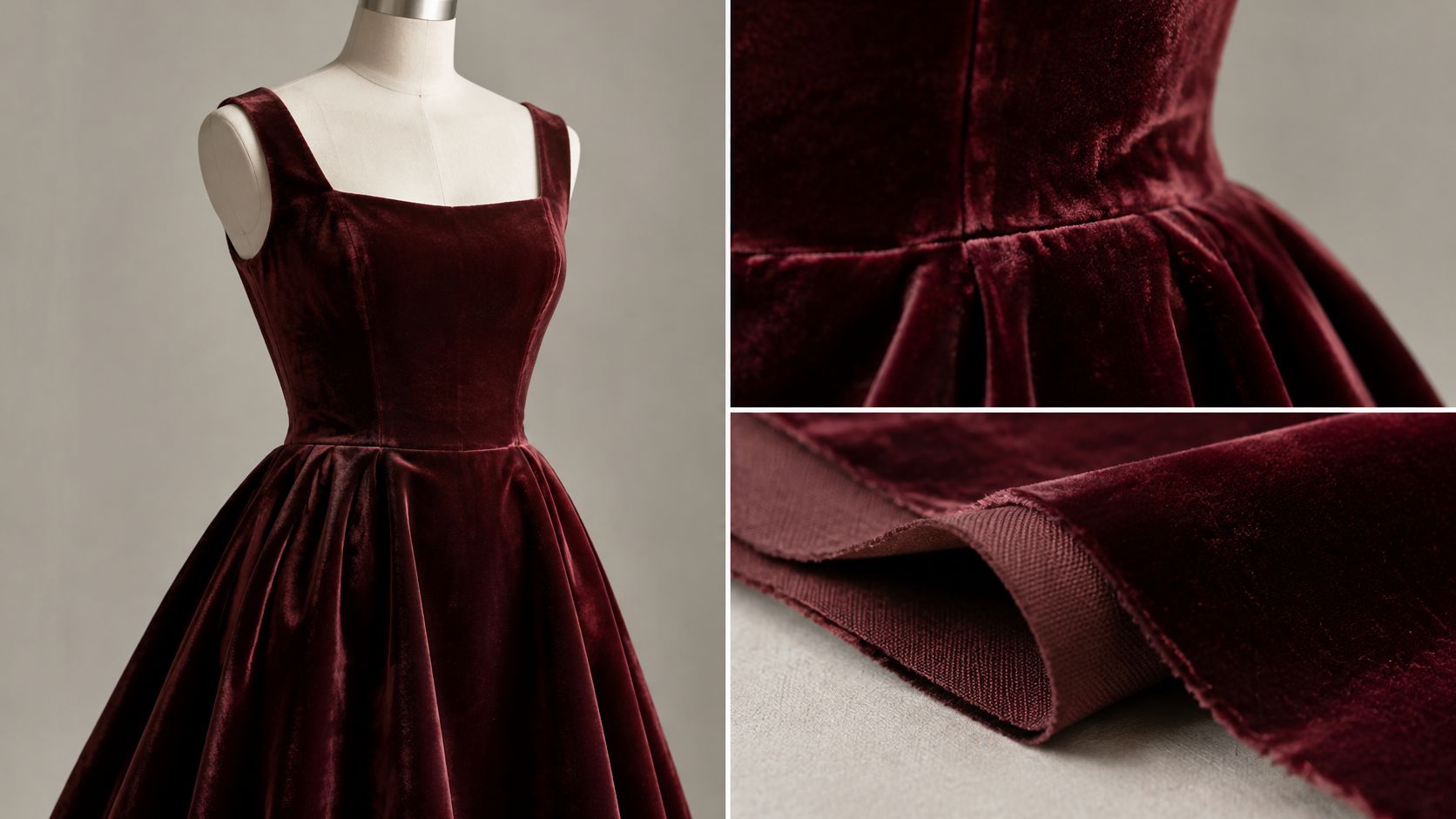
Velvet is a structure, not a decorative finish. Fibers, seams, steam, styling, and fit all follow from that pile.
Velvet Fibers Compared by Feel, Warmth and Care
The word on the hangtag matters less than the fiber line. This is how the common velvets compare on the three questions buyers ask: how it falls, how warm it feels for its weight, and how you have to clean it.
| Fiber | Feel and drape | Warmth and breathability | Care needs |
|---|---|---|---|
| Silk | Fluid, luxurious drape with a soft sheen | Warm and breathable for its weight | Dry clean or gentle hand wash |
| Cotton | Soft with more body and less drape | Breathable, moderate warmth | Gentle machine wash cold, can crush pile |
| Rayon or viscose | Fluid, smooth drape | Breathable, light to moderate warmth | Dry clean; can lose shape when wet |
| Polyester | Resilient, holds shape well | Lower moisture absorption, can feel clammy | Gentle machine wash or dry clean; check label |
| Nylon | Sleek, durable surface | Lower moisture absorption, can feel clammy | Gentle wash; check label |
| Stretch blend with elastane | Recovers after sitting, follows movement | Warmth follows the base fiber and any lining | Follow the most delicate fiber in the blend |
How to read the table
Silk gives the most fluid drape and a natural warmth, and it asks for dry cleaning or a very gentle hand wash. If you don't want to guess at solvents, a specialist such as professional dry cleaning in Singapore is the safer route for a silk velvet dress than a home wash. Cotton feels softer and heavier, with less swing, and a hot wash can crush the pile. Rayon or viscose drapes beautifully and then can lose its shape once it's wet, so treat a spill as a blot, not a soak.
Polyester and nylon hold their shape and resist wear. They also take up less moisture, so a polyester velvet dress can feel clammy in a warm, crowded room even when the cut is right. A stretch blend with elastane recovers after you sit and moves with the body. Its care follows the most delicate fiber in the mix, not the elastane.
Two decisions settle most purchases. How often, and in what climate, will you wear the dress? How much care will you give it? A resilient polyester can outlast a fragile silk you wear once and then avoid because cleaning feels like a chore.
How to Check Pile Direction and Seams Before You Buy
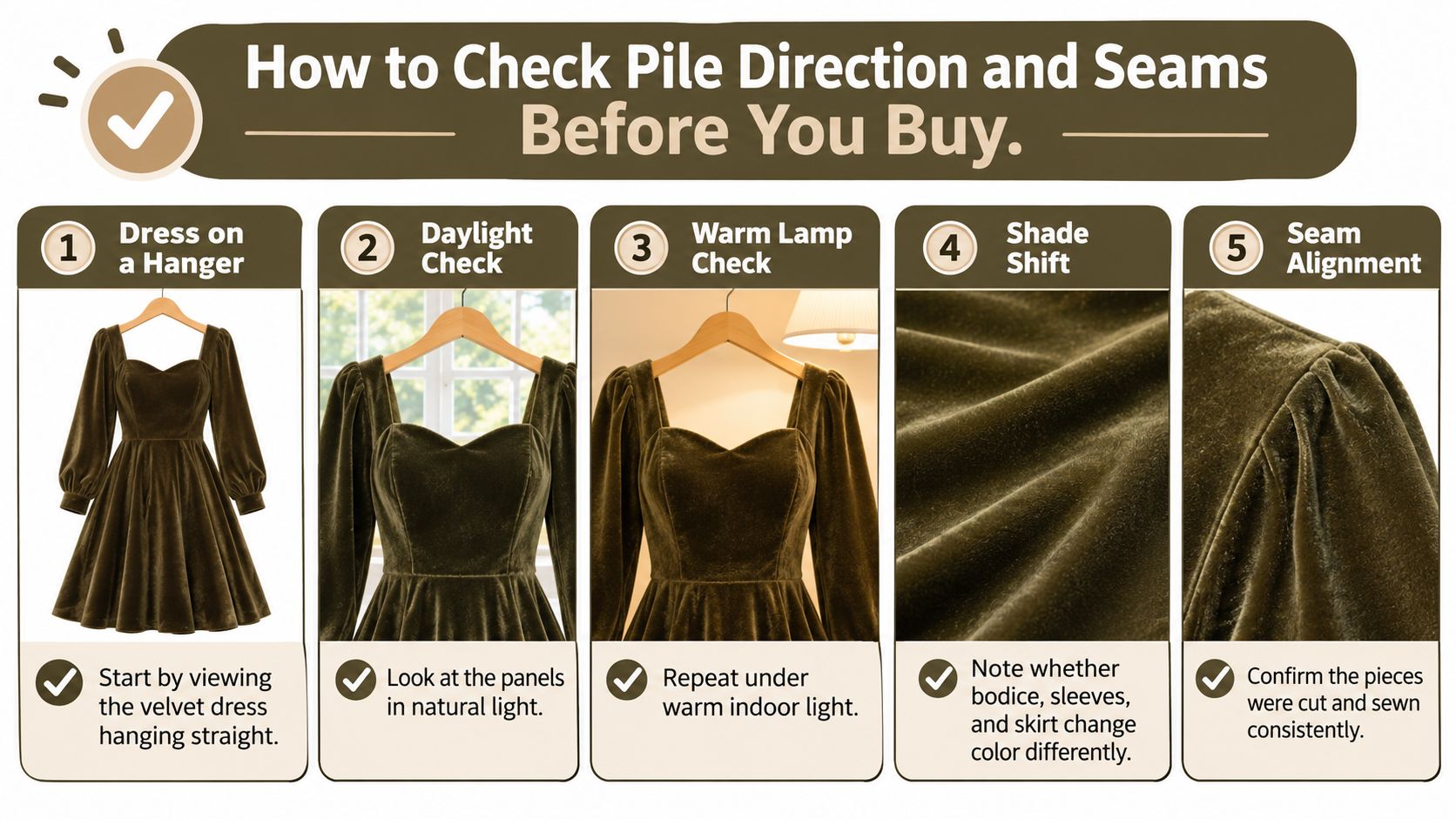
Start with the dress on a hanger, not folded on a table. A flat lay hides the shade shifts that show up the moment the cloth hangs in real light.
- Daylight, then a warm lamp. Look at bodice, sleeves, and skirt in daylight, then under a warm lamp. If the panels shift in shade, the pieces were probably cut on different pile directions.
- Fault or a planned block. A single-color velvet dress with mismatched panels is a construction problem. A deliberate color block is labeled and repeated on purpose. Random two-tone is not a style.
- Stroke both ways. Run your palm up and down. A shiny patch or a flattened stripe is heat or pressure damage, not "character."
- Check the stress points. Collar edges, darts, hems, and zipper seams are where crushed nap and seam impressions show first.
- Press and release. Dense pile that springs back points to sound cloth. Pile that stays flat has often been compressed in storage or transit.
- Judge the pile by eye. Apparel velvet is commonly cut with a pile height of about 1.0–1.5 mm and a fabric mass of about 110–160 g/m², as Textile Tuts' velvet and velour weaving guide notes, tuned for drape rather than upholstery abrasion. A short, even pile looks crisp. Long, uneven pile tends to shed and mark. Cutting "against" the pile reads darker. The opposite direction reads lighter, so mixed nap can look like two dye lots from one batch.
- Read the fiber line before you assume how the dress will clean.
If you sew your own, nap control starts at the pattern, not at the iron. A clear walk-through of how to sew velvet smoothly covers cutting with one nap and keeping the pile from creeping under the foot. On a bought dress, the same faults are what a quality control check should catch before the garment ships: one nap, matched panels, and no crushed seams.
A well-cut velvet dress looks like one color in daylight and under a lamp. A tired one already shows shiny seams before you've worn it.
How to Steam and Store a Velvet Dress Without Crushing the Pile
A hot iron on the face flattens or shines the pile. Shiny patches, crushed nap, and seam impressions don't brush out later. New Mexico State University's clothing care guidance recommends steaming plush fabrics instead of pressing them, then brushing gently while the surface is still damp. In production, seams are often sewn with a straight stitch around 2.0–3.0 mm, finger-pressed or steamed from the reverse, sometimes over a needle board.
Steam without touching the face
- Read the fiber first. Silk, rayon, cotton, and polyester tolerate heat and moisture differently. Skipping this and reaching for high heat is the mistake that ruins a collar.
- Use ambient steam or a hover. Hang the dress on a padded hanger in a steamy bathroom after a shower, or hold a handheld steamer a few centimetres off the cloth and keep it moving. The head never rests on the pile.
- Prefer the reverse. Steam from the inside where you can, so moisture reaches the base of the pile without a hot plate on the face.
- Brush while damp. A soft clothes brush, with the nap, lifts the pile. Brushing against it just rearranges the shade.
- Hang until dry. Don't lay the dress flat to "set." Pile distortion often shows only once the cloth is flat, so inspect it hanging.
- Store upright and unstacked. A wide padded hanger, away from damp, beats a crammed rail. Long pressure from heavy goods on top crushes the pile even with no heat at all.
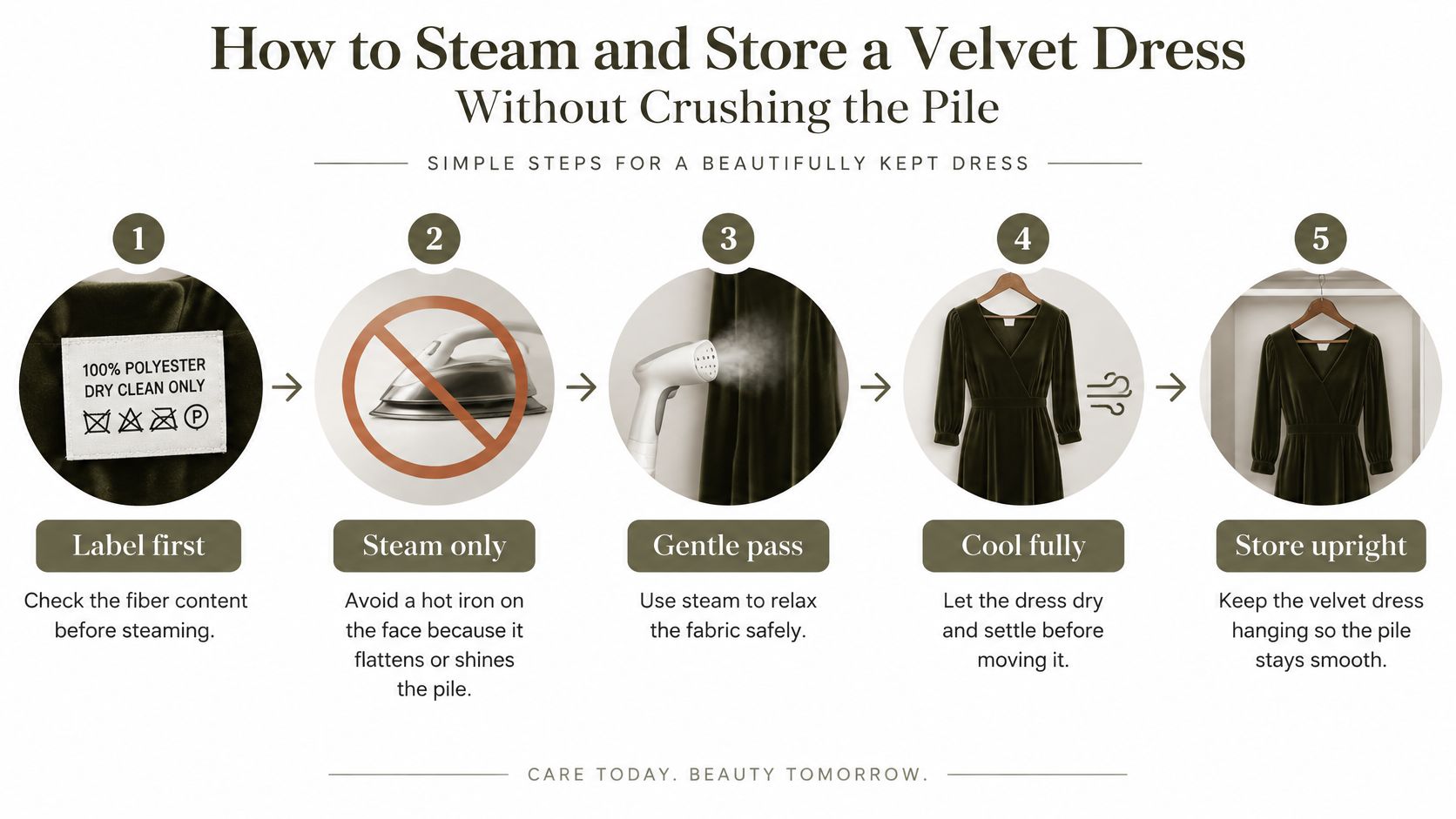
After care, a healthy velvet dress shows an even sheen, no bright iron ghosts, and a nap that springs back when you stroke it. If the seat stays shiny after a proper steam, the pile was crushed hard enough that steam can't rebuild it. That's a wear limit, not a technique you missed.
How to Style a Velvet Dress for Day and Night
Start with the occasion. The same velvet dress changes role with what you put next to it. The pile is already the loudest texture in the outfit, so everything else should either quiet it or contrast it on purpose.
Day
Pair a velvet midi with a denim or camel jacket, flat loafers or ankle boots, and a simple leather bag. Keep jewelry small so the pile stays the focus. A slim belt on a wrap dress marks the waist without adding another shiny surface. Brush the nap with a soft brush before you leave so the sheen runs one way. Don't park a heavy bag or coat on the dress in the car. That's how you arrive with a flat patch on the hip.
Night
Move to satin or metal. A metallic clutch, strappy heels, and drop earrings read clearly against a matte-looking pile. Black, deep green, burgundy, and ivory look richer on velvet than the same dyes do on flat cloth, because the pile swallows light. Bright pastels can look chalky in the same room. In cold weather, a wool coat or a faux-fur wrap sits well over the dress, and tights in a matching or sheer tone smooth the leg line.
Style for the hours you'll be out. A full evening stack on a daytime midi looks costumey. Day shoes under a floor-length velvet dress look unfinished. Match the accessories to the clock, then stop.
Sustainability Trade-offs Between Velvet Fibers
"Eco velvet" isn't automatically a lower-impact dress. Velvet can be silk, rayon or viscose, cotton, polyester, nylon, or a blend, and the fiber changes the environmental picture more than the pile does. NatuClothes' guide to velvet fabric types makes the split clear: polyester accounts for 57% of global fiber production and is commonly used for velvet, while the U.S. textile recycling rate was only 14.7% in 2018. Blends are especially hard to recycle because the components have to be separated first.
Recycled or lower-impact inputs can improve the start of the story. They don't finish it. A mixed-fiber velvet dress can still sit in the waste stream. A fragile dress worn once can carry a worse use profile than a durable synthetic worn many times.
Five checks before you buy
- End of life: Can this fiber be recycled or composted as the dress is built, trims included?
- Shedding: Will a synthetic pile release microfibers every wash?
- Durability: Does the pile recover after sitting, or mark on the first night?
- Care: Will you follow the cleaning method, or will the dress languish because it's fussy?
- Wear frequency: How many occasions will this silhouette earn beyond one party?
Prefer single-fiber construction where you can, and read the composition before the marketing line. Factories that offer sustainable manufacturing options still need a mono-material spec and a care label that matches the fiber. The decision rule is plain. Buy the velvet dress you'll wear often and can care for, not the one that only sounds sustainable.
Production Specs Designers Should Set for Velvet
A tech pack for a velvet dress has to lock the nap before anyone debates color. These are the values worth writing down. On our platform, apparel controls include fabric weave alongside construction notes for seams, stitching, closures, and linings, which is where these lines belong.
| Spec | Value to write | Why it matters |
|---|---|---|
| Nap direction | One direction for all pieces, arrow on every pattern piece | Prevents two-tone panels from mixed cutting |
| Pile height | About 1.0-1.5 mm for apparel | Balances drape with pile stability |
| Fabric mass | About 110-160 g/m² | Supports fluid drape |
| Stitch length | Straight stitch about 2.0-3.0 mm | Limits pile distortion at seams |
| Seam finishing | Finger-press or steam from the reverse side | Avoids seam impressions on the face |
| Steam setting | Set from the recorded fiber content | Silk, rayon, cotton and polyester tolerate heat differently |
| Pre-production approval | Inspect under diffuse and directional light | Reveals shade variation a flat lay hides |
| Shipping | No heavy stacking on finished garments | Prevents pile crush without heat |
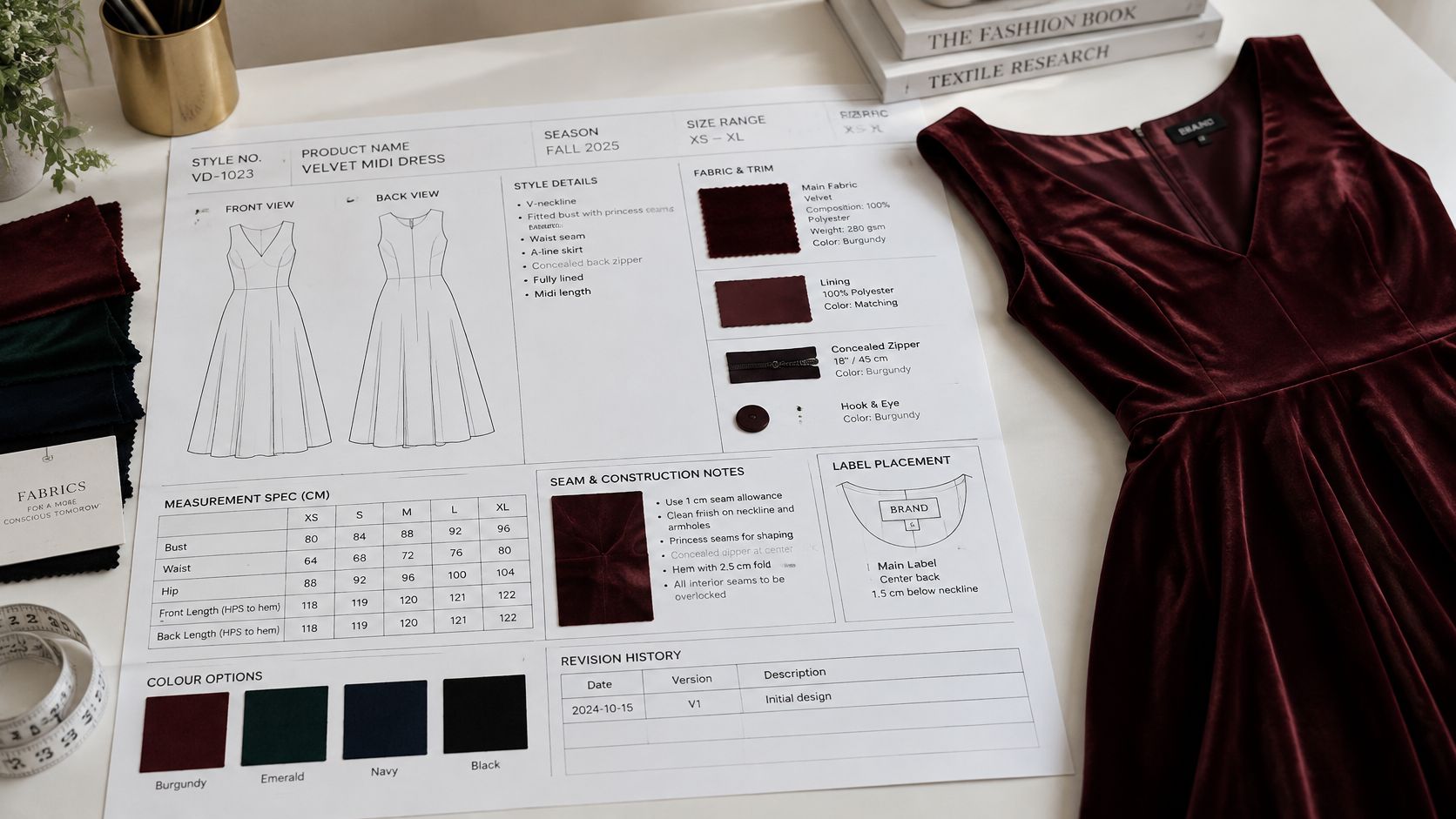
The nap rule does the most work. Specify one direction, put a nap arrow on every pattern piece, and ban mixed cutting unless a color block is the design. Record fiber content before anyone sets a steam temperature. Approve the pre-production sample under diffuse light and under a directional lamp. A sample can hit pile height and fabric mass and still fail if the nap is flattened at collars, darts, hems, or zippers. Treat those numbers as drape targets, then do a sit-and-wear check. A useful spec sheet for fashion designers is only as good as the nap and fiber lines someone on the floor can follow.
Choose a Velvet Dress for Your Occasion and Climate
Pick the occasion first, then the climate, then the fit. Each step narrows fiber and weight. "Winter fabric" is an unreliable shortcut. Warmth comes from weight, pile density, lining, coverage, and ventilation, not from the word velvet.
Review patterns back that up. In Accio's read of velvet wrap dresses, difficulty of entry represented 50% of reported negative feedback, while stiffness and lack of insulation each represented 25%, and Accio's velvet dress trend notes also place velvet-party-dress searches at a peak in November and December. A dress built only for holiday photos may sit unworn the other ten months. A style that works for a cold party can feel airless in a humid market.
- Name the months. If you'll only wear it between late November and New Year, buy for that night and stop. If you want spring evenings too, skip the heaviest pile.
- Match fiber to the room. Lighter, more breathable silk, cotton, or rayon for warm rooms and humid markets. Heavier cloth plus a lining for cold party nights. Polyester's lower moisture uptake is a comfort problem in heat, not a bonus.
- Sit and lift your arms. Armhole and hip ease show up when you sit, not when you stand in a mirror. Wrap styles that are hard to enter fail before the party starts.
- Check recovery. Stretch should spring back after you sit. If the seat stays shiny in the fitting room, it will stay shiny at dinner.
- Ask what the lining does. A lining can add warmth, or it can add weight and trap heat. Don't assume it's insulation.
The right velvet dress fits the occasion, the climate, and your body. The wrong one only looks like velvet on the hanger.
If you're specifying a velvet dress rather than only shopping for one, Genpire turns a prompt, sketch, or reference into multi-view concepts and factory-ready tech packs with materials, construction, and care notes. You can lock nap direction, fiber, and lining before a sample is cut, then share the file with your factory. Start with a velvet dress concept on Genpire.