Taking bust, waist, and hip measurements and choosing a size from a chart sounds straightforward. It isn't enough for product development. A tape measurement, a scanner output, and a population-chart value can describe different anatomical sites, while the same person's bust, waist, and hip can point to different sizes.
Body circumference measurements need context before they can support a fit decision. Pattern and product teams need to know where a girth was taken, how it was captured, whose body it represents, and whether the number describes a body or a finished garment. Without that information, a precise-looking value is still an ambiguous specification.
Table of Contents
- Standard Body Circumference Points at a Glance
- How to Take a Circumference That Repeats
- Circumference Families by Garment Zone
- Population Means Behind a Size Range
- Tape Scans and Phone Measures Are Not Equal
- When Bust Waist and Hip Disagree
- From Body Girth to Tech Pack Fields
- Lock the Protocol Before the Spec Goes Out
Standard Body Circumference Points at a Glance
A circumference is a closed girth around the body at a named anatomical landmark. Torso girths generally follow a horizontal plane; limb girths may follow a plane perpendicular to the limb axis. Neither is a garment width or a length such as sleeve length.
Use the following chart as an operator vocabulary, not permission to choose between landmarks during measurement. Where a row offers alternative sites, the technical designer must select and document the intended site before capture.
Standard body circumference points
The reading precision below is an operational recording convention, not a claim that every anatomical site can be located with equal accuracy.
| Point | Landmark | Posture | Tape rule |
|---|---|---|---|
| Bust | Fullest part of the bust | Standing, arms relaxed at sides | Horizontal, snug, no skin compression; record consistently |
| Chest | Fullest chest, typically nipple line in menswear | Standing, arms relaxed | Horizontal, snug, no compression |
| Underbust | Directly beneath the bust, on the ribcage | Standing, arms relaxed | Horizontal, snug, no compression |
| Natural waist | Rib-to-iliac-crest midpoint for a WHO waist; narrowest torso only when explicitly specified | Feet together, weight even, end of a normal expiration | Horizontal and parallel to the floor |
| Abdomen | Umbilicus or greatest anterior protrusion, selected in advance | Standing, normal breathing | Horizontal, no compression |
| High hip | Iliac-crest level or a documented offset below the specified waist | Standing, feet together | Horizontal, snug |
| Hip | Fullest part of the buttocks | Standing, feet together, weight even | Horizontal, snug |
| Neck base | Base of the neck, passing over the seventh cervical vertebra | Chin level, shoulders relaxed | Follow the neck-base contour, snug |
| Upper arm (sleeve girth) | Fullest biceps with the arm hanging | Arm relaxed unless the protocol specifies a bend | Perpendicular to the arm axis, snug |
| Elbow | Over the elbow point | Arm position explicitly specified | Perpendicular to the arm, snug |
| Wrist | Over the wrist bones | Arm relaxed | Snug, no compression |
| Thigh | Fullest thigh below the crotch | Weight even on both feet | Horizontal, snug |
| Knee | Mid-patella | Standing, knee soft | Horizontal, snug |
| Calf | Fullest calf | Standing, weight even | Horizontal, snug |
| Ankle | Narrowest point above the malleoli, the ankle-bone prominences | Standing, weight even | Horizontal, snug |
Names that can mislead the sample room
Chest, bust, and underbust aren't interchangeable. Menswear chest usually describes the fullest chest, while womenswear bust describes the fullest bust. Underbust is a separate ribcage measure used in bra and fitted-bodice development.
High hip also needs more than a familiar name. A team might use the iliac crest or establish an offset below its chosen waist landmark. Write the actual rule into the record rather than assuming every operator locates high hip identically. Hip, by contrast, refers to the fullest buttock girth.
The label natural waist deserves particular care. An apparel team's narrowest-torso waist isn't automatically the same site as an anatomically defined survey waist. Preserve the distinction in the measurement name when both are needed.
Finally, sleeve on a tech pack usually means a length. The circumference in this chart is upper-arm girth, not sleeve length, armhole circumference, or a finished sleeve's flat width.
Copy the landmark sentence into the measurement record before entering a number. That small discipline prevents an operator, patternmaker, and factory from assigning different meanings to the same field.
How to Take a Circumference That Repeats
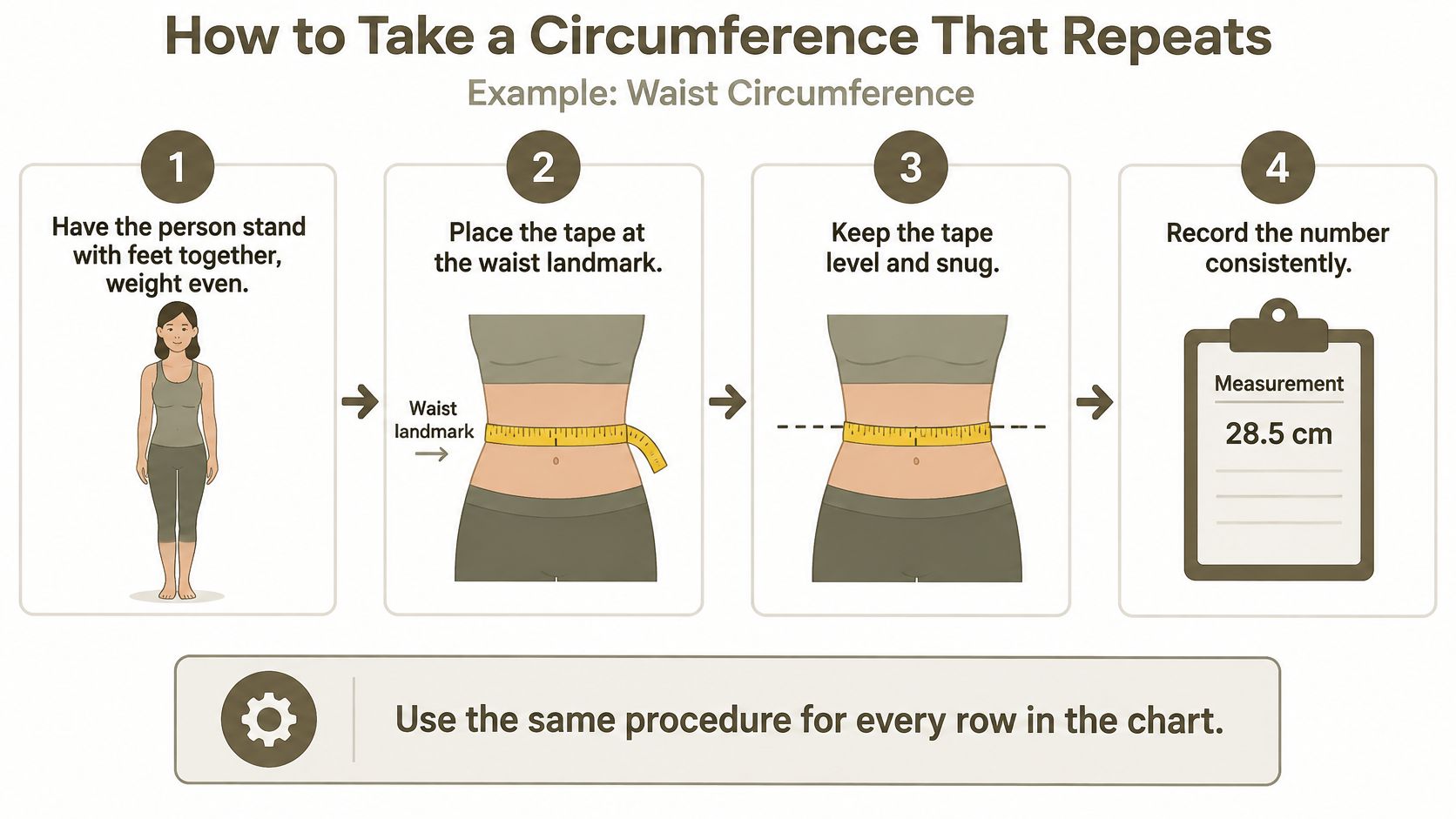
A repeatable reading starts with the person and the landmark, not the tape. For waist measurement, the WHO STEPS manual specifies the midpoint between the lower margin of the last palpable rib and the top of the iliac crest, with a horizontal, noncompressing tape, a reading after normal expiration, and recording to the nearest 0.1 cm.
The waist procedure makes the essential controls visible. Use the same capture discipline for other girths, while retaining each point's prescribed landmark, limb position, and tape orientation.
A controlled capture sequence
Prepare the person. Ask them to stand with feet together, weight evenly distributed, and arms relaxed. Measure on skin where practical, or over light clothing. Reject a reading taken over a bulky waistband, folded fabric, or a garment that reshapes the body.
Locate before wrapping. Palpate the lower rib margin and iliac crest, then identify their midpoint. Don't substitute the visually narrowest part of the torso. If the landmarks aren't clear, resolve that uncertainty before recording anything.
Position the tape. Use a calibrated flexible tape and inspect its path around the front, sides, and back. A mirror or a second operator can help identify a tilted loop. Restart if the tape slips away from the marked plane.
Control tension and breathing. Ask for normal breathing, then read at the end of an ordinary expiration. The tape should touch the body without indenting it. Don't ask the person to hold their stomach in or forcefully empty their lungs.
Repeat independently. Release and reposition the tape rather than rereading an unchanged loop. Keep the individual readings so the reviewer can distinguish genuine agreement from a copied value. Define the repeat-and-review rule before the session.
Reject procedural failures. Retake readings after posture changes, tape compression, slippage, or uncertain landmarking. Don't average an obviously faulty reading into an otherwise acceptable set.
Agreement is more useful than extra digits
A repeatability rule should tell operators when to stop and when to escalate. If readings don't agree within the project's approved band, inspect technique and landmark placement rather than continuing until a convenient value appears.
Operator gate: Landmark verified, tape orientation checked, breathing state recorded, and unit written beside the value.
Record clothing conditions too. A later operator shouldn't have to guess whether an apparent body change came from the participant, the tape position, or the layer underneath it.
Circumference Families by Garment Zone
Organize body circumference measurements by the garment decision they support. A list of girths is useful for capture, but a patternmaker needs relationships between points to determine where fabric must accommodate the body.
These working families group the chart by garment job. They aren't a replacement for anatomical definitions, and a point can serve more than one product category.
Torso and neckline decisions
Torso girths include bust, chest, underbust, waist, abdomen, high hip, and hip. Together, they describe the volume a bodice, shirt, dress, or trouser block must accommodate. A dress block needs the relationship among bust, waist, and hip, not only the largest of those values.
Bust and underbust are particularly useful as a pair for a fitted bodice. The outer bust envelope alone doesn't describe the ribcage beneath it. Likewise, a trouser team needs waist and hip together, with abdomen or high hip added where the intended rise and silhouette require them.
Neck-base girth supports collar and neckline development. A shirt block combines chest accommodation with a separately designed collar opening. A hood also needs an opening and attachment strategy, but neck-base circumference alone cannot determine the hood's volume or movement allowance.
Upper and lower limb decisions
| Working family | Points used together | Practical garment decision |
|---|---|---|
| Upper limb | Upper arm, elbow, wrist | Shape a sleeve from its upper volume through its bend and cuff |
| Upper leg | Thigh, knee | Establish a jean's thigh room and transition toward the knee |
| Lower leg | Calf, ankle | Check a tapered trouser, close-fitting legging, or boot shaft against the wearer |
A sleeve may fit the upper arm while restricting movement at the elbow. Specify the elbow posture used during capture and assess the garment in the positions its wearer will use. A comfortable standing fit doesn't establish comfortable reach or bend.
For a tapered leg, thigh, knee, calf, and ankle form a sequence. Reducing only the hem opening can leave an unintended concentration of fabric above it or make the opening impractical for dressing. Fabric behavior and opening construction belong in that decision.
Head circumference is a separate accessory measure and isn't part of this apparel girth set. Don't replace it with neck-base girth when developing a hat, helmet cover, or pull-on opening.
When torso points suggest different size labels, keep their identities intact. Averaging bust, waist, and hip would create a number that corresponds to none of the garment's actual fit requirements.
Population Means Behind a Size Range
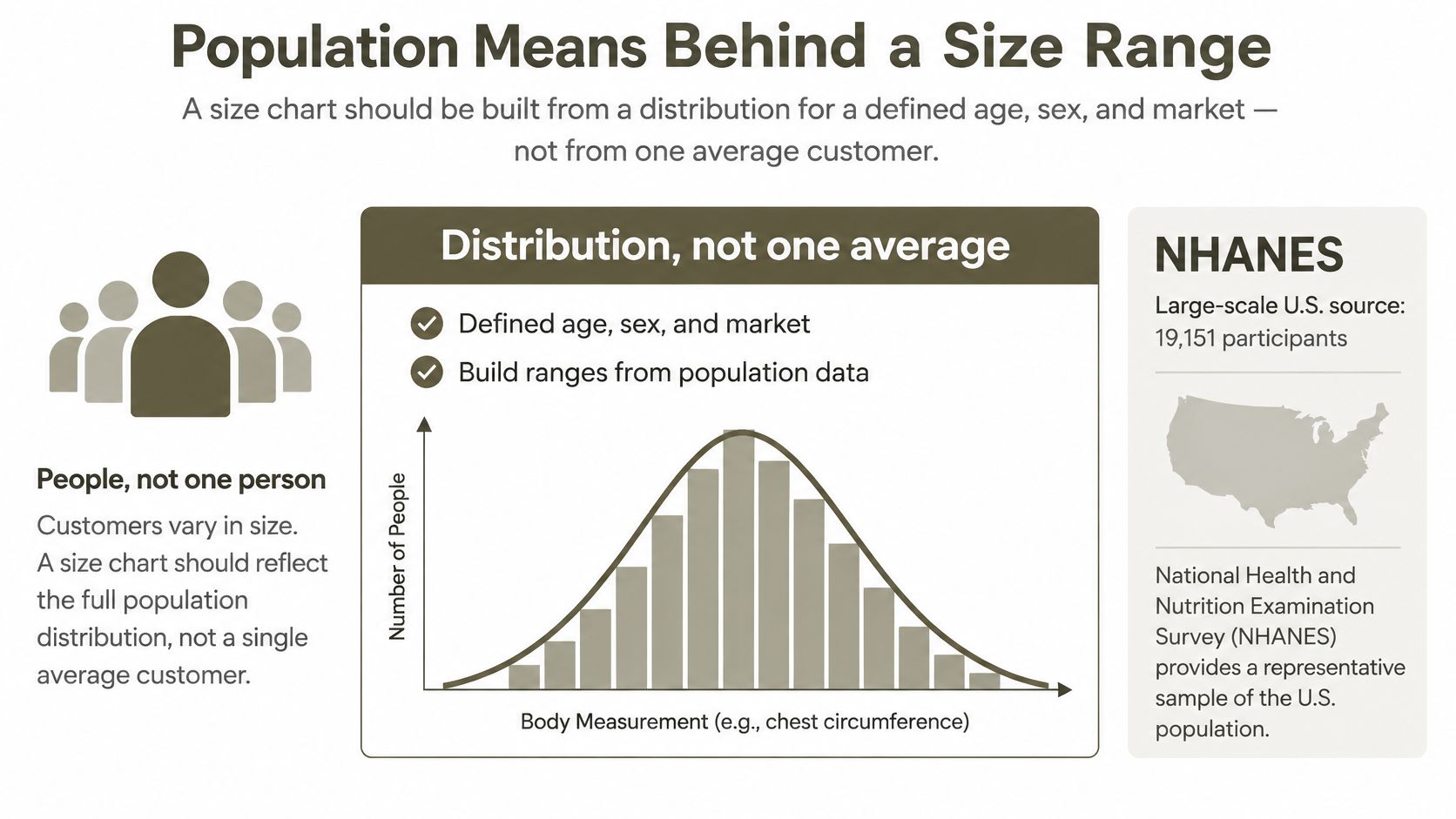
A population mean is not a size range. It marks the center of a defined group, while percentiles show how measurements are distributed around that center. For fit development, that distinction helps teams decide which bodies a range is intended to accommodate.
The NHANES reference report for 2011–2014 includes 19,151 participants and provides weighted means, standard errors, and selected percentiles by age and sex, with additional adult breakdowns by race and Hispanic origin.
Population reference figures
These figures describe specific populations and analyses. Treat them as reference points, not ready-made base-size recommendations.
| Source | Population | Measure | Value |
|---|---|---|---|
| NHANES reference report | U.S. survey participants | Weighted circumference means and percentiles | Age- and sex-specific distributions, with additional adult breakdowns |
| CDC NCHS | U.S. men | Average waist circumference | 40.6 inches |
| CDC NCHS | U.S. women | Average waist circumference | 38.5 inches |
| NHANES-based adult-men analysis | U.S. adult men | Mean waist circumference | 100.76 cm, standard deviation 15.71 cm |
For 2021–2023, the CDC National Center for Health Statistics reports average waist circumferences of 40.6 inches for U.S. men and 38.5 inches for U.S. women. A separate 2024 NHANES-based study in the International Journal of Endocrinology reports a mean waist of 100.76 cm, with a standard deviation of 15.71 cm, for its U.S. adult-men study population.
These summaries answer different population questions. Before using a figure, check who was included, the survey period, and how the measurement was taken. A circumference without its measurement protocol is like a pattern dimension without a named point: the number alone cannot guide a reliable comparison.
Turn coverage into a product decision
Define the intended age group, market, and sex-based sizing framework where applicable. Then set the required coverage in light of adjustability, fabric stretch, layering, and the consequences of poor fit.
- Everyday knitwear: Assess how stretch and silhouette accommodate the target distribution.
- Outerwear: Develop the garment for its intended underlayers, while keeping stored body measurements separate from added garment ease.
- Protective products: Check fit and coverage against the product's functional requirements rather than borrowing a casualwear range.
- Children's apparel: Use child-specific measurements and proportions, not a scaled-down adult table.
A person's waist percentile does not necessarily match their hip, chest, or limb percentiles. Building a size range from separate percentile values can therefore create an artificial combination that does not represent the relationships among measurements in the target population.
Record the population segment and measurement protocol alongside each reference table. Without them, a valid figure can become a poor design assumption when reused for a different market or measurement method.
Tape Scans and Phone Measures Are Not Equal
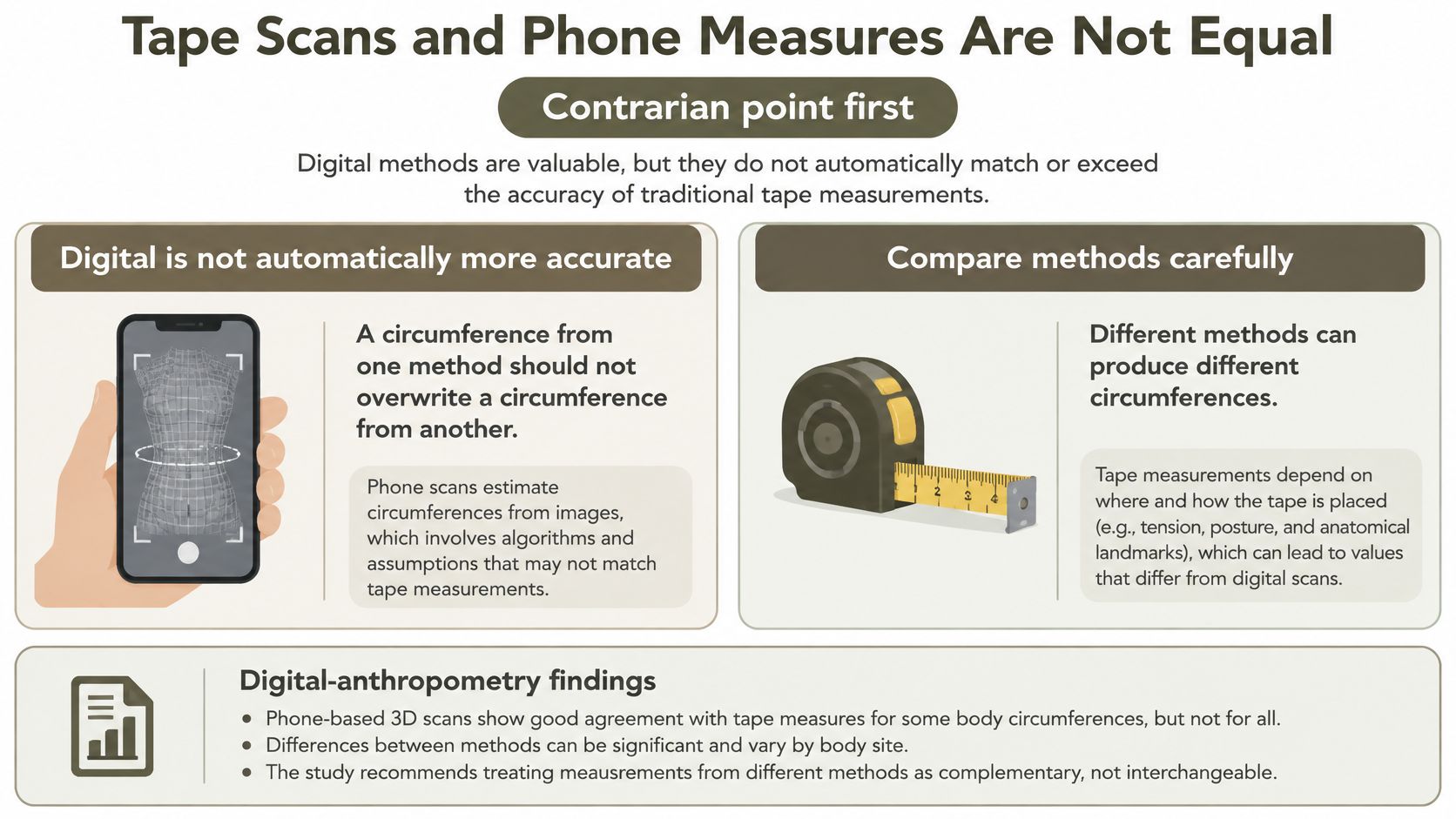
Digital isn't automatically more accurate. A scanner's circumference shouldn't overwrite a tape value because the software produces a polished model or displays more decimal places.
A digital-anthropometry comparison published in the Journal of Personalized Medicine examined 11 anatomical sites using conventional tape and digital systems, finding average differences of approximately 2 cm and root-mean-square errors from 0.51 to 3.27 cm, despite strong correlations. Its trained tape protocol recorded triplicate measurements to the nearest 0.1 cm and averaged them.
Correlation doesn't establish interchangeability
Methods can track larger and smaller bodies similarly while consistently disagreeing about the circumference itself. That's why a strong correlation doesn't justify combining their outputs into one unqualified column.
Landmark definitions are part of the problem. The comparison identifies inconsistent measurement sites across manufacturers and distinguishes the WHO rib-to-crest midpoint waist from the NIH superior-iliac-crest site. Both can produce legitimate readings of the same person, but they don't represent an identical measurement definition.
Guidance also changes manual performance. A 2025 pilot published in Discover Sustainability reported average error of about 13.2% for unguided manual measurements, 5.7% with guidance, and 6.7% for body scans, with scanners tending to produce larger circumferences at difficult-to-locate landmarks.
Those pilot results don't establish a universal ranking of tape, phone, and scanner products. They support a narrower, useful conclusion: operator guidance and landmark identification deserve the same attention as the capture technology.
Keep provenance with the measurement
Use separate method-qualified fields or records until equivalence has been evaluated for the intended workflow.
- Method and device: Identify tape capture or the scanning system, including the relevant software version where available.
- Capture conditions: Record clothing, pose, and any departure from the approved procedure.
- Landmark mapping: Confirm what the system means by waist, abdomen, or upper arm.
- Validation status: Mark values as unreviewed, reviewed, accepted, or requiring recapture.
A precise display is not proof that the device measured the anatomical loop your pattern requires.
Route ambiguous waist, abdomen, shoulder, arm, and ankle scan outputs to human review before release into a block or chart. Review should establish the site and conditions, not merely confirm that the number looks plausible.
When Bust Waist and Hip Disagree
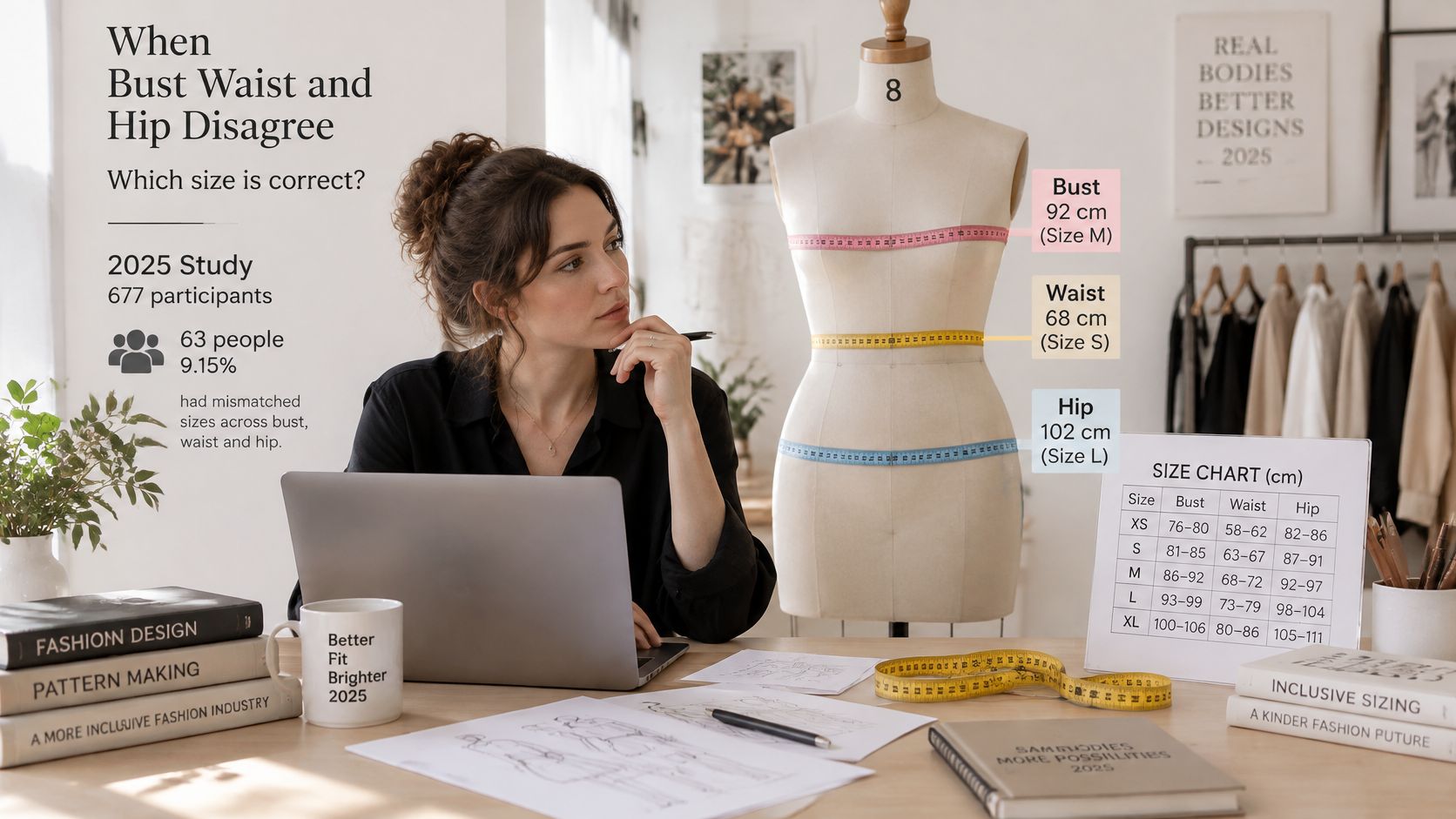
Which size is correct when bust, waist, and hip suggest different labels? The useful answer is often a shape-aware fit decision, not a single winning measurement.
A 2025 Scientific Reports study reported consistent bust, waist, and hip size classifications for only 9.15% of participants, while 90.84% had differing classifications and 35.45% weren't adequately accommodated by the existing sizing system. Those findings describe the evaluated system and participants, not every apparel chart.
Separate individual mismatch from market mismatch
An individual mismatch occurs when a person's proportions cross the boundaries of an existing chart. A market mismatch occurs when the chart's underlying proportions don't adequately describe the intended customer population.
The local Saudi women's measurements are relevant to the second problem. A regional measurement table should be evaluated on its own terms rather than treated as confirmation that an imported chart will fit. Translating a letter size or converting units doesn't validate the source chart's proportions.
For an individual customer with a smaller waist and fuller hip, choosing trousers from waist alone may leave insufficient hip room. Develop from the fit-critical hip accommodation, then shape the waist through the block, darts, seams, waistband, or an appropriate adjustment feature.
Make the design response explicit
- Retain separate inputs. Keep bust, waist, and hip values intact instead of reducing them to a nominal size.
- Group by useful shape relationships. Evaluate whether different waist-to-hip or bust-to-waist relationships require separate blocks.
- Choose the fit-critical girth. Bust may lead a woven-jacket decision, while hip may lead a trouser decision. Confirm the choice against silhouette and use.
- Specify ease independently. Movement and styling allowances belong in garment development, not in an edited body value.
- Validate before grading. Check representative bodies and fit samples against the intended market before extending the block across the range.
A woven jacket illustrates why the largest label isn't automatically the answer. Selecting enough bust room may still require different waist shaping, shoulder development, or sleeve accommodation. The pattern team must evaluate the whole garment rather than enlarge every dimension indiscriminately.
A market-level mismatch needs a different intervention. Rebuild the body-measurement intervals and test the relevant shape groups instead of relabeling the existing chart.
Document those decisions alongside the sample instructions. The same omissions that complicate shape-aware sizing can contribute to factory sample rejection and tech-pack mistakes, especially when a factory has to infer which dimension controls the fit.
From Body Girth to Tech Pack Fields
A factory shouldn't have to infer whether a waist value describes a body, a finished garment loop, or a garment measured flat. These are different fields with different purposes.
The ISO clothing anthropometry framework distinguishes measurement locations, body-based size designation, and population measurement tables through ISO 8559-1, ISO 8559-2, and ISO 8559-3 respectively. Designers or manufacturers determine garment ease separately; body-measurement tables don't prescribe finished-garment dimensions.
Circumference fields for a tech pack
The example below is a hypothetical development record, not a prescribed trouser allowance or universal acceptance standard. Its arithmetic demonstrates how to keep the fields separate.
| Field | What it stores | Example |
|---|---|---|
| Measurement name | Controlled point name from the chart | Natural waist circumference |
| Anatomical landmark | Protocol site, not a garment seam | Midpoint of last palpable rib and iliac crest |
| Value and unit | Body girth only, in centimetres | Hypothetical body value of 76.1 cm |
| Tolerance | Approved repeat or acceptance band for that record | Hypothetical controlled-reading band of ±0.5 cm |
| Population segment | Whose body the number represents | Women, named target market and age band |
| Source protocol | Capture method and anatomical procedure | WHO STEPS tape capture |
| Ease | Designer allowance stored apart from body value | Hypothetical addition of 4 cm |
| Garment circumference | Body value plus the specified ease | Calculated garment girth of 80.1 cm |
Start with the measurement name and landmark. The name lets the team find the field; the landmark tells the operator what it means. Don't replace anatomical wording with a garment seam description, because that would change a body record into a construction instruction.
Next, store the body value and unit without altering either for intended fit. In the hypothetical record, the body waist remains 76.1 cm.
The separate ease field contains 4 cm. Adding that allowance produces a hypothetical garment circumference of 80.1 cm. A corresponding half-girth would calculate to 40.05 cm, but only if the factory's flat measurement method represents that same complete loop without an overlap or construction adjustment.
Separate repeatability from production acceptance
Body-reading tolerance answers whether capture is sufficiently repeatable for the project. Garment point-of-measure tolerance answers whether a manufactured sample or production unit meets the approved specification. Don't copy the former into the latter.
Specification safeguard: A body capture band is not a factory sewing tolerance.
Choose each acceptance rule deliberately, considering the product, material, construction, and inspection method. The hypothetical band in the table illustrates a field that must be approved, not a standard every team should adopt.
Add posture, breathing state where relevant, measurement side, capture date, method, and validation status to the record. Keep raw repeated readings available when they support review.
Use a fashion spec-sheet checklist to connect these fields with the garment's construction points of measure. Grading should follow the approved body intervals and design rules; the sample room should check finished-garment measurements, including the intended ease.
Lock the Protocol Before the Spec Goes Out
Treat measurement release as a go or no-go decision. A spreadsheet full of numbers isn't ready for grading merely because every cell contains a value.
Use a named reviewer to approve the measurement record and a revision identifier to connect it to the correct pattern and sample request. If the body table changes, the team needs to know which garment specifications require reevaluation.
Release checks
Confirm controlled names. Every girth has its landmark sentence. Replace ambiguous labels such as sleeve with upper-arm circumference when that's what the field means.
Check capture context. Method, posture, unit, date, and relevant breathing state accompany the value. Missing context requires clarification or recapture, not a guess.
Reconcile the specification fields. Body value, ease, and garment circumference remain separate. The selected grading intervals belong to the intended population and approved block.
Preserve shape differences. Bust, waist, and hip inputs remain available even when the product carries a single consumer-facing size label. The pattern instructions state how the team resolved any mismatch.
Approve scan exceptions. Ambiguous waist, abdomen, shoulder, arm, and ankle outputs have a documented human-review decision before they enter production specifications.
Send one coherent handoff
Release the measurement protocol with the construction specifications, not as an unconnected attachment. Our generated tech packs include points of measure, such as sleeve length and shoulder width, in centimetres. Keeping those construction dimensions beside the relevant girth records helps the factory distinguish garment geometry from body inputs.
Use the tech-pack checklist before sending to a factory to check the complete handoff, including revision consistency and unresolved measurement questions.
When an approved specification becomes an order, carry its revision reference into purchasing documents. For teams coordinating that downstream handoff, Supply Automate's guide to preparing POs for Amazon FBA is a useful purchasing resource, separate from the technical work of defining fit.
Don't authorize grading or sampling until the landmark, method, tolerance, and ease are documented. The reviewer should be able to explain what each number means without contacting the person who entered it.
Genpire turns prompts, sketches, and references into product concepts, technical specifications, and production assets, with a tech-pack workspace for construction details and measurement documentation. Visit Genpire to develop your next apparel specification, and bring an approved landmark protocol and body-measurement table so your team can keep body girth, ease, and garment dimensions distinct.