In the NewProd research on new-product development, 54.8% of successful products had completed at least nine of the thirteen possible development stages, against 38.2% of failed products (NewProd study of new product development). The same study found that just 3 of 203 projects, or 1.5%, completed every stage. Discipline, in other words, isn't an exhaustive checklist. It's knowing which gates matter and refusing to walk past them.
Most advice on how to turn an idea into a product stops exactly where the difficult work begins. It takes you from sketch to concept, then waves in the direction of a factory. The bridge that carries a concept into production is a factory-readable specification, plus the evidence gate that decides whether to spend on tooling and inventory. Get those two right and an ordinary idea becomes a product. Skip them and a beautiful concept becomes an expensive sample.
The sequence below is one I'd follow in that order, from brief to first production run, with the document and the decision that has to exist at each handoff.
Table of Contents
- The Six Stages From Idea to Factory-Ready Product
- Define the Brief and Test Demand Before You Draw
- Turn the Concept Into a Tech Pack Factories Can Price
- Send an RFQ, Review Feasibility and Order Samples
- Decide Whether to Commit Tooling, Inventory and IP
- Choose Your First Step This Week
The Six Stages From Idea to Factory-Ready Product
A 2023 survey of 767 engineers and designers by Protolabs found that the average product-development journey lasted about 22 months. Nobody holds 22 months of decisions in their head, which is why the work breaks into stages with a handoff between each one.
Six stages cover the distance: brief and concept, design refinement, tech pack and engineering, RFQ and feasibility review, samples and testing, then bulk production and launch. Each one produces something a stranger can inspect, and each ends at a question that decides whether you spend more.
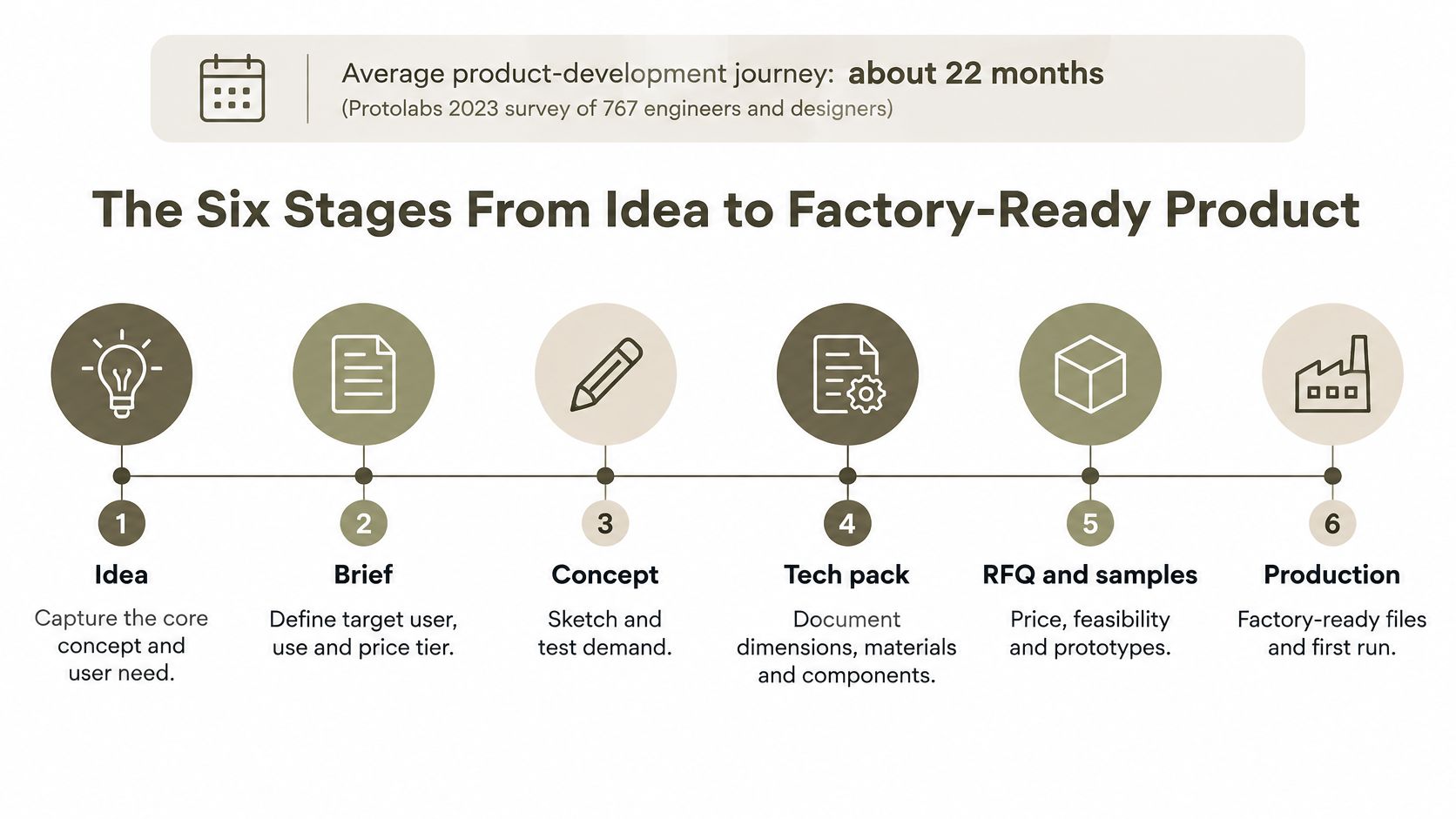
What each stage hands over
Brief and concept produces a target user, an intended use and a multi-view concept set. The gate asks whether one concept fits both the brief and the target price. Design refinement settles silhouette, materials, colors and detail views, and it passes only when materials and construction are decided rather than assumed. In a custom project those two stages typically run 2 to 3 weeks of concept work and 3 to 4 weeks of industrial design, with another 4 to 6 weeks of CAD and engineering before anything reaches a supplier, for 8 to 12 weeks in total.
Tech pack and engineering produces dimensions, a bill of materials, and construction and component specs. Its gate is blunt in a useful way: could a factory price this without asking a single question? RFQ and feasibility review collects supplier quotes and factory comments, and passes only when a vetted factory can build the thing at your target cost.
Samples and testing produces a physical sample and a set of pass/fail results. It passes when every threshold in the tech pack is met, not when the sample looks good on a table. Bulk production and launch needs an approved sample, a production order and launch assets, gated by whether demand is proven enough to commit volume.
| Stage | Key output | Gate question | Typical time |
|---|---|---|---|
| Brief and concept | Target user, intended use, multi-view concept set | Does one concept fit the brief and target price? | 2 to 3 weeks |
| Design refinement | Silhouette, materials, colors and detail views | Are materials and construction settled? | 3 to 4 weeks |
| Tech pack and engineering | Dimensions, bill of materials, construction and component specs | Could a factory price it without asking questions? | 4 to 6 weeks |
| RFQ and feasibility review | Supplier quotes and factory feedback | Can a vetted factory build it at target cost? | 1 to 2 weeks |
| Samples and testing | Prototype or sample with pass/fail test results | Does the sample pass every test threshold? | 2 to 4 weeks |
| Bulk production and launch | Approved sample, production order, launch assets | Is demand proven enough to commit volume? | 4 to 8 weeks after approval |
Use the map to locate your evidence
Find the stage you're in today and write down what would let you leave it. If the answer is "everyone liked the concept", you haven't passed the gate; you've had a meeting. The delay between stages is rarely effort. It's an unanswered question nobody wrote down.
Define the Brief and Test Demand Before You Draw
A brief that a designer can act on and a factory can eventually price has eight fields: target user, intended use, key features, material preferences, aesthetic direction, price tier, product category and hard constraints. Every field narrows the options, which is why a prompt made only of adjectives returns concepts nobody can quote.
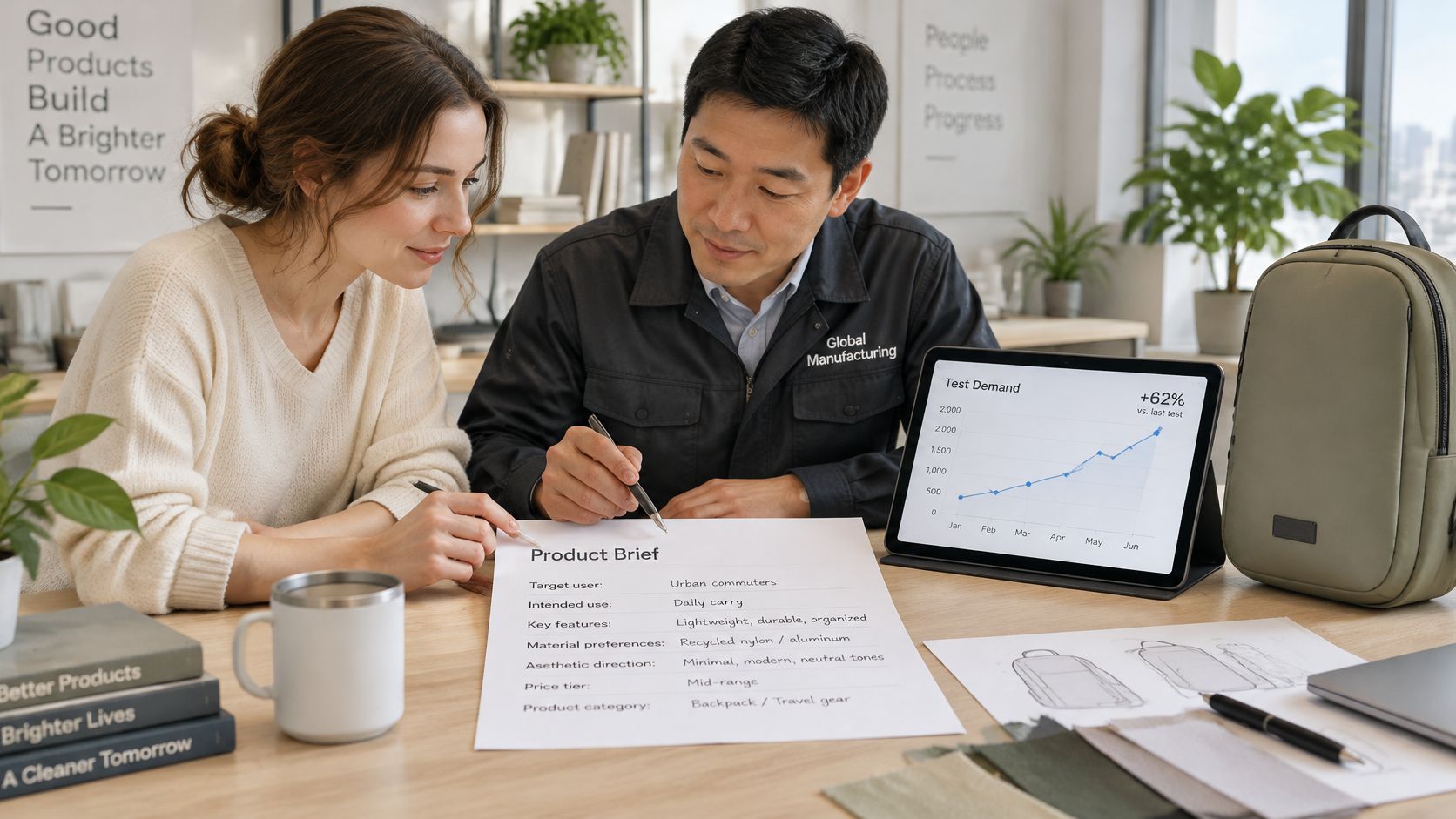
Write each field as a decision rather than a mood. "Affordable" becomes $38 retail with a $12 landed cost. "Premium materials" becomes full-grain leather, 1.4 mm, natural finish, no PU backing. Vague inputs produce generic outputs, and generic outputs produce samples that miss on cost before they miss on taste.
Run discovery in three passes
- Five to ten short interviews. Fifteen minutes each. Ask what they use now, what breaks, what they paid and what they'd give up to fix it. Don't pitch.
- A scan of three to five comparable products. Record price, materials and the visible weak point in reviews. That weak point is your opening.
- A note on what buyers already pay. Your price tier should come from the market, not from your cost plus a hopeful margin. A structured market research pass that logs competitor prices and complaints in one place saves you from redoing this at the RFQ stage.
Then look at conversion. A review of consumer-oriented new-product development research reports that approximately 15% of initial new-product ideas become commercial successes, while about 60% of products introduced to the market succeed. That gap is a selection effect: what reaches the market has already survived research, feasibility, testing and launch preparation.
So track stage-specific numbers instead of counting concepts: ideas accepted for development, prototypes completed, samples approved, products launched, products hitting margin targets. Four concepts that die cheaply at the brief stage cost less than one that dies after tooling.
Worth watching before you commit to a direction:
Pick one concept and write the kill condition
Generate multi-view concepts with front, back and side views, then choose one, or two if they're genuinely different bets. Before any refinement work, write a one-page go/no-go note.
Go/no-go note: who the customer is, which problem the product solves, what you'll test first, and the condition that would make you drop the idea.
These questions need answers before design work starts. Who is the buyer and who is the user, if they differ? What do they do today instead? What will this cost to make at the volume you'll order? Which claims will need testing or certification before you market them? A blank answer is a stage you haven't finished.
Turn the Concept Into a Tech Pack Factories Can Price
Research on design decision timing found that more than 50% of concept-phase decisions were revised, and defects discovered late carried a rework multiplier above 10×. Decisions made before design freeze accounted for 86% of expected program cost, with 34% determined before concept freeze (Design Science study on the relative impact of early versus late design decisions). Front-loading isn't tidiness. It's the cheapest hour in the project.
A factory prices what it can see. Show it a render and it guesses; show it a specification and it quotes. The tech pack is that specification, and it's built in a fixed order.
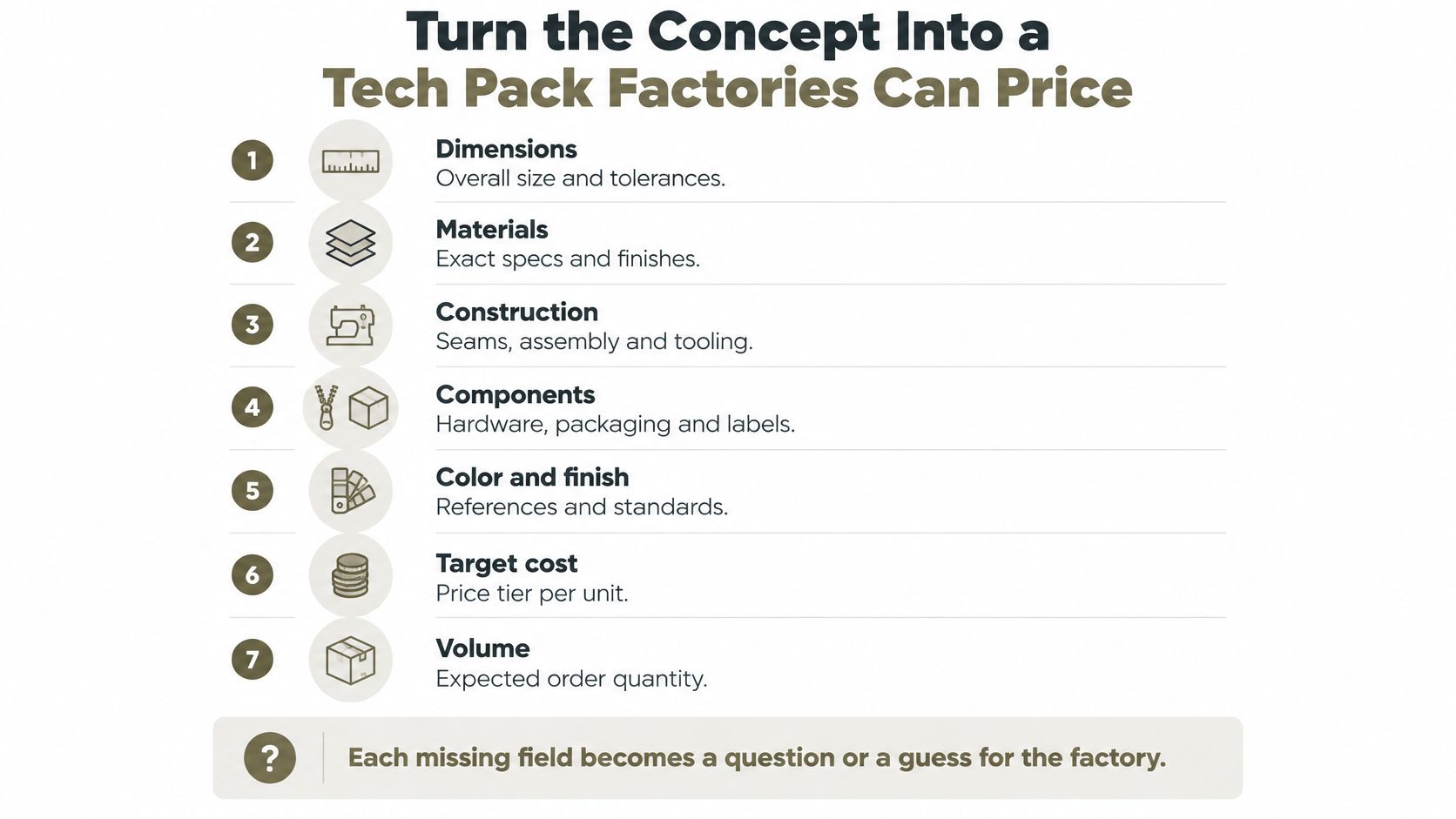
Six parts, in the order a factory reads them
- Flat sketches of front, back and key details, with call-outs for every feature that costs money. A perspective render hides seam placement and closure type, and those two items change the price.
- A measurement table with each point of measure and its tolerance. Write "chest 56 cm, plus or minus 0.5 cm", never "chest about 56".
- A bill of materials listing every component with its material spec, supplier reference and quantity, including thread, zips, labels, interfacing and packaging. Missing components become substitutions the factory chooses for you.
- Construction notes: seam type, stitch density, closures, finishes and assembly order. State stitches per inch rather than "good quality stitching", because that phrase means something different in every factory.
- Quality standards and test methods with pass/fail thresholds: seam strength, abrasion cycles, colorfastness, drop impact, dimensional tolerance, assembly time. A subjective "looks right" cannot be enforced at the end of a production line.
- A dated revision log naming who changed what. Untracked revisions are how a factory builds last month's version with this month's confidence.
The outside-reader pricing check
Hand the pack to someone who has never seen the concept and ask them to price it. Every question they ask marks a gap. If they ask what the lining is, your BOM is incomplete. If they ask how the base attaches, your construction notes are thin. Ten minutes of that test saves a week of email.
What a complete pack looks like, page by page
Page one is a cover image with style number, revision date and who approved it. Page two, flats. Page three, measurements and tolerances. Page four, the BOM. Page five, construction detail. Page six, tests and thresholds. Page seven, revision history. Anyone opening the file should be able to tell which version they have without asking, which is the entire point of a factory-ready tech pack rather than a folder of images.
Send an RFQ, Review Feasibility and Order Samples
Failure among commercialized products generally runs at roughly 30% to 49%, and a PDMA best-practice study put fast-moving consumer goods at about 49% (review of Stage-Gate research). Most of that loss is decided before the factory quotes, at the handoff where requirements are still open.
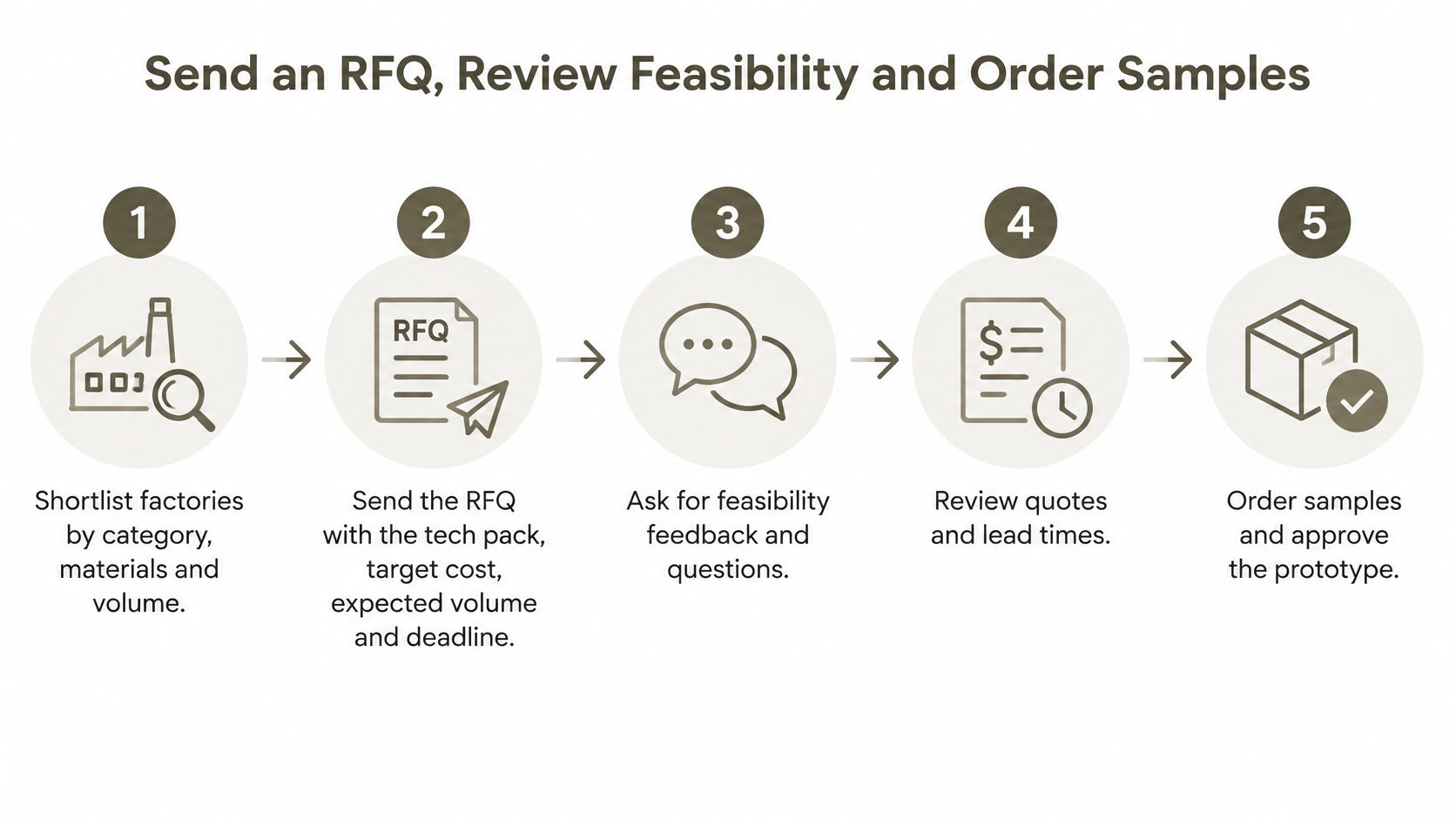
The handoff in seven steps
- Shortlist factories by category, materials and volume. A factory that is excellent at high-volume injection moulding is the wrong call for sixty units. If the product is drinkware, a promotional drinkware supplier may already own the moulds and decoration lines you'd otherwise pay to develop.
- Send the RFQ with the tech pack, target cost, expected volume and a deadline attached. Without a volume figure, quotes are fiction in both directions.
- Ask for feasibility comments on construction, materials and lead time before you compare a single price. Factories can tell you which detail is expensive, and it's free advice.
- Compare quotes on the same specification. Two numbers that describe slightly different products aren't comparable, and the lower one is usually the one that deleted a component.
- Order a sample with a written list of what you're checking, tied to the thresholds in the tech pack. "Send a sample" produces a sample; "test seam strength at 60 N and report the result" produces evidence.
- Log factory comments in the shared file and reissue the pack with each revision, so the next round doesn't reopen a settled question.
- Approve the sample in writing only after it passes. A thumbs-up emoji in a chat thread is not an approval, and it won't protect you when bulk arrives different.
The two gates that save the most money
No sample order without a complete spec. No tooling without an approved sample. Unresolved requirements that enter the handoff come back as scrap, rework or a delayed container, and all three cost more than the week you'd have spent closing the gap.
The most common slip is sending a sketch-only brief to several factories, then comparing quotes that describe different products. The second most common is treating the sample as the finish line rather than the test. Sourcing is difficult at this scale: in its 2024 State of Manufacturing Report, Fictiv found that 43% of respondents identified sourcing fast, high-quality options for low-volume manufacturing as a major challenge. Which is exactly why the specification has to do the arguing for you.
Genpire runs that sequence in one workspace, from prompt to tech pack to RFQ to sample approval to bulk production, and its manufacturing experts review each design for feasibility before production starts. If you're still deciding who builds the sample, this guide to working with a prototype manufacturer covers what to ask before you pay.
A finished sample round is three things: a physical sample, a comment log with every issue numbered, and a signed approval naming the revision it applies to.
Decide Whether to Commit Tooling, Inventory and IP
Launching fast is not automatically the rational next step for a physical product. The 2025 MAGNET manufacturing survey reported that only 45% of manufacturers launched a new product, down from 58% in 2023, while 67% identified lack of funding as the primary innovation constraint. Cash is the binding constraint, not speed.
So rank every planned commitment on four criteria before you sign anything.
| Criterion | Question to ask | Warning sign |
|---|---|---|
| Reversibility | Can you cancel or resell this without loss? | Tooling or custom moulds already committed |
| Cash at risk | How much money is locked before the first sale? | Minimum order quantities above your pilot budget |
| Learning value | Will this step answer a question customers have not answered? | The step repeats evidence you already have |
| Compliance exposure | Does the product make safety or performance claims? | Claims made without test or certification |
Set the pilot threshold before the pilot runs
Whenever tooling or a minimum order quantity ties up cash, run a smaller paid pilot or preorder first, and write the pass threshold in advance. A number, not a feeling: a preorder count, a reorder rate among pilot users, a return rate you'd accept. Deciding the threshold afterwards lets you rationalise any result.
Enough evidence generally looks like three things. Customers describe the problem without you prompting them. Pilot users reuse the product or order again. The unit economics work at the price the market actually pays, not the price you'd like.
Where custom parts waste money: if a standard zipper, hinge, bottle or fitting performs identically and the customer never sees the difference, buy the standard part and spend the savings on the surface they touch.
IP and claims aren't paperwork
An idea record documents that you had the idea. It does not, on its own, create legal protection, and a dated file is not a substitute for a clearance search. Run that search, and check the design against existing registrations, before you commit to manufacturing and before you market. Originality and IP defensibility of AI-generated designs sit with you as the customer, which is the correct place for them.
Claims follow the same logic. If the product says waterproof, flame resistant, food safe or medically beneficial, test or certify it before the claim appears in a listing. Marketing a claim you haven't verified converts a design problem into a regulatory one, and that's the most expensive category of rework there is.
Choose Your First Step This Week
Wherever you're starting, the next move is smaller than it feels and the readiness proof is specific.
| Starting point | Next action | Proof of readiness |
|---|---|---|
| Idea only | Write the brief and run five to ten user interviews | Brief fields complete and customer named |
| Concept | Build the tech pack and run the outside-reader pricing check | Outside reader prices it without questions |
| Tech pack | Send the same spec to three factories for feasibility comments | RFQ answers return with no open questions |
With only an idea, don't open a design tool. Write the eight brief fields, book five interviews, and ask each person what they bought last time and what annoyed them about it. Your output is a named customer and a price tier, not a sketch.
With a concept, the tech pack is the work. Build the flats, the measurement table with tolerances, the BOM and the construction notes, then hand it to someone who wasn't in the room. If they can price it without asking anything, you're ready for suppliers. If they can't, you've found the questions a factory would have charged you a sample round to discover.
With a tech pack, send the identical specification to three factories and ask each for feasibility comments before you look at prices. Read the comments first, because they tell you which details are expensive and which are impossible, and that information is worth more than a quote comparison at this stage.
If you'd rather not assemble the design-to-specification stage from separate tools, Genpire's workflow is one route to it, and solo founders without any design background have shipped custom products through it. The work still has to be done, and the gates still have to be passed.
The test that overrides everything else in this article is one line long. If you can't name the customer, the next step is research, not design.
Genpire turns a prompt, a sketch or a reference image into multi-view concepts, a factory-ready tech pack and an RFQ in one workspace, so the specification a factory prices stays tied to the idea that started it. If you're holding a concept and want the next handoff to be a document rather than a conversation, visit Genpire and work through the six stages in order.