You're probably in one of two situations right now. Either a product is stuck in sample round after sample round, or your team has a beautiful concept that still isn't ready for a factory to quote with confidence.
That gap is where most consumer brands lose time and margin. A sketch can look finished long before a factory can build it repeatably. A founder sees a backpack, lamp, jewelry piece, or speaker. The factory sees stitch order, wall thickness, draft, gate location, plating process, carton dimensions, incoming QC, and whether the drawing leaves room for interpretation.
Design for manufacturing is the discipline of closing that gap early. It means designing a product so it can be made at the cost, speed, and quality your brand needs, instead of only the way it looks in a concept render.
Table of Contents
- What Design for Manufacturing Means for Consumer Brands
- How DFM Became a Formal Discipline
- Core DFM Principles That Shape Every Product
- Material and Component Choices Across Consumer Categories
- Tolerance, Warpage, and the Real Cost of Precision
- From Concept to Factory-Ready Specs Without the Rework Loop
- Scale-Up, Sourcing, and the Gaps Most DFM Guides Miss
- Practical Checklist for Your Next Consumer Product
What Design for Manufacturing Means for Consumer Brands
A common version of this problem looks simple on the surface. A founder approves backpack sample #7, but the factory still can't hit the shape consistently. The top handle twists, the front pocket binding puckers, and a decorative reinforcement panel keeps forcing tooling or pattern changes even though it adds almost no user value. Money disappears into revisions that didn't need to exist.
That's what design for manufacturing fixes.
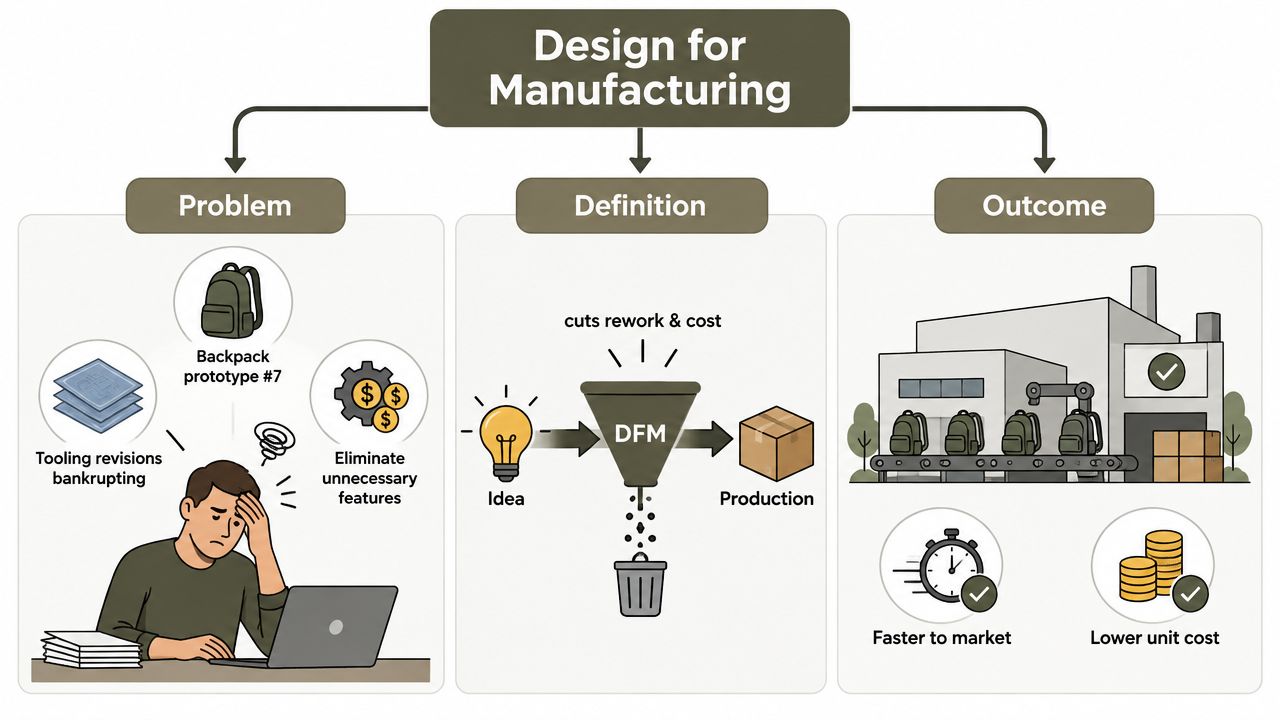
For consumer brands, DFM isn't about chasing extreme precision for its own sake. It's about making sure the product can survive the workflow from concept to sourcing to sample to production. The design has to fit the process already running on the factory floor, not the fantasy version of that process in a pitch deck.
Why consumer-goods DFM feels different
Consumer products live under different pressures than aerospace or medical hardware.
- Aesthetics drive decisions: A visible seam, color break, gloss mismatch, or warped face panel can matter more than a hidden internal tolerance.
- Runs are often shorter: Many brands don't have automotive-scale volume to absorb expensive custom processes.
- Factories vary more: The CAD file matters, but the sewing line, molding shop, plating vendor, or final assembly station often matters more.
- Supplier capability defines reality: Two factories can quote the same drawing and build two very different products.
Practical rule: If the product only works when a highly specific factory improvises around your unclear intent, the design isn't manufacturable yet.
What DFM actually balances
In plain language, DFM sits at the intersection of three things:
Design intent
What you want the product to look like, feel like, and do.Material reality
What fabric, resin, wood panel, metal finish, foam, or PCB process will allow.Supplier capability
What your chosen factory can repeat without heroics.
A strong consumer product doesn't just look right in a render. It assembles cleanly, tolerates normal process variation, uses available components, and arrives with specs the factory can trust. That's the difference between shipping a hero product and burning cash in endless sample rounds.
How DFM Became a Formal Discipline
Design for manufacturing didn't begin as software or a checklist. It grew out of a hard industrial lesson. If every part is unique, production stays slow, expensive, and dependent on individual craftsmanship.
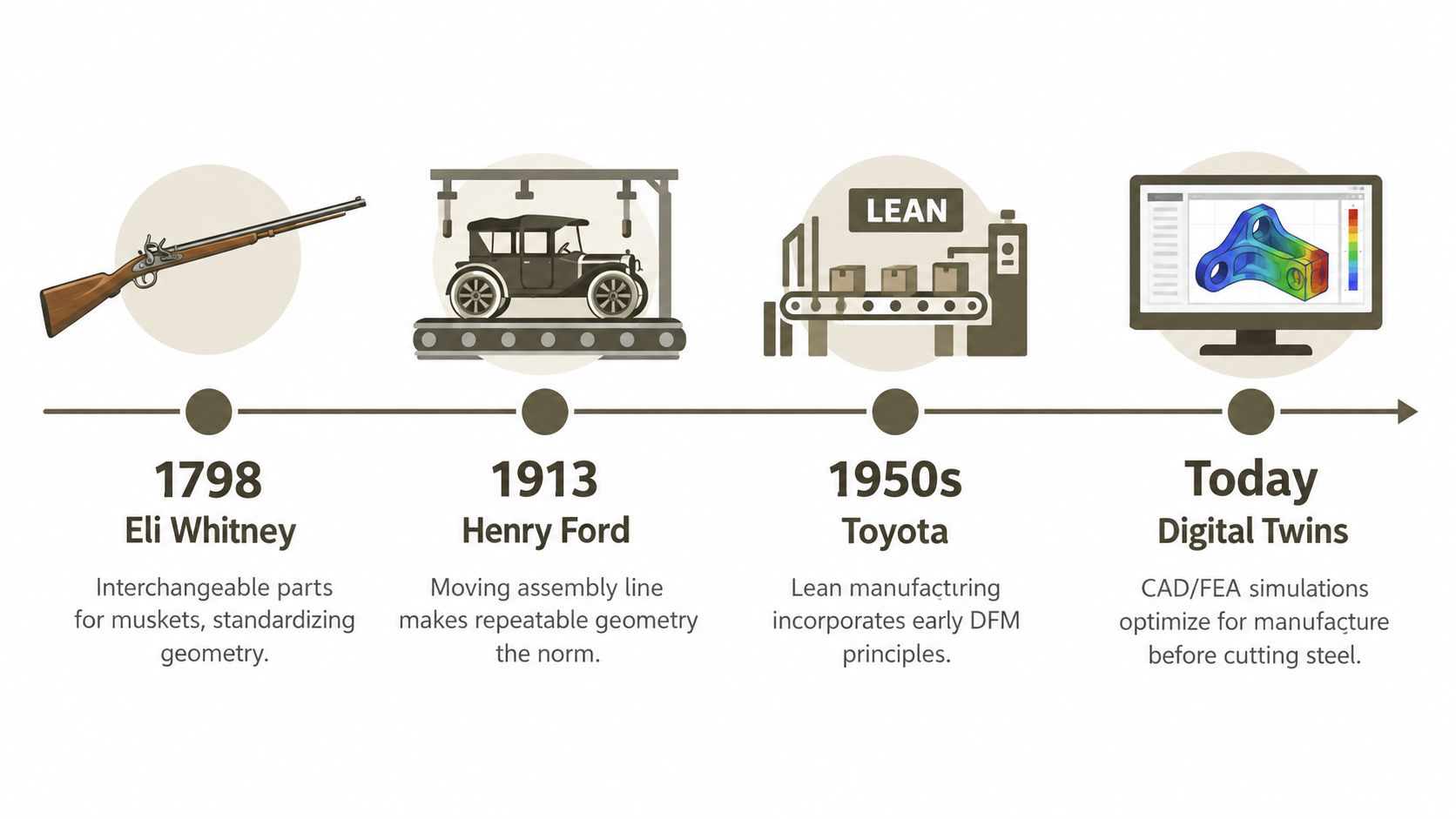
One widely cited milestone is the introduction of interchangeable parts in musket production in 1788, which helped shift manufacturing from handcrafted variation toward standardized, repeatable production. DFM wasn't broadly recognized as a formal discipline until much later, and one historical line traces that structure through the creation of a formal product-design curriculum at Carnegie Institute of Technology in 1934, followed by Geoffrey Boothroyd and Bill Wilson's 1978 NSF-supported research, their 1981 report titled Design for Manufacturability, and the addition of a DFM module in 1985. That arc is summarized in this history of design for manufacturing and assembly.
Why formalization mattered
Before DFM became a named discipline, experienced engineers still knew the core truth. A design decision made upstream could raise tooling cost, complicate assembly, or create inspection headaches later. Formal DFM turned that intuition into a repeatable method.
That mattered because product teams needed a way to answer practical questions early:
- Can this shape be molded, sewn, die-cut, plated, or assembled consistently?
- Which dimensions need control?
- Which details add no value but create process risk?
What that history means for brands now
Consumer brands feel this history in a very direct way. You might not be building engines or industrial equipment, but you're still relying on repeatability. In many consumer categories, the 2D drawing or tech pack is the contract. If it's vague, the factory fills in the blanks.
That's why support around documentation matters as much as design taste. For teams working on branded physical products, a resource like durable asset labelling consultation is useful because it shows how production constraints and identification requirements shape product decisions long before final output.
Today the tools are newer, but the logic is the same. Prompt-driven concepting, toleranced drawings, and tech-pack generation only help if they carry manufacturing intent all the way through the handoff.
Core DFM Principles That Shape Every Product
Most consumer DFM decisions fall into four buckets. Material choice, part count, tolerance allocation, and assembly flow. If you get those four right, many downstream problems get smaller fast.
Material choice sets the ceiling
Material isn't a styling decision with a cost attached. It's the process decision that controls what the factory can reliably do.
A matte ABS enclosure, a recycled PET woven shell, and anodized aluminum can all support the same brand language. They can't all support the same wall sections, cosmetic finish behavior, tooling path, or rework options. If you choose a material that fights the process, every later revision becomes more expensive.
Part count is hidden labor
Every seam, fastener, insert, trim piece, and sub-assembly is work someone has to do. Even if the parts themselves are cheap, the operations often aren't.
A good rule on the factory floor is simple. If a feature creates a new handling step, a new fixture, or a new chance for misalignment, treat it as a cost item. Decorative complexity looks harmless in a render because the software doesn't charge labor.
When a designer adds “just one more detail,” the line often adds one more operation, one more inspection point, and one more way to make a defect.
Tolerance should follow function
Teams get wasteful fast. Precision is valuable only when it protects function.
One DFM guide shows how fast cost rises as tolerances tighten: relative cost moves from 1× at ±0.5 mm to 1.5 to 2× at ±0.1 mm, 2 to 3× at ±0.05 mm, 3 to 5× at ±0.025 mm, 5 to 10× at ±0.010 mm, and 10 to 20× at ±0.005 mm, largely because production can shift into precision grinding, lapping, temperature control, and full inspection. Those figures come from this DFM tolerance guide.
Decorative embossing, hidden brackets, and non-mating surfaces rarely need extreme precision. Hinge fits, seals, clips, and bearing interfaces might.
Assembly should feel obvious
The cleanest products tend to assemble in one clear sequence. Ideally with one orientation, minimal handling, and as few tool changes as possible.
Core DFM Principles Applied to Consumer Goods
| Principle | Consumer Goods Application | Typical Impact |
|---|---|---|
| Material selection | Match resin, fabric, metal, or wood to the actual process and supplier capability | Fewer process conflicts and cleaner quoting |
| Part consolidation | Remove non-essential trims, brackets, hardware, and decorative layers | Lower labor, fewer errors, simpler sourcing |
| Tolerance allocation | Tighten only on functional interfaces like clips, hinges, doors, seals, or alignments | Better cost control and less inspection burden |
| Assembly simplification | Design products to go together in a clear sequence with minimal reorientation | Faster line training and fewer assembly mistakes |
A lot of DFM is just disciplined subtraction. Keep the features users notice. Remove the ones only the concept board notices.
Material and Component Choices Across Consumer Categories
The same DFM principle applies across categories. Fit the process, don't fight it. What changes is where the risk sits.
Global industrial design activity makes that scale visible. In 2023, about 1.2 million industrial design applications were filed worldwide, containing an estimated 1.5 million designs, up 2.8% from 2022. Category mix matters too: textiles and accessories accounted for 17.3%, furniture and household goods 16.9%, tools and machines 11.0%, electricity and lighting 9.2%, and ICT and audiovisual 8.8% of the world total, according to WIPO's industrial design figures. Consumer-goods DFM is not a niche concern. It sits inside a huge volume of design-led manufacturing work.
The process changes by category
Apparel lives and dies by cut, sew, shrinkage behavior, and finish consistency. Footwear adds lasting, outsole tooling, and pattern symmetry. Accessories often hinge on hardware standardization. Furniture depends on panel logic, nesting, joinery, and shipping geometry. Electronics pile mechanical fit, PCBA constraints, test access, and compliance on top.
That doesn't mean each category needs a different philosophy. It means each category reveals a different bottleneck first.
Compare the real levers
Material and Component Trade-offs by Consumer Category
| Category | Primary DFM Lever | Common Pitfall | Cost Driver |
|---|---|---|---|
| Apparel | Choose fabrics and trims the line already runs well | Styling details that complicate sewing order | Labor and rework |
| Footwear | Reuse lasts, outsoles, and shared constructions where possible | Too many unique upper or tooling variations | Tooling and component complexity |
| Accessories | Standardize hardware, zipper families, buckles, and attachment methods | Custom trims that create sourcing delays | Small components and hand assembly |
| Furniture | Design around sheet size, joinery method, and pack-out logic | Shapes that waste material or ship inefficiently | Material yield and machining time |
| Electronics | Select available components and connectors with testability in mind | Late component swaps after mechanical lock | Sourcing, rework, and validation |
In jewelry and plated accessories, finish selection creates its own manufacturability decisions. A practical reference like this materials plating guide for jewelry helps teams understand how base material and finish choice affect durability, appearance, and production compatibility.
For home goods teams, the bigger pattern is workflow control. A connected specification process matters as much as the bill of materials, especially when categories mix soft goods, hard goods, and decorative requirements. That's why a unified workflow like home goods PLM becomes useful. It keeps materials, components, revisions, and production notes in one thread instead of scattering them across PDFs and email chains.
Tolerance, Warpage, and the Real Cost of Precision
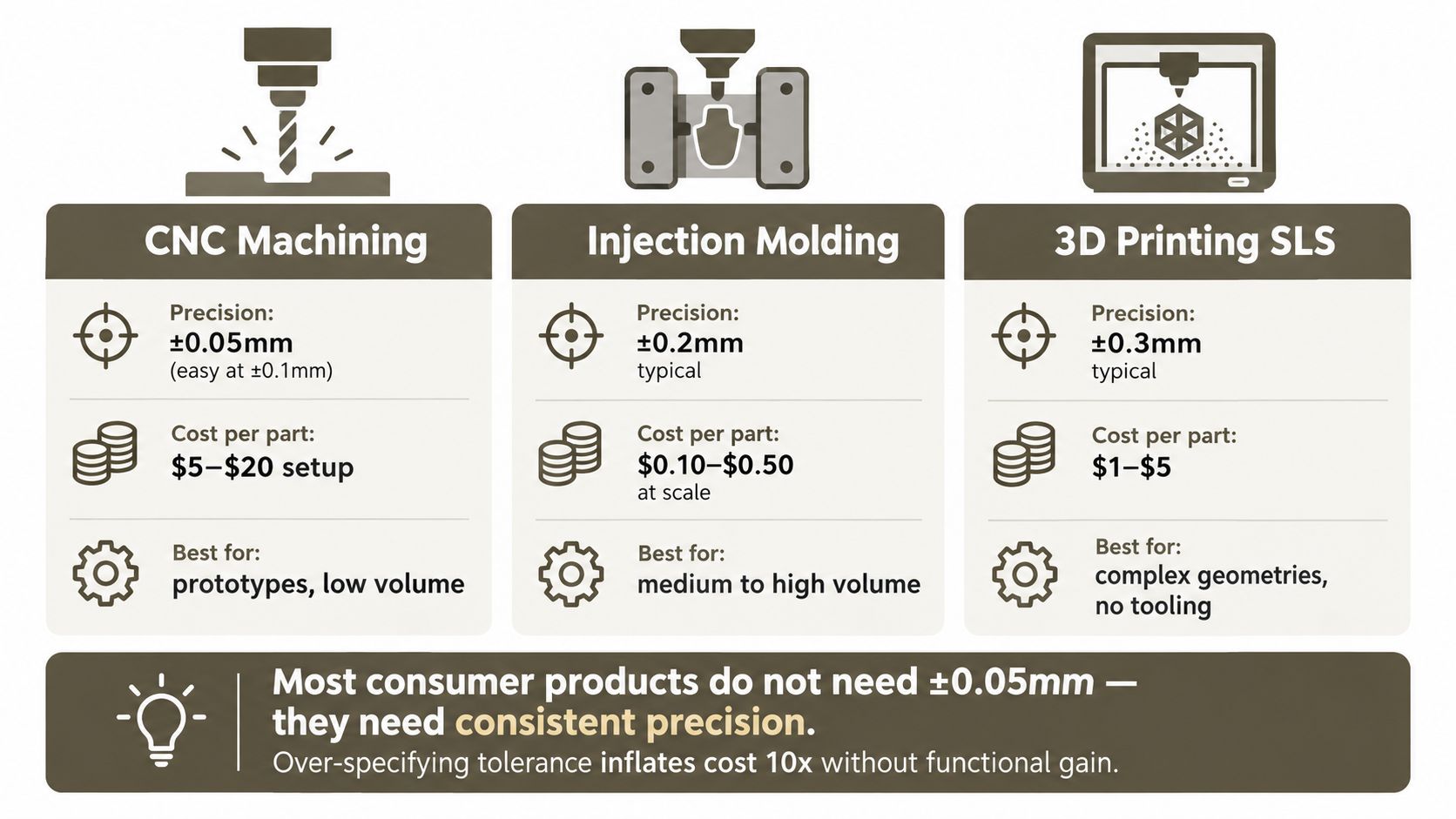
Most consumer products don't fail because they weren't precise enough in theory. They fail because the wrong features were held tightly, while the features that matter were left ambiguous.
Where precision earns its keep
A mating battery door, a snap fit, a seal groove, or a hinge axis can justify tighter control. A decorative face texture usually can't.
If you treat every visible dimension like a critical aerospace feature, the factory responds by slowing down, inspecting more, and charging for process capability you didn't need. Precision is a budget. Spend it where a loose result causes field failure, functional noise, bad fit, or customer frustration.
Shop-floor advice: Tight tolerances belong on interfaces, not on ego.
Warpage is usually a geometry problem first
In injection molding, part distortion often starts with cooling imbalance, not operator error. One molding guide recommends keeping core and cavity wall-thickness variation within 10% of total wall thickness, because differential cooling is a major source of warpage. The same guide recommends ribs at about 60% of main wall thickness, tight tolerances only on mating features, and datum-based control using ASME Y14.5 or ISO 1101 for critical features, all described in this injection molding tolerance guide.
That advice is practical because it points upstream. If a large flat enclosure has uneven walls, random heavy bosses, and cosmetic surfaces that double as structural surfaces, the mold shop can't “fix” the concept cleanly later.
A simple way to allocate tolerances
Use three buckets:
- Critical interfaces: Clips, hinges, closures, seals, and alignments. These get the tightest control.
- Visible but non-functional features: Cosmetic faces, embosses, trim transitions. These need consistency, not heroic precision.
- Hidden structure: Internal ribs, buried supports, non-contact surfaces. Keep these as loose as function allows.
Teams that need a good primer on this often benefit from a practical resource on designing for dimensional accuracy, especially when they're moving between prototyping methods and production methods.
The best tolerance strategy doesn't try to make everything perfect. It protects what the user can feel, hear, open, close, or break.
From Concept to Factory-Ready Specs Without the Rework Loop
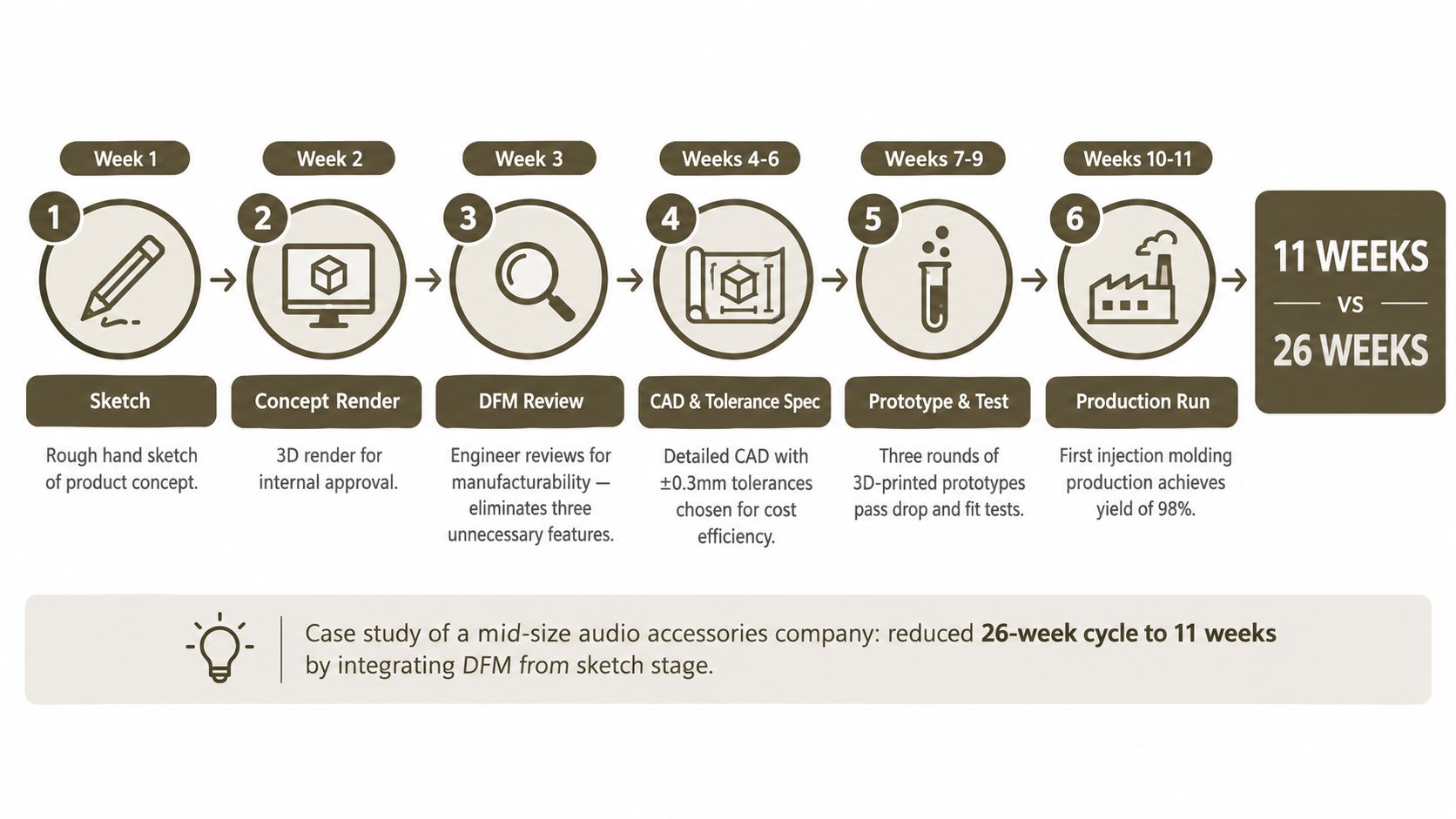
The old consumer-product workflow burns time in translation. A concept starts as a sketch. Then someone rebuilds it in Illustrator for presentation. Then another person rewrites dimensions into a spreadsheet. Then sourcing creates its own BOM sheet. Then the factory asks for a different template. Every handoff drops context.
That's where rework really starts. Not at tooling. At file fragmentation.
What a cleaner workflow looks like
A factory-ready path usually follows the same artifact chain:
Concept input
Text prompt, rough sketch, reference board, or marked-up existing product.Visual concept
Multi-view render or technical sketch that clarifies intent.Dimensioned definition
Sizes, key interfaces, components, and construction choices become explicit.Tech pack and BOM
Materials, trims, finishes, tolerances, callouts, and notes move into a manufacturing document.Quote and sample
The factory prices what's specified, not what they guess you meant.Pilot and production handoff
Revisions stay linked to the same source data.
Why brands keep looping
The issue usually isn't a lack of creativity. It's version drift. A color update changes one PDF but not the BOM. A hardware revision gets noted in email but not in the spec sheet. The dimensions on page two don't match the CAD export the supplier is using.
For teams trying to reduce that handoff friction, a practical primer like Tech Pack 101 for AI specs is useful because it shows how manufacturing intent needs to travel with the product definition from the start.
One source of truth beats heroic coordination
Integrated systems have a real DFM role. They don't replace engineering judgment. They reduce opportunities to lose it.
Genpire is one example of that type of workflow. It converts prompts, sketches, and references into product concepts and factory-ready specifications, so the BOM, visuals, and production notes stay tied together instead of being rebuilt across disconnected files.
The handoff should not be a translation exercise. It should be a transfer of already-structured intent.
When the workflow is sound, factory-ready specs stop being a last-minute deliverable. They become the natural output of the way the team already works.
Scale-Up, Sourcing, and the Gaps Most DFM Guides Miss
A prototype can prove that a product is possible. It doesn't prove that it's ready for repeatable production.
Many DFM discussions stop too early. They focus on whether a part can be made once, not whether a brand can source, build, test, revise, and support it across a real production run.
Prototype success is not production readiness
A 2026 manufacturing report found that 97% of companies still experience delays or failures when moving from prototype to full production, and another dataset in the same source found that 62% of respondents named manufacturing planning as the dominant supply-chain challenge, while 83% of engineers spend 4+ hours each week on procurement tasks instead of design work. Those figures are reported in this manufacturing scale-up study.
That tracks with what brands see in practice. A lab sample can look great while the production line still struggles with dye-lot drift, cavity variation, pack-out damage, MOQ shifts, or supplier substitutions.
Scale-Up Risks by Category
| Category | Pilot-to-Production Risk | Mitigation |
|---|---|---|
| Apparel | Fabric variation, wash behavior, trim substitutions | Lock approved materials and define acceptance standards clearly |
| Accessories | Hardware inconsistency and vendor changes | Standardize components and approve alternates early |
| Furniture | Yield loss, finish inconsistency, shipping damage | Validate process, packaging, and panel logic before scale |
| Electronics | Component lifecycle changes, test gaps, firmware mismatch | Freeze revision control and align hardware with production test plans |
| Connected products | Support burden from firmware and app dependencies | Plan update, serialization, and lifecycle ownership early |
Electronics and connected products change the DFM brief
A 2025 industry report noted that rising electronics content in traditionally mechanical products forces teams to consider both software and hardware, while sustainability regulation and time-to-market pressure add complexity. Related 2026 commentary says manufacturability can't be separated from compliance, cybersecurity, sourcing, firmware, and lifecycle support, with earlier factory involvement and closed-loop production feedback becoming more important. That shift is discussed in this review of what's changing in DFM.
So if you're building a smart light, audio accessory, wearable, or connected home product, DFM now includes test points, serialized data, firmware version control, replacement strategy, and field update logic.
Factory selection matters here too. A brand that wants fewer late surprises should do manufacturer discovery earlier, not after industrial design is “done.” A guide on how to find a manufacturer can help teams assess sourcing fit before they lock choices that only one supplier can support.
Practical Checklist for Your Next Consumer Product
Before you send files to a factory, stop and answer four sets of questions. If your team can't answer them clearly, the product probably isn't ready for tooling.
Materials and components
- Have you approved substitutes: If the exact trim, resin, finish, foam, or connector goes unavailable, do you already know the acceptable alternates?
- Does the sourcing match the region: A component that looks cheap on paper can become painful if only one region or one vendor can supply it.
- Have you matched the material to the process: Good-looking materials still fail if the line can't cut, mold, sew, plate, or finish them reliably.
Tolerances and cosmetics
- Did you separate critical from non-critical dimensions: Functional interfaces need clear control. Cosmetic surfaces usually need consistency more than ultra-tight numbers.
- Are finish callouts specific enough: “Matte black” is not a manufacturing instruction by itself.
- Have you designed for the process: Draft, wall uniformity, seam placement, hardware clearance, and assembly access should already be resolved.
Factory handoff
- Is the tech pack complete: BOM, materials, callouts, measurements, construction notes, and QC expectations should agree with each other.
- Can the factory quote without guessing: If a supplier needs three clarification calls before pricing, the handoff is still incomplete.
- Do sample comments flow back into the master file: Don't let production learning live only in email.
Scale-up readiness
- Do you control BOM versions: The team needs one current source of truth.
- Is tooling ownership defined: Don't leave that vague.
- Have you planned lifecycle support: For electronics and connected products, that includes firmware, compliance, testing, and post-launch updates.
The practical aim is simple. Fewer ambiguous files. Fewer sample loops. Fewer expensive surprises after approval.
Genpire helps consumer brands turn prompts, sketches, and references into factory-ready product concepts, tech packs, and production assets that carry manufacturing intent through sourcing and handoff. If you're trying to reduce sample churn and build a cleaner path from concept to production, visit Genpire.