The most repeated advice about the fabric specification sheet is to make it bigger. Add more fields, more certifications, more columns, more sustainability claims, and the document becomes "complete."
Length isn't the problem. Ambiguity is.
A sheet that says "tensile strength passed" hands a mill nothing to build against. A sheet that says ASTM D5034, warp 45 kgf minimum, weft 30 kgf minimum, specimens conditioned 24 hours at 21°C and 65% relative humidity, hands over a target, a method and a verdict. The difference between those two lines isn't detail for its own sake. It's whether the line carries evidence a third party can reproduce.
The test: hand the sheet to a mill that has never met you and hasn't seen the sample. If the returned cloth matches what's on your desk, you wrote a specification. If it doesn't, you wrote a description.
That reframing changes what belongs on the page. Each field stops being a place to record a preference and becomes a small evidence record: the value, the unit, the tolerance type, the method that produced it and the document that proves it. Build the sheet that way and the factory can construct the fabric and verify it without another email.
Table of Contents
- Core Fields Every Fabric Spec Sheet Needs
- Fiber, Construction and Weight Entries Explained
- Performance Tests and How to Write Their Results
- Tolerances, Pass Limits and Failure Handling
- Finish, Color and Hand-Feel Standards
- Care Labels and Legal Fields Linked to Testing
- Traceability and Chemical Evidence Records
- Send a Complete Spec Sheet to Your Factory
Core Fields Every Fabric Spec Sheet Needs
A factory that receives fiber, weight, width and color will build something. It just won't be your fabric, because those four fields describe a cloth without specifying it. The minimum record falls into four groups, and they appear in the order a buyer reads the page: what the cloth is, what it looks like, how it was tested, and who signed off on the result.
| Field | What to record | Example entry |
|---|---|---|
| Fiber composition | Percent by weight, largest first, totalling 100 | 65% polyester / 35% cotton |
| Construction | Woven, knit or nonwoven, plus weave or knit structure | Plain weave, 2/1 twill |
| Yarn details | Count or denier, ply and twist direction | 40 Ne combed cotton, single ply, Z twist |
| Fabric weight | GSM as primary unit, with tolerance | 135 g/m² ±5% |
| Usable width | Width after excluding selvedges, with minimum | 150 cm usable, 148 cm minimum |
| Color standard | Physical reference or recognized color system | Lab dip LD-2026-04 approved under D65 |
| Finish | Process and performance requirement | Compressive pre-shrink, softener, 20 wash cycles for water-repellent finish |
| Test conditions | Method number, direction, conditioning | ASTM D5034, warp and weft, 24 h at 21°C and 65% RH |
| Control record | Lab, report date, lot ID, revision | Accredited lab, report dated 2026-03-12, Rev C |
Reading the Table as a Build Order
The first five rows let a mill buy yarn and set a loom. The color row lets a dyehouse mix a recipe. The test rows and control rows let a quality manager accept or reject a delivery, and that's the half most sheets skip. A document can be perfectly adequate for sampling and still get bounced at a buyer's onboarding review because nobody can tell which laboratory produced the numbers, when, or against which roll.
Width deserves a note because it's where estimators lose money. Nominal width includes selvedges that get cut away; usable width is what the marker planner can place a pattern on. When a robe or a wide panel depends on a full 150 cm face to avoid a center seam, the difference between nominal and usable changes the consumption figure outright, and the guide to estimating yardage for choir robes walks through that calculation on wide goods.
Every row needs three things: a value, a unit and a tolerance type. Leave a field blank and the factory answers it by guessing, usually with the cheapest option that fits the price. Write "width" without a minimum and you'll get 146 cm. Write "GSM" without a tolerance and 128 g/m² arrives as compliant.
Fiber, Construction and Weight Entries Explained
A fabric name alone is not a build instruction. The sheet must identify the fiber blend and construction precisely enough that a second mill can reproduce the material. List fibers by descending percentage and make the total 100%. “Poly cotton” leaves the proportions undefined; specify each fiber and its share instead.
Name the construction, too. Wovens need a weave such as plain, 2/1 twill or sateen. Knits need a structure such as single jersey, 1×1 rib or interlock, with machine gauge where it affects the fabric. For nonwovens, identify the process, such as bonded or spunlaced. These entries narrow the available choices to a construction the factory can set up consistently.
Yarn Details in the Units the Mill Uses
Use the yarn-count system the mill works with: Ne for combed cotton, denier for filament and textured yarns. Include ply and twist direction, Z or S. A 30 Ne single and a 20 Ne single can produce visibly different cloth at the same GSM, so omitting count leaves an important part of the fabric definition open. If elastane provides the stretch, include its percentage in the fiber composition.
Weight and Width in One Figure
Use grams per square metre (GSM) as the primary weight unit. To convert ounces per square yard to grams per square metre, multiply by 33.9.
| Ounces per square yard | Typical use |
|---|---|
| 4 oz (136 g/m²) | Lightweight shirting and lining |
| 6 oz (203 g/m²) | Mid-weight shirting and dresses |
| 8 oz (271 g/m²) | Chinos and light canvas |
| 10 oz (339 g/m²) | Heavy canvas and outerwear shell |
| 12 oz (407 g/m²) | Denim and workwear |
| 14 oz (475 g/m²) | Heavy denim and duck canvas |
Record the conditioning state used for the weight measurement and state its tolerance. Without those details, a mill and a buyer may compare results taken under different conditions as if they were equivalent.
For cotton garments laundered repeatedly, such as washable white gowns for immersion, weight and shrinkage requirements affect whether the fabric will continue to hang as intended. Treat each entry as an evidence record: identify the specified value, its tolerance and how compliance will be checked. A second mill should be able to build the fabric from the sheet without guessing.
Performance Tests and How to Write Their Results
Test rows sort into three groups. Physical properties cover weight, width and dimensional change. Mechanical properties cover tensile, tear, bursting, abrasion, pilling, stretch and recovery. Chemical and colorfastness properties cover pH, formaldehyde where relevant, and color resistance to light, washing and rubbing. The ASTM textile standards catalogue keeps these as separate standards for physical, mechanical and chemical properties, including CRE stretch testing, bursting-strength testing and the equipment requirements for tensile testing, which is why a single "lab tested" stamp tells a buyer nothing.
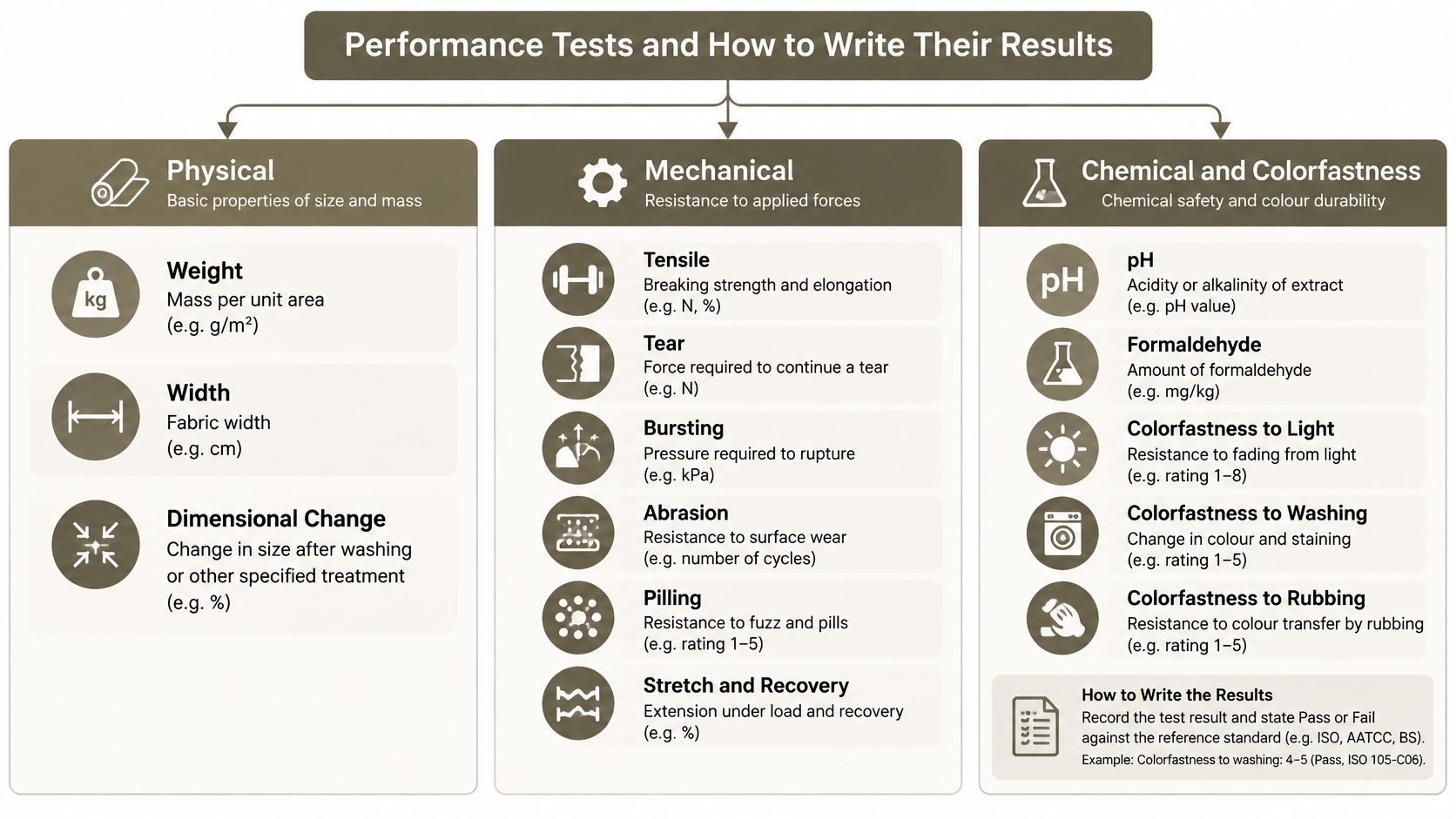
A production-ready sheet records fiber composition and measurable acceptance criteria on the same document, and the acceptance criteria need a method attached to each one.
| Property | Method | Direction or condition | Typical use |
|---|---|---|---|
| Tensile strength (grab) | ASTM D5034 | Warp and weft tested separately | Woven apparel and home textiles |
| Tear strength | ASTM D1424 (Elmendorf) | Warp and weft | Workwear and upholstery |
| Bursting strength | ASTM D3786 | Single result per method | Knit jersey and socks |
| Abrasion resistance | ASTM D4157 (Wyzenbeek) | Double rubs to end point | Upholstery and denim |
| Pilling | ASTM D4970 | Cycles per method | Knitwear and fleece |
| Stretch and recovery | ASTM D2594 | Direction that matters for garment seams | Elastic knits and stretch wovens |
| Colorfastness to washing | AATCC 61 | Staining and fading grade | Apparel |
| Colorfastness to rubbing | AATCC 8 | Wet and dry | Denim and dark colors |
| Dimensional change after laundering | ISO 3759 | Warp and weft, before and after wash | Woven and knit apparel |
What Makes a Result Reproducible
Five details turn a number into a result: the method number, the test direction, the conditioning, the sample size and the pass limit. Direction matters because warp and weft behave differently enough that reporting one figure hides the gap. A woven shirting might clear its tensile minimum in the warp and fail in the weft, and a sheet reading "tensile passed" buries exactly that finding.
Abrasion limits follow end use rather than a universal number. Take an upholstery programme where a decorative cushion is specified at 15,000 Wyzenbeek double rubs and a contract sofa at 30,000 or more. Neither figure needs defending in the document. It needs the method, the end point definition (visible yarn break or two broken threads, stated), and the name of whoever set the limit.
Where Vague Wording Costs Money
Stretch and recovery belong on the sheet in the direction that carries the seam load. A four-way stretch woven and a two-way stretch twill fail in different places, so "stretch 20%" without a direction is unbuildable.
Shrinkage is the field most often written as "low shrinkage". Nothing about that phrase is measurable. The ISO 3759 method defines preparation, marking and measurement of fabric before and after a specified washing, dry-cleaning, soaking or steaming treatment, which makes the specification reproducible instead of aspirational. Name the treatment and the cycle count on the sheet. Recycled polyester knits are a case in point: relaxation shrinkage in the course direction can exceed the wale direction, so the notes on recycled polyester sample shrinkage are worth reading before you set one symmetric limit and expect both directions to hold.
A test without method, direction and limit is a claim, not a result.
Tolerances, Pass Limits and Failure Handling
Every numerical line is one of three types, and the type has to be labelled or the mill will treat it as optional. A target is the aim, the number the mill should hit. A tolerance is the band around it, expressed as a percentage or an absolute figure. A mandatory limit is a pass or fail line that can't be waived without a documented deviation signed by the buyer.
| Attribute | Typical tolerance or limit | Type | Measurement note |
|---|---|---|---|
| Fabric weight (GSM) | ±5% | Tolerance | Measure on conditioned sample |
| Usable width | 148 cm minimum on a 150 cm spec | Mandatory limit | Exclude selvedges |
| Shrinkage, warp and weft | ±3% | Mandatory limit | Set per wash cycle on the care label |
| Shade difference (ΔE) | 1.0 or less within a lot | Tolerance | Lab-measured against approved standard |
| Tensile and tear | Minimum set by end use | Mandatory limit | Warp and weft separately |
| Roll defects | Four-point system per 100 linear yards, buyer limit | Mandatory limit | Use the defect scale in the sheet |
The Failure Sequence
When a roll fails, the sheet should already say what happens next, in order, so the decision doesn't get made by whoever answers the phone.
- Quarantine the affected roll or lot and mark it against the lot ID on the receiving record.
- Retest the same property in the same direction on retained samples, using the method named on the sheet.
- Classify each defect against the sheet's defect scale, not against a verbal impression of how bad it looks.
- Decide: reject, accept with a written deviation, or re-cut the roll for a smaller component.
- Log the corrective action against the lot number so the next delivery can be checked for the same fault.
Who decides: the mill documents a deviation, the buyer signs it, and the lot number goes on both. A mill that approves its own exception has just moved the risk onto your label.
Tolerance setting also has a cost side. A ±2% weight band on a single jersey will reject good production and raise the price, while ±8% lets through cloth that won't hit your yield calculation. The design for manufacturing guidance on trimming cost without loosening quality is useful here, because the right band is the tightest one the process can hold consistently, not the tightest one anyone can write down.
Finish, Color and Hand-Feel Standards
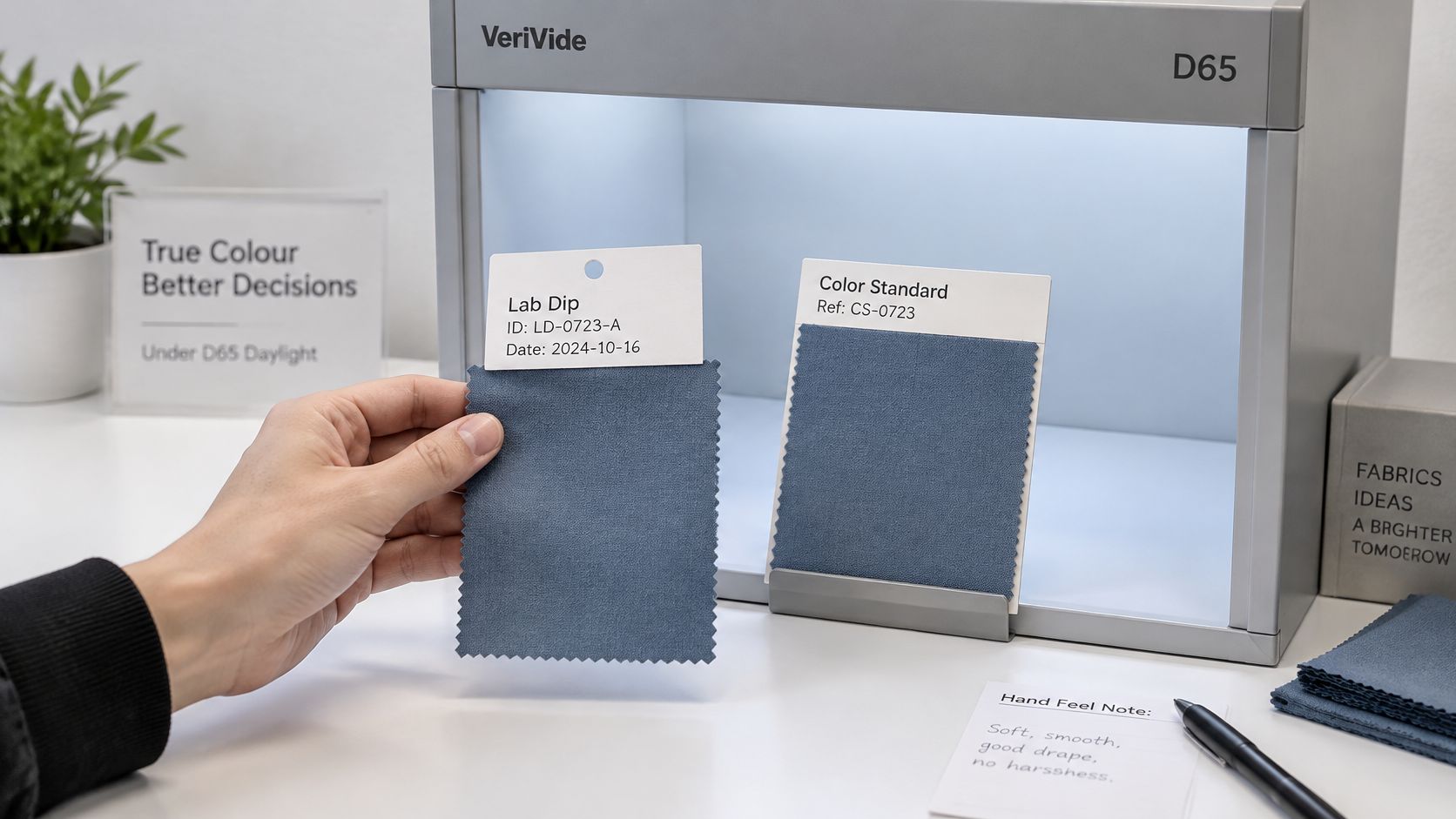
Color needs a controlled reference, never a name. "Navy" describes a family, not a shade. A physical lab dip or approved strike-off carries an ID (LD-2026-04), an approval date, and the light source used for assessment, typically D65 daylight, because a match under tungsten is a different judgment. Where the buyer works in a recognized system, add the Pantone TCX reference alongside the physical standard and state which one governs in a dispute. The physical dip should, since it's the object both parties signed off on.
Finishes With a Number Attached
List each finish with the performance it's meant to deliver, not just its name.
- Compressive pre-shrinking reduces residual shrinkage, so it pairs with the ±3% limit rather than standing alone as a process note.
- Softener and enzyme wash change hand and surface, so they need an approved swatch for comparison on arrival.
- Water repellency needs a spray rating plus a wash-cycle count, for instance survival of 20 home launderings before the rating drops.
- Brushing or peaching needs a surface description and a photo standard, because "soft peach" is not inspectable.
Then set the shade band: the ΔE allowed between rolls and between dye lots. Within-lot and across-lot limits are usually different numbers, and writing one figure for both invites an argument at receiving.
Hand feel gets a reference swatch number and a short description of stiffness or drape the buyer can check in the warehouse. Packaging belongs in the same block: core diameter, roll or fold format, roll length, and the label content on each roll. Keep the approved reference sample stored with the revision letter it matches, so a dispute two seasons later is settled against the same physical object rather than a memory.
Care Labels and Legal Fields Linked to Testing
The tested fabric and the printed care label are two documents describing one product, and the sheet is where they get joined. For products sold in the United States, the FTC's labeling guidance under the Textile and Wool Acts requires most covered textile products to disclose fiber content, country of origin and the identity of the responsible manufacturer, importer or marketer, with fiber names and percentages generally listed in descending order by weight. That's a legal field set, not a design preference, so it lives on the sheet beside the construction data.
Care instructions are a separate technical control. The FTC Care Labeling Rule requires manufacturers and importers to give regular-care instructions covering washing or dry-cleaning, and it allows compliant care symbols under ASTM guidance. The sheet should therefore record the wash method, water temperature, drying method, bleaching rule, ironing temperature and any professional-care limits the fabric can survive.
Linking Each Care Line to a Test Row
Every instruction on the label should point at a number on the sheet.
- Machine wash cold at 30°C points to the dimensional change result measured after that exact cycle, not after a generic wash.
- Do not bleach points to the colorfastness test that justified the restriction, usually a chlorine or oxygen bleach exposure with a shade change grade.
- Tumble dry low points to the shrinkage figure after the drying method, since shrinkage measured flat-dried and reported for tumble drying is a different claim.
- Dry clean only points to the solvent response, including any finish that a solvent would strip.
A care instruction with no test row behind it is an assumption wearing a label.
Destination markets change the list. Labelling, chemical, flammability and product-safety rules vary by country, so give the sheet a market column and a revision note whenever a rule changes. A garment sold into the US and the EU carries two compliance profiles on one specification.
Traceability and Chemical Evidence Records
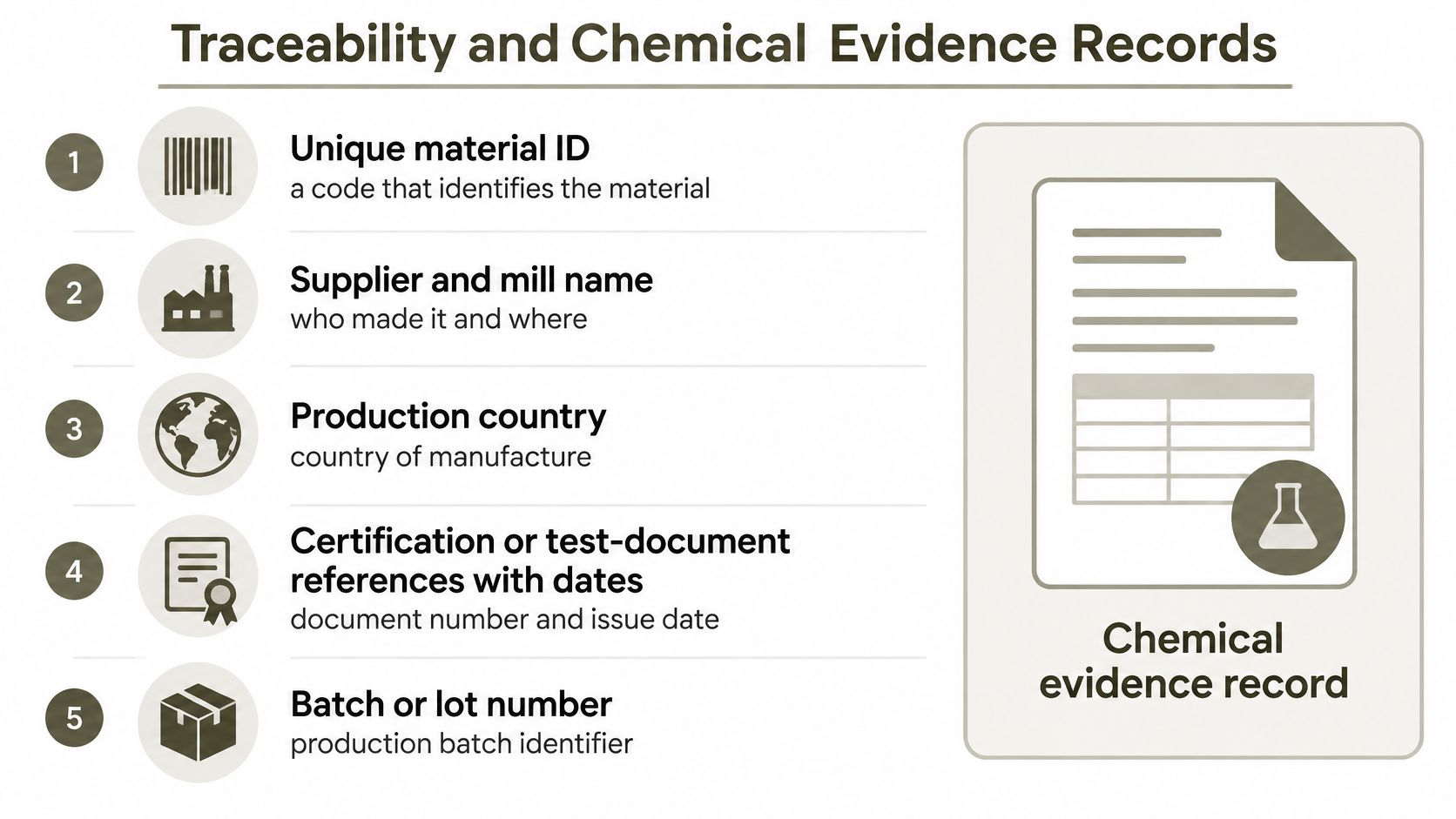
Construction data tells a factory how to build the cloth. A second layer tells a regulator, a retailer or an auditor where it came from. The EU Digital Product Passport framework for textiles is expected to connect product identity with fiber composition, recycled content, origin, substances of concern, durability, repairability, care instructions, end-of-life guidance and environmental information. Most specification sheets today can't support that, because they were never structured at material, supplier and lot level.
Four Evidence Types, Never Mixed
Tag every claim with what kind of evidence stands behind it. A measured result is your own lab report. A supplier declaration is a signed statement, useful but not proof. A third-party certification carries a certificate number, issuing body, lot covered and expiry date. An estimate is a planning figure and should be labelled as one.
A recycled polyester line reading "40% recycled" with nothing attached is a marketing sentence. The same line with a certificate number, issuer, covered lot and expiry date is a record. Adding more claims isn't automatically safer: an unsupported or non-machine-readable claim raises risk rather than lowering it, because someone downstream will eventually ask for the document.
Working rule: any claim without an attached record gets downgraded to an estimate or removed before the sheet is issued.
What a PFAS Line Should Actually Record
Chemical status is usually written as a yes or no. Testing has moved past that. CEN published EN 17681-1:2025 for PFAS analysis in textiles, replacing the 2022 method and adding alkaline hydrolysis with LC-MS/MS to improve detection of PFAS associated with side-chain fluorinated polymers. A declaration that predates that change may still be accurate under the old scope and misleading under the new one.
Separate intentionally added substances from restricted-substance screening, then record for each screen: the method and revision, the laboratory, the sample identity and date, the result with its detection limit, and which layer was tested, whether fabric, coating, membrane, thread, trim or finished garment. The question isn't "Is it PFAS-free?" It's "Free according to which definition, test method, layer and market requirement?" Keep superseded reports, flag the method change, and state plainly whether the old and new results are comparable.
Send a Complete Spec Sheet to Your Factory
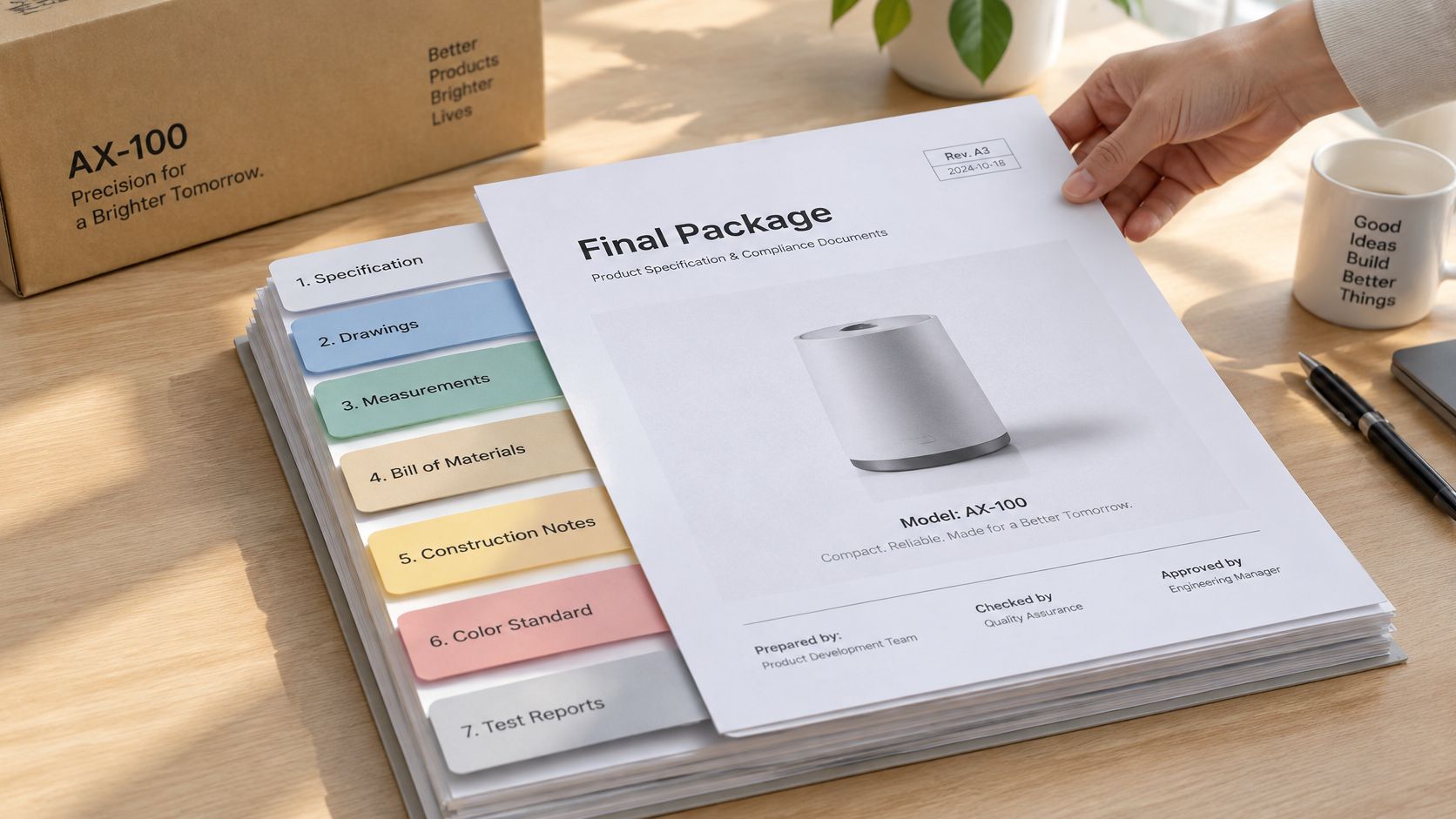
A fabric spec sheet controls what the factory builds only when each value can be checked against a defined method and record. Include it in the prototype package with its revision, drawings, dimensions, bill of materials (BOM), construction notes, color standard, lot-matched test reports, and care and label copy. If a field is blank or ambiguous, the factory has to interpret it, and different interpretations can produce different fabric.
The Sign-Off Sequence
- Check every field for a stated value, unit, tolerance type, and evidence record where applicable.
- Match test reports to the material and lot named on the sheet. A report for a similar fabric from an earlier season does not establish the current lot's result.
- Identify the color standard by sample ID and the light source under which it was approved.
- Review the package before quoting so comments and changes are tied to the same revision.
- Build the sample against the sheet. A photograph alone does not define measurable requirements.
- Measure the returned sample at each point of measure and compare the results with the specified values and tolerances.
Bulk orders depend on dye-lot shade control: the approved shade standard and lot records help determine whether fabric from separate lots can be used consistently in one run. For a related example of a high-volume product category, see bulk graduation stole ordering.
A quick preview of the video walkthrough of the packing and documentation stage:
Genpire's sample-making process has three steps: design review of the tech pack, material sourcing, and expert sample construction. Its tech packs include drawings, measurements, a BOM, and construction notes, and can be downloaded as XLS, SVG, or PDF files. Use the tech pack checklist before sending a package to a factory to check that the revision being quoted is the one you intend to approve.
One export line shows how to bring key requirements together:
Style 2026-SH-014 | Rev C | 65% polyester / 35% cotton | Plain weave | 135 g/m² ±5% | 150 cm usable, 148 cm minimum | LD-2026-04 approved under D65 | ASTM D5034 warp and weft, lot 26-0317, report dated 2026-03-12
Freeze the revision before requesting a prototype quote. When every factory quotes against the same specification, their proposals are easier to compare than quotes based on different interpretations of an email.
Genpire can take a sketch, reference, or existing sheet and generate a tech pack with measurements, a BOM, and construction notes. Export it as XLS, SVG, or PDF to share with a factory. Start at Genpire to prepare a factory-ready package.