The most popular advice about fashion product development starts with inspiration, trend forecasting, and a compelling sketch. That advice leaves out the part that causes most factory delays. A fashion product developer's real strength comes from specification clarity, disciplined approvals, and the ability to turn a creative direction into instructions a supplier can execute without guessing.
Apparel remains a long-cycle business in many major markets. McKinsey's reported apparel timelines show that hybrid players averaged 44 weeks end to end, vertically integrated players averaged 28 weeks, and sportswear companies averaged 75 weeks for the full go-to-market process. Those timelines make one point clear: the developer isn't only supporting design. They're controlling the handoffs that determine whether a style moves cleanly from concept to bulk production.
Table of Contents
- Redefining the Fashion Product Developer Role
- Core Responsibilities and Daily Workflows
- Mastering the Tech Pack and Specification Clarity
- Navigating the Sampling and Production Timeline
- Data Governance and Future Compliance Requirements
- Accelerating Workflows with AI Operating Systems
- Hiring and Structuring a Modern Product Team
Redefining the Fashion Product Developer Role
A fashion product developer is often described as the person who takes a design from sketch to production. That definition is accurate but incomplete. The job is less about moving a file through a workflow and more about removing ambiguity before ambiguity reaches the factory.
A designer may communicate silhouette, attitude, proportion, and visual references. A supplier needs measurable information. They need to know the fabric composition and weight, the seam construction, the stitch type, the placement of trims, the points of measure, the tolerance, the grading logic, and the acceptable result at inspection. If any of those decisions remain implied, the factory has to interpret them. Interpretation creates variation, and variation creates another sample, another approval cycle, or a production problem.
The translator between intent and execution
The strongest developers act as translators between three different realities:
- Creative intent: What the garment should look and feel like.
- Commercial constraints: What materials, construction methods, and quantities make sense for the product.
- Factory execution: What a supplier can produce consistently with its equipment, skills, capacity, and existing processes.
That bridge function requires judgment. A developer might preserve a distinctive sleeve shape while changing the internal construction, or recommend a different trim because the original component is difficult to source reliably. They might challenge a measurement that looks attractive in a drawing but would restrict movement in the finished garment.
This is also why market understanding still matters, but it should inform the technical brief rather than replace it. A resource such as product launch market research 2026 can help a team frame customer needs and launch context. The developer's responsibility begins when those inputs must become a product that can be sampled, costed, approved, and repeated.
Practical rule: If a factory can reasonably interpret a detail in two different ways, the tech pack hasn't finished doing its job.
The role therefore sits at the center of calendar planning, material decisions, technical documentation, fit approval, supplier communication, and production sequencing. Creative thinking remains essential, but the developer's professional value is measured by how reliably the team reaches a manufacturable, approved product without unnecessary rework.
Core Responsibilities and Daily Workflows
A fashion product developer's day rarely follows a clean sequence, and that unpredictability is part of the job. The developer may review a fit sample in the morning, resolve a zipper substitution before lunch, then reconcile a revised measurement chart with sourcing, design, and the factory. Each decision creates consequences elsewhere, so the role depends on keeping specifications, approvals, and ownership aligned.
The calendar provides the first control point. Development needs agreed milestones for the brief, material confirmation, proto sample, fit review, pre-production approval, and bulk readiness. These dates expose conflicts before they become urgent, particularly when several styles rely on the same fabric mill, trim supplier, pattern maker, or factory line. A delayed approval can become a sampling delay, then a production constraint.

What the developer handles in practice
Material and trim coordination involves more than requesting swatches. The developer checks whether the fabric supports the silhouette, whether the proposed finish is available, whether the trim works with the intended construction, and whether a substitution changes appearance, performance, or care requirements. Sourcing may manage supplier negotiations, but the developer must understand the manufacturing effect of each choice.
Daily work commonly includes:
- Calendar control: Tracking dependencies, approval gates, supplier commitments, and decisions that could move the critical path.
- Design translation: Converting sketches and references into flats, construction notes, measurements, and material requirements.
- Cost and feasibility review: Checking whether a proposed detail fits available materials, machinery, labor skills, and production capacity.
- Fit management: Preparing fitting comments, separating major fit corrections from cosmetic preferences, and recording which changes are approved.
- Supplier communication: Sending one clear revision, answering technical questions, and documenting decisions so the same issue does not return in the next sample.
- Production readiness: Confirming that the approved sample, measurements, materials, labeling, packaging, and quality expectations match before bulk work begins.
Managing the trade-offs
The developer balances design fidelity, speed, cost, quality, and manufacturability. These priorities often conflict. A complex pocket may support the visual identity while increasing construction risk. A premium fabric may create the intended drape but require another seam finish. A quick material substitution may protect the calendar while changing handfeel or appearance.
Good developers do not reject difficult ideas automatically. They identify the specific risk, present workable alternatives, and make the trade-off visible to the decision-maker. They also close the loop in the working record. An unresolved preference left in email can reappear as a different interpretation in the next sample, creating another round of comments and approvals.
Sampling speed depends heavily on specification clarity. A developer who catches an unsuitable fabric before pattern work starts protects more time than one who negotiates urgently after a failed sample arrives. The same discipline applies to measurement changes, trim substitutions, and compliance information. Each decision should have a clear owner, status, approved version, and operational effect, so the factory is working from current information rather than reconstructing intent from scattered messages.
Mastering the Tech Pack and Specification Clarity
Trend direction may start a product, but specification clarity determines whether a factory can build it consistently. The tech pack is the fashion product developer's central control document. It should operate as a factory blueprint, translating visual intent into measurable manufacturing instructions.
A supplier should be able to assess construction, identify missing information, quote the style, make a sample, and record revisions from the document. An attractive sketch paired with a fabric name does not provide enough control. Ambiguity at this stage becomes clarification emails, incorrect assumptions, and avoidable sample revisions later.
Build the document around decisions
A reliable tech pack usually includes these technical layers:
- Flat sketches: Show front, back, side, and detail views where needed. The flat should expose seams, panels, openings, pockets, topstitching, closures, and placement details that a fashion illustration may conceal.
- Bill of materials: List the main fabric, lining, interlinings, trims, labels, thread, closures, packaging components, and material-specific requirements.
- Points of measure: Define exactly where each measurement begins and ends. A chest measurement has little value if the factory and brand use different reference points.
- Grade rules: Explain how the garment changes between sizes. Grading should reflect the intended fit rather than apply an automatic increment to every measurement.
- Construction methods: Specify seam types, seam allowances, stitch requirements, finishing, pressing, reinforcement, and assembly order wherever sequence affects quality.
- Revision history: Record what changed, why it changed, who approved it, and which version the supplier must use.
The Shopify guide to creating a tech pack describes the document as a manufacturing blueprint with flat sketches, a bill of materials, points of measure, grade rules, construction methods, and revision information. These layers let the supplier assess manufacturability against explicit specifications instead of interpreting a visual concept alone.
Make fit comments actionable
“Make it more fitted” is not a technical instruction. A useful comment identifies the location, the desired change, the affected measurement, and the approval consequence. For example, state that the side seam should move inward at the waist, name the relevant point of measure, and specify whether the adjustment applies to every size or only the base size.
The same discipline applies to materials. “Use a softer fabric” leaves the supplier to define softness. State the required handfeel, weight range, stretch behavior, finish, and approved substitute criteria. This preserves room for factory judgment while setting a controlled decision boundary.
A practical garment spec reference for swag can help teams compare how technical garment information is organized. For a broader explanation of the document's role, see this tech pack guide. The software matters less than the operating rule: one approved source, one visible revision history, and no production instruction stored only in an email thread.
A specification should also distinguish approved decisions from open questions. Mark each item with an owner, status, affected component, and required action. Store the latest measurement chart, artwork, material detail, and construction note together, with clear version control. Otherwise, a factory may combine a current sketch with an outdated trim instruction or an earlier measurement chart.
The cheapest sample is the one you do not have to remake because the first brief was precise.
Precise documentation cannot remove every physical check. It can prevent avoidable revision loops, shorten clarification cycles, and give the factory a defensible record of what was approved. That is the practical value of a tech pack: it turns creative decisions into controlled manufacturing data.
Navigating the Sampling and Production Timeline
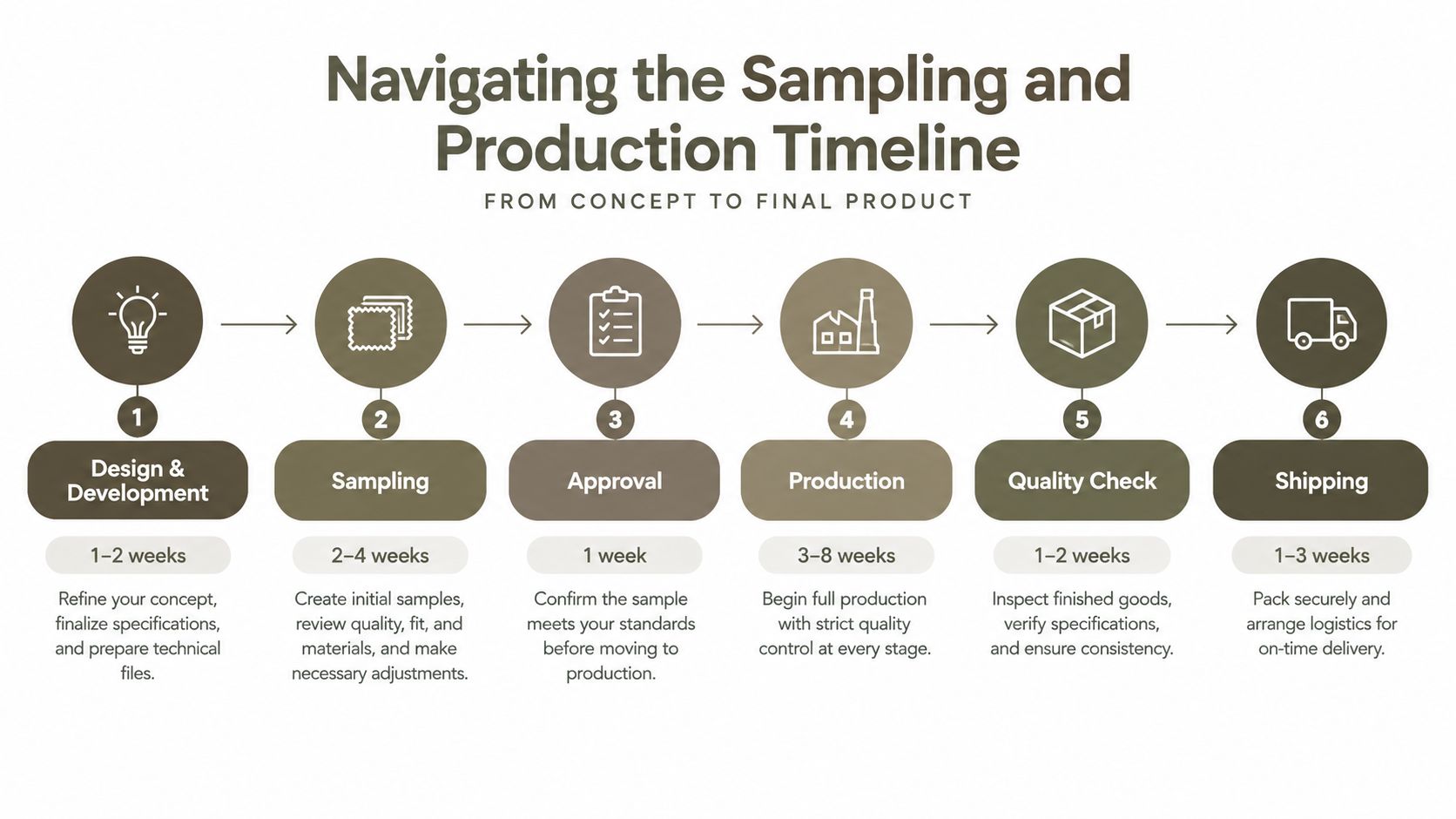
The bottleneck in fashion development is rarely a lack of ideas. It is unclear specification, repeated sampling, and decisions that arrive too late for the factory to act on them. A garment moves from concept to bulk production through controlled physical checkpoints, and each checkpoint should answer a different question. The product developer keeps the team from reopening every question at every stage.
The process begins with a concept brief and technical direction. Before requesting a proto, confirm that the silhouette, base measurements, construction intent, material assumptions, and required components are clear enough to test. A proto can expose proportion and construction problems, but it should not carry the burden of finalizing every production detail.
Give each sample a decision
A practical sequence is staged:
- Proto sample: Confirms that the factory can interpret and assemble the design. Review silhouette, major construction, and the relationship between pattern and material.
- Fit sample: Tests measurements, balance, comfort, mobility, and proportion on the intended fit model. Record corrections by location, severity, and owner.
- Pre-production sample: Confirms approved materials, trims, construction, labeling, finishing, and size logic before bulk cutting.
- Top-of-production sample: Checks whether the production line reproduces the approved standard after bulk manufacturing begins.
A sample without a decision is an expensive object moving between offices. Close every review with approved changes, rejected changes, unresolved questions, responsible owners, and the exact file version governing the next action. That record prevents a factory from applying a verbal correction to one sample while production follows another standard.
Protect the critical path
Cross-border development can lose weeks to fabric lead times, customs, and shipping, even when the factory completes its own sample work on schedule. The risk increases when fabric ordering waits for sample approval or a trim decision remains open while other tasks continue.
Separate work that can run in parallel from work that requires a gate. Material testing, supplier questions, label artwork, and preliminary costing can progress during sample review. Bulk approval must remain tied to the agreed technical standard. A fast review is useful only when the next approved action is clear.
Traditional apparel development has often taken 6 to 9 months, with a first run requiring 20 to 32 weeks, while fast-fashion models have operated on 6 to 10-week lead times, according to this industry overview of fashion product development. These figures represent different operating models, not a universal promise. They show that speed comes from sequencing, material readiness, decision authority, and fewer avoidable loops, rather than just asking a factory to work faster.
For a detailed map of the journey, see this fashion production timeline from sketch to first sample. At every gate, ask: what uncertainty is this sample meant to remove, and who has authority to approve the answer?
Data Governance and Future Compliance Requirements
A product developer now has responsibilities that extend beyond the physical garment. The style file must increasingly support sourcing decisions, supplier communication, quality control, product information, and traceability. A beautiful sample with incomplete provenance data is not a finished product record.
Regulatory transparency, digital product passports, material scrutiny, and supply-chain volatility are pushing brands to capture product information earlier. The challenge is that many teams still keep that information in separate spreadsheets, emails, CAD files, supplier portals, and local folders. When the data is scattered, nobody can confidently answer which material was approved, where it came from, which supplier made the component, or which revision reached production.
Capture the evidence at concept stage
The most useful data fields are the ones that support both manufacture and later verification:
- Material identity: Fiber composition, fabric construction, finish, color, and approved alternatives.
- Component origin: Supplier, mill or trim source where available, certifications, and supporting documentation.
- Construction record: Assembly methods, finishing details, testing requirements, and quality checkpoints.
- Size and fit logic: Base size, points of measure, tolerances, grading rules, and approved fit comments.
- Supplier accountability: Factory identity, production location, responsible contacts, and the version of the technical pack used.
- Change history: The reason for each material, construction, or measurement change and the person who approved it.
This is not a request to turn designers into compliance specialists. It is a recognition that the developer is already closest to the decisions that create the product's operational identity. If those decisions aren't captured when made, reconstructing them later is slow and unreliable.
Treat governance as part of development
Data governance doesn't mean adding paperwork after the creative work is complete. It means defining ownership, naming conventions, approval states, and required fields before a style advances. A supplier should never receive a file whose status is unclear, and a developer shouldn't have to compare several attachments to determine which measurement chart is current.
The skills gap makes this harder. Teams may have strong creative talent but uneven technical documentation habits, while digital tools vary between departments. Recent industry analysis highlights fragmented workflows, skills shortages, regulatory pressure, and scattered product data as connected challenges rather than isolated problems. It also reports that generative AI adoption among fashion executives has passed 35 percent in areas including customer service, image creation, and product discovery, but that adoption doesn't solve data governance by itself. See the Lectra Observatory analysis for that broader context.
The modern fashion product developer should therefore ask two questions at the start of a style: Can the factory make this consistently? Can the brand prove what this product is and how it was made?
Accelerating Workflows with AI Operating Systems
AI is useful in product development when it removes clerical friction without hiding technical decisions. It isn't useful when it produces attractive images that a factory can't interpret, or when a team treats generated output as approved specification.
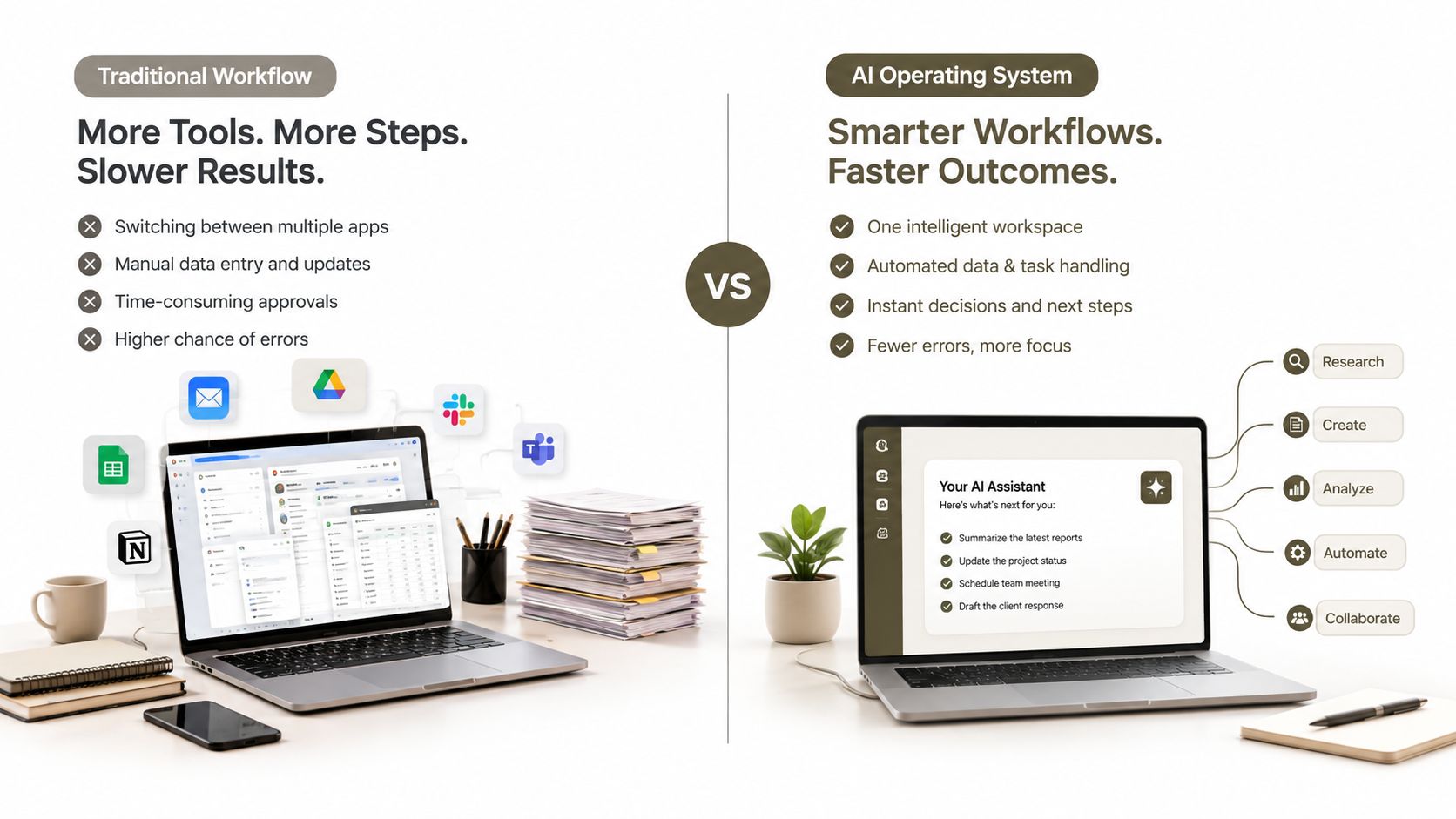
The traditional workflow usually breaks context into separate tools. A designer works in a concept or CAD environment, a technical designer prepares specifications, sourcing requests quotations, an agency manages revisions, and the supplier responds through email. Each handoff creates another opportunity for an outdated file, missing comment, or unrecorded decision to enter the process.
A unified operating system changes the question from “Which file should I send next?” to “Which approved product record does every contributor use?” The difference is operational, not cosmetic.
Compare the two working models
| Fragmented workflow | Unified AI workflow |
|---|---|
| Concepts, flats, specs, and comments sit in separate locations. | Concepts and technical outputs remain connected to the same style record. |
| A supplier receives a file and asks follow-up questions through email. | The supplier can comment against the relevant product information. |
| Revisions depend on manual updates across documents. | AI-assisted edits can update the working direction while the developer retains approval control. |
| Marketing visuals are created after technical work, often from a different reference. | Product concepts, virtual try-on views, and launch assets can draw from a shared direction. |
Prompt-based creation is valuable at the front of the process because it lets a team explore silhouettes, materials, and color directions quickly. An AI editor becomes more useful when the developer can revise a sleeve, closure, material, or proportion without rebuilding every view manually. Brand DNA, stored palettes, references, and moodboards can also reduce drift between separate concepts.
The technical test is stricter. A generated visual must lead to construction details, component breakdowns, measurements, and revision control. Virtual try-on can help a team evaluate visual direction before committing to physical work, but it doesn't replace tactile inspection, fit validation, or production sign-off for every category.
Adopt tools around the bottleneck
The right adoption sequence starts with the failure that costs the team the most time. If the problem is unclear tech packs, prioritize structured specifications and supplier comments. If the problem is concept volume, use prompt-based generation and editable references. If the problem is version drift, centralize the style record before adding more automation.
A platform such as Genpire brings concepting, technical packs, supplier collaboration, and production assets into a connected workflow, with exports including SVG, PDF, and Excel. Its relevance depends on whether the team needs that combination and whether its review process preserves human approval at the technical gates. The AI product development workflow guide provides additional context on using AI across these stages.
The developer should approve the specification, not outsource accountability to the generator.
What doesn't work is adopting AI as a separate image-making layer while leaving measurements, BOMs, supplier questions, and revisions in disconnected files. That setup may increase visual output while preserving the original bottleneck. A stronger operating model connects the creative prompt to the technical record, then gives the developer a clear place to inspect, correct, approve, and communicate the result.
Hiring and Structuring a Modern Product Team
A modern product team shouldn't hire primarily for the ability to produce beautiful sketches. Sketching matters, but the more revealing test is whether a candidate can explain how a design becomes a repeatable garment.
Ask candidates to review a deliberately incomplete tech pack. Can they identify the missing points of measure, unclear construction, material risk, and approval dependency? Can they turn vague fit comments into actionable corrections? Can they challenge a design respectfully when the proposed fabric, trim, or assembly method creates a production problem?
Assess the skills that protect the calendar
A strong fashion product developer usually demonstrates:
- Technical judgment: They understand patterns, construction, fit, materials, tolerances, and quality expectations.
- Supplier fluency: They can ask a factory precise questions and recognize when an answer creates a downstream risk.
- Commercial awareness: They can discuss feasibility and cost trade-offs without reducing every decision to the cheapest option.
- Documentation discipline: They maintain revision history and treat the approved tech pack as a controlled record.
- Decision management: They know which issue needs immediate escalation and which can wait for the next gate.
- Digital adaptability: They can use CAD, PLM, digital sampling, structured workspaces, and AI-assisted tools without confusing speed with approval.
The team structure should place product development close to design, sourcing, and production rather than burying it between departments. Designers need early technical feedback. Sourcing needs material and supplier decisions before they become urgent. Marketing needs accurate product attributes and visuals that match the approved garment.
Build around ownership
Assign one person ownership of each critical decision. The developer may own the technical pack and sample comments, sourcing may own supplier terms and material availability, design may own the creative direction, and production may own line readiness and quality execution. Shared collaboration is valuable, but shared accountability often means nobody can close an issue.
Start with a simple operating rhythm. Review the calendar and open risks regularly, hold fit sessions with written comments, maintain a single approved product record, and require a clear decision at every sample gate. The best team isn't the one with the most software or the largest creative department. It's the one that turns good ideas into clear instructions before the factory has to guess.
Genpire offers an AI-driven workflow for turning prompts, sketches, and references into product concepts, technical specifications, tech packs, and production assets, with supplier collaboration built into the process. If specification clarity and version control are slowing your development calendar, visit Genpire to assess whether a connected workflow fits your team.