You've probably lived through this launch. A designer sends a tech pack, sourcing rebuilds the bill of materials in a spreadsheet, the factory responds in a chat thread, and a sample arrives based on a version nobody can identify. The product may be good, but the process has become a relay of files, messages, and memory.
Integrated product development replaces that relay with a continuous workflow. Concept decisions, specifications, supplier communication, sampling, approvals, and production data stay connected as the product moves forward. The point is not to use newer software. It's to reduce the measurable cost of every handoff, so teams can move from concept to factory-ready output in days instead of allowing disconnected steps to stretch across weeks.
Table of Contents
- The Handoff Problem in Modern Product Development
- What Integrated Product Development Actually Means
- The Five Stages of an Integrated Workflow
- What Integration Really Changes in Speed and Cost
- How an End-to-End Platform Connects the Stages
- KPIs That Tell You Integration Is Working
- Common Misconceptions and Pitfalls to Avoid
The Handoff Problem in Modern Product Development
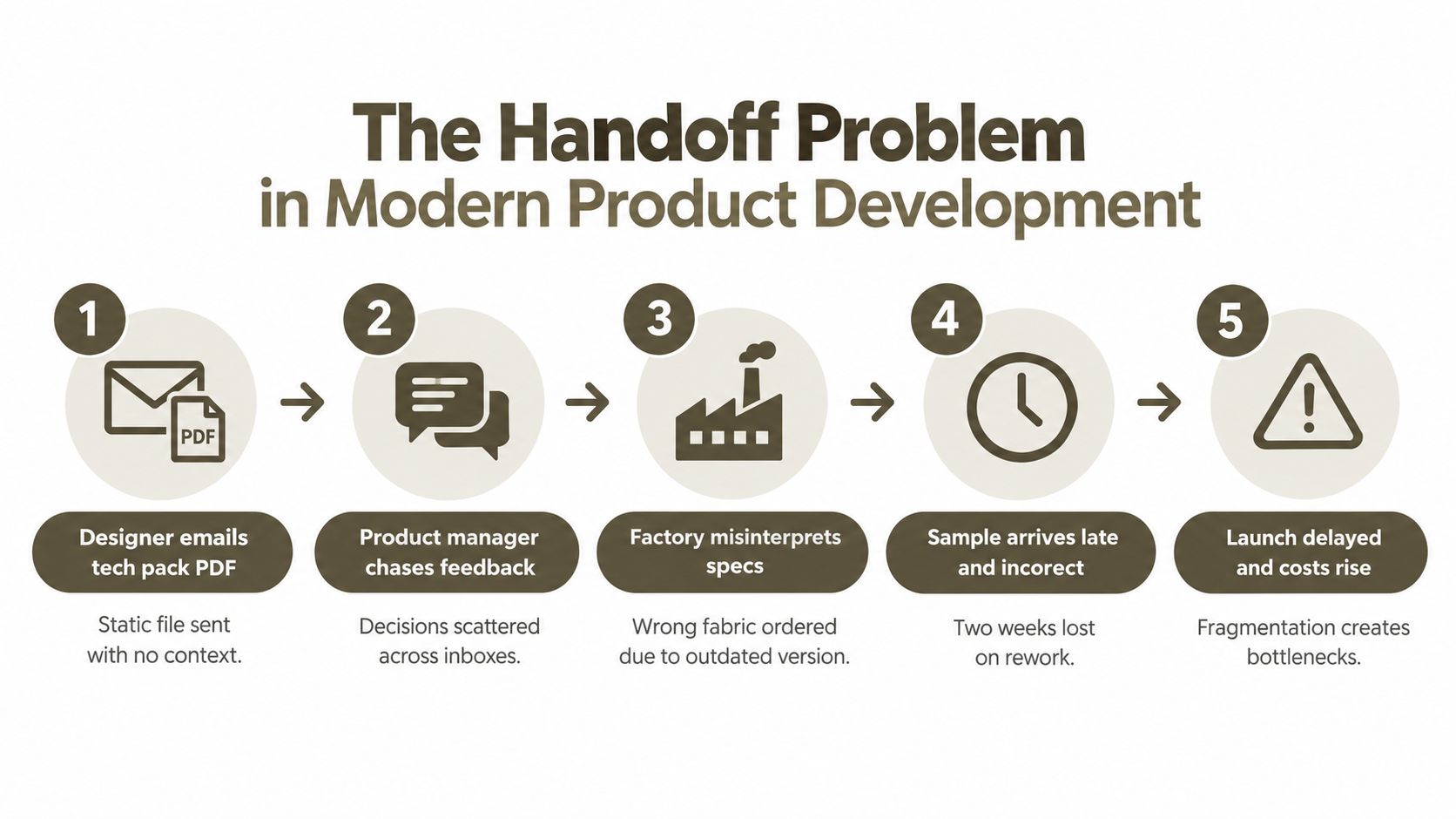
At 9:12 on a Tuesday morning, an apparel designer emails a PDF tech pack for a new overshirt. The document contains sketches, measurements, construction notes, and a preliminary material list. The sourcing manager downloads it, opens Excel, and retypes the BOM so factories can quote the style.
By late morning, the product manager has added comments to the email thread. The designer has marked up a separate PDF. A factory merchandiser replies through WhatsApp with a question about the pocket fabric and sends a photograph of a redlined page. One supplier is working from the first PDF, another has the marked-up version, and the sourcing manager's spreadsheet contains a material substitution that no one else has seen.
Where the time disappears
The lost time rarely appears as one obvious failure. It accumulates in small pauses:
- Re-entering information: The sourcing manager copies specifications from a PDF into a spreadsheet, creating another opportunity for a typo or omission.
- Searching for decisions: The product manager checks inboxes and chat messages to determine whether the designer approved the fabric change.
- Reconciling versions: The factory compares attachments and asks which measurement table is current.
- Repeating RFQs: Sourcing delays quote requests because the BOM and construction details don't agree.
- Reworking samples: The factory makes a sample from an outdated instruction, and the team spends another review cycle correcting preventable errors.
Practical rule: If a person has to copy product data from one system into another, treat that copy as a handoff cost, not as harmless administration.
Why this remains the default
Many teams call their process collaborative because they share a folder or keep everyone on the same email chain. That arrangement still separates ownership. Design finishes its work, then passes a file to sourcing. Sourcing passes a revised file to a supplier. The factory sends feedback back through a different channel.
The communication playbook by Grumspot is useful for improving stakeholder updates, but communication discipline alone can't repair disconnected product records. Teams also need a shared place where the approved specification, open questions, revisions, and decisions remain attached to the product.
That's the distinction between more communication and better integration. A team can exchange messages all day and still lose the context behind a change. Genpire's guidance on team collaboration in AI product design reflects the operational requirement: people need to collaborate around the same product information, not merely discuss the same product in separate channels.
What Integrated Product Development Actually Means
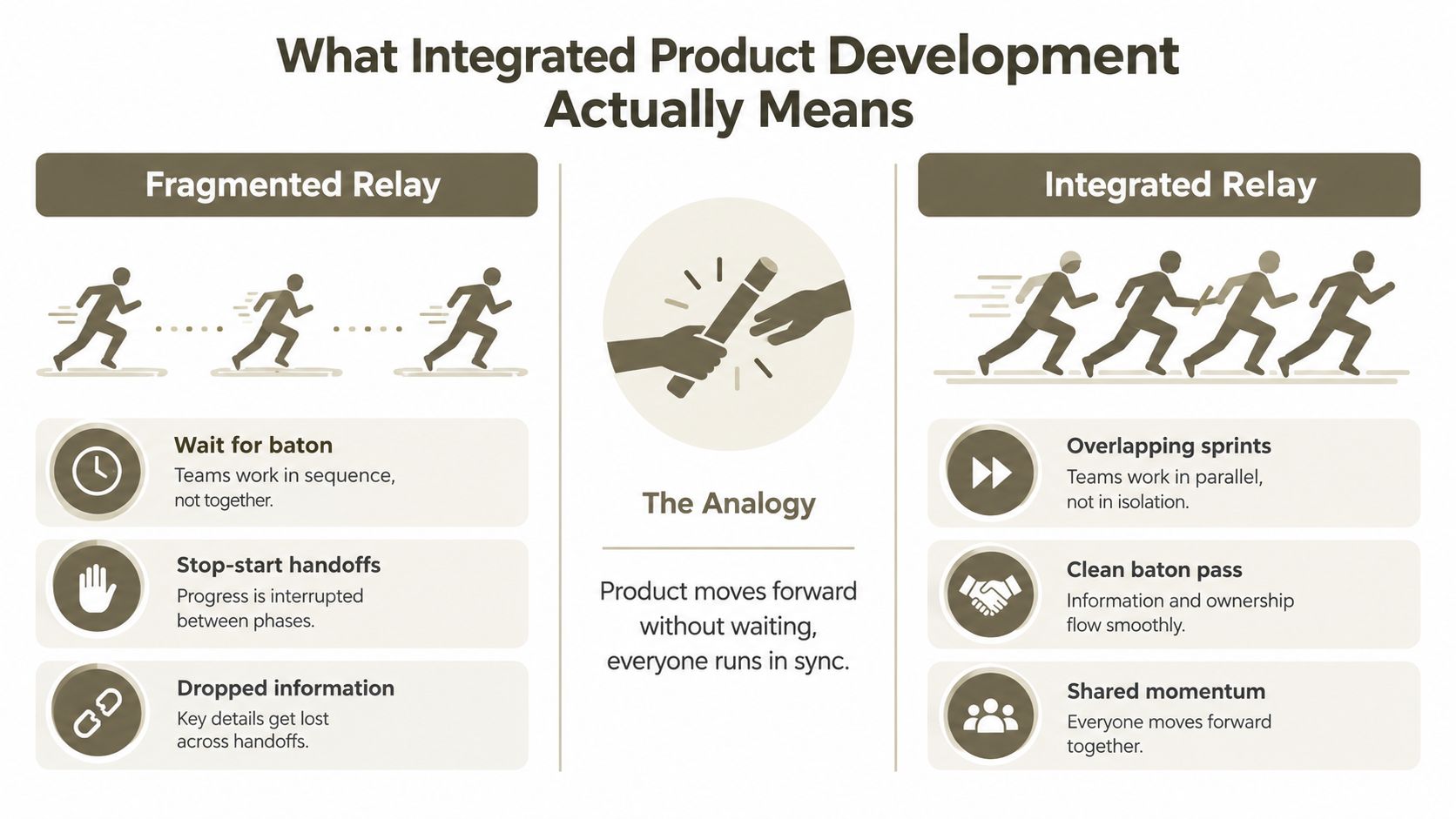
A relay race is a useful picture of serial product development. One runner completes a segment, stops, and hands the baton to the next runner. The second runner can't act until the first runner finishes, and a poor handoff costs momentum or drops information.
Integrated product development works more like an orchestra reading from a shared score. The designer, technical designer, sourcing manager, supplier, and production team still have different responsibilities, but they work from connected information and can respond to changes while the product is developing.
The product record is the thread
Take one garment's specification sheet. In a serial process, the designer creates it, the technical designer reformats it, sourcing copies selected fields into an RFQ, and the factory interprets a PDF during sampling. Each transfer can separate a measurement from its construction note, or a material choice from the reason it was selected.
In an integrated workflow, the underlying product record carries:
- Design intent, including references, silhouette, color, and material direction.
- Technical data, including measurements, tolerances, construction details, and components.
- Commercial inputs, including target cost, supplier questions, and quote responses.
- Development history, including sample comments, approvals, rejected alternatives, and revisions.
- Production requirements, including the approved specification, quality checks, and shipment information.
The file format may change when a team exports a PDF, Excel workbook, or factory document. The important point is that the data object stays connected underneath. People aren't rebuilding the product every time it crosses a functional boundary.
Integration is not the same as parallel work
Parallel work doesn't mean everyone edits everything at once. That would create its own confusion. Integration means each function sees the information it needs, understands what changed, and knows which decision is approved.
A sourcing manager can begin supplier research before every creative detail is final, while the designer continues refining the silhouette. A factory can flag an unworkable seam during specification development instead of waiting for the first physical sample. The product advances through overlapping decisions, with controls around ownership, approvals, and revision history.
That structure grew from concurrent engineering, which U.S. industry adopted in the 1980s in response to global economic pressure. Manufacturing handbooks later formalized the use of phased, parallel release so production preparation could be ready when design was released. The historical record from the Software Engineering Institute shows why this matters: integrated work moves decisions earlier, when changes are generally easier to absorb and downstream surprises are less likely.
The Five Stages of an Integrated Workflow
A continuous workflow doesn't remove stages. It connects them. The same product data becomes more detailed as the team moves from an idea to a production commitment.
1. Concepting
A designer starts with a brief containing reference images, fabric direction, color intent, target customer, and target cost. Instead of storing those inputs across a moodboard, an email, and a separate planning document, the team keeps them together.
For a lightweight overshirt, the brief might identify the desired drape, pocket shape, closure, and finish. Sourcing can review material feasibility while the designer is still shaping the concept. That early conversation is more useful than a late rejection because it changes the design before technical work hardens around it.
2. Technical specification
The team turns the concept into a structured tech pack. Measurements, BOM items, construction notes, artwork, and quality requirements are written once and reused downstream.
Teams often mistake documentation for integration. A polished PDF can still be a dead end if someone must manually recreate its contents for an RFQ. Integration keeps the structured information available, while exports remain available for partners who need familiar formats.
For broader lifecycle context, a CPG product life cycle marketing guide can help teams connect development decisions with later launch and market activity.
3. RFQ and supplier alignment
The same specification is sent to qualified factories. Supplier questions attach to the relevant component or construction detail, and quote responses can be compared without rebuilding the request for every recipient.
If one factory proposes a different fusible or stitch method, the team can evaluate that change against the original product intent. The decision becomes part of the record instead of disappearing into a private message.
4. Sampling
Prototype feedback stays attached to the style. Fit notes, photographs, measurements, and approval comments follow the revision they describe.
That arrangement lets the technical designer distinguish a new design direction from a correction to the existing sample. It also gives the factory a clearer instruction set, because the latest approved change doesn't have to be inferred from a chain of unrelated attachments.
5. Production
Once the sample is approved, its data informs the purchase order, quality checkpoints, component requirements, and shipment planning. The production team shouldn't have to ask which version of the BOM was approved or manually compare the PO with a separate tech pack.
The idea-to-factory roadmap offers a practical way to think about this progression. The underlying principle is simple: the product record travels, not just the document.
What Integration Really Changes in Speed and Cost
Integrated product development changes the calendar by reducing waiting, re-entry, and correction. It doesn't make every product development task instant, and it won't remove decisions that require testing or supplier negotiation. It does reduce the time teams spend reconstructing information that already exists.
Historical evidence gives the pattern useful scale. One concurrent engineering example reduced a six-step sequential process from 15 weeks to 9 weeks, a 40% reduction, while Boeing's 777 program was delivered 40% faster than comparable earlier aircraft programs, as summarized by User Solutions' concurrent engineering overview. A research-based estimate also reported that concurrent engineering could reduce total system cost by almost half and reduce development lead time from 650 months to 540 months, an improvement of about 20%, although the figures illustrate a historical model rather than a promise for every brand. The same research summary reports development-time reductions from 30% to 70%, engineering changes down by 65% to 95%, and time-to-market improvements from 20% to 90% across broader literature, so results depend heavily on product complexity and implementation.
Compare the operating pattern
| Metric | Traditional, serial handoffs | Integrated workflow |
|---|---|---|
| Calendar time | Each function waits for the previous deliverable | Functions overlap around connected information |
| Rework cost | Errors surface after data has been copied or reinterpreted | Issues can be identified closer to the original decision |
| Sample development | Feedback moves through separate files and messages | Feedback remains attached to the product revision |
| RFQ preparation | Sourcing may rebuild information for each request | Structured product data supports repeatable requests |
| Approval control | Teams debate which attachment is current | A revision history identifies the approved state |
A modeling study cited by Eindhoven University of Technology found that conceptual design expanded from 3% to 33% of total effort in concurrent models, yet aggregate development time still fell by about 50% because later delays were reduced. That's an important correction to the idea that integration merely makes the front of the process busier. Teams may spend more attention early, but they avoid pushing unresolved decisions into sampling and production.
Rework remains the pressure point. Research on design rework found that the discovery window can span one-quarter to three-quarters of the original scheduled design effort, making revision tracking, interface control, and freeze milestones essential. Measure your own approval-cycle duration, number of sample rounds, revision count, and PO corrections. Those figures reveal where integration is creating value more reliably than a general claim that the process feels faster.
How an End-to-End Platform Connects the Stages
An end-to-end platform changes the team's working environment from a collection of destinations into one connected product workspace. The designer doesn't finish in one application and then ask sourcing to start over somewhere else. Each stage adds information to the same product record.
Genpire is one example of this model. Its workflow connects concept creation, technical specifications, supplier collaboration, sampling, and production assets. A concept brief can populate structured tech-pack fields. The tech pack can support an RFQ. Supplier responses can feed a sample tracker, and sample approval can carry the accepted details into production specifications.
Passing state instead of passing files
A file answers, “What did someone export?” A product state answers more useful questions:
- Which version is approved?
- Which components changed?
- Who needs to review the change?
- What supplier response influenced the decision?
- Which sample comments remain open?
- What production information depends on this approval?
That distinction matters when a sourcing manager in New York and a factory merchandiser in Hanoi work on the same style. They should see the same BOM, the same comments, and the same status at the same moment, subject to their permissions. They shouldn't have to decide whether a chat attachment supersedes an email PDF.
The practical connection points
A connected workflow typically needs four controls:
- Structured inputs: Concepts, measurements, materials, and construction details use consistent fields rather than only free-form documents.
- Contextual communication: Comments attach to a style, component, image, or revision.
- Approval states: The system distinguishes draft, review, rejected, and approved information.
- Traceable changes: Users can see what changed and understand which downstream work may be affected.
A platform still needs clear operating rules. If a designer changes a measurement without recording the reason, or a supplier continues using an offline spreadsheet, the digital thread breaks even when the software is connected.
Teams evaluating the procurement layer may also benefit from guidance on streamlining procurement with AI and ERP, particularly when product decisions must connect with purchasing and enterprise systems.
Genpire's end-to-end product development solutions are designed around this connected flow, with outputs that can support downstream manufacturing needs. The mental model is the key change: you're no longer passing files between departments. You're passing the current state of the product.
KPIs That Tell You Integration Is Working
A platform launch doesn't prove integration. The workflow is integrated only when people can move information forward without rebuilding it, and when managers can identify where the process stalls.
Track the six signals that expose leakage
- Concept approval to tech-pack release: Set an internal target that fits your team's capacity, such as release within five business days. If the cycle slips, review whether briefs lack required inputs or whether technical designers are waiting for decisions.
- RFQ response cycle: A qualified supplier request should have a defined response expectation, such as 72 hours. When responses arrive late, audit the completeness of the request, supplier access, and the clarity of quote requirements.
- Sample rounds per style: A practical target is 2.5 or fewer rounds per style. If the number rises, compare the first sample against the original brief and identify whether fit, material, construction, or communication caused the correction.
- First-pass bulk acceptance: Track whether production passes the first quality review, with a target above 90% where that level is appropriate to your product and inspection method. A weak result calls for a review of approved sample data, tolerances, and factory quality checkpoints.
- Tech-pack revisions: Keep a visible count, with an operating target below 3 revisions. More revisions may indicate unstable briefs, late supplier input, or unclear approval authority.
- PO accuracy at goods receipt: A target above 98% can expose whether approved product data reaches purchasing and receiving. If accuracy falls, compare the PO with the final approved BOM and investigate manual edits.
Don't treat thresholds as universal laws. Use them as diagnostic triggers. The value comes from connecting a missed KPI to a specific audit, rather than blaming the team for a number that lacks context.
Integration is working when a missed target points to a visible process failure, not a mystery hidden in someone's inbox.
Common Misconceptions and Pitfalls to Avoid
Buying software is the easiest part of integration. The difficult work is deciding who owns data, how suppliers participate, and which event changes the official product state.
Myth one, a shared folder is an integrated workflow
A folder can store files, but it doesn't automatically connect a measurement change to an RFQ, sample comment, or purchase order. If staff still rename PDFs, email approvals, and maintain private spreadsheets, the folder has become a larger silo.
Myth two, buying a PLM covers the entire lifecycle
A PLM system may manage important product information without supporting creative concepting, supplier quoting, sample feedback, or production coordination in the way your team works. Map the complete path before choosing a system. Identify where data enters, where it gets retyped, and where external partners lose access.
Myth three, factories should join only at sampling
Late factory involvement turns manufacturing knowledge into a correction mechanism. Suppliers can flag material availability, construction difficulty, and process constraints earlier, when the team still has room to adjust the design.
Myth four, integration suppresses creative iteration
Good integration doesn't freeze ideas prematurely. It separates exploratory versions from approved versions, so designers can experiment without confusing the factory about what to make. Creative freedom improves when the team can trace which direction is active.
Myth five, KPIs will fix themselves after launch
They won't. A platform can record a slow approval cycle just as accurately as a fast one. Leaders must review the workflow, remove unnecessary gates, onboard suppliers, and enforce the rule that decisions belong in the product record.
Use this short self-audit:
- Data ownership: Is one named person accountable for each core field?
- Supplier onboarding: Can factories access and comment on the information they need?
- Version control: Can anyone identify the approved revision without asking in chat?
- Feedback loops: Do sample comments remain attached to the style and its revision?
- Production continuity: Does the approved sample drive the BOM, PO, and quality checks?
Teams report measurable improvements only after these operating habits change. Integration is a management design problem supported by technology, not a software installation disguised as transformation.
If your team is losing time between concept, tech packs, RFQs, sampling, and production, Genpire provides a connected workspace for turning product ideas into structured specifications and manufacturing assets. Visit Genpire to see how an end-to-end workflow can reduce handoff friction and give your design, sourcing, and factory partners one product record to work from.