Most sourcing advice starts with a factory list. That's backwards. The first question shouldn't be, “Which manufacturers of garments can produce this?” It should be, “Have I given a capable manufacturer enough information to produce it correctly?”
A factory can't sew an intention. It can sew a pattern, follow a measurement chart, source an approved material, and interpret construction instructions. If those inputs are vague, fragmented, or contradictory, even a strong production partner will make assumptions. Those assumptions become sample revisions, missed approvals, inconsistent fits, and expensive delays.
The best sourcing strategy therefore begins before the first request for quotation. It begins with a specification package that makes your product unmistakable.
Table of Contents
- Why Your Tech Pack Dictates Your Factory Success
- Building Factory-Ready Specifications with AI
- Navigating the Global Apparel Sourcing Landscape
- Vetting Capabilities and Negotiating Terms
- Mastering the Sampling and Quality Control Workflow
- Red Flags and Transitioning to Bulk Production
Why Your Tech Pack Dictates Your Factory Success
Brands often blame a manufacturer when the first sample comes back wrong. Sometimes the factory is at fault. More often, the factory has been asked to resolve unanswered questions that should have been settled by the brand.
A sketch may show a relaxed sleeve, but not define the sleeve opening, armhole shape, seam allowance, or relationship between the sleeve and body measurements. A fabric reference may show a brushed surface, but omit composition, weight, stretch direction, recovery, finishing, or acceptable substitutions. A zipper may appear in an image without a supplier reference, size, finish, tape color, or puller specification.
Those omissions create room for interpretation. Different people then work from different versions of the same design. The pattern maker follows one file, the sourcing manager emails another reference, and the factory's sample room makes a reasonable decision that the brand later rejects.
Practical rule: If a factory must ask what you meant, the tech pack is not finished.
Treat the document as a production contract
A factory-ready tech pack should function as the operational reference for design, pattern making, sampling, costing, and bulk production. It doesn't need to be overloaded with decorative pages. It does need to answer the questions that affect fit, construction, materials, appearance, and inspection.
At minimum, the package should connect:
- Multi-view technical drawings, including front, back, side, and detail views where construction isn't visible from the main flats.
- Measurement specifications, with points of measure, tolerances, grading logic, and a clearly identified base size.
- Bill of materials, covering shell fabric, lining, interlining, thread, labels, hardware, packaging, and approved alternatives.
- Construction instructions, including seam types, stitch requirements, finishing methods, reinforcements, and assembly order where sequence affects quality.
- Artwork and placement details, with scale, position, technique, color references, and repeat information.
- Sample comments and revision history, so the approved change is clear and older instructions cannot re-enter production without notice.
The tech pack guide is useful for separating a presentation concept from the information a production team really needs. The distinction matters because a beautiful concept board can communicate mood while still failing to communicate manufacture.
Why fragmented files cause avoidable delays
A shared folder full of sketches, screenshots, spreadsheets, voice notes, and email threads isn't a controlled specification system. It forces the factory to reconstruct your product before it can price or sample it. That slows the quote, creates inconsistent assumptions, and makes later accountability difficult.
A single workspace is more valuable than another decorative page in the deck when it connects the visual reference to the actual component and instruction. The person reviewing a pocket should be able to find its dimensions, opening construction, stitch detail, material, and approved placement without searching through unrelated messages.
That clarity also changes how factories assess you. Experienced production teams can quickly distinguish a brand that understands its product from one that expects the factory to develop the product without a defined brief. Clear specifications don't guarantee a good factory, but unclear specifications make it harder for a good factory to succeed.
Building Factory-Ready Specifications with AI
AI can accelerate specification work, but it can't replace product judgment. A generated drawing may look precise while hiding an impossible seam, an unsuitable material, or a fit decision nobody has approved. Use AI to create structure and speed, then use technical review to make the file manufacturable.
Start with a controlled product brief
Begin with the information that must remain stable across every output:
- Define the product intent. State the garment category, customer, fit, use case, silhouette, and essential design features.
- Add references deliberately. Use sketches, product images, fabric references, trim examples, and detail images. Label what each reference controls, such as proportion, surface, color, or construction.
- Separate fixed decisions from open decisions. A specified hem finish shouldn't sit beside an unapproved inspiration image that implies another finish.
- Create the size and measurement logic. Identify the base size, key points of measure, tolerances, and grading expectations before the factory starts a pattern.
- Record assumptions. If fabric composition, hardware, or seam treatment is provisional, mark it as provisional instead of allowing it to look approved.
Tools such as SKU-ready creative workflows can help teams organize product creation before the specification moves into production review. The useful principle is simple: creative exploration and manufacturing instruction should be connected, but they shouldn't be confused.
Generate views, then inspect the construction
A text prompt or reference image can produce a useful starting concept. The next step is to generate front and back views, then add side views and enlarged details for areas such as collars, cuffs, pockets, plackets, waistbands, closures, and branded components.
Look for contradictions between views. Does the back yoke appear in one view but disappear in another? Does the pocket opening change angle? Does the drawcord exit at a different location? Is the front closure shown as a zipper in one image and a placket in another?
The AI tech pack workflow becomes valuable when the visual output is connected to structured construction details and component breakdowns. A factory should receive more than a picture. It should receive an interpretable specification that can move into pattern making, sampling, costing, and production discussion.
Build the component breakdown before the RFQ
For each garment, list every component that affects price or execution. That includes the main fabric, contrast fabric, lining, rib, elastic, thread, labels, buttons, snaps, zippers, drawcords, prints, embroidery, wash treatment, and packaging.
Then attach the relevant information to each item. A component record might include the material description, color, finish, supplier reference, placement, quantity per garment, testing requirement, and acceptable substitute. Many quote comparisons fail at this point. One factory prices a specified zipper and another prices a cheaper substitute, but both appear comparable until the sample exposes the difference.
An AI-assisted workspace can also preserve brand references through a stored moodboard, palette, and visual language. That helps keep generated concepts aligned with the intended aesthetic, but a technical designer still needs to approve the final proportions, materials, and construction. AI reduces repetitive drafting and file assembly. It doesn't remove the need to decide what the garment must do.
Finally, export files in formats the factory can use, such as SVG for technical graphics, PDF for review, and Excel for measurements and component data. Name files consistently, identify the revision, and make one version the approval reference. A fast workflow is only useful when it produces fewer opportunities for misinterpretation.
Navigating the Global Apparel Sourcing Landscape
The right manufacturer depends on the product's economics, not on a generic ranking of countries. A factory that is ideal for a standardized, high-volume basic may be a poor fit for a short run with demanding fit work, frequent revisions, or complex finishing.
Global apparel manufacturing is enormous. Industry revenue was estimated at $507.9 billion in 2025, with 459,000 businesses operating worldwide, according to the SelectUSA textiles industry overview. The same source describes garments being produced across more than 150 countries, with China, Bangladesh, Vietnam, India, and Pakistan together accounting for roughly 60% to 70% of global finished garment production.
That concentration reflects capability, supplier ecosystems, labor availability, machinery, and accumulated production knowledge. It also means that overseas sourcing can offer deep specialization and scale, particularly when the design is stable and the order can support the factory's preferred production rhythm.
Match the manufacturing model to the product
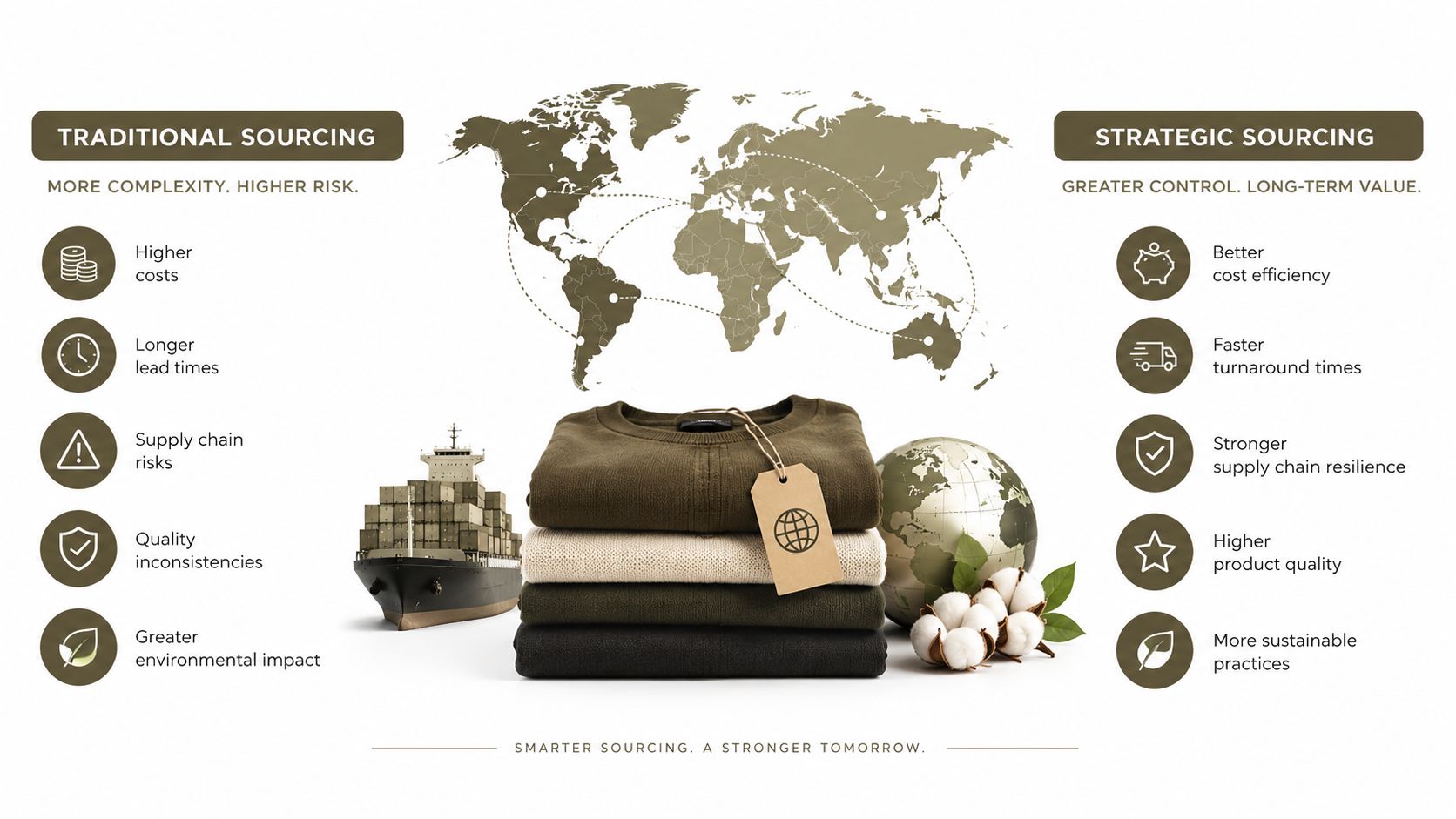
Large export hubs generally make more sense when you have repeatable specifications, predictable demand, and enough volume to absorb material minimums, development work, and freight coordination. Their strength is often capacity and unit-cost efficiency, not necessarily rapid response to a small design change.
US and EU factories can be more relevant when the product requires close collaboration, faster physical feedback, specialized finishing, or shorter replenishment cycles. Their advantage is not automatically a lower landed cost. It may be proximity, communication, flexibility, compliance visibility, or the ability to react while the market window is still open.
Standard apparel lead times commonly run 12 to 20 weeks end to end, while the cited breakdown places Asian factories often around 10 to 16 weeks and US or EU production around 8 to 14 weeks. The apparel production lead-time guide identifies design and sample approval, fabric sourcing, bulk cutting and sewing, and final quality control as major stages. Fabric availability, approval cycles, and construction complexity commonly create the pressure points.
Nearshoring isn't a universal solution
Nearshoring is often presented as an easy answer to overseas risk. It isn't. Local production still has capacity constraints, material dependencies, setup costs, and labor costs. Moving a basic garment closer to the customer may improve proximity while making the unit economics unsuitable.
The more defensible use case is a product where speed, flexibility, compliance, and inventory risk matter more than the lowest possible unit cost. That can include shorter runs, higher-margin garments, products with frequent style updates, or categories where a missed selling window is more damaging than a higher manufacturing price.
The global trade structure reinforces this caution. In 2021, China accounted for roughly one-third of worldwide clothing exports, with an export value of about $176 billion, while the European Union as a bloc represented almost 30% of global clothing exports, according to the global apparel supply chain overview. The same source reports that the United States imported more than $100 billion worth of clothing in that year.
A sourcing director should therefore compare landed cost, development speed, order flexibility, compliance requirements, inventory exposure, and communication effort. “Local” and “overseas” are starting points for investigation, not conclusions.
Vetting Capabilities and Negotiating Terms
Once the product file is controlled, factory evaluation becomes more objective. Don't ask only whether a factory can make garments. Ask whether it can make this garment, at the required complexity, with the required materials, within the commercial constraints your business can support.
Request specific evidence. A factory should be able to explain which operations it performs in-house, which it outsources, how it handles pattern development, where materials come from, how it manages approvals, and how it records production changes. A polished website doesn't answer those questions.
Compare the factory against the order
| Evaluation Criteria | Overseas Hubs (Asia) | Nearshore / Local (US/EU) |
|---|---|---|
| Best fit | Stable styles, repeat orders, scalable volume, established material networks | Shorter runs, fast reaction, close collaboration, specialized or premium products |
| Primary commercial strength | Production scale and broad supplier ecosystems | Proximity, communication, flexibility, and shorter physical feedback loops |
| Main risk to investigate | Longer coordination chains, freight exposure, and approval delay | Higher cost base, constrained capacity, and material availability |
| Material sourcing | May offer deep fabric and trim networks, but verify the actual mill and substitute policy | May simplify communication, but confirm whether materials are local or imported |
| Sampling process | Define courier, approval, and revision responsibilities in writing | Use proximity for fittings, but still document every approval formally |
| Compliance review | Verify factory identity, subcontracting, labor practices, and audit records | Verify labor, environmental, and subcontracting practices rather than assuming proximity proves compliance |
| MOQ discussion | Ask whether the minimum applies by style, color, material, or size run | Ask the same questions, especially when the factory serves small brands |
| Lead-time control | Tie dates to fabric approval, sample approval, and material receipt | Use shorter distance to improve feedback, not as a substitute for written milestones |
MOQs deserve precise questioning. Ask whether the stated minimum applies per style, color, fabric, size run, or total order. A factory may accept the total quantity while imposing separate minimums on each color or material, changing the commercial decision completely.
Ask what happens when the plan changes
A capable partner should explain its process for late material arrival, failed testing, rejected samples, operator changes, subcontracting, and production interruptions. You also need to know who pays for rework caused by a factory deviation and how the parties approve a substitute.
For negotiation structure, these quoting tips for fabrication shops offer a useful reminder: a quote is only comparable when the scope is comparable. Give every factory the same tech pack, reference sample requirements, packaging assumptions, shipping terms, payment milestones, and response deadline.
A strong purchase agreement should record:
- Approved reference: Identify the final sample, measurement chart, material approvals, and artwork files.
- Milestones: Tie dates to specific events, such as material approval, pre-production sample, cutting start, inline inspection, final inspection, and shipment readiness.
- Change control: Require written approval for substitutions, construction changes, or tolerance changes.
- Quality process: Define inspection points, defect classification, corrective action, and reinspection.
- Commercial terms: Record deposits, balance timing, currency, shipping responsibility, duties, and ownership of patterns and tooling.
- Subcontracting: Require disclosure and approval before work moves outside the named facility.
Digital supplier collaboration can support this discipline when the factory sees the approved information without editing the master record. The vendor management workspace is one example of a setup that can give external partners controlled, view-only access while keeping internal teams aligned.
The factory that asks precise questions is often safer than the factory that agrees to everything immediately. Vague confidence at quotation stage tends to become a negotiation during sampling.
Mastering the Sampling and Quality Control Workflow
Sampling should not be treated as a single yes-or-no event. It is a controlled sequence that tests whether the design, materials, pattern, construction, and inspection criteria agree with one another.
Consider a jacket with a shaped collar, a lined body, branded hardware, and a specific sleeve balance. If the brand approves only the front appearance, the factory can still produce a sample that looks acceptable from one angle while the collar roll, lining pull, sleeve pitch, or hardware placement is wrong. The correction then reaches the pattern, materials, and sewing sequence at the same time.
Use a staged approval sequence
Start with a digital review. Check silhouette, proportion, panel lines, pocket placement, trim scale, artwork, and color relationships before ordering physical materials. AI editing and virtual try-on tools can help compare changes to silhouette, material, and color before the team commits to cutting fabric, but the output should remain a review aid rather than the fit approval itself.
Then move through a disciplined physical sequence:
- Prototype review: Confirm the overall construction and identify issues that make the design impractical.
- Fit sample: Check measurements, balance, ease, movement, and grading assumptions on the intended fit model or fitting method.
- Material and trim approval: Confirm the actual fabric, shrinkage behavior, color, hand feel, hardware, labels, and finishing.
- Pre-production sample: Review the complete approved construction with production materials and the intended decoration or wash process.
- Golden sample release: Mark the approved sample, measurement chart, component list, and inspection notes as the bulk reference.
Every comment should identify the exact location, required change, responsible party, and next approval. “Make the sleeve better” is not a production instruction. “Reduce sleeve opening at the finished edge, preserve the approved cuff width, and update the measurement chart” is actionable.
Focus quality checks where defects cluster
Quality control becomes more effective when inspectors look for known failure points instead of performing a vague final glance. One study found that 78.56% of defects came from six top defect positions, with uncut thread accounting for 23.72% and spots for 20.70% in the reported production setting. The garment sewing quality study provides the supporting defect analysis.
Translate that finding into an inspection plan. Check thread trimming, visible marks, seam alignment, skipped stitches, puckering, uneven hems, closures, and measurement points at the stage where each problem is easiest to correct. A defect found before pressing and packing is easier to address than one found after the garment has passed through several finishing operations.
Factory-floor observation: The cheapest correction is the one made before the same mistake travels through the entire batch.
Keep one controlled file for comments, approvals, and revisions rather than scattering decisions across email. Factory teams should comment against the current version, and the brand should close each comment with a recorded decision. For broader operational thinking, the framework behind e-commerce fulfillment quality checks is also relevant: inspection standards work best when they are defined before the goods arrive, not improvised after a problem appears.
Red Flags and Transitioning to Bulk Production
Final sample approval doesn't mean the factory is ready for bulk. It means the product has reached a reference point. The next question is whether the factory can reproduce that reference with the same materials, process, people, and controls.
Watch for unexplained movement in the schedule. Fabric approval that keeps slipping, a sudden change in the promised production line, unclear answers about subcontracting, or a request to replace a critical component without a documented approval are operational warnings. So is a factory that can't show how it will preserve the approved measurements and construction details once the sample room hands the order to production.
Protect the approved reference
Before cutting begins, confirm that the factory has the correct:
- Golden sample and measurement chart, with tolerances visible to the inspection team.
- Fabric and trim approvals, including color, finish, composition, and substitute rules.
- Pattern and marker version, identified against the approved product revision.
- Artwork files, with placement, scale, technique, and color instructions.
- Packing and labeling instructions, including folding, tickets, cartons, and assortment requirements.
- Inspection checklist, with critical, major, and minor issues defined for the product.
- Change log, showing who approved every deviation from the original specification.
Don't allow a verbal correction to outrank the controlled file. If the factory proposes a different seam, material, or trim because the approved option is unavailable, request the alternative sample or documented evidence needed for a decision. A cheaper substitute that changes hand feel, durability, appearance, or compliance is not a neutral change.
The period while bulk production is on the sewing line is also a useful time to prepare launch assets. Once the product specification and approved visuals are stable, AI product-creation tools can generate e-commerce flats, editorial scenes, and campaign concepts for review without waiting for a traditional shoot. Keep those marketing outputs tied to the approved product so the customer doesn't see details that bulk production won't deliver.
The practical test for any manufacturer is consistency under handoff. Can the team move from concept to tech pack, tech pack to sample, sample to cutting, and cutting to finished goods without losing the decisions that define the garment? If the answer is unclear, the sourcing problem isn't solved by another factory search. It requires a stronger operating record.
Genpire connects product concepting, factory-ready tech packs, supplier collaboration, sampling, and bulk-production files in one workflow, with structured construction details and standard exports for manufacturing teams. Visit Genpire to turn your next garment specification into a clearer, controlled brief before you request quotes.