The most repeated advice about manufacturing on demand is that it is automatically cheaper, cleaner, and faster than a factory run. That advice falls apart as soon as the volume, the tooling bill, and the customer's patience stop lining up.
A founder hears "make it when they order it" and pictures empty warehouses and a shorter path to market. Sometimes that picture is right. Often the machine time per unit, the finish work, and a long wait erase the savings that skipping a mold was supposed to create.
Treat the choice as a break-even decision. Match the trigger, the batch size, and the supplier rules to one product, then compare that path with a tooled run at the volume you expect to sell.
Table of Contents
- What Manufacturing on Demand Means Today
- Four On-Demand Models Compared Side by Side
- Benefits and Drawbacks Against Mass Production
- How an On-Demand Workflow Runs From Design to Delivery
- Keeping Quality Consistent Across Suppliers
- Where On-Demand Fits Each Product Category
- Decide Whether On-Demand Costs Less and Next Steps
What Manufacturing on Demand Means Today
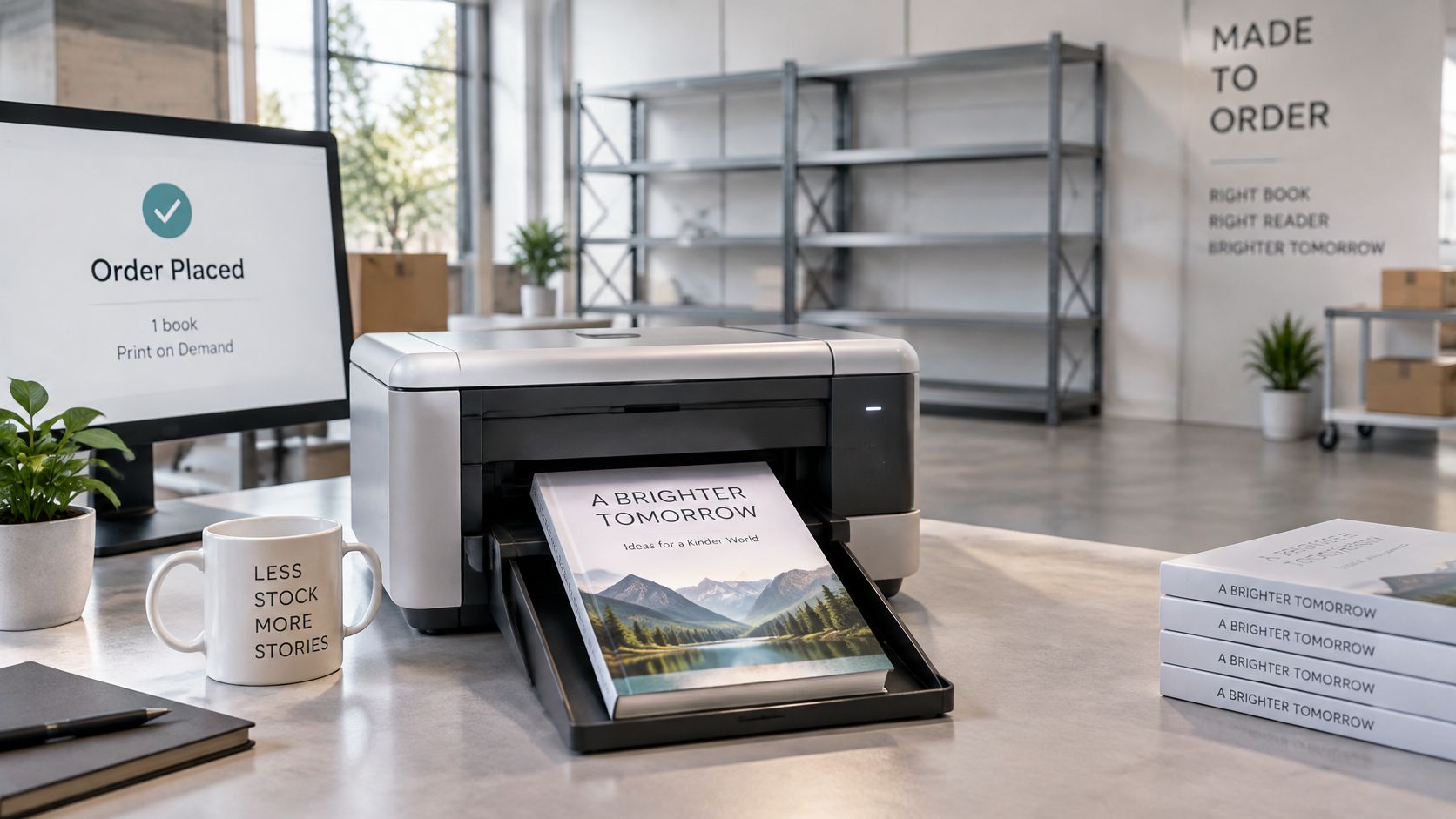
Think of a book that a shop prints only after a buyer pays. The title never sits in a warehouse. Manufacturing on demand applies the same logic to physical goods. A product lives as a digital specification, production starts when an order or a demand signal arrives, and the goods ship from a flexible or nearby factory rather than from a stocked shelf.
Mass production works the other way. A plant runs a long batch against a forecast and holds finished goods until they sell. The risk sits in the warehouse. On-demand production moves that risk into the calendar, because the buyer waits while the part is made.
That wait used to be the whole business model. A 2023 MIT report describes the preindustrial pattern as largely artisanal: goods were made in low volumes and adapted to one person. Digital design, automation, and cheaper hardware changed the constraint. The least expensive commercially available 3D printer cost about $10,000 in the late 2000s, and desktop printers later became available for roughly $100, a 99% price reduction. The same report notes that by 2015, end-use parts already accounted for 51% of additive-manufacturing service activity, so the work had moved past prototypes toward finished products.
A cheaper printer is not a factory. Desktop hardware made small batches and local customization reachable outside large plants. It did not, by itself, give you certified materials, repeatable tolerances, or the throughput of an injection-molding cell.
The same idea shows up in goods people already customize by hand. If you start your custom furniture order with a maker who builds to a measured room, you are already buying a configured product instead of a stocked one. The digital version of that promise is a file the factory can read without a new mold for every change.
Three signals mark a real candidate:
- A digital file already exists. Drawings, a tech pack, or a 3D model can be revised without cutting new steel.
- Demand is uncertain. A forecast would leave you with stock you cannot sell.
- Tooling is hard to justify. Complex geometry or a custom option would be amortized over too few units.
If none of those three is true, a conventional run is often the cheaper path. The models below show which trigger fits which product.
Four On-Demand Models Compared Side by Side
The models differ on what starts production and how many units each run makes.
| Model | What starts production | Typical order size | Typical lead time | Best fit |
|---|---|---|---|---|
| Single-unit on demand | One order, usually from a digital file | 1 unit | Days to 2 weeks | Personalized items and low-risk test products |
| Make-to-order | Customer commits to a configured product | 1 to a few hundred | 1 to 4 weeks | Configurable footwear, furniture and custom apparel |
| Small-batch on demand | Stock falls below a reorder threshold | 50 to 500 units | 2 to 6 weeks | Seasonal lines and uncertain demand |
| Regional micro-factory | Demand forecast in a local market | Tens to thousands per run | 1 to 3 weeks | Bulky goods and short-shipping markets |
Single-unit and make-to-order
Single-unit on demand starts when one buyer orders, usually from a file. A name on a tote, a one-off bracket, or a test colorway fits. Lead time is often days to two weeks. You learn whether anyone wants the product before you fund a run. You also pay a high unit cost, because setup is spread across a single piece.
Make-to-order waits until the buyer commits to a configured product. Custom footwear, made-to-measure furniture, and configurable apparel sit here. The order might be one unit or a few hundred for a team or a retailer. Expect one to four weeks. The buyer has already accepted a wait, which is the condition this model needs.
Small batches and local factories
Small-batch on demand releases a run of 50 to 500 units when stock falls below a threshold you set. Seasonal colorways and unproven SKUs fit. Lead time is typically two to six weeks, so the threshold has to cover sales during that gap. A small-batch manufacturing guide is useful when you are setting that reorder point against real minimums and finish times, not a slogan about flexibility.
Regional micro-factories build close to the buyer's market. A local demand signal, not a single checkout, starts the run. Quantities run from tens of units into the thousands, with lead times of one to three weeks once the cell is qualified. Bulky goods win here because you avoid shipping air and packaging across an ocean. Simple, high-volume parts usually do not, because a distant high-volume plant still beats a small local cell on unit cost.
These rows combine. Many brands keep a generic core in stock and finish the variant only after the order arrives. That practice is postponement. Form postponement goes one step further: generic components sit near the market, and only the last configuration is local, which shortens delivery without stocking every SKU.
Map demand certainty and the degree of customization to one row, then test that row against unit cost before you lock a supplier.
Benefits and Drawbacks Against Mass Production
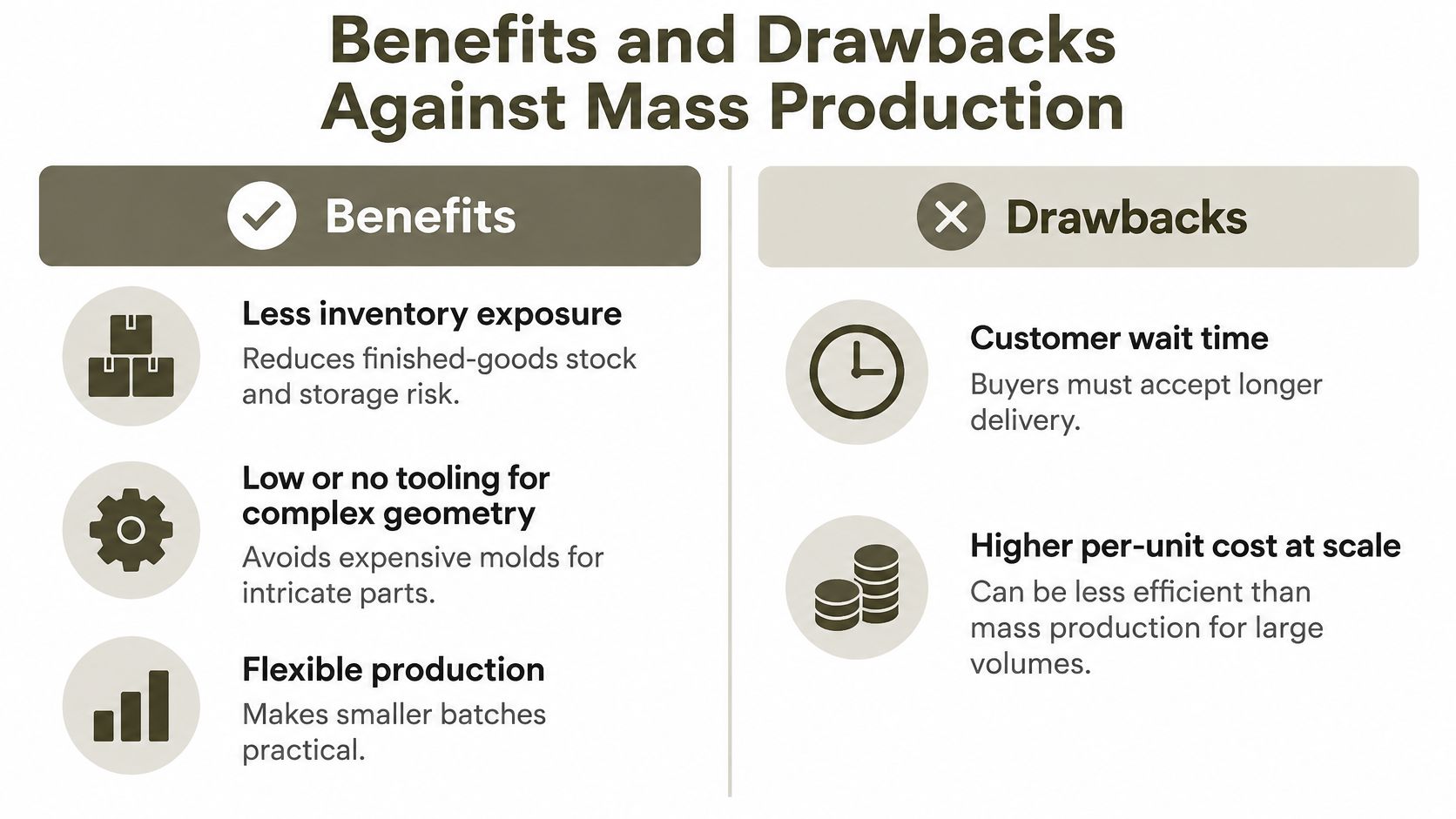
On-demand production cuts finished-goods exposure only if the customer will wait. Inventory savings and delivery time pull in opposite directions, and quality has to stay high while both move.
What you gain, and what that gain costs
Less stock, more calendar risk. Make-to-order and mass-customization systems cut finished-goods exposure by building against real orders. Research on mass-customization supply chains describes a three-way link among customer waiting time, satisfaction probability, and supply-chain integration. Manufacturer, customizer, and retailer can all benefit when waiting time stays in a moderate range and expected quality stays high. Drop the stock to zero and stretch the promise past what buyers will accept, and the inventory win turns into lost orders.
Low or no tooling, slower machines. Complex geometry can skip molds and dies. That is the gain founders notice first. The cost is throughput. A molding press can outrun an additive or low-volume cell by a wide margin once the tool exists. Surface finish often needs extra steps, and those steps add days and labor the quote sometimes hides.
Faster iteration, harder consistency. You can change a file between runs without cutting new steel. You also need people who can read that file, qualify the material, and hold the same result on the next machine. Weak standards across materials and processes are a standing drawback, not a startup problem that disappears after the first good sample.
Say a bag brand clears the warehouse and promises six weeks. A competitor keeps the core style in stock and ships in three days. The first brand saved storage. It also handed the impatient buyer to the second brand. The integration finding above is the design constraint: sync the spec, the supplier's capacity, and a lead-time promise the factory can hit.
Postponement is the middle path when a full make-to-order wait is too long. Hold the generic body, delay the final color, size, or hardware until the order is known, and you cut SKU stock without asking every buyer to wait for a blank sheet of production.
Practical rule: Write the lead-time promise first. Then pick the model that can meet it at a quality level buyers will accept.
How an On-Demand Workflow Runs From Design to Delivery
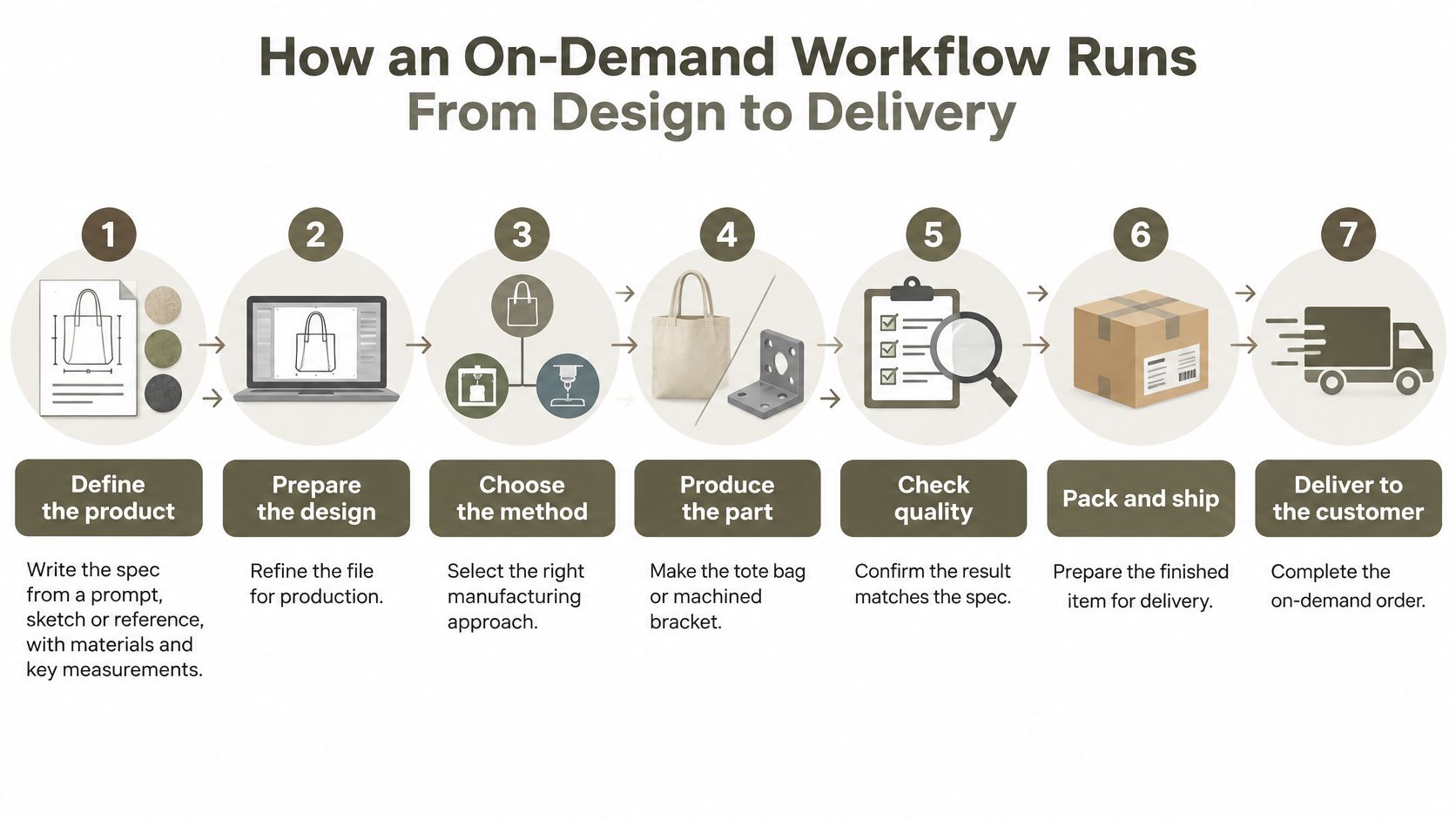
The same seven steps cover a canvas tote and a machined bracket. What changes is the file, not the sequence. Skip a step and the quotes, the sample, and the bulk run start describing three different products.
From a spec to a locked sample
- Define the product. Write the spec from a prompt, a sketch, or a reference, and name the materials and the key measurements. Leave the finish open and every factory prices a different surface, so the quotes cannot be compared.
- Build the tech pack. Add measurements, the bill of materials, and construction notes so each factory reads the same drawing. A pretty render is not a pack. Without callouts, the sewer and the machinist both guess.
- Request quotes. Send one pack to several manufacturers and compare unit price, minimum order quantity, and lead time on the same page. Our network is built so you are not spending the usual four to six weeks just finding who can quote. A production planning pass on demand, capacity, materials, and the schedule belongs here, before you promise a date.
- Order a sample. Sampling is its own transaction. Testing a sample does not commit you to bulk. Bulk risk starts only when you place the bulk purchase order.
From approval to the first ship
- Approve against the spec. Measure the sample against the tech pack and log every change as a numbered revision. The common slip is approving a part against last week's file while the factory already holds a newer one.
- Place the bulk order. Lock the revision and the quantity, then track the job from quote received through bulk in production. Changing the quantity after the lock usually resets the lead time you just published.
- Inspect the first articles. Check them against the approved sample before the full run ships. A passed sample that nobody compares to the first production pieces is how a bad batch leaves the building.
A team should be able to see one status at a time: tech pack drafted, RFQ sent, quote received, sample ordered, sample approved, bulk in production, shipped. We show that sequence on the project so a founder and a factory are not emailing different versions of "where is it."
If two factories can quote different finishes from your pack, the pack is not done. Fix the callout before you collect more prices.
Keeping Quality Consistent Across Suppliers
Adding a second factory cuts geographic risk and can shorten a route. It also creates version drift, requalification work, and a real chance the customer rejects the second source's parts. A 2025 additive-manufacturing trend discussion from CECIMO points to inconsistent standards, limited certification, quality-assurance gaps, and tolerance differences between systems as barriers to industrial use. Production quality, precision, material behavior, and inspection can differ from one supplier to the next.
The question is not whether a file can be made. It is whether the same file produces an equivalent, saleable product every time you move it.
A supplier-transfer protocol
Run this list before a new factory is allowed to ship:
- Locked revision control. Only one spec is live. The file name, revision letter, and date match on the pack, the quote, and the shop floor.
- Material and process equivalency. The alloy, polymer, fabric, and finish are the ones named in the tech pack, not a local substitute that "looks close."
- A golden sample at each factory. You approved it, and each site keeps that physical reference, not a photo of it.
- Measurable tolerances. Critical dimensions are numbers, such as ±0.2 mm on a mating face, not "close to print."
- An inspection plan. Say which features are checked, how many pieces per lot, and what fails the lot.
- Traceability. Each batch ties back to a material lot, so a bad shipment can be isolated.
- Approval gates. A new factory does not ship until the gates above are signed. Speed is not a reason to skip one.
Our quality control step sits inside production coordination for this reason. A passed sample at factory A does not transfer to factory B by email.
The test is simple. Send the same locked file to two suppliers. Both sets of parts have to pass the same inspection plan against the same golden sample. If one fails, you do not have two sources. You have one source and a file that has not traveled yet.
Where On-Demand Fits Each Product Category
On-demand production pays when avoiding tooling or unsold inventory is worth more than the higher unit cost. Volvo cut manufacturing time for selected assembly tools from 36 days to 2 days, about a 94% reduction, by building them with additive manufacturing from digital files, according to a KTH study of on-demand production. That advantage is most likely when a part has complex geometry, uncertain demand, or too few units to justify conventional tooling. For a simple part ordered in high volume, slower throughput, finishing work, and material qualification can erase the savings.
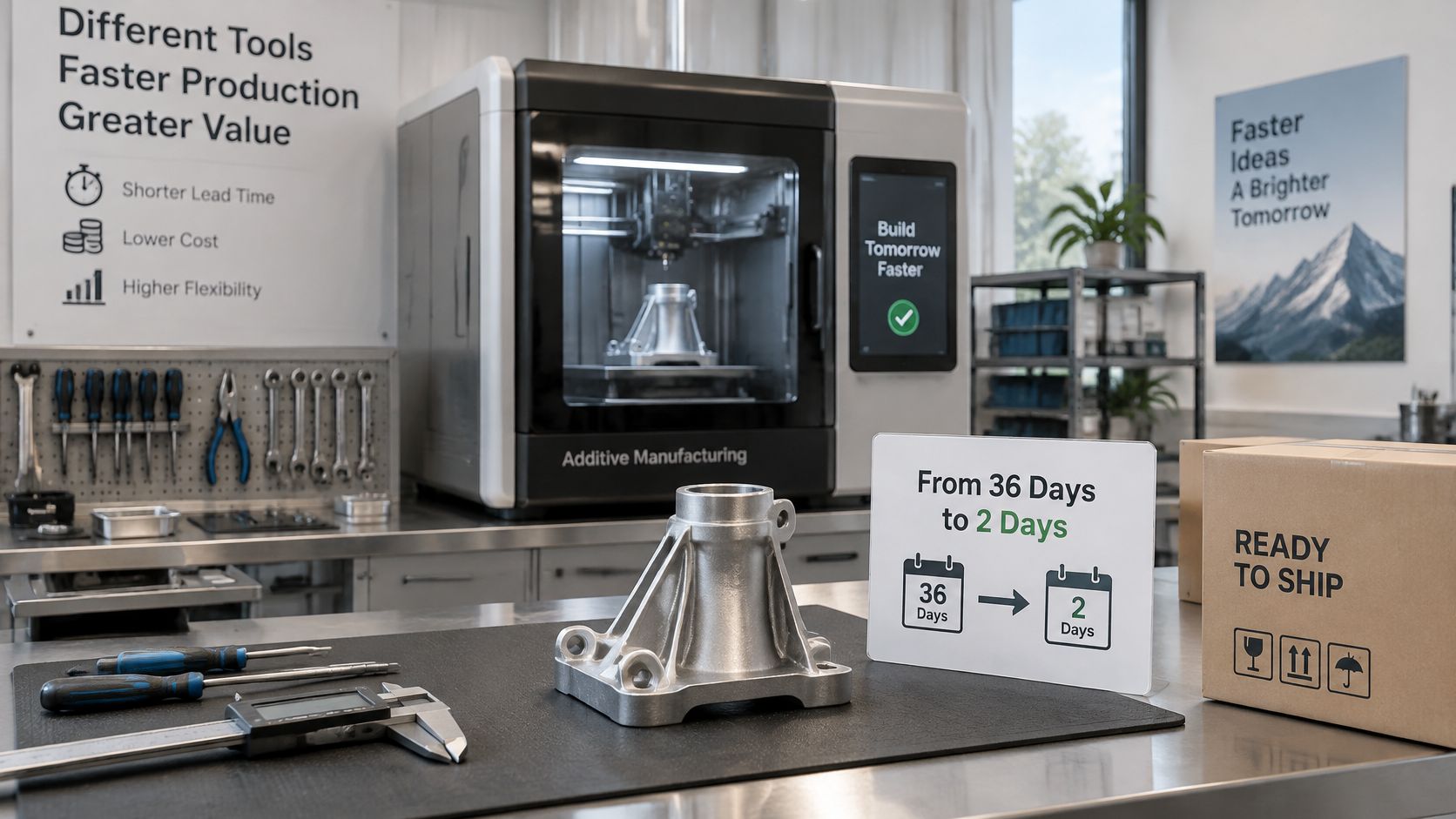
Sort products by geometry, expected demand, tooling cost, and certification needs. Then compare the cost of flexible production with the cost of a tool spread across the likely order volume.
| Category | Best model | Reversal condition |
|---|---|---|
| Fashion and apparel | Make-to-order | Very high volume of one standard style |
| Footwear | Make-to-order | Standard sizes sold in high volume |
| Jewelry | Make-to-order | Stable, high-volume catalog pieces |
| Furniture | Regional micro-factory | Simple geometry sold in high volume |
| Toys and home goods | Small-batch on demand | Proven bestseller needing high-volume tooling |
| Electronics enclosures | Small-batch on demand after CNC prototype | Very high volume with a stable design |
Soft goods, metal, and bulky pieces
Fashion and apparel can suit make-to-order for inclusive sizes or a small drop, where producing ahead risks leaving inventory unsold. A single standard tee at very high volume is a different calculation: a conventional line can spread setup costs across more units. Footwear follows the same logic. A fit-specific or personalized pair may not justify a custom last at low volume; standard sizes sold in high volume may.
Jewelry has an inventory trade-off as well as a production one. Made-to-order reduces the need to hold precious metal in designs with uncertain demand. For a stable catalog piece with steady reorders, repeat batches may be more practical than making every order separately.
Bulky furniture can favor a regional micro-factory because shipping weighs more heavily in the delivered cost. Simple geometry and high annual volume can reverse that result if a distant high-volume plant makes each piece cheaply enough to offset freight.
Short runs before a tool
Toys and home goods can suit short licensed runs and test batches, where demand is not yet proven. Before you fund that test, find proven niches with Trendlytic. Aim the first 50 to 500 units at demand that already shows up in sales or search data, not a guess. If sales support a larger run, compare the tool cost against the savings on each unit.
Electronics enclosures often start with a CNC prototype, move to a small batch, then shift to a tool if the design stabilizes and volume rises. CNC machining can hold tight tolerances and provide production-like finishes while the design is still changing. Once volume is very high, molding may cost less per unit. Continuing to use a prototype route after that point means paying for flexibility the product no longer needs.
Decide Whether On-Demand Costs Less and Next Steps
On-demand production is not a cheaper version of injection molding, CNC at scale, or an established factory run. A 2025 review of the cost question is direct about the barriers that remain: high equipment cost, limited material availability, skilled-labor needs, and weak standardization. Additive routes are still limited by relatively slow rates, surface-finish limits, post-processing, and a hard time scaling from a prototype to high-volume output. The method is most defensible when demand is uncertain, SKU variety is high, tooling would be expensive, or customization carries a premium.
The costs people leave out of the slide
Six drivers decide the comparison, and generic claims about speed or waste skip most of them.
- Tooling amortization. A mold is a fixed bill. Spread it over more units and it shrinks.
- Setup per run. Every small batch pays setup again. A long run pays it once.
- Machine time per unit. Slow processes stay expensive even when the file is free to change.
- Material and finishing. The resin, alloy, fabric, and the coating or hardware can dwarf the machine rate.
- Post-processing. Support removal, tumbling, dyeing, or hand assembly is labor, and labor does not scale like a press.
- Shipping distance. A local cell can win on freight for a bulky item and still lose on the part itself.
Say a mold is $20,000. Over 1,000 units it adds $20 each. Over 10,000 units it adds $2 each. That arithmetic is why a beautiful on-demand quote at 80 units can be the wrong quote at 12,000. The bands below are indicative. Part size, material, and finish move the line.
| Annual volume | Tooling cost | Usually best method | Reason |
|---|---|---|---|
| Under 100 units | None to low | On-demand or additive | Tooling cost cannot be spread across enough units |
| Above 10,000 units | High | Conventional tooled production | Lowest unit cost at scale |
Between those bands, run the numbers instead of picking a slogan. Brands that already cost headwear by the piece, including the trim and the freight, can use a costing guide for hat brands as a model for laying unit cost, setup, and shipping on one sheet.
A four-factor check, then one quote
Score the product before you talk about a press.
- Estimate per-unit cost under two methods. Use the same annual volume, the same material spec, and the same finish for both.
- Add shipping and finishing. Displayed making prices are not the landed cost. Taxes, duties, customs, and shipping sit outside an all-in making price unless checkout says otherwise.
- Compare the totals at the volume you expect, not at the volume that makes your preferred method look good.
- Score demand certainty, customization, tooling cost, and annual volume, then match the score to a model. Uncertain demand plus expensive tooling points on demand. A stable design above a high volume points to a tool.
Then get one real quote, not a slide.
- Upload the design as a tech pack, 3D files, sketches, or specifications.
- Take an instant quote based on materials, complexity, and quantity, with more than one method and timeline where they apply.
- Have manufacturing experts review feasibility and suggest specification, material, or process changes before you spend on a tool. Design-for-manufacturing work is this review, aimed at cost and quality together.
- Receive the prototype from a vetted partner, shipped to you with quality assurance documentation. Most of those prototype partners are international, so an overseas sample is a normal path, not an exception.
Pick one product this week. Run the four-factor check. Request one quote before anyone approves tooling.
Genpire turns a consumer-product idea into factory-ready specs, quotes, samples, and bulk orders, so a manufacturing on demand decision is based on a real pack and a real price instead of a generic claim about speed. Upload a prompt, a sketch, or a file, compare methods at your volume, and keep sampling separate from the bulk commitment. Visit Genpire when you are ready to run that check on one product.