You're reviewing a first sample and the silhouette is wrong. You briefed a bomber, the factory sent a boxy Harrington, and someone else on the team keeps calling it a field jacket because it has flap pockets. The tech pack gets reopened, measurements shift, and you lose a sampling round to a naming problem.
That confusion is common because jacket names mix silhouette, insulation, weather protection, and cultural origin in one label. A shell jacket signals weather protection and may have little insulation, while a field jacket describes a pocket heavy, military derived construction. If your brief doesn't separate those layers, the factory fills the gaps for you.
The word itself explains part of the spread. The term derives from the French jaquette and Middle French jaquet for a small or lightweight tunic, which is why it became a broad name for relatively short outer garments while coat often described longer coverings, as outlined in the etymology and history of the jacket. Later names added occupation, geography, and military use.
This guide standardizes ten core names of jackets with silhouette cues, construction details, and Genpire ready spec tactics. Use it to lock a reference, build cleaner tech packs, and help customers create outfits from fewer pieces without buying overlapping styles.
Table of Contents
- 1. Denim Trucker Jacket
- 2. MA-1 Flight Bomber Jacket
- 3. M-65 Field Jacket
- 4. Harrington Jacket
- 5. Perfecto Moto Jacket
- 6. Puffer Jacket
- 7. Windbreaker
- 8. Barn Jacket
- 9. Varsity Jacket
- 10. Chore Coat
- Top 10 Jacket Styles Compared
- Turn Jacket Ideas Into Factory-Ready Specs
1. Denim Trucker Jacket
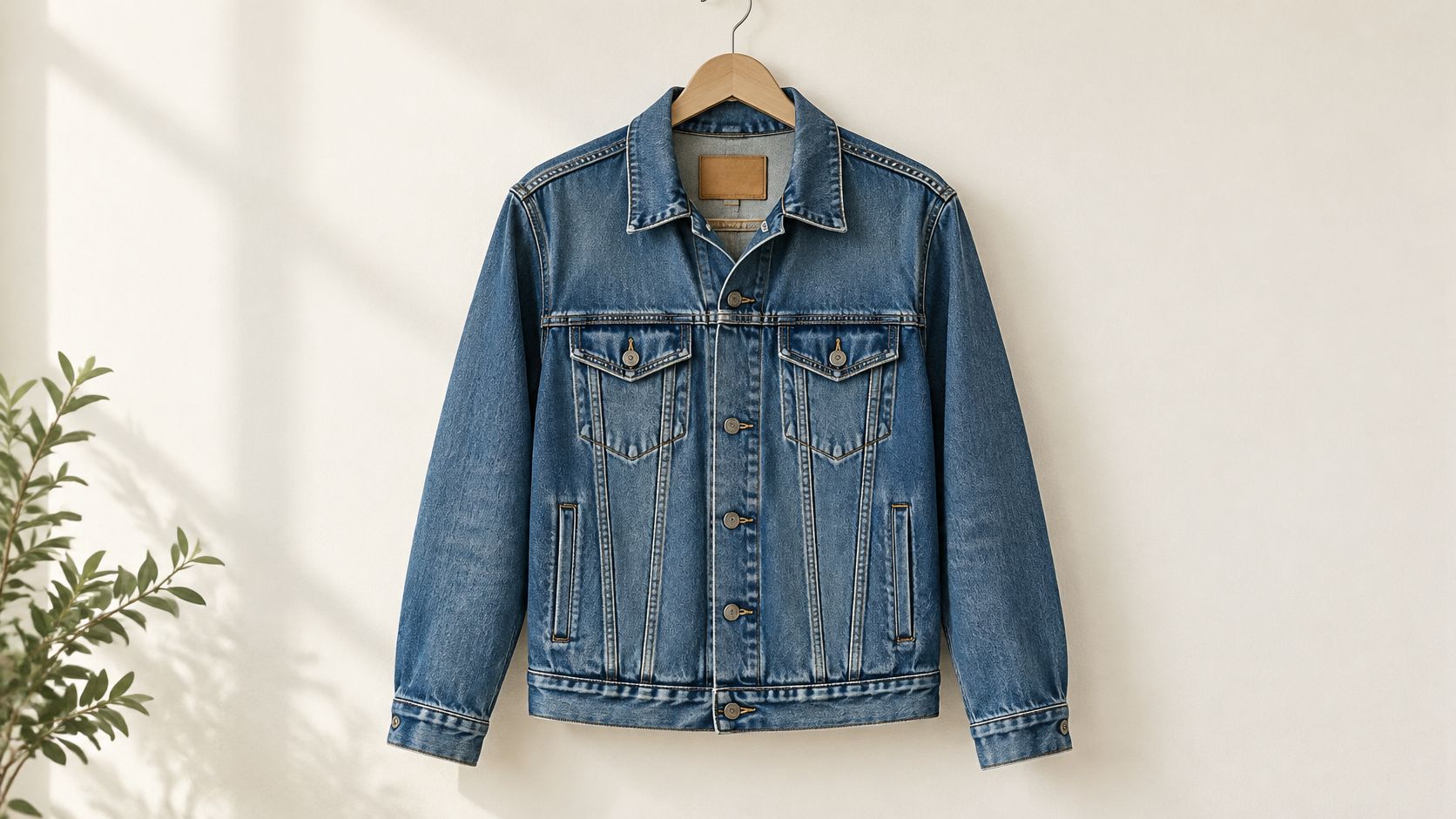
A trucker has a short, hip-length body, front button closure, pointed collar, button-flap chest pockets, and vertical seams from chest to hem. Its boxy silhouette leaves room through the waist for layering over a tee or light knit. A longer hem or zip front changes the block, so label those as deliberate variations in the tech pack.
The Levi's Type III was introduced in 1962 and remains a familiar factory reference. Lee and Wrangler versions from the same era offer further pattern cues. For a women's adaptation, the Thrills women's Bailey denim jacket shows how the pocket and yoke arrangement can work with a softer fit. Place the chosen reference beside the flat in Genpire, then mark the shoulder, chest, and hem proportions to keep sampling aligned.
Tech Pack Priorities
- Denim specification: State fabric weight, warp and weft yarn counts, and the wash process. These choices affect hand feel and how the body holds its shape.
- Topstitch control: Record thread color and stitch density, and mark bartack locations at pocket corners and yoke seams.
- Fit tolerances: Set sleeve length and shoulder width limits. Excess length in either area can weaken the compact, boxy silhouette.
When assessing clothing manufacturers for denim development, share the wash standard and a worn reference alongside the fabric details. Denim color comes from the wash process, so a Pantone alone cannot specify the finished shade.
2. MA-1 Flight Bomber Jacket
Waist length, ribbed cuffs and hem, a short stand collar, and a clean zip front define the MA-1. The body has volume through the chest and sleeve, then pulls in sharply at the rib. That contrast is the whole silhouette, so don't grade the rib like a regular hem.
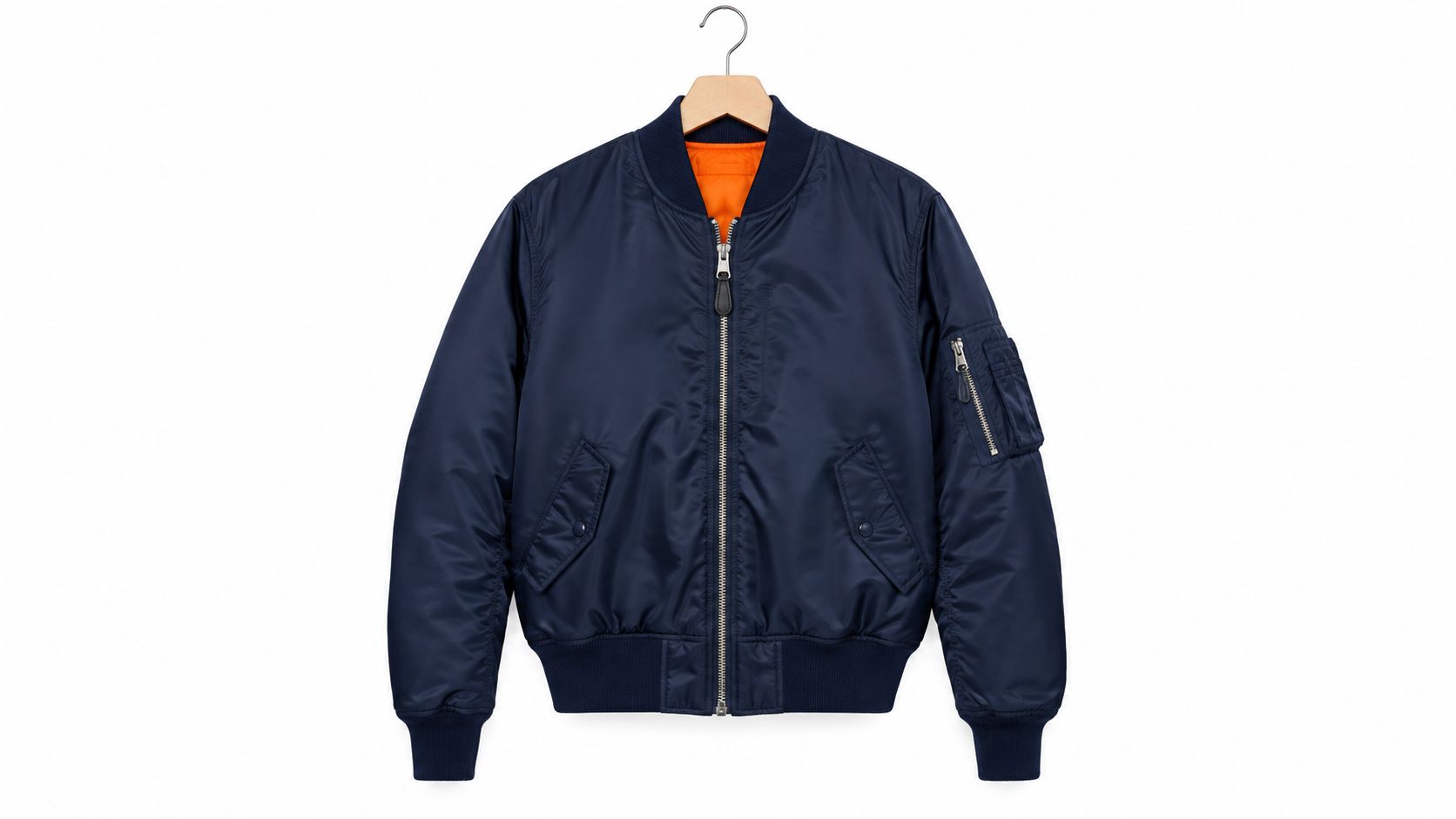
The lineage is functional, not decorative. The U.S. Army Type A-1 was first issued in 1927, followed by the A-2 in 1931 with a zip closure, snap fasteners, and leather collar, and the nylon MA-1 in the 1950s replaced earlier leather flight jackets, according to the history of the bomber from A-1 to MA-1. Alpha Industries produced the MA-1 for the U.S. military and later for civilians, and its appearance in Top Gun (1986) pushed it into streetwear.
Practical rule: Specify the rib before the shell color. Gauge, stretch, and recovery at cuff and hem determine whether the jacket blooms correctly or hangs like a windbreaker.
Call out lining color and zipper tape color as separate components with Pantone references, including the signature orange lining if you're using it. Define storm flap construction and snap or zip placement in a close up diagram. In Genpire, lock those components so an AI color edit doesn't change the lining.
3. M-65 Field Jacket
Four bellows pockets on the front are the fastest identifier. The M-65 is a longer, straight body in cotton sateen, with a stand collar, concealed hood, button and zip front, and adjustable cuffs and hem. It's built to carry, not to insulate on its own, and it expects layers underneath.
Adopted by the U.S. Army in 1965 and produced by Alpha Industries among others, it's now a standard reference for utility outerwear. Heritage brands keep releasing civilian versions, but many remove the liner compatibility and shrink the pockets. Decide early whether you're making a faithful utility piece or a fashion field jacket, because pocket volume changes the front pattern.
What Factories Need First
- Pocket map: Give dimensions, bellows depth, flap shape, closure, and stitch placement for every pocket, front and interior.
- Hood attachment: Specify snap or zip type, gauge, and where the hood stores in the collar.
- Fabric lock: Define cotton sateen weight and finish with shrinkage limits to avoid lot to lot variation.
Don't approve this style from a front view only. Check side volume with pockets loaded, or you'll discover pulling at the front closure only after bulk production.
4. Harrington Jacket
The Harrington is lightweight, waist length, and cleaner than a bomber. Look for a zip front, buttoning stand collar, slanted flap pockets, elasticated or knit hem and cuffs, and the signature tartan lining. The back often has an umbrella yoke for rain runoff. It sits close without the puff of flight nylon.
Baracuta's G9, introduced in the 1930s, is the historical anchor, and James Dean wearing a G9 in Rebel Without a Cause (1955) fixed it in popular culture. That history matters for merchandising, but for development the lining and collar are what separate a Harrington from a generic blouson in a buyer's mind.
Specify the tartan repeat and placement so the pattern aligns at center back and side seams, or state clearly that it won't match and save the fabric cost. Include knit gauge and recovery for collar, cuffs, and hem, because a loose collar makes the whole jacket look tired. Define zip type, size, and tape color in the component list, not in a comment.
In Genpire, generate the jacket open and closed. The lining is a selling feature, and your e commerce view needs to prove it exists.
5. Perfecto Moto Jacket
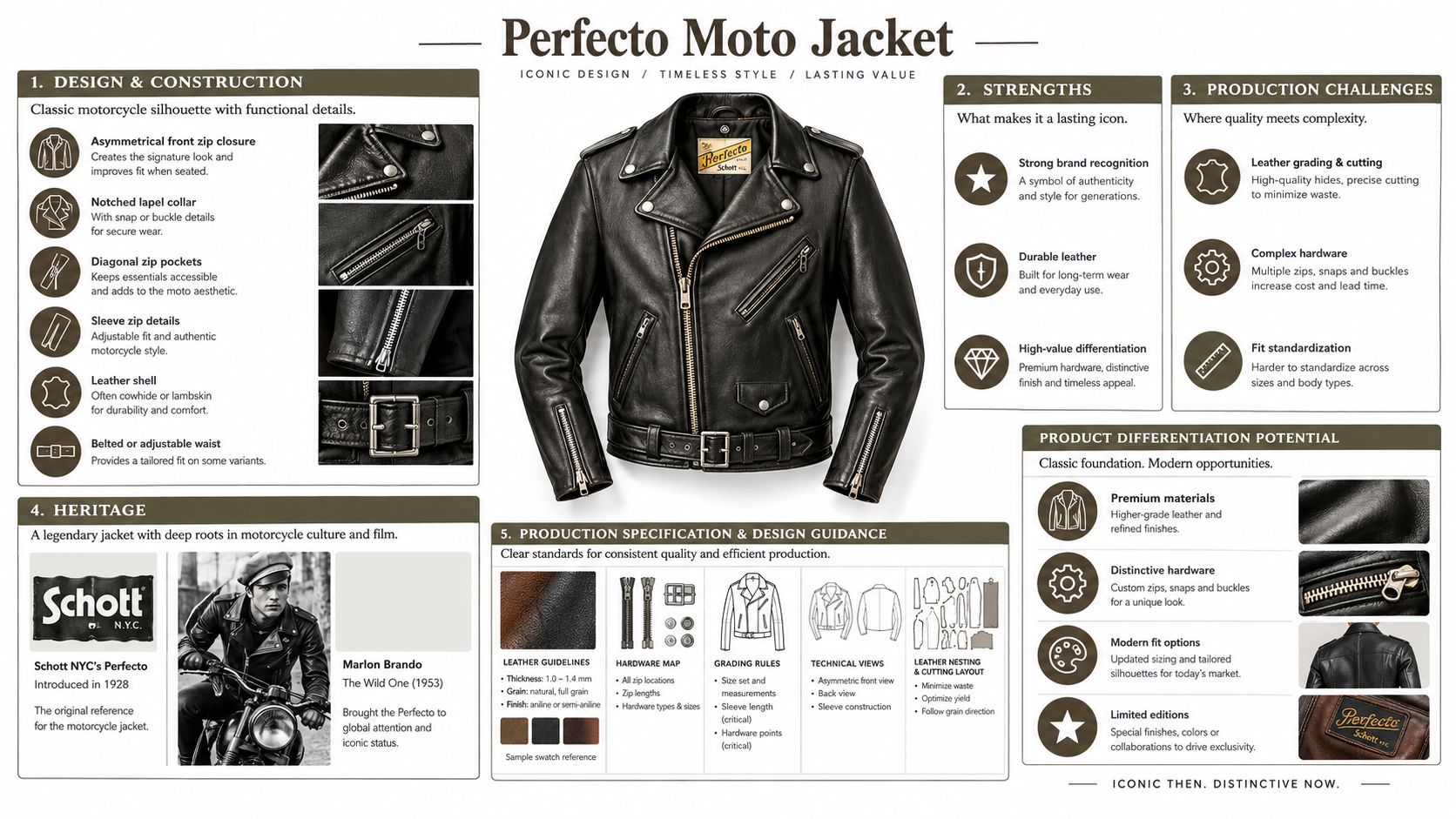
Asymmetry is the test. A Perfecto has a diagonal front zip, wide notched lapels that snap down, a belted or cropped waist, zip cuffs, and angled zip pockets. A straight zip leather jacket is a cafe racer or a generic moto, not a Perfecto, and confusing the two changes lapel, collar, and front pattern entirely.
Schott NYC introduced the original Perfecto in 1928, and Marlon Brando wearing one in The Wild One (1953) made it a cultural uniform. It's also one of the hardest jackets to sample well because leather thickness, lapel roll, and zip angle interact. Small errors look like costume.
Spec It Like Hardware
- Leather callout: State thickness, grain, finish, and attach a swatch reference with acceptable variation range.
- Hardware diagram: Map every zip location, length, gauge, and puller finish on one page.
- Grading focus: Define sleeve pitch and shoulder grading carefully, since mobility is limited in leather.
If you're evaluating clothing design software for complex outerwear, use the Perfecto as your trial style. If the system can't hold asymmetric details across views, it won't hold them in production.
6. Puffer Jacket
A puffer isn't a silhouette first. It's an insulation system built from baffles or channels that hold down or synthetic fill in place. Length, hood, and fit can vary from cropped fashion to long expedition, but the quilted volume and fill specification define warmth. Calling something a puffer without fill data tells a factory almost nothing.
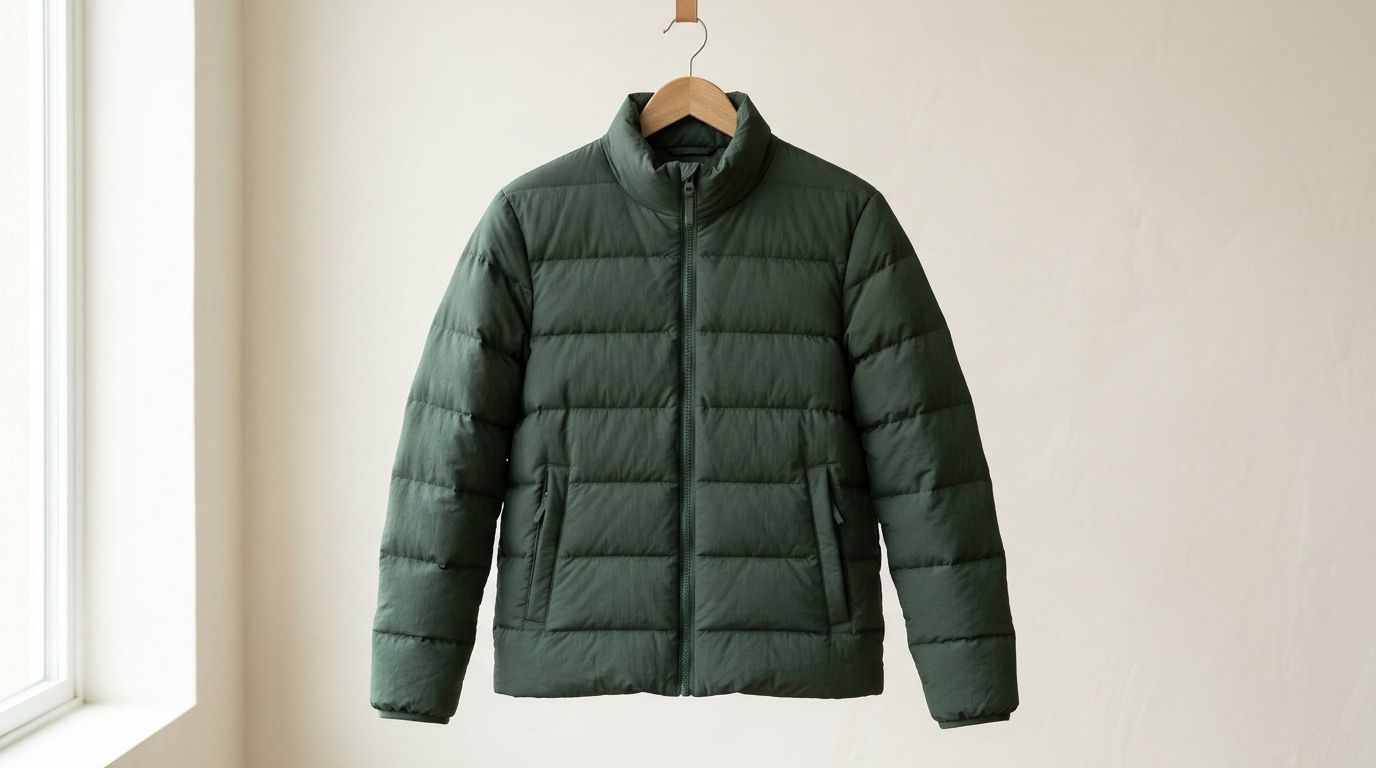
Eddie Bauer's Skyliner from 1936 is an early down reference, while Moncler later turned the puffer into a premium fashion category. Both use the same principle, trapped air, but their baffle width, shell shine, and fit blocks serve different customers. Your spec needs to say which end you're building for.
Specify fill power, fill weight by size, and baffle dimensions together. Changing baffle width without adjusting fill weight creates cold spots or an overstuffed sample you'll chase for rounds.
Document baffle stitch pattern, seam allowance, and down proof shell requirements, plus responsible sourcing documentation if you're using down. For synthetic styles, state gsm by panel, not just total weight. A structured workflow for AI tech packs for insulated apparel helps keep fill tables, baffle maps, and shell specs in one version instead of scattered spreadsheets.
7. Windbreaker
A runner heading into gusty weather needs a light shell that blocks wind without adding insulation. The windbreaker typically uses nylon or polyester, with a zip front, elastic or adjustable cuffs and hem, and sometimes a packable hood. Its silhouette is usually athletic and easy to layer. Specify it as a windbreaker, not a rain jacket, unless the fabric and garment construction support that claim.
For water protection, reference the current EN ISO 24232 standard, which supersedes EN 343. Water penetration and water vapor resistance are assessed independently. Use the EN 343 rain protection class requirements to check the standard's classification, and avoid assigning a protection class unless the product has been tested to the applicable requirements. Call it a waterproof hardshell only when the fabric, sealed seams, and closures support that performance. Otherwise, use water resistant shell.
A black quarter-zip windbreaker illustrates a pullover silhouette with a half zip and kangaroo pocket. In Genpire, use the reference to define the front opening, pocket dimensions, and hem shape in the tech pack.
Development Notes
- Material data: Specify denier, coating type, and the tested water resistance target.
- Adjustability: Record elastic width and tension, drawcord length, and cord lock type.
- Packability: If packability is a product claim, define the pocket-to-pack dimensions and show how the shell folds into it.
8. Barn Jacket
The barn jacket reads work first. It's a straighter, hip to thigh length body in heavy cotton canvas, usually with a corduroy collar, button or snap front, large patch pockets, and a flannel or quilted lining. The fit allows movement and layering, and the fabric should look better after abrasion, not worse.
Carhartt work jackets and Filson canvas outerwear sit in the same heavy duty tradition, even when pocket layouts differ. Fashion versions often keep the collar contrast and big pockets but drop canvas weight. That changes drape and durability, so don't reference a heritage photo while specifying a lightweight twill.
Specify canvas weight, weave, and finish with shrinkage limits, and wash test it before cutting samples. Canvas that shrinks unevenly will twist patch pockets and pull the front placket.
- Reinforcement: Define bartack and rivet locations at pocket mouths, placket base, and cuff openings.
- Lining build: Document lining attachment, quilting pattern, and whether the lining is removable.
- Collar contrast: State corduroy wale, color, and undercollar material separately.
In Genpire, check this style in a three quarter view. Pocket placement that's balanced from the front often sits too low once sleeve volume is visible.
9. Varsity Jacket
Wool body, contrasting sleeves, striped rib trim, and snap front. That's the varsity formula, finished with chenille or embroidered lettering and patches. It originated with American schools and colleges recognizing athletic achievement, and the decoration is part of the product, not an afterthought.
Brands like Real McCoy's reproduce vintage versions with historical detailing, while schools still use the style for team recognition. The production challenge is multi material coordination. Wool, leather or synthetic sleeves, rib knit, lining, snaps, and patches all shrink, stretch, and color match differently.
Control the Components
- Material pairing: Specify wool grade, sleeve material type, and color matching tolerance across panels under the same light source.
- Patch placement: Give exact measurements from center front and shoulder, plus size tolerance for chenille and embroidery.
- Rib trim: Define stripe repeat, knit gauge, and attachment method at collar, cuff, and hem.
Approve a full decorated sample, not a blank body with patches pinned on. Patch weight pulls the chest, and snap spacing has to work around lettering. Photograph it buttoned and open for the sales team before you lock grading.
10. Chore Coat
The chore coat is loose, mid length, and deliberately simple. It has a shirt style or corduroy collar, button or snap front, and multiple large utility pockets, often three patch pockets outside with one interior pocket. Inspired by French workwear, it's cut to work over knitwear without binding at the shoulder.
Carhartt chore coats are a core American workwear reference, while French workwear versions tend to use lighter cotton twill and a softer collar. Both share the same logic, accessible pockets and a body you can move in. If you slim it into a blazer fit, you've changed the category and the customer expectation.
Fit check: Measure the chore coat over the heaviest layer it's meant to cover. A sample that fits over a tee in the studio will fail over a sweater in a customer's first wear.
Specify fabric weight, weave, and washing process, because garment wash softens the collar and changes pocket shape. Document pocket dimensions, flap or no flap, division stitches, and closure types. Define grading rules for shoulder, chest, and length separately, since adding length without chest ease makes larger sizes feel restrictive despite looking oversized.
Top 10 Jacket Styles Compared
| Jacket Type | Implementation Complexity | Key Resources | Expected Outcome | Ideal Use Cases | Key Advantage |
|---|---|---|---|---|---|
| Denim Trucker Jacket | Low; simple pattern, though heavy seams need care | 12–14 oz denim, metal buttons, topstitching | Durable, versatile light layering | Casual wear and transitional weather | Ages and fades distinctively |
| MA-1 Flight Bomber Jacket | Low to moderate; knit trims need careful matching | Nylon shell, lining, rib knit, zipper | Lightweight, recognizable outerwear | Streetwear and everyday layering | Clean silhouette adapts to many colorways |
| M-65 Field Jacket | High; multiple pockets, hood, and hardware | Cotton sateen, lining, buttons, snaps, drawcords | Durable, practical protection from wind and light rain | Utility wear and outdoor activities | Functional pocket system |
| Harrington Jacket | Low to moderate; lining and knit trims add steps | Lightweight cotton blend, plaid lining, knit trims, zipper | Lightweight, seasonally versatile jacket | Casual and smart-casual wear | Signature lining gives it a distinct identity |
| Perfecto Moto Jacket | High; complex leather cutting, fit, and hardware | Leather, multiple zippers, snaps or buckles | Durable, distinctive statement outerwear | Motorcycle-inspired and fashion wear | Strong recognition and premium detailing potential |
| Puffer Jacket | High; fill distribution and baffling require precision | Nylon or polyester shell, down or synthetic fill, lining | High warmth-to-weight insulation | Cold-weather outdoor and fashion use | Lightweight warmth and adaptable styling |
| Windbreaker | Low; few components and simple construction | Lightweight nylon or polyester, zipper, elastic or drawcords | Lightweight wind resistance, with limited warmth | Sportswear and mild, windy conditions | Low material use and efficient production |
| Barn Jacket | Moderate; robust seams and lining require attention | Heavy cotton canvas, corduroy, flannel or quilted lining | Durable, warm workwear layer | Farm, outdoor, and workwear use | Tough construction with a simple silhouette |
| Varsity Jacket | High; combines materials, trims, and decoration | Wool, leather or synthetic sleeves, knit trim, patches, lining | Durable, customizable heritage outerwear | School, team, and lifestyle apparel | Strong personalization through colors and lettering |
| Chore Coat | Low to moderate; straightforward shape with multiple pockets | Heavy cotton or duck canvas, buttons or snaps, collar fabric | Durable, roomy workwear layer | Manual work and casual layering | Generous fit and practical pocket layout |
Turn Jacket Ideas Into Factory-Ready Specs
Pick one silhouette and stop naming by vibes. A usable product definition has three layers, the style label such as bomber or parka, the technical function such as insulated or storm shell, and the construction details that a factory can measure. When those layers are separate, you can change one without confusing the other two.
That separation matters commercially. Warmth doesn't come from the word parka. It comes from insulation type, fill weight, construction, and weather protection, and a technical benchmark for military grade winter jackets lists roughly 10,000 to 28,000+ mm water column resistance and 5,000 to 25,000+ g/m²/24 h moisture vapor transmission, with operational jackets commonly targeting 20,000 mm or higher and MVTR above 15,000 g/m²/24 h for high intensity activity, as detailed in the military winter jacket performance benchmark. You don't need expedition numbers for a city puffer, but you do need numbers. Otherwise lightweight, midweight, and heavyweight mean whatever each factory decides.
Fit language needs the same discipline. Size and fit reportedly account for 53% of apparel returns, far ahead of color at 16%, with outerwear frequently associated with fit related returns, as reported in the analysis of fit related outerwear returns. Adding more sizes alone doesn't fix that. Pair every jacket name with ease, length, shoulder type, sleeve articulation, hem adjustment, and intended base layer, whether that's a shirt, knitwear, or a protective layer. In Genpire, use multi view concepts and virtual try on to check that allowance before you cut a sample.
Accurate naming also pays off after the first sale. In 2025, 153 U.S. fashion brands had resale listings, a 325% increase from 2021, as noted in the review of circular fashion and resale growth. Resale, repair intake, and authentication all depend on construction based descriptions, not a catchy style name. A product recorded as a cropped synthetic puffer with a stated fill weight and baffle map is easier to search, repair, and resell than one recorded only as a winter jacket.
Build your next style in that order. Choose a blank or generate a concept in Genpire, lock the silhouette cues from this guide, then encode materials, measurements, hardware, and performance targets in the tech pack workspace. Export one unified file for supplier comments instead of emailing revised PDFs. You'll cut sampling rounds, move to RFQ faster, and give every team, from design to resale, the same definition of what you made.
Start with one of these ten silhouettes in Genpire, turn your prompt or reference into multi view concepts, and build the factory ready tech pack with measurements, materials, and hardware locked in one place. You'll move from a jacket name to a quotable specification faster, with fewer sample corrections and clearer supplier feedback.