A launched product is not a sketch that survived a meeting. In a PDMA comparative performance study of 453 business units across 24 countries, 61% of products launched by participating organizations met the study's success criteria, so roughly 39% did not. Results split by region: North American companies reported 67.5%, European companies 56.8%, and Asian companies 48.6%. The gap is not a talent shortage. It is what happens after the first attractive concept appears.
Table of Contents
- Why Product Ideas Fail Before Launch
- Frame the Brief Before You Ideate
- Generate Families of Concepts on Purpose
- Score Concepts Before Sampling Starts
- Turn Winners into Factory-Ready Specs
- Pitfalls to Avoid and What to Do Next
Why Product Ideas Fail Before Launch
A pile of sketches is not a product idea generation process. Commercial results hinge on evaluation, priority, definition, and development before anyone cuts a sample. Organizations running near a 50% product-failure rate faced far higher costs than those operating nearer a 20% failure rate, according to that same PDMA comparison. Those figures are a warning about selection discipline, not a promise that any tool will land you on the better side of the range.
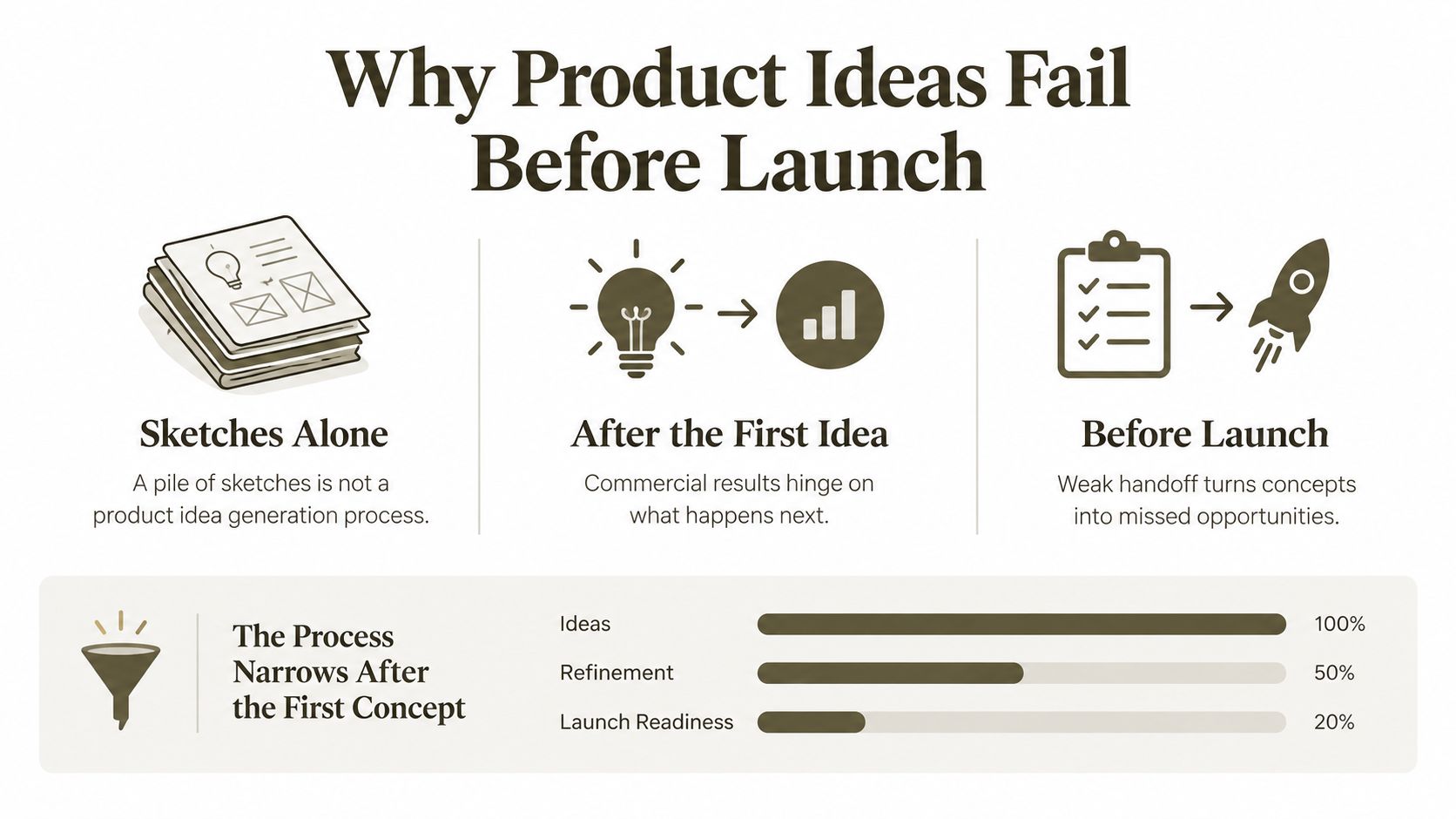
Pretty concepts die in sampling for boring reasons. The user is vague. The differentiator is a colorway. The factory cannot tell which construction you meant, or the cost band only works if the supplier ignores minimums. Designers fall in love with the render. Sourcing inherits a file that cannot answer a quote.
Who this chain is for
The workflow has to serve in-house product and technical designers, founders, sourcing teams, and manufacturers. The categories are physical: apparel, footwear, home, toys, and electronics. A soft-goods tech pack and a toy assembly are different documents. Both still need a named user, a reason to exist, and a manufacturing assumption before fabric, resin, or a circuit board is committed.
Practical rule: Generating ideas is only one part of innovation performance. The ability to evaluate and define them before launch is what changes the cost of being wrong.
Treat the rest of the work as a chain, not a moodboard. Start with problem evidence. Produce visual alternatives on purpose. Write a technical definition. End with a documented advance-or-kill decision. A good process sends fewer concepts into sampling, and the ones that go already carry a user, a differentiator, and a manufacturing assumption.
Frame the Brief Before You Ideate
Nothing multiplies until the opportunity is on one page. Prompts, sketches, and reference images come after that page exists. Well-defined predevelopment work is strongly tied to better outcomes. Products supported by well-defined and well-executed predevelopment activities reached a 75% success rate, compared with just over 31% when those activities were lacking, as reported in this synthesis of new-product success factors. Predevelopment covers opportunity identification, idea screening, market and customer analysis, concept definition, and project specification. The same source cites PDMA findings that failure rates vary by industry, from 35% for healthcare products to 49% for consumer goods. That range is context, not a target you can copy.
What belongs on the page
Write the brief before the divergent pass. Keep it to one page so a founder and a technical designer can argue about the same constraints.
- User problem: Name the pain in the user's words, not a category trend.
- Who feels it: Segment, occasion, and the job the product does.
- Price and margin: A ceiling the factory quote has to live under.
- Category and channel: Apparel, footwear, home, toys, or electronics, and where it will sell.
- Non-negotiables: Materials the brand will not use, compliance, lead time, and minimum-order reality.
Brand DNA is stored aesthetic direction: moodboards, palettes, and references that keep later generations on-brand. Without it, the next pass produces generic concepts that could belong to anyone. With it, you can still explore construction without drifting off the brand.
Founders who want a wider starting set can discover business ideas worth validating before they lock a physical brief. Validation of a business idea is not a spec. Pair that outside scan with focused market research on the segment you intend to serve, then write the constraints down.
Skip the brief and the failure is predictable. A founder generates twenty silhouettes over a weekend. None of them names a customer or a cost band. The factory asks who it is for and what it should cost. Nobody can answer, so sampling becomes the research plan. That is the expensive version of ideation.
Concepts without a named user pain do not enter generation. If you cannot say who hurts and what they will not pay, you are decorating, not developing.
Generate Families of Concepts on Purpose
The brief is the constraint. This pass is only about range. It is not the decision.
Run a timed divergent pass, then stop before anyone polishes a favorite. Use short prompts, rough sketches, reference images, forced combinations, and constraint variations. In a controlled design-thinking experiment, teams using resource constraints and “Yes, and” prompts generated 64% more ideas than baseline teams in the same period, yet the intervention did not produce more original ideas, as summarized in this note on new product development. Quantity and novelty need separate scores. More sketches are not automatically better products.
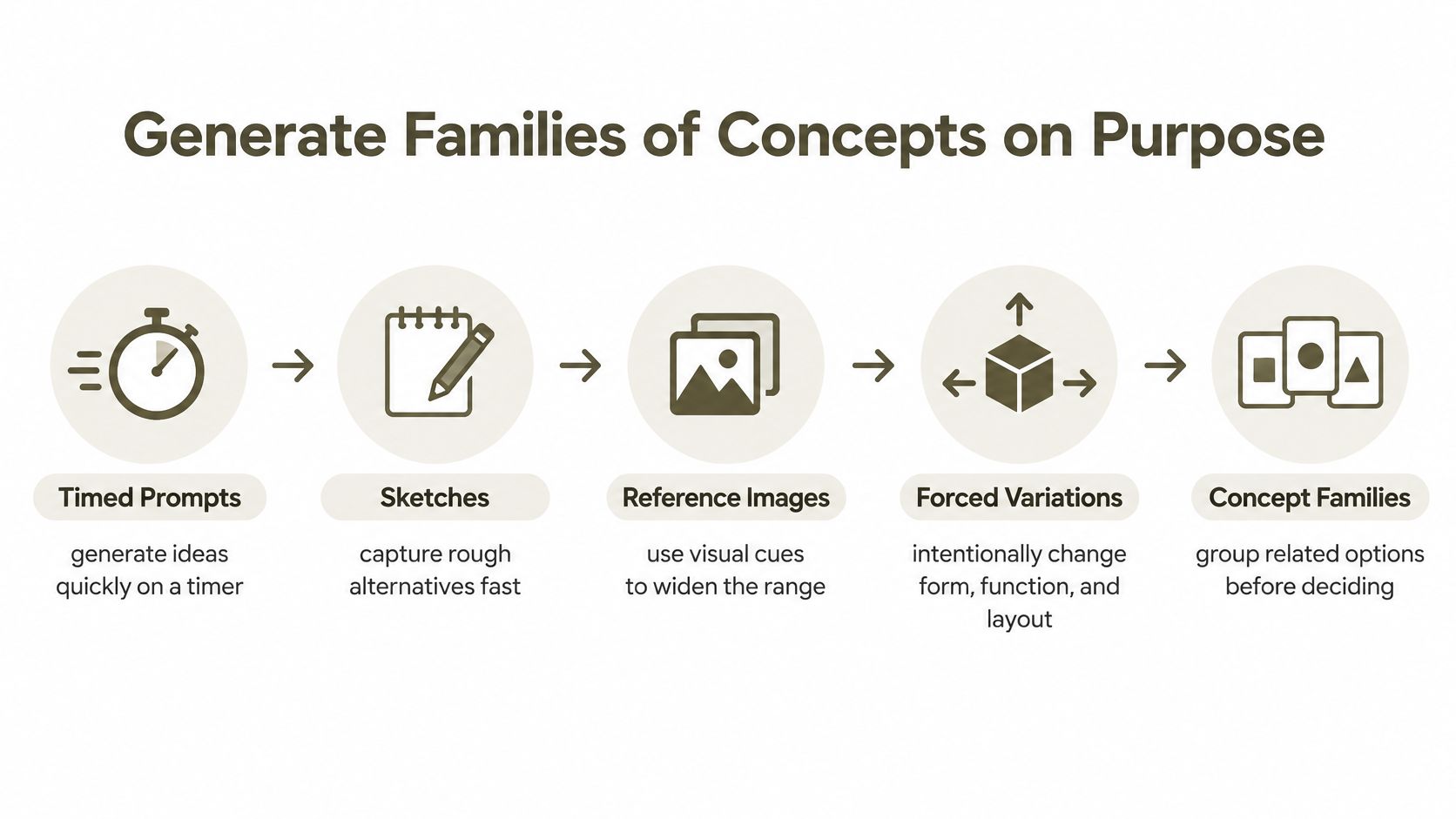
Novelty also fades inside a single sitting. Experimental fixation research found that the percentage of new ideas declines as sessions progress, with statistically significant negative relationships between idea order and novelty generation. The team keeps nudging the first attractive render. That is fixation, and it shows up fast in visual product work.
How to fill the wall without committing
- Cap the clock. Generate for a fixed window. When it ends, stop adding.
- Split the inputs. One person works from the problem. Another works from references. A third works from a hard constraint, such as fewer parts or a banned material.
- Force unrelated families. Do not let every concept be a tweak of concept one.
- Change the reference set. New images, not another pass on the same board.
- Keep the rejects. A killed direction is evidence, not clutter.
- Open the editor last. Silhouette, material, color, and detail edits happen only after families exist.
A library of editable blanks can start a family faster. A blank is a starting form, not a validated product. Label it that way so nobody treats a template as demand.
Three footwear families can share one Brand DNA palette and still differ. One is a cemented casual shoe with a low part count for a short lead time. One is a stitched trail shoe with a tougher outsole and a higher target price. One is a slip-on for indoor-outdoor use with a simple lining and an easy repair. Same brand, different construction, different use case. You have not chosen tooling, cost, or a factory.
Small-goods teams hit the same trap. A maker scanning a Shivora Candles handmade gift guide can list dozens of gift directions. Those directions stay concepts until vessel, wick, fill, pack-out, and order quantity are written as assumptions, not vibes.
Score Concepts Before Sampling Starts
Range is finished. The gate decides what is allowed to become a sample.
Evidence from 203 industrial product launches found that initial screening, preliminary market assessment, preliminary technical assessment, and detailed market research were strongly associated with launch outcomes, as reported in this review of early screening practice. A historical funnel benchmark in that same discussion is blunt: out of 100 initial ideas, about 15 survive screening, 6 survive development, 3 survive testing, and 2 reach commercialization. The point of the gate is to spend sampling money on the few that earned it.
Work the logic in this order, without treating brainstorming as the vote. Constraints are already written. Ideas already exist. Run a preliminary market check and a preliminary technical check. Score what remains. Prototype only the strongest. Build a quantified case before development.
Innovation leaders still put human insight ahead of shortcuts. 89% of surveyed companies said they often or always prioritize understanding customer needs, and 72% integrate direct user feedback and empathy-driven insights throughout development, according to Bain's 2025 innovation report on human insights. Faster ideation can raise the count of plausible concepts and also raise the odds you pick one with no demand. For how that evidence connects to design choices, see this discussion of product-market fit in AI-assisted design.
Concept Gate Scorecard
| Criterion | What good looks like | Kill signal |
|---|---|---|
| Customer-problem severity | A specific pain from the target segment | “Everyone might like this” |
| Distinctiveness | A difference a buyer can name | A color or logo swap |
| Desirability | Concept-test interest, not internal applause | Polite reactions only |
| Technical feasibility | A plausible route a factory can attempt | Unknown process or fantasy tolerance |
| Unit-economics potential | Cost sits inside the brief's price band | Margin only works if volume is magical |
| Supply-chain risk | More than one credible source, or a conscious single-source bet | One region, one mill, no backup |
| Speed to prototype | A sample path measured in a known cycle | Sampling requires a new factory category |
Every concept record should hold the target customer, use case, differentiator, material or technology assumptions, estimated cost, manufacturing route, and the validation evidence collected so far. If a field is empty, the concept is not ready to score.
Sustainability sits on the same card, not in a later checklist. In a 2025 survey of 254 manufacturing and supply-chain leaders, 95% said extreme climate events were affecting supply-chain strategy, 91% reported sustainability initiatives and governance, and 95% said implementing sustainable practices was important, according to Fictiv's 2025 State of Manufacturing report. Separately, 94% of consumer-product organizations reported taking steps toward greater sustainability, while AI use for sustainability rose to 38% in 2025 from 35% in 2024 and 24% in 2023. Score carbon and material assumptions, supplier concentration, repairability, expected life, and end-of-life. Label uncertain estimates as estimates.
Premature enthusiasm is the main failure mode. Weak customer definition and an unclear value proposition are reasons to reject, not reasons to “explore in sampling.” A gate review should kill a concept that cannot show a specific user pain, credible willingness to pay, manufacturability, or a testable advantage. The output is a kill, hold, or advance the team can defend in a meeting.
Turn Winners into Factory-Ready Specs
The decision is made. The remaining job is to stop the winner from being misread.
Teams usually move a concept in one of three ways.
A slide deck plus email is fast to send and slow to quote. Views live in one file, a cost guess in another, and construction in a thread. Version drift is the default. The factory comments on last week's PDF.
A CAD-only file can be precise and still unusable. Many consumer brands do not have CAD skill in-house, and a model without construction notes, components, and a manufacturing route does not answer an RFQ. The supplier guesses the seam, the hardware, or the tolerance, then you pay for the guess in the sample.
One shared record holds multi-view visuals, construction, components, and supplier notes together. Comments land on the file people will build from. That is the handoff that survives a factory review.
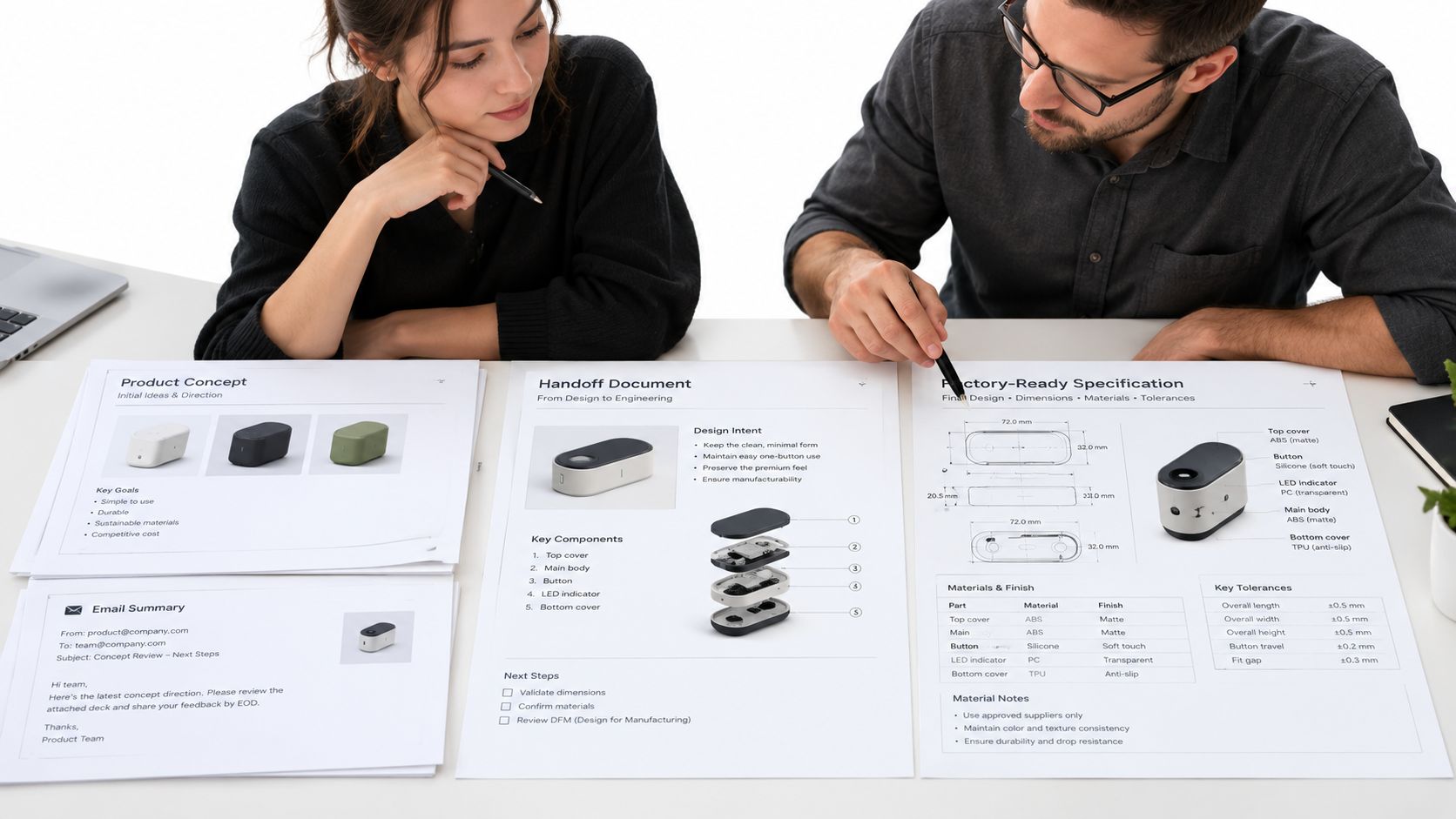
Genpire sits on that third path as an AI operating system for consumer goods. Prompts, sketches, and references become multi-view concepts. Brand DNA keeps generations on-brand. An editor revises silhouette, material, color, and detail, with manual override when the model is wrong. An agentic tech-pack workspace captures construction and component breakdowns. Exports to SVG, PDF, and Excel feed the people who still work in those formats. The same record should still carry the scorecard evidence: who the user is, why the concept advanced, and which cost and material assumptions are only estimates.
What the factory actually needs
Before an RFQ, a supplier should be able to see:
- Views and construction: How the product is built, not only how it looks.
- Components: Materials, trims, parts, and any technology assumptions.
- Route: The manufacturing path you think you are buying.
- Open questions: What you still need the factory to confirm.
Virtual Try-On and Marketing Studio are visualization and launch imagery. They are not proof of demand. A clean e-comm flat does not replace willingness to pay.
The pains this kind of record replaces are familiar: weeks-long cycles, agency handoffs, missing CAD skills, inconsistent tech packs, and slow photoshoots. Genpire states a cycle compression of 9–13 weeks and about 65% versus traditional processes. Treat that as a platform claim, not a result you can assume for every category. Free view-only supplier seats let a factory read the file without a paid seat. A unified file limits version drift. Plans are credit-based. The data policy states that customer designs do not train the models.
Physical categories outside soft goods face the same translation problem. Teams scaling up terpene-enhanced cannabis products still have to turn a promising formula direction into specifications a production partner can quote. Apparel and footwear teams can pressure-test that translation against design for manufacturing before the sample is cut. If the scorecard's kill signals are still open, do not hide them in a pretty export.
Pitfalls to Avoid and What to Do Next
The failures that wreck this work are consistent, and they are avoidable without a new framework.
Brainstorming is not the decision. A loud room can fill a wall. It cannot tell you which concept a buyer will pay for or which one a factory can make.
Do not refine the first pretty image. Cap the generation session. Vary references. Keep rejected families so the team can see what it walked away from, and why.
Do not skip willingness to pay. Interest in a rendering is not a price. If nobody has reacted to a cost, you do not have a commercial concept yet.
Do not hide uncertain cost or carbon estimates. Write the number, label it as an estimate, and say what would change it. A false precision is worse than a blank you admit.
Do not send a visual without a route. Construction, components, and a manufacturing path have to travel with the image. A human manufacturability review happens before a visual becomes a specification.
Sustainability does not wait until design approval. It belongs on the scorecard: part count, material combinations, durability, packaging, sourcing geography, and end of life. Choosing a recycled content callout after the silhouette is frozen is a late patch, not a front-end constraint.
Evidence bar before any sample
Advance a concept into sampling only when the record has all of these:
- Problem proof from the people who feel the pain.
- Target-segment input, not a generic persona.
- A concept test or a willingness-to-pay signal.
- A preliminary bill of materials.
- Supplier feedback on route, minimums, or risk.
- A written kill-or-advance note someone will stand behind.
Pick one live consumer concept this week. Fill the brief and the scorecard. Generate at least three unrelated families inside the brand's visual rules. Advance only the concept that survives the gate, and put it into a shared spec a supplier can view. If you want that chain in one workspace instead of prompts, slides, and spreadsheets, run the flow on Genpire and keep the evidence on the same record as the drawing.
Genpire turns prompts, sketches, and references into multi-view concepts and factory-ready specs for consumer goods, so a product idea generation process can carry customer proof, materials, cost, and manufacturing assumptions in one record. Use it to brief, generate concept families, and export construction a supplier can quote. Visit Genpire and put one live concept through that chain this week.