You're reviewing a tech pack for a new bag or jacket, and two words keep appearing on almost every line. The shell says polyester. The coating says polyurethane. The lining, strap, and trim repeat the same names in different combinations.
That repetition isn't lazy specifying. Polyester and polyurethane do different jobs, and confusing them leads to samples that crack, delaminate, or fail your sustainability claim. Learning to specify each one precisely is now a core product skill.
Table of Contents
- Why Polyester and Polyurethane Matter to Product Designers
- The Polymer Foundations Behind Polyester and Polyurethane
- How Polyester and Polyurethane Differ in Performance
- Where Polyester and Polyurethane Show Up in Apparel and Accessories
- Care, Durability, and Aging Implications for Real Products
- The Bio-Based and Compostable Question Mark
- Recycling Realities for Polyester-Based Polyurethane
- A Spec-Ready Checklist for Designers and Manufacturers
Why Polyester and Polyurethane Matter to Product Designers
You're building a small collection, maybe a rain jacket, a tote, and a trainer. Your factory asks a simple question you can't answer from the sketch alone. Which polyester, and which polyurethane, exactly?
That's the moment material literacy stops being background knowledge. A woven polyester shell behaves nothing like a polyurethane coating on top of it, even though both names sit in the same bill of materials. If you write only the generic names, the factory fills the gaps with whatever grade it has in stock.
What goes wrong with generic calls
Consider a synthetic leather bag. You want a soft hand feel, clean folding at the gusset, and a surface that survives daily abrasion. Your supplier can meet that brief with several polyurethane chemistries, coating weights, and backing fabrics, each with different aging behavior.
If your spec doesn't separate the backing fiber, the coating chemistry, and the finish, you're not really approving a material. You're approving a look on day one. Problems show up later as peeling, stiffness, or color change.
A material name tells a factory a family. A specification tells it which member of that family to buy, test, and repeat.
Buyers and regulators now ask harder questions too. Where did the fiber come from? Is any content recycled? Can the product be separated at end of life, and does your durability claim have test data behind it?
Those questions connect design choices to manufacturing reality. Treating material selection as part of design for manufacturing decisions means you decide construction, bonding, and testing while you're still sketching, not after sampling.
Two families, not two single materials
Think of polyester mainly as a fiber and fabric platform. Think of polyurethane mainly as a tunable system you can make soft, foamy, elastic, or rigid. They also combine, because many polyurethanes are built using polyester polyols.
That overlap is where most confusion starts. Once you can separate fiber, coating, foam, and molded elastomer in your own head, supplier conversations get much shorter and samples get closer first time.
The Polymer Foundations Behind Polyester and Polyurethane
Start with a plain analogy. A polymer is a long chain built from repeating links. Change the links, and you change whether the chain packs into a strong fiber or stretches like rubber.
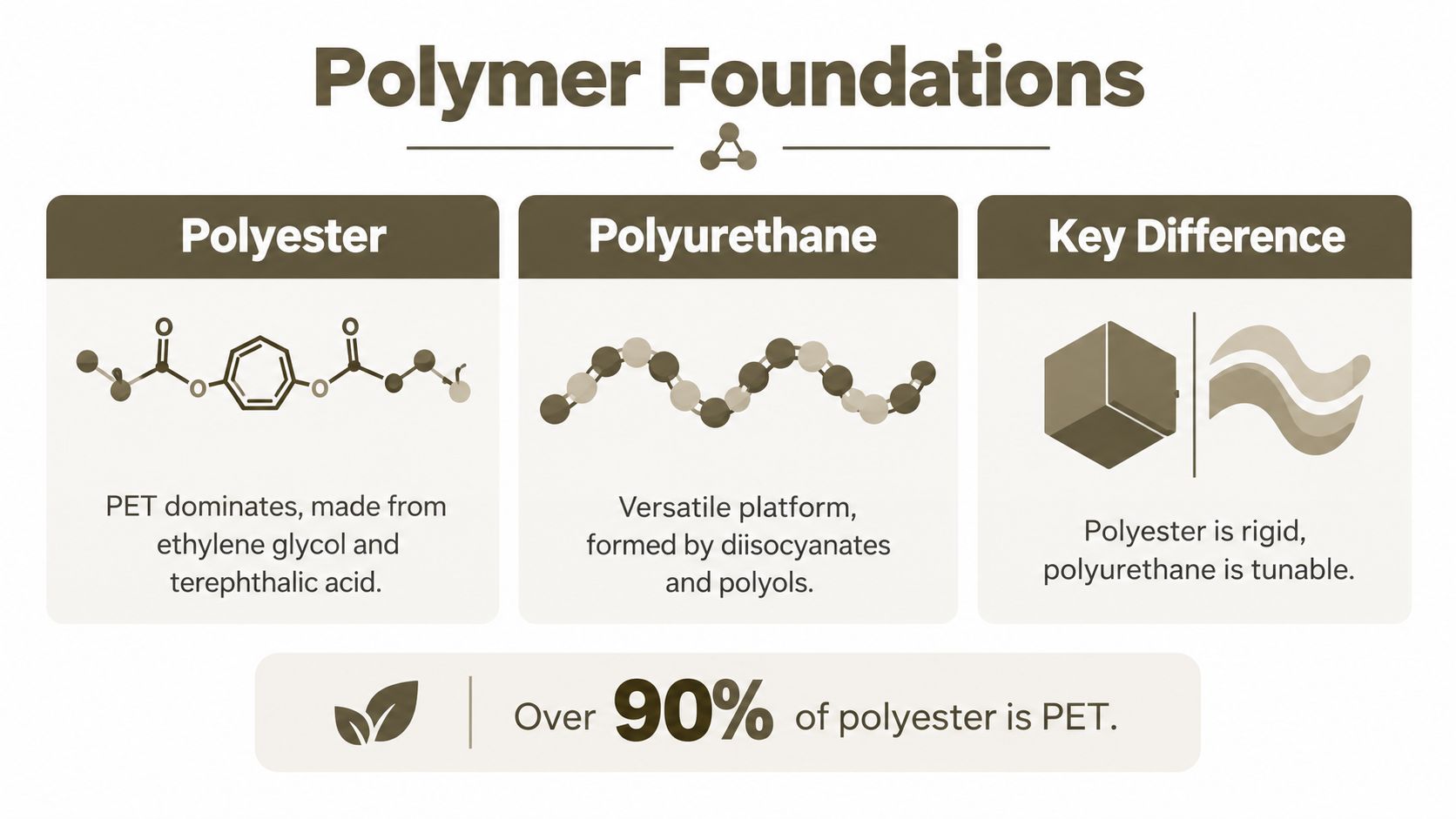
Polyester gets its name from ester links along the chain. In textiles, that almost always means polyethylene terephthalate, or PET. PET was patented in 1941 by British chemists John Rex Whinfield and James Tennant Dickson, yet polyester became a major textile material only from the 1970s onward, and more than 60% of PET production is used for textile fibers, according to the polyethylene terephthalate production and history overview.
Why PET became the default fiber
PET chains pack in an orderly way when drawn into filament. That gives you useful tensile strength, dimensional stability, and repeatability at low cost. Mills can then turn the same polymer into filament yarn, staple fiber, fleece, woven shell fabric, or knitted lining.
The scale is hard to overstate for sourcing. In 2018, global production of all natural and synthetic textile fibers reached approximately 107 million metric tonnes, with synthetic fibers accounting for nearly two-thirds of the total, and polyester represented about 55 million tonnes, as reported in the source linked above. You're not specifying a niche fiber. You're specifying the world's most widely used synthetic fiber.
Why polyurethane works differently
Polyurethane is built around urethane links formed by reacting polyols with isocyanates. Change the polyol, the isocyanate, or the additives, and you don't get a minor variant. You can get flexible foam, rigid insulation, an elastic coating, an adhesive, or a synthetic leather surface.
Otto Bayer and colleagues produced the first polyurethanes in 1937, commercial polyisocyanates followed in 1952, and flexible polyurethane foam production began in 1954, while worldwide production reached approximately 25 million metric tonnes by 2019, equivalent to about 6% of all polymers, according to the polyurethane history and production overview. Flexible and rigid foams represented roughly 67% of polyurethane production in 2016, per the same source.
That helps you read a data sheet correctly. Polyester usually narrows the conversation quickly. Polyurethane only starts it, because you still need chemistry type, hardness, form, and processing method.
How Polyester and Polyurethane Differ in Performance
A PET bottle, a polyester fleece, and a polyurethane coated jacket don't feel related in use. That's because form matters as much as chemistry. Fiber orientation, coating thickness, and crosslinking change what your hands and test lab measure.
Use the numbers below as a sanity check when a supplier sends a data sheet. They won't replace testing your exact construction, but they show whether a claim is in a plausible range.
Polyester vs Polyurethane Performance Snapshot
| Property | Polyester Fiber (PET) | Polyester PU Coating | Polyester TPU |
|---|---|---|---|
| Typical role | Woven, knitted, or fleece fabric | Thin flexible surface or waterproof layer | Molded, extruded, or laminated elastomer |
| Stretch behavior | Limited unless textured or blended | High, designed to bend and fold | High, varies with hardness |
| Main strength | Tensile strength and dimensional stability | Flexibility with surface protection | Elasticity with thermoplastic processing |
| Moisture concern | Low fiber absorption, finish matters | Hydrolysis risk in heat and humidity | Drying needed before processing |
| Spec risk | Wrong yarn, weave, or finish | Generic PU call with no chemistry | Wrong grade or wet resin |
Coatings that have to move
For flexible coated textiles, representative polyester PU grades report tensile strengths of approximately 20 to 35 MPa and elongation at break of roughly 430 to 450%, according to the Icaflex polyester polyurethane product details. That elongation explains why a thin coating can fold at a seam without cracking straight away.
It doesn't mean every coating survives a product's life. Polyester PU is more vulnerable to hydrolysis than polyether PU, especially with prolonged humidity, sweat, or wet storage. If you're comparing active or recovery garments, this Thermo Recovery Wear fabric breakdown is useful context for how moisture facing fabrics get described to wearers, but your tech pack still needs the underlying chemistry and test limits.
Molded parts that have to process cleanly
Polyester based thermoplastic polyurethane, or TPU, sits in a different category. Commercial data indicate tensile strength around 25 to 70 MPa, a processing or melt range near 170 to 220 °C, and service temperatures commonly spanning approximately minus 20 to 120 °C, according to the Formerra thermoplastic polyurethane overview.
Those ranges are wide because hardness and formulation change the result. Don't compare a soft TPU film with a hard molded heel counter as if they're interchangeable. Ask for grade, Shore hardness, and the exact test method behind every value.
Where Polyester and Polyurethane Show Up in Apparel and Accessories
Audit a finished jacket from outside to inside and you'll usually find both polymers several times. The trick is naming the job each layer performs, rather than listing materials as decoration.
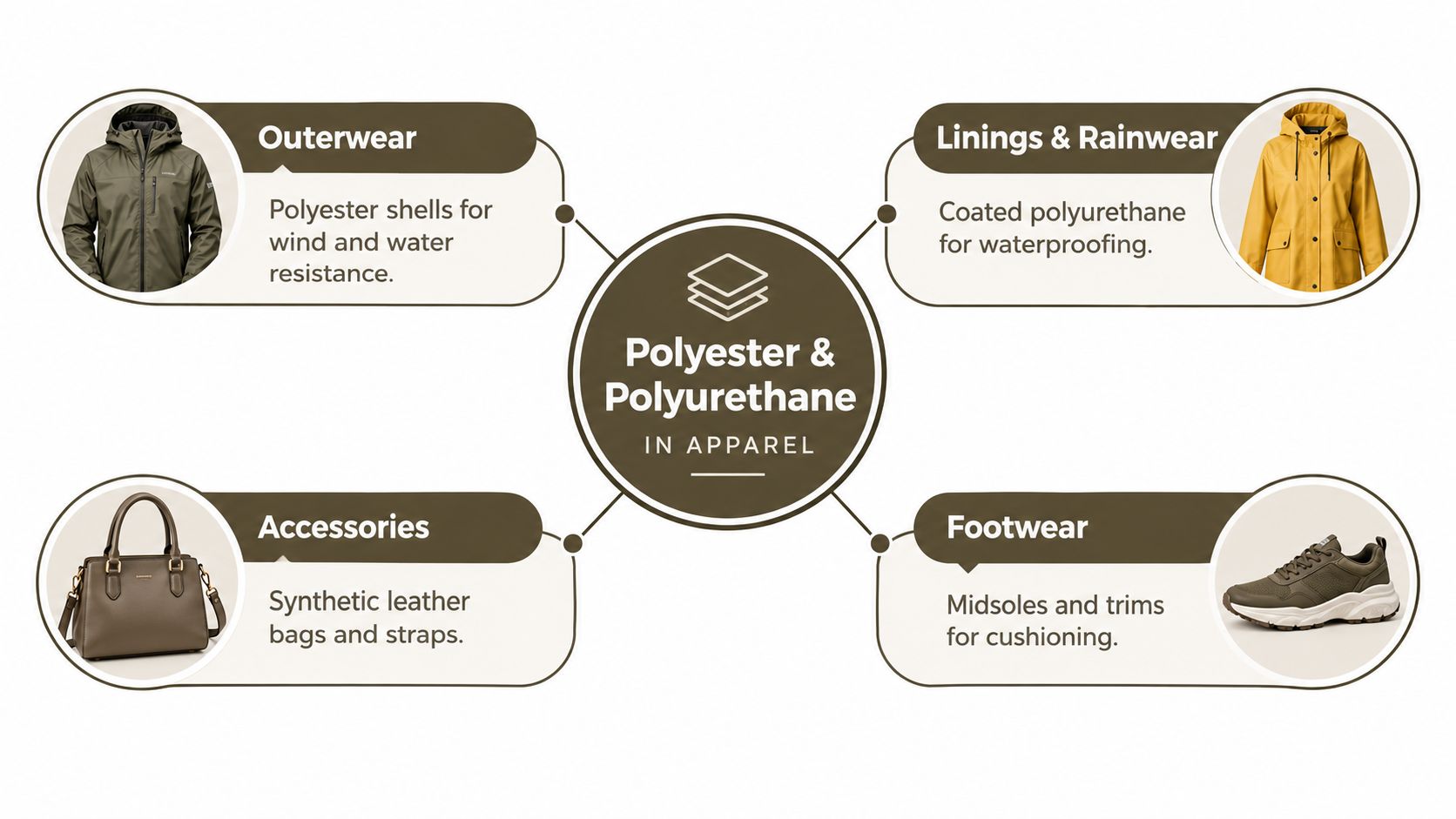
A typical rain shell uses woven polyester for the face fabric because it holds shape and accepts durable finishes. A PU coating or laminate underneath provides water resistance. A polyester lining then protects that coating from abrasion against clothing and skin.
Common pairings you'll see in tech packs
- PU coated polyester: Rainwear, bag shells, and packable outer layers where you need a light fabric with added water resistance and a dry surface.
- Synthetic leather: A PU surface over a polyester or blended backing for bags, straps, footwear uppers, and trims that need consistent color and grain.
- Foam lamination: Polyester fabric bonded to PU foam in bra cups, shoulder straps, padded panels, and protective cases where cushioning matters.
- TPU details: Welded logos, abrasion patches, heel counters, eyelet reinforcements, and molded components that need elasticity plus clean edges.
Footwear shows the separation clearly. Polyester mesh gives the upper structure and breathability. PU foam can cushion the collar or midsole, while TPU parts add support where a soft foam would deform too easily.
Bags follow the same logic. A polyester canvas carries the load, a coating slows water entry and staining, and foam behind a laptop panel absorbs knocks. If one layer fails, users describe the whole bag as poor quality, even though the failed polymer did only one job.
Practical rule: Write the function beside every material call, such as load bearing, waterproofing, cushioning, or surface appearance. Factories solve the right problem faster when they know why a layer exists.
That habit also exposes weak constructions early. If you can't explain why a coating, foam, and adhesive all need to be there, you may be adding cost and recycling problems without improving the product.
Care, Durability, and Aging Implications for Real Products
Most polyester fiber survives ordinary washing well, but the product around it may not. Coatings, laminates, foams, prints, and adhesives usually set the care limit, not the base fabric.
Heat, humidity, sweat, sunscreen, and long storage in a sealed bag can attack polyester PU through hydrolysis. The first signs are often tackiness, cracking at folds, or flaking along seams. By the time a customer sees peeling, the chemistry has been changing for a while.
Moisture control starts in the factory
TPU adds a processing lesson that designers rarely see. Water absorption is often reported near 0.5 to 1.2% after 24 hours at 23 °C, and one representative specification limits pre processing humidity to 0.02% with drying for about 2 to 3 hours at 100 to 110 °C, as noted in the Formerra source linked above.
Wet resin can produce bubbles, surface defects, and weaker molded parts. You don't need to run the dryer yourself, but your specification should require the supplier to state grade, drying profile, and maximum moisture content. Small skin contact products make the point well, and ranges such as Watch bands show how straps face sweat, washing, flexing, and storage conditions that quickly expose a weak elastomer choice.
Tests worth requesting before bulk
- Hydrolysis aging: Accelerated exposure that helps predict cracking or tackiness in humid use and storage.
- Abrasion testing: Surface wear data for coated fabrics, synthetic leather, straps, and high contact panels.
- Wash fastness: Appearance, adhesion, and dimensional checks after the care cycles you're claiming.
- Flex testing: Repeated bending at folds, gussets, toe spring areas, and strap attachment points.
Don't accept a pass with no conditions attached. Ask which standard, load, temperature, humidity, and number of cycles produced the result. A test that doesn't resemble your product's life gives false confidence.
Care labels should then match the evidence. If a coated jacket needs cool washing and air drying to protect the laminate, say so plainly. Don't promise easy care just because the polyester face fabric could tolerate more.
The Bio-Based and Compostable Question Mark
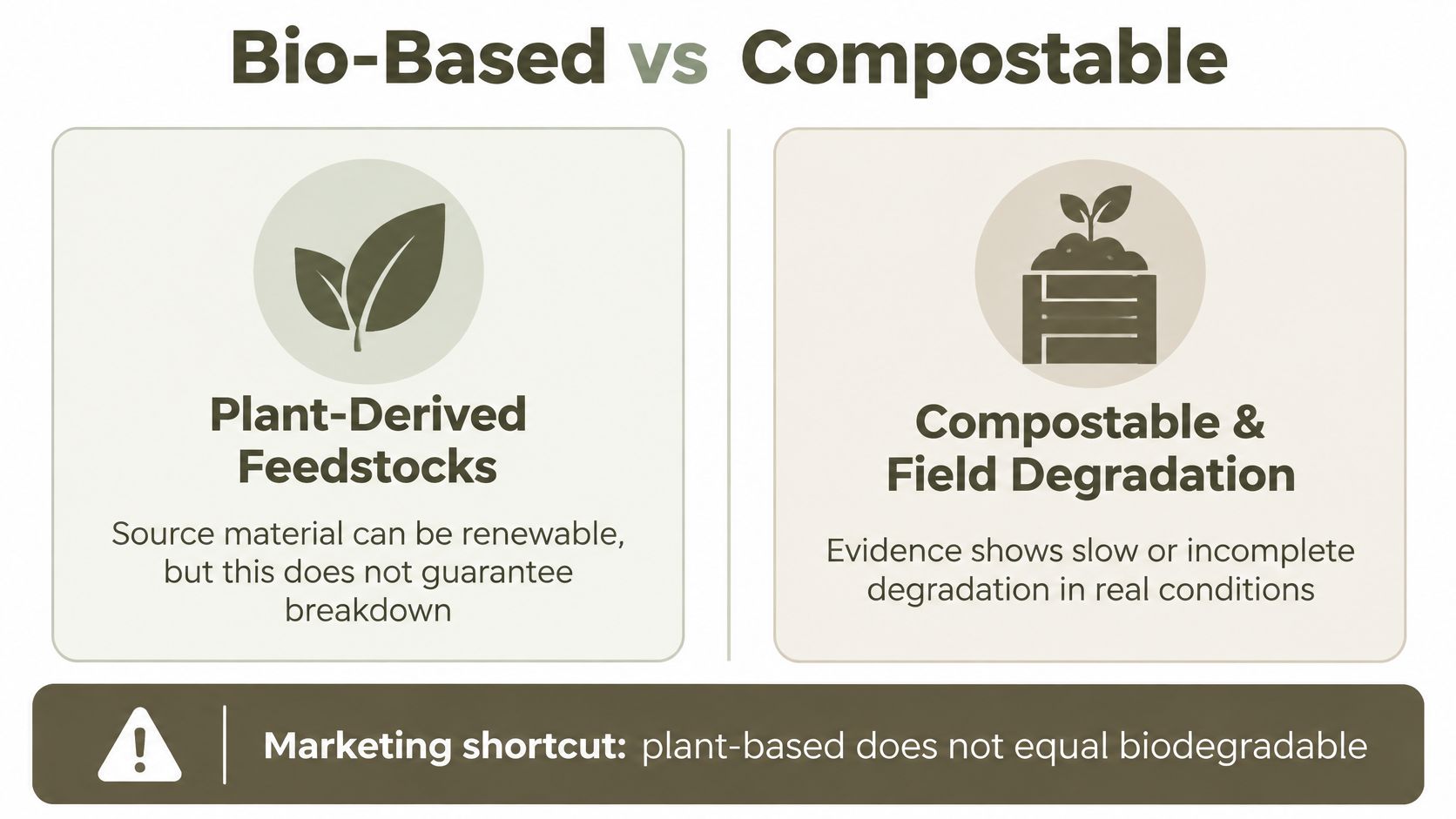
Plant derived doesn't automatically mean biodegradable. Those phrases answer different questions, and mixing them up creates the fastest route to an unsupported product claim.
Bio-based describes where some carbon in the material came from. Compostable describes what happens under specific conditions, within a specific time, using a specific test. A polyurethane can use a bioderived polyol and still persist for a very long time after disposal.
What the degradation evidence actually says
In a 45 day composting test, polyurethane foams made from bioderived polyester polyols showed average mass loss of 25.4 plus or minus 3.6% and greater disintegration than comparable polyether polyol polyurethane, according to the bioderived polyurethane composting study.
Read that carefully. Mass loss and disintegration aren't the same as complete biodegradation into safe compost. A sample can break into smaller pieces while much of the polymer remains.
Field conditions are slower still. A separate 807 day field study reported that a starch based polyurethane coating degraded 2.2 times faster than petroleum based polyester polyurethane, yet still estimated roughly 75 years for 90% degradation when buried in soil, compared with about 163 years for the petroleum based counterpart, as summarized with the composting evidence above.
Questions to ask before you print a claim
Ask the supplier which part is bio-based, the polyol, the whole polymer, or only one ingredient. Ask which additives, pigments, coatings, and adhesives sit in the finished construction. Then ask which environment the test used, because industrial compost, home compost, soil, landfill, and marine conditions aren't interchangeable.
You'll also need durability in the same conversation. A faster degrading coating that fails early can create more waste through returns and replacements. Comparing options through sustainable manufacturing options and material trade offs helps keep carbon origin, service life, toxicity, and end of life in one decision instead of treating a leaf icon as proof.
Write claims narrowly. Name the component, the bio-based content basis, and the verified disposal route if one exists. If you can't name all three, you don't have a consumer ready claim yet.
Recycling Realities for Polyester-Based Polyurethane
Can polyester based polyurethane be recycled at high quality, rather than shredded into a lower value filler? Sometimes, in controlled conditions. That answer is more useful than a blanket yes.
PET fiber recycling and PU foam recovery are different systems. Once you bond polyester fabric, PU coating, foam, adhesive, and print into one inseparable panel, a recycler receives a composite, not a clean polymer stream.
Chemical recycling changes the conversation
A 2025 ACS study demonstrated two chemical recycling pathways for conventional polyester polyol polyurethane, one pot hydrolysis and a two step process using methanolysis followed by hydrolysis, recovering identifiable feedstocks including adipic acid, monoethylene glycol, dimethyl adipate, and 4,4 prime methylenedianiline, according to the ACS polyester polyurethane chemical recycling study.
That matters because it shows a route back to chemical building blocks. It doesn't prove your shoe, bag, or jacket can enter that route today at commercial scale.
Laboratory recovery proves chemistry is possible. Product design, collection, sorting, and economics decide whether recovery happens.
Clean production scrap is the easiest starting point. The factory knows the formulation, color, additives, and contamination level. Post consumer products arrive mixed, dirty, aged, and often missing any useful material declaration.
For a consumer facing comparison of recycled fabrics, the recycled material bag breakdown is a helpful plain language starting point. Your internal spec needs more detail, including polymer family, coating type, adhesive, filler, pigment, and whether layers can be separated.
Design choices that keep options open
Favor constructions a recycler can identify and process. Reduce unnecessary mixed laminates, document every layer, and ask whether mechanical fastening can replace permanent bonding in low stress areas. Where bonding is essential, record the adhesive family instead of hiding it under a generic assembly note.
Also ask an uncomfortable question early. Will the energy and chemical inputs for depolymerization beat the benefit for this specific waste stream? If nobody can answer, describe the product as designed with recovery in mind, not as recyclable without qualification.
In the United States alone, approximately 3.7 million tonnes of polyurethane were consumed in 2016, about 2.0 million tonnes were discarded, and only around 390,000 tonnes were recycled, primarily into carpet underlayment, as reported in the polyurethane source linked earlier. That gap is your design brief. Durability, separability, and honest labeling matter because recovery infrastructure can't fix an undocumented composite on its own.
A Spec-Ready Checklist for Designers and Manufacturers
Copy the fields below into your next tech pack and force an answer for each one. Blank fields are useful too, because they show exactly where a supplier conversation needs to happen before sampling.
You don't need chemistry training to use this well. You need consistent questions, named test methods, and a record that travels from concept to bulk without getting rewritten in email threads.
Material identity fields
- Polymer family and form: State PET fiber, polyester PU coating, polyether PU, PU foam, or polyester TPU, plus woven, knitted, film, foam, or molded form.
- Grade and supplier code: Record the commercial grade, not only a color name or hand feel description.
- Construction details: Add yarn or fabric construction, coating weight, foam thickness, hardness, backing, adhesive, and finish.
- Content claims: Separate recycled content, bio-based content, and virgin content by component, with the calculation basis.
Using structured fields like these in a workspace such as Genpire, where concepts move into component level tech packs, can help keep the same material language in front of designers and suppliers. The tool doesn't make the decision for you. It reduces the chance that a decision gets lost.
Performance and processing fields
- Mechanical targets: Tensile strength, elongation, tear, abrasion, and flex requirements tied to the component's actual job.
- Aging requirements: Hydrolysis, UV, wash, sweat, and storage conditions with acceptance limits after exposure.
- Processing controls: For TPU, resin drying profile, maximum moisture, melt window, hardness, and conditioning after molding.
- Care validation: The exact wash and dry method used to approve the care label you're printing.
Review your document against spec sheet essentials for fashion designers before you send it, especially if several people edit materials, trims, and construction pages separately. Consistency across pages prevents a factory from following an old coating call on page two after you changed it on page five.
End of life fields
- Separability: State whether layers can be removed, and give disassembly instructions where that's realistic.
- Declarations: List coatings, adhesives, fillers, pigments, and finishes that affect recovery.
- Claim evidence: Attach the test standard and conditions behind recycled, bio-based, compostable, or recyclable wording.
- Scrap route: Ask the factory how clean cutting and molding scrap is segregated during production.
End every supplier review with one direct question. What would you change in this construction to make it last longer and be easier to recover? You'll learn quickly whether you're talking to a factory that understands materials or one that's only matching a sample by sight.
Turn your next polyester and polyurethane brief into a factory ready product package with consistent material fields, component breakdowns, and tech pack exports in one workspace. Visit Genpire to move from prompt or sketch to production assets your suppliers can review and comment on directly.