A founder has a strong product idea, a polished sketch, and a supplier ready to review it. Then the questions arrive. What material should the factory use? Which seams are intentional? How should the product look from the side? Does the design still fit the brand when production constraints are applied?
This gap between an appealing idea and a buildable product is where many launches slow down. AI can now generate visual directions quickly, but more options don't automatically create better decisions. Without a method for filtering concepts, teams can spend less time drawing and more time sorting through attractive ideas that aren't feasible, distinctive, or worth sampling.
Product concept design closes that gap. It turns a brief, a customer need, and a brand point of view into visual and functional proposals that people can compare, test, refine, and eventually document for production. The strongest process treats concepting as a decision system, not a creativity contest.
That shift matters to several teams at once. Designers need a clear way to explore without losing the original brief. Founders need confidence that a concept deserves investment. Sourcing and manufacturing teams need enough detail to judge materials, construction, and supplier capability before a sample is ordered.
The practical path is straightforward. First, define what a concept must achieve. Then connect visual exploration to user preference, brand DNA, manufacturability, and lifecycle cost. Finally, carry the selected direction into technical documentation and validation. The result isn't a better-looking sketch. It's a concept with a defensible reason to move forward.
Table of Contents
- Introduction to Product Concept Design That Actually Ships
- What Product Concept Design Really Means
- Why Early Concept Decisions Drive Cost Speed and Quality
- The Product Concept Design Process From Brief to Validation
- Essential Deliverables and Best Practices That Prevent Rework
- Tools and AI Workflows That Accelerate Concepting
- Real World Examples and Your Next Steps in Product Concept Design
Introduction to Product Concept Design That Actually Ships
A designer creates ten attractive handbag concepts in an afternoon. The founder selects one, then the supplier flags unavailable hardware, a material that cannot hold its shape, and construction details too vague to price or sample. The team revisits the drawings while the launch calendar stays fixed.
The underlying problem is treating the image as the product concept. A useful concept is a decision record. It identifies the intended user, the problem or opportunity, the brand cues, materials, key dimensions, construction logic, and unanswered questions. Those details give design, sourcing, and manufacturing teams a shared basis for deciding whether an idea deserves a tech pack and a sample.
Physical product development can take many months from an approved direction to an initial release. The full path from idea to first shipment also commonly spans a long development cycle, as outlined in consumer product development guidance. One benchmark places the route from a validated concept to an initial release at 12 to 18 months, according to product launch timeline benchmarks. Concept decisions continue affecting tooling, sampling, sourcing, and launch timing after the original sketch is no longer visible.
Practical rule: Advance a concept when another team can understand what to build, why it matters, and what still requires testing.
AI increases the speed and volume of exploration. Prompt-based tools can generate silhouettes, colorways, materials, and use contexts before a traditional sketching session is complete. The gain is useful only when each option receives a clear selection rationale tied to feasibility, brand DNA, user value, and lifecycle cost. Otherwise, faster ideation produces a larger sorting problem.
Product concept design therefore works like a filter as well as a generator. It helps a team compare directions, reject attractive but impractical ideas, and reserve technical documentation and sampling for concepts with a defensible path to production. This guide explains that path, from brief and early decisions through validation, deliverables, and AI-supported workflows.
What Product Concept Design Really Means
Think of a product concept as a movie trailer, not the finished film. A trailer communicates the central idea, mood, characters, and promise. It helps people decide whether the direction is worth pursuing. It doesn't contain every production detail, but it must be coherent enough to support a decision.
Product concept design performs the same job. It translates a user need, market opportunity, or brand intention into a proposed product direction before the team commits to detailed engineering, tooling, or production. The output can include sketches, renders, reference materials, color options, functional notes, and early feasibility assumptions.
The distinction between related design activities
Ideation produces possibilities. A designer may explore a wide range of shapes, features, and visual languages without resolving them. Ideation favors breadth.
Concept design gives selected possibilities enough structure to compare. It asks whether the product communicates the intended value, fits the brand, serves a real use case, and could plausibly be made.
Industrial design develops the product's form, interaction, ergonomics, materials, and manufacturing logic in greater detail. Engineering converts those decisions into technical systems, tolerances, components, and processes. Prototyping creates a physical or functional representation so the team can test assumptions.
A fashion example makes the difference clear. Ideation might generate cropped jackets with different collars, closures, and proportions. Concept design chooses a few coherent directions and documents their intended fabric weight, fit, pocket placement, visual references, and target wearer. Technical design then turns the chosen direction into measurements, construction details, and a sample request.
The same logic applies elsewhere:
- Furniture: A concept defines the intended sitting experience, silhouette, material character, joinery direction, and room context before detailed CAD.
- Consumer electronics: A concept aligns the product's physical language, interaction priorities, display placement, and brand expression before engineering resolves internal packaging.
- Home goods: A concept connects use case, form, material, cleaning requirements, packaging constraints, and visual identity.
Why the concept is a decision artifact
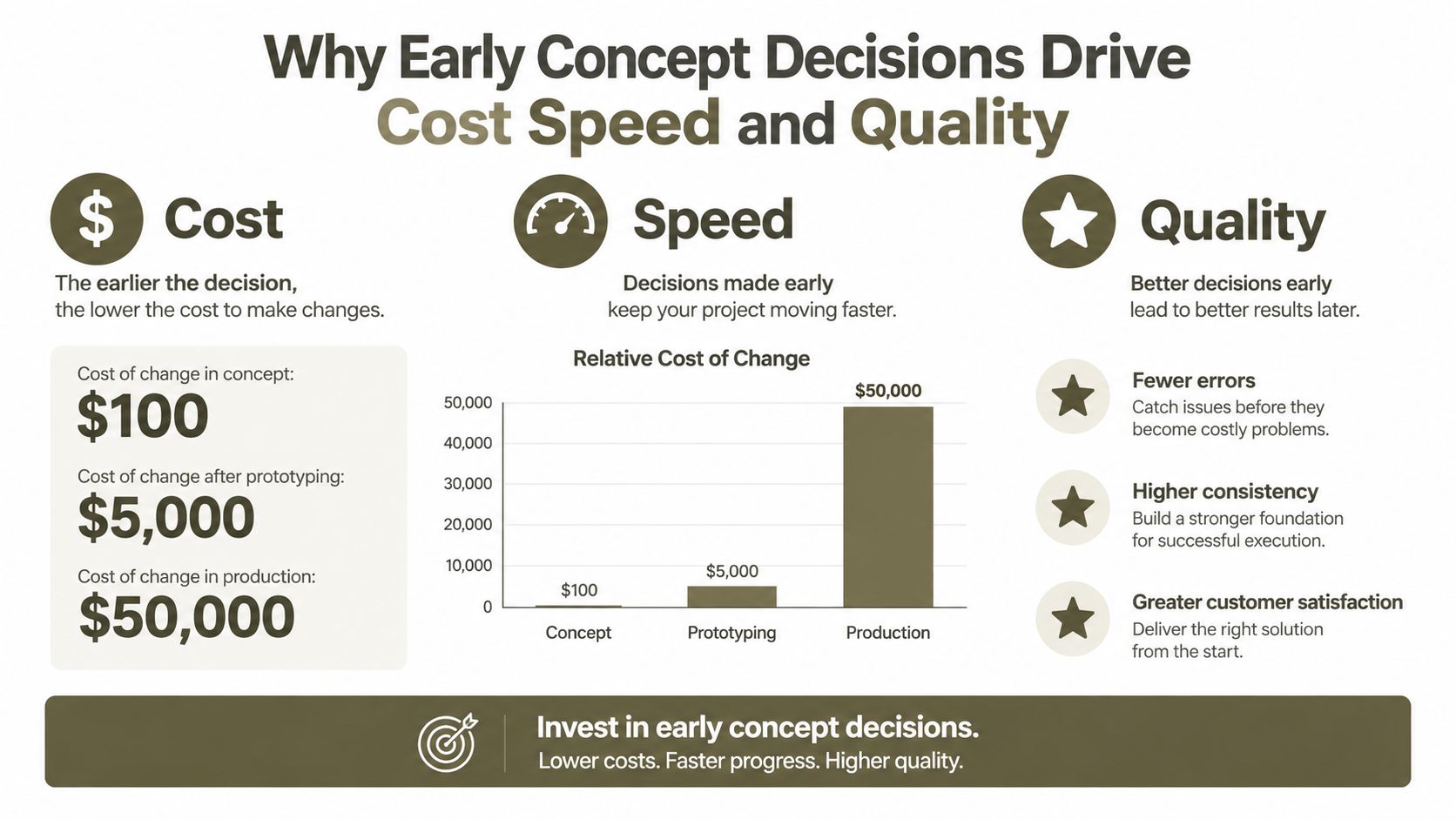
A concept doesn't need to answer every production question. It does need to expose the important ones early. If the proposed chair requires a material that scratches easily, or the electronic device's shape leaves no room for assembly, the team should discover that before committing to tooling.
The best concept makes trade-offs visible. It gives design, engineering, sourcing, marketing, and leadership a shared object to discuss, rather than separate assumptions hidden in conversations.
Why Early Concept Decisions Drive Cost Speed and Quality
A founder approves a polished concept on Monday. By Friday, a supplier has priced materials, engineering has reviewed the construction, and the sample request is underway. Then someone notices that the closure is difficult to use or that the shape does not fit the brand. A change that took minutes in a concept image now affects specifications, sourcing, tooling, and schedules. Early decisions do not remove uncertainty. They make uncertainty cheaper to investigate.
The calendar shows the difference. Design-led workflows commonly spend 2 to 4 weeks on initial design, followed by 3 to 6 weeks for prototyping, according to product development timing research. In fashion and soft goods, technical design and tech-pack creation commonly take 1 to 3 weeks, while sampling often takes 4 to 8 weeks across 2 to 3 rounds, according to fashion production timeline guidance.
These periods depend on one another. A fast sketch has little value if the selected concept causes repeated sampling. A precise tech pack cannot rescue a product that customers do not understand or want. Quality comes from connecting desirability, brand fit, feasibility, and production detail before the direction becomes expensive to change.
Four forms of advantage
Market advantage comes from selecting a concept that addresses a meaningful need or creates a clear opportunity. Internal excitement is not enough. The review should identify the user problem, expected behavior, and reason someone would choose the product.
Brand strength comes from applying recognizable brand cues deliberately. Color, proportion, material, detail, and interaction can express brand DNA. The team should distinguish the elements that must remain from those that can change across categories.
Manufacturing insight comes from testing feasibility while alternatives are still available. Designers can compare a complex closure with a simpler construction, or a premium material with a more available substitute, before the direction is fixed. Applying design for manufacturing principles helps connect visual intent with production constraints.
Schedule advantage comes from reducing ambiguity at handoff. Clear specifications let suppliers interpret the same design intent instead of filling gaps with assumptions that return as sample corrections.
For apparel and consumer goods, detailed documentation can reduce avoidable sampling work. Brands with detailed professional tech packs average 1.8 sample rounds before approval, compared with 3.4 rounds for incomplete tech packs, according to tech-pack benchmarks and manufacturing guidance. The same source reports that unclear or missing measurement specifications account for roughly 40% of first-sample rejections.
The expensive mistake isn't choosing a rough direction. It's treating an unresolved direction as production-ready.
A useful concept review asks more than “Do we like it?” Reviewers should ask which user behavior the concept supports, which brand cues it preserves, what materials and components it assumes, what could fail during sampling, and whether its expected value justifies the effort required to make it.
The diagram below shows a sequence for turning early intent into a validated direction.
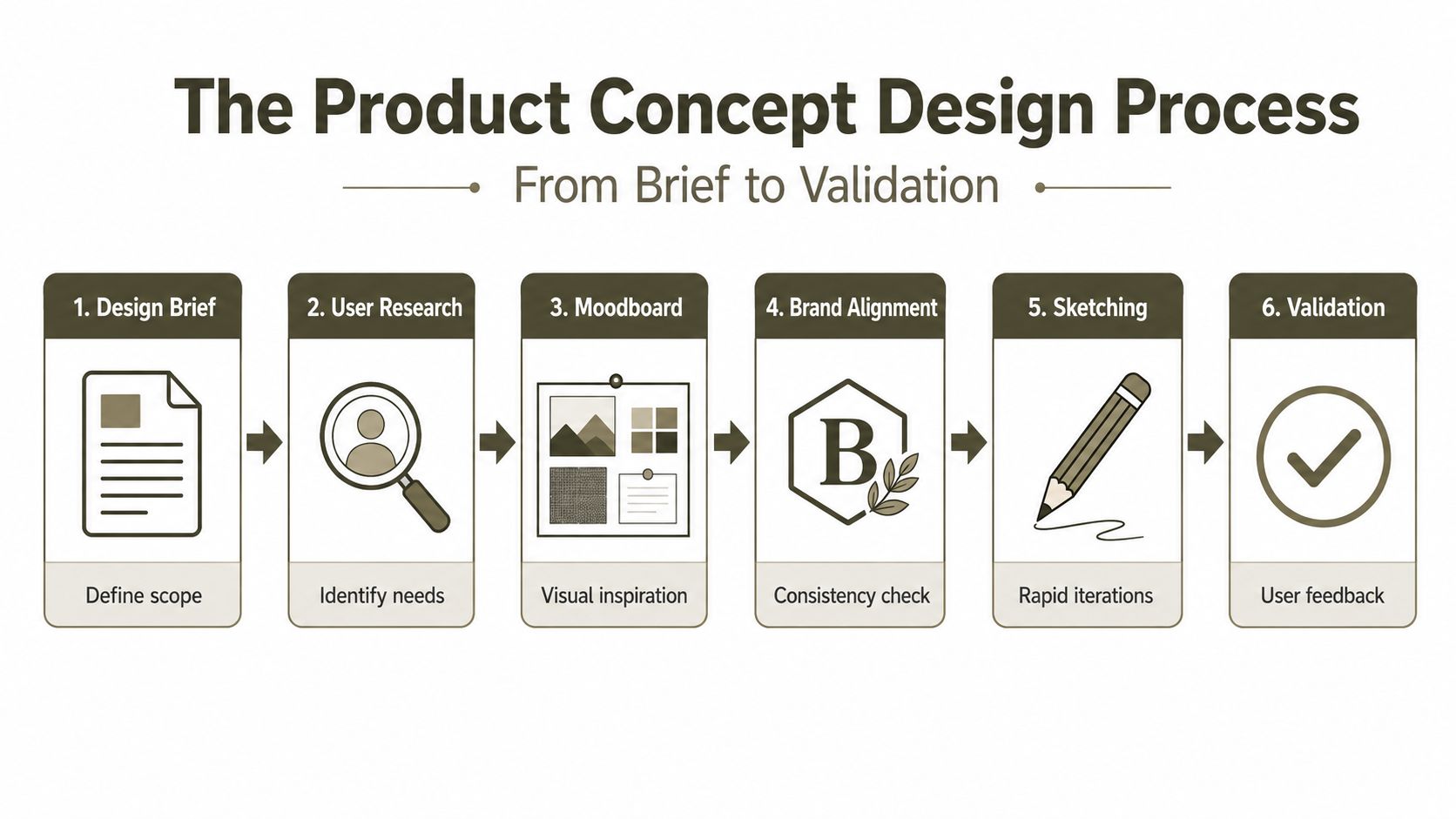
Concept testing then helps the team compare directions, gather evidence, and decide which ideas deserve a tech pack and sample. AI can speed up that comparison by organizing references, surfacing repeated constraints, and documenting decisions. Human judgment still determines whether the concept fits the user, the brand, and the product's lifecycle cost.
The Product Concept Design Process From Brief to Validation
A reliable workflow behaves like a chain. Each stage creates an input for the next, so the team doesn't jump from a vague idea directly to a polished render.
Start with a decision-ready brief
Write down the intended user, use case, business objective, category, price or positioning logic, launch context, constraints, and success criteria. Include boundaries such as preferred materials, target production method, required certifications, packaging needs, or essential brand elements.
A weak brief says, “Create a modern travel bag.” A stronger brief says, “Create a compact travel bag for commuters who need quick access, weather resistance, and a quiet premium appearance. Preserve the brand's restrained geometry and tactile material language.”
Research the person and the opportunity
Research should reveal what people currently do, where existing products frustrate them, and what alternatives already satisfy the need. Review customer conversations, competitor products, category reviews, supplier input, and relevant market signals.
Don't confuse popularity with opportunity. Academic work on design gaps and product opportunity identification describes valuable opportunities as spaces where consumer preference and manufacturing feasibility intersect. That means a concept can be attractive yet strategically weak if it cannot be made reliably or doesn't solve a sufficiently important problem.
Build the visual territory
A moodboard isn't decoration. It establishes the visual territory before the team debates individual details. Collect references for proportion, texture, finish, color, hardware, environment, typography, and user behavior. Mark which references express brand DNA and which are exploratory.
Translate the board into a controlled palette and a small set of design principles. For example, “soft structure,” “quiet contrast,” and “visible utility” give the team more guidance than a collection of attractive images alone.
Generate and narrow directions
Create multiple directions, but make each direction internally coherent. A concept should combine its silhouette, material, details, use context, and brand cues into one argument.
Then narrow using explicit criteria:
- Preference: Does the intended user recognize value or relevance?
- Feasibility: Can the team source, assemble, and quality-check it?
- Brand fit: Would the product still look like part of the portfolio?
- Lifecycle responsibility: Can the material, repair, packaging, and end-of-life implications be defended?
- Commercial role: Does it fill a clear gap or strengthen an existing range?
Refine the selected concept
Refinement resolves ambiguity rather than adding decoration. Produce front, side, back, top, and perspective views where they clarify form. Mark openings, seams, joints, fasteners, interfaces, proportions, and user touchpoints.
Invite engineering, sourcing, and manufacturing into this stage. Their input should change the concept while change is still manageable, not arrive as a rejection after the team has emotionally committed to the render.
Validate before technical commitment
Validation can involve target-user feedback, stakeholder review, material checks, supplier questions, ergonomic trials, or a quick physical mockup. Ask focused questions tied to decisions. Which direction communicates the intended use? Which feature seems unnecessary? What looks difficult to clean, carry, assemble, repair, or understand?
Record the feedback and the resulting changes. A validated concept isn't one that receives universal praise. It's one where the team knows which assumptions are supported, which are unresolved, and why the selected direction deserves a tech pack.
Essential Deliverables and Best Practices That Prevent Rework
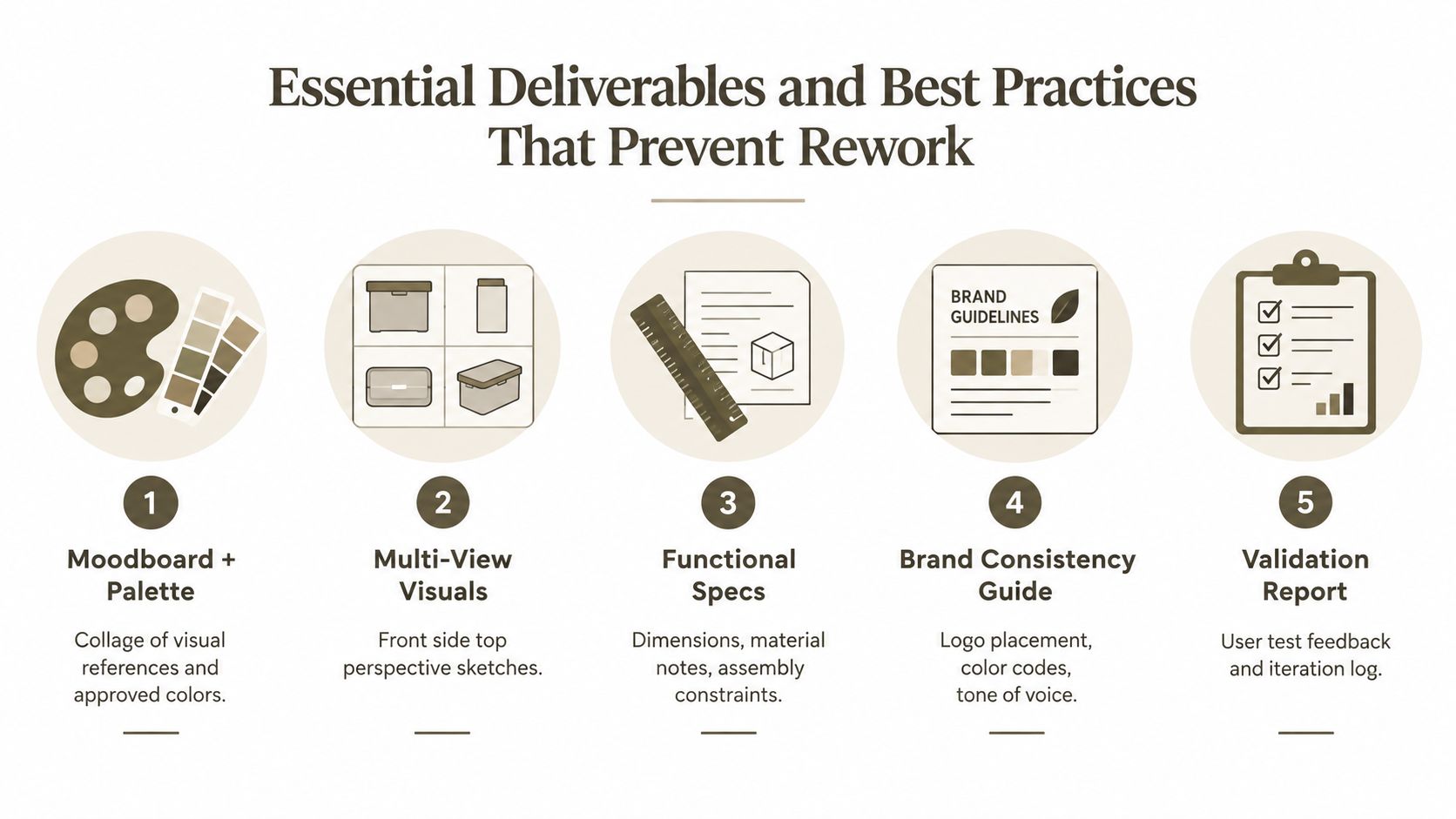
A concept earns its place in development when its documents answer practical questions before they become meeting debates, email threads, or sample comments. Treat each deliverable as a decision record. It should clarify intent, expose risk, or show what must happen next.
Start with the moodboard and palette. Define the visual territory through approved color references, finish direction, material examples, and notes on what must remain consistent. A screen image can shift between devices, so critical colors need a recognized reference system. This gives the team a stable target rather than a subjective impression.
Multi-view visuals explain the product as a complete object. Front and perspective views communicate the main idea, while side, back, top, and detail views clarify volume, placement, proportion, and user touchpoints. Select views based on the decisions a supplier, engineer, or reviewer must make.
The documents that carry intent into production
A technical sketch adds construction logic to the visual proposal. Mark seam paths, fold lines, attachment points, hardware, openings, interfaces, and transitions between materials. Label each detail as decorative, functional, or structural so nobody has to infer its purpose.
A measurement chart defines geometry instead of leaving dimensions to visual estimation. For soft goods, record points of measure and relevant tolerances. For hard goods, document key dimensions, wall-thickness assumptions, interfaces, and assembly constraints. A bill of materials connects those decisions to components, materials, finishes, and sourcing questions.
A brand consistency guide keeps approved variations from drifting away from the product family. It can define logo placement, color use, typography, texture, proportion, and the design features that express the brand across categories. Mark what is fixed and what may change.
A validation report records how the direction earned further development. Include the concepts reviewed, participants or stakeholders, questions asked, feedback themes, decisions made, and assumptions that still need a sample or engineering check. The purpose is not to collect praise. It is to show why one concept deserves a tech pack while another needs more evidence.
A supplier shouldn't have to infer whether a detail is decorative, functional, structural, or accidental. Label it.
A practical quality check
Before technical development begins, audit the concept:
- Intent: Can someone state the user, use case, and product promise plainly?
- Views: Do the visuals show every angle needed to interpret the form?
- Construction: Are joins, closures, components, and interfaces identified?
- Materials: Are material roles, finishes, substitutions, and lifecycle considerations visible?
- Measurements: Are critical dimensions defined rather than estimated from an image?
- Brand DNA: Which elements are fixed, and which may vary?
- Validation: What evidence supports the direction, and what remains a risk?
- Version control: Can every reviewer find the current file and decision status?
Documentation also determines whether a concept can move efficiently into sampling. Industry guidance reports 1.8 sample rounds for detailed professional tech packs and 3.4 rounds for incomplete ones. Another cited benchmark describes 3 to 5 revision rounds for styles with incomplete or missing tech packs, compared with 1 to 2 when documentation is stronger. These figures appear in tech-pack documentation guidance.
Sustainability belongs in the decision record, not only in final marketing copy. Check the chosen material, construction, packaging, repair path, and variant strategy against the intended lifecycle. Personalization needs the same discipline. Define which variables can change without disrupting fit, sourcing, assembly, or brand recognition.
Tools and AI Workflows That Accelerate Concepting
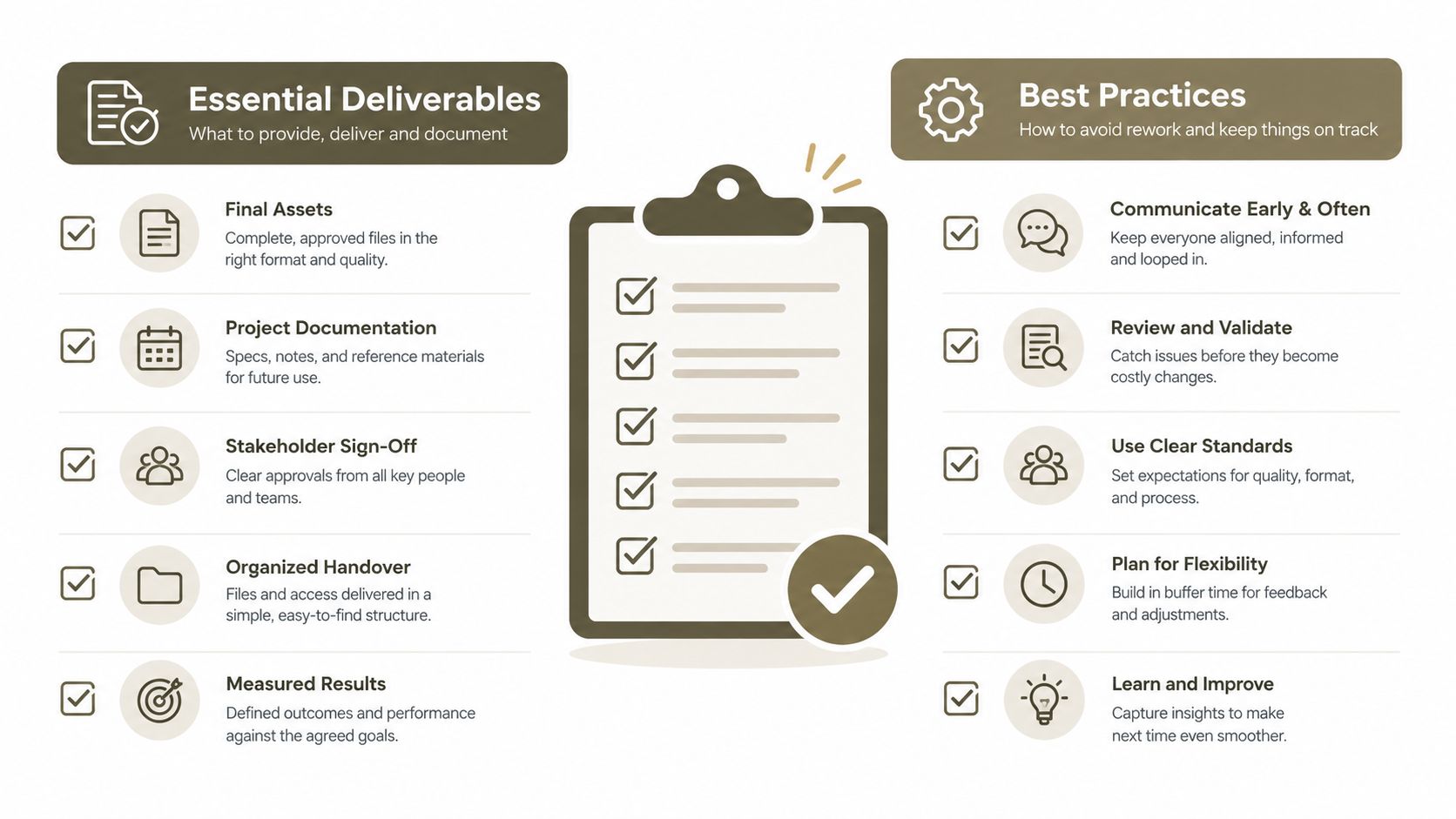
Traditional workflows remain valuable because hand sketches, physical references, CAD, and direct supplier conversations expose details that software can hide. Their weakness is fragmentation. A designer may create visuals in one tool, specifications in another, feedback in email, and supplier files in a shared folder. Each handoff creates an opportunity for version drift.
AI-accelerated workflows change the order and cost of exploration. A designer can begin with a text prompt, rough sketch, or reference image, generate several directions, and edit silhouette, material, color, or detail without rebuilding every view manually. The designer still needs to judge proportion, feasibility, brand fit, and user value.
| Workflow need | Traditional approach | AI-accelerated approach |
|---|---|---|
| Explore directions | Hand sketches, reference boards, separate renders | Prompt-based variations connected to approved references |
| Test a silhouette | Redraw or rebuild the form | Edit the silhouette while preserving selected attributes |
| Maintain brand DNA | Manual reference checking | Stored palettes, moodboards, and brand rules |
| Prepare specifications | Separate technical drawing and spreadsheet work | Linked multi-view visuals, construction notes, and exports |
| Gather feedback | Email threads and scattered files | Shared review space with comments and version context |
Use AI for breadth and repetition. It works well when you need alternate colorways, material explorations, contextual scenes, or early visual comparisons. Use manual design judgment for meaning and commitment, especially when deciding whether a feature improves the use case, whether a construction detail is realistic, or whether a trend has displaced the brand's identity.
Teams handling many visual assets should also audit the typography inside concept boards, product graphics, and launch materials. A practical guide to auditing typography assets can help identify missing fonts, inconsistent versions, and licensing or handoff problems before those assets reach production.
A unified workspace can connect concept exploration with technical documentation and supplier review. For example, AI product design tools can support prompt-based creation, multi-view visuals, editable references, brand inputs, technical sketches, and production-oriented exports. The tool doesn't decide which concept deserves investment. Your criteria and review process do that.
The right question isn't whether AI replaces sketching. It's whether the workflow preserves intent while removing repetitive work. If generated options multiply faster than the team can evaluate them, add a decision gate rather than generating more.
Real World Examples and Your Next Steps in Product Concept Design
An apparel team begins with a brief for a lightweight overshirt that should feel utilitarian but remain appropriate for city wear. The first visual direction uses oversized pockets and heavy hardware. User feedback favors the accessible pocket layout, while sourcing flags the hardware weight and cost. The team keeps the utility logic, reduces the hardware, and documents the revised closure before sampling.
A footwear team faces a different problem. Several generated uppers look distinctive, but one requires a complex layered construction that complicates assembly. A simpler direction preserves the brand's recognizable color blocking and improves feasibility. The team chooses it because it creates a stronger balance between preference, brand DNA, and production confidence.
For furniture, the key decision may be lifecycle cost rather than novelty. A chair with an unusual one-piece form attracts attention, but a replaceable cover and simpler frame create a more maintainable product. The concept review makes that trade-off visible before detailed development.
An electronics founder can use the same filter. A transparent shell may communicate technical sophistication, yet it can create concerns around repairability, fingerprints, and component visibility. The concept should advance only if those concerns have a credible design response.
Before your next sprint, verify:
- The brief names a user, use case, and product promise.
- The concept has clear brand cues and controlled variables.
- Visuals show enough views to explain the form.
- Materials, components, and construction assumptions are recorded.
- Preference and feasibility have both influenced selection.
- Sustainability and personalization rules are explicit.
- Open risks have owners and validation methods.
- The selected direction is ready for a technical conversation, not merely a presentation.
When the concept passes that checklist, move deliberately into product prototype ordering. The purpose of the prototype isn't to prove that the render was attractive. It's to test the assumptions that still matter.
Genpire connects AI-assisted concept creation with multi-view visuals, technical specifications, tech-pack development, and supplier collaboration for consumer goods teams. If you want to turn your next product brief into a more testable, production-aware concept, visit Genpire and explore the workflow.