A historical study of 700 firms found that only 1 in 7 new-product ideas succeeded against its original profit objectives. Product concept research therefore works best as an economic filter, not as a survey designed to confirm that an attractive idea feels exciting.
A polished render can win a preference test and still fail at the factory. The material may be difficult to source, the construction may require unrealistic tolerances, the target cost may collapse the margin, or a regulatory requirement may invalidate the design. Strong concept research connects customer desirability with those commercial and technical constraints before a team commits to development.
Table of Contents
- Why Product Concept Research Matters More Than You Think
- Setting Clear Objectives Before Testing Begins
- Conducting Market and User Research to Inform Concepts
- Designing Concept Tests That Actually Predict Outcomes
- From AI-Generated Concepts to Factory-Ready Specifications
- Establishing Metrics, Kill Rules, and Iteration Loops
- Avoiding the Costliest Concept Research Mistakes
Why Product Concept Research Matters More Than You Think
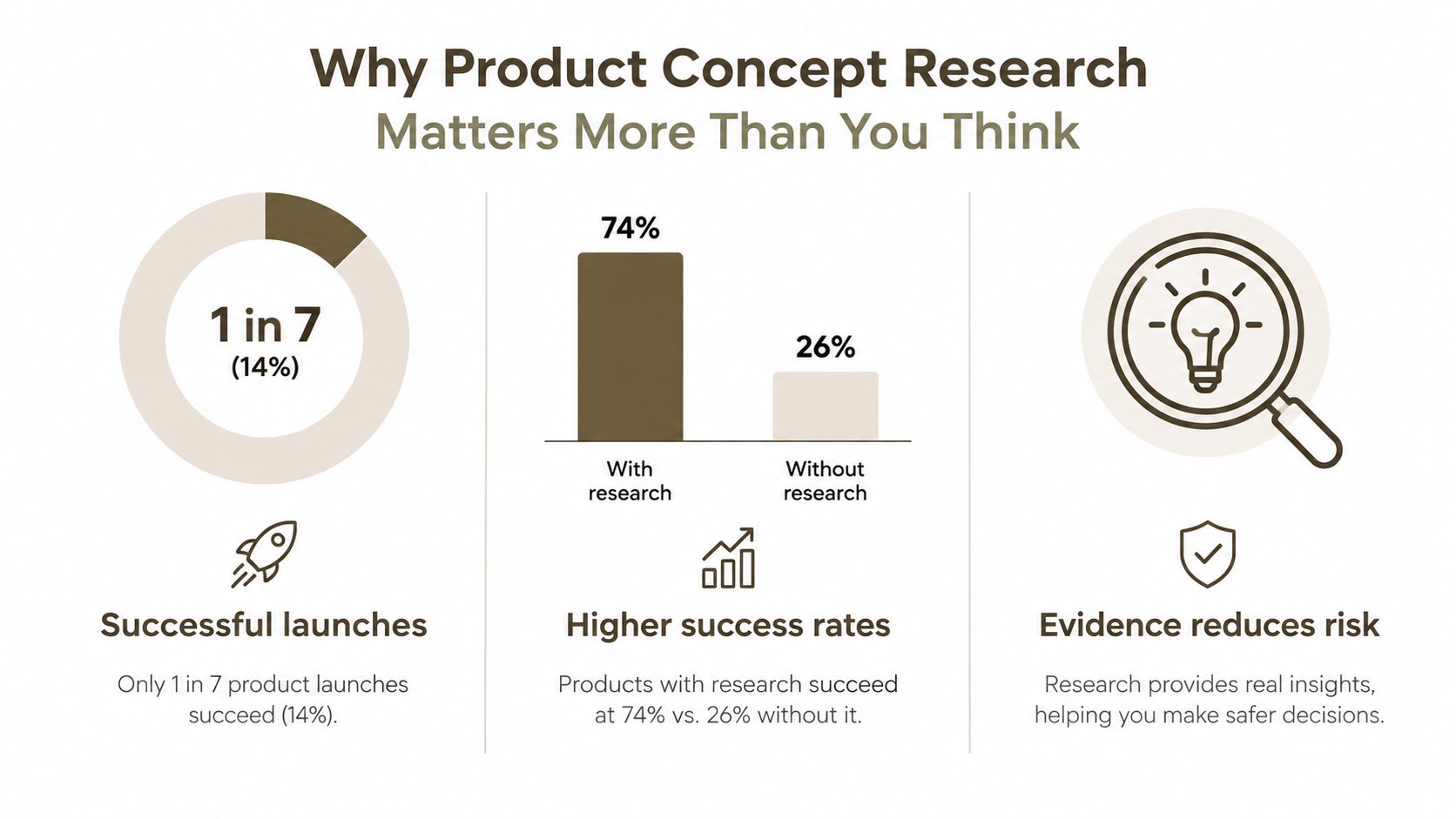
The historical evidence is uncomfortable because it shifts responsibility away from execution alone. The Booz, Allen, and Hamilton study examined 700 consumer and industrial firms and found that, on average, only 1 in 7 new-product ideas met the company's original profit objectives, as documented in the original product innovation study. The implication for a modern team is practical: a large idea pipeline isn't an asset if nobody has a disciplined way to remove weak concepts.
Concept research gives that pipeline a decision point. Before designers develop detailed construction, sourcing teams engage factories, or marketers prepare a launch, the team can ask whether the proposed product solves a meaningful problem, communicates its value, differs from available alternatives, and appears worth paying for. A negative answer at this stage is useful. It protects time and budget that would otherwise be spent making an unviable concept look more finished.
The economic filter
An MIT Sloan teaching case reports historical new consumer packaged goods failure rates of 45.6% in 1961, 53.4% in 1971, 64.5% in 1981, and 80.0% in 1991. The case models a funnel in which 64 initial ideas narrow to 16 after concept testing, 8 after product development, and 4 after test marketing, with estimated costs rising from $20,000 for concept testing to $200,000 for product development and $500,000 for test marketing. These are historical teaching-case estimates, not universal current benchmarks, but they show why early rejection has economic value. (MIT Sloan product-development teaching case)
A useful data-driven product ideation workflow should make this filtering explicit. The team isn't asking, “Do people like this image?” It's deciding whether the concept deserves the next investment, and which assumptions still need evidence.
Practical rule: Treat early research as permission to stop, not as evidence that every concept should continue.
Setting Clear Objectives Before Testing Begins
Most weak concept tests begin with a vague question such as, “Which design do people prefer?” That question produces a ranking, but not a decision. Before creating stimuli or recruiting participants, write down what the team must learn and what action each possible result will trigger.
Build a one-page concept brief
Start with the customer and the job. Define the target segment in behavioral terms, not just age or location. Identify the situation that creates demand, the current workaround, and the moment when the buyer decides that the existing option is inadequate.
Then document the concept hypothesis:
- Customer problem: What recurring difficulty or unmet need does the product address?
- Proposed response: What does the product do differently from existing alternatives?
- Value exchange: Why would the intended buyer consider the product worth its proposed price?
- Competitive frame: Which products, services, or habits would the concept replace?
- Operational assumptions: Which materials, processes, suppliers, certifications, or tolerances could determine feasibility?
This brief should also state what the concept isn't trying to solve. Feature accumulation makes research harder to interpret and manufacturing more complicated. A tightly defined promise gives respondents something specific to evaluate and gives engineers a manageable set of requirements to challenge.
Define the decision before collecting feedback
Set GO and KILL thresholds in advance. A GO decision might require clear comprehension, evidence of need satisfaction, acceptable perceived value, credible purchase intent, and no critical technical objection. A KILL decision might follow from a weak problem fit, confusion about the product's purpose, an unattractive price-value relationship, or an unresolved manufacturing risk.
Don't choose thresholds after seeing the results. Post-hoc standards allow internal enthusiasm to reinterpret disappointing evidence as a reason to keep refining. Record the criteria in a shared document that product, design, marketing, sourcing, and technical stakeholders approve before testing begins.
The research design should answer specific questions:
- Which segment has the strongest problem fit?
- Which value proposition is understood without explanation?
- Which concept is distinctive relative to current alternatives?
- What feature or benefit drives perceived value?
- What would make a buyer reject the concept?
- Which assumptions require prototype, supplier, or compliance verification?
This alignment prevents a familiar conflict. Marketing may prefer the most visually distinctive direction, while manufacturing favors the concept with fewer component and tolerance risks. Both perspectives belong in the decision, but neither should redefine success.
Conducting Market and User Research to Inform Concepts
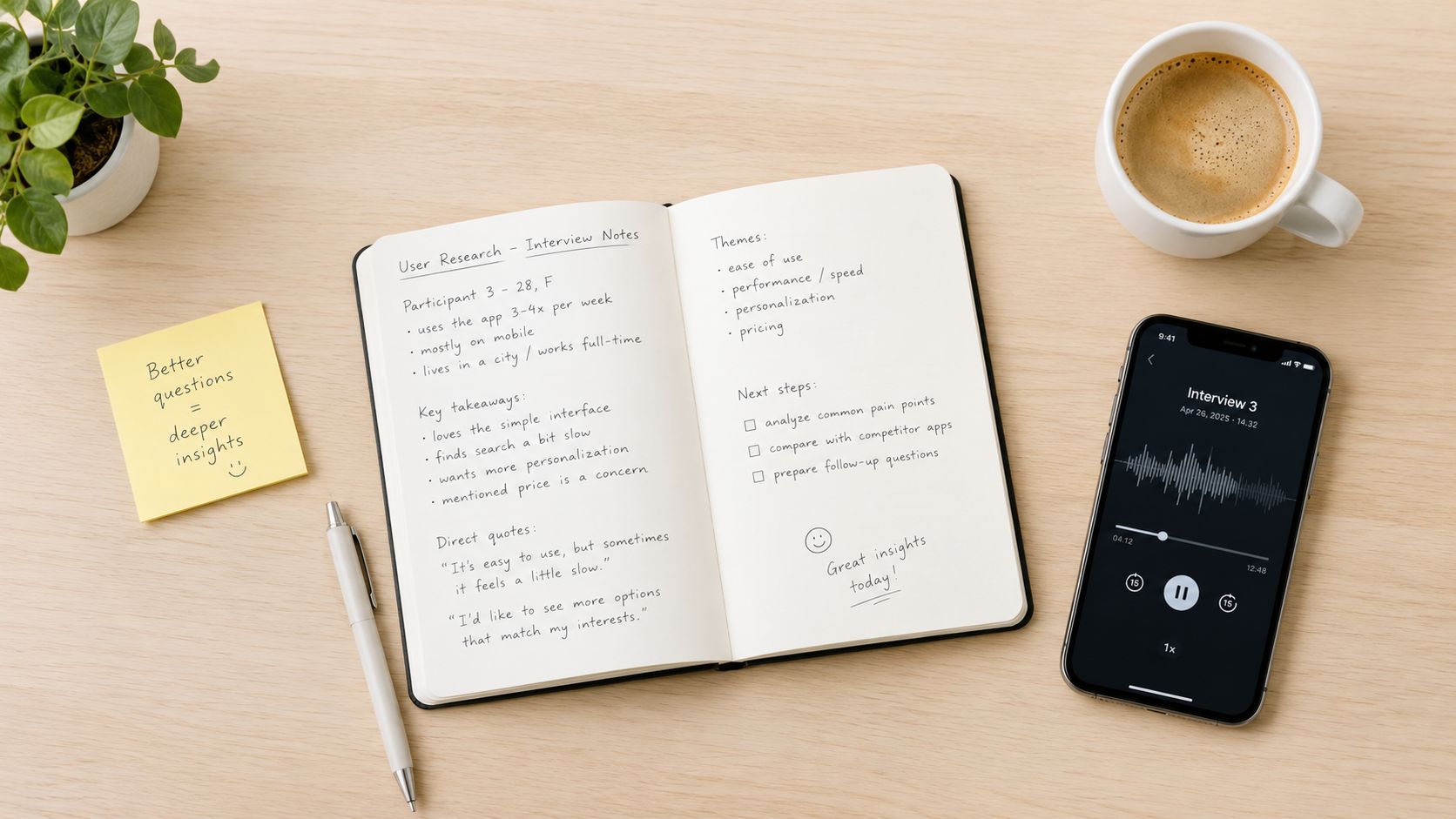
Interview-first research exposes the problem before a polished render starts shaping opinions. Begin with recent behavior, not reactions to an imaginary product. Ask participants to describe the last time they encountered the problem, what they used, what frustrated them, and which compromises they accepted. Delay questions about whether they “would buy” the concept. People may like an abstract idea, then reject it when price, inconvenience, or an existing alternative becomes concrete.
This sequence also protects the team from confusing visual appeal with product viability. A concept can look distinctive while relying on expensive materials, difficult tolerances, or an assembly process a factory cannot repeat consistently. Research should therefore give design, product, sourcing, and engineering the same evidence base for deciding which trade-offs deserve investigation.
Convert language into requirements
Record customer language, then translate it into testable requirements rather than copying every request into the specification:
- Observed situation: The user carries an item between locations and struggles with protection or access.
- Underlying job: The user needs secure transport without unnecessary bulk.
- Design requirement: The product must balance protection, weight, opening behavior, and storage.
- Validation question: Which trade-off matters most in the actual use context?
This translation prevents surface requests from dictating the design. A buyer may ask for “more pockets” when the underlying need is faster access or better organization. Adding components could increase cost, weight, and production complexity without solving the underlying problem. The design response should address the job and then test whether the proposed construction can deliver it.
Competitive research provides a second evidence layer. Map current products by price position, material, construction, distribution, durability, repairability, and user complaints. Repeated compromises can reveal an opportunity, but an opportunity is not just an empty visual position in the market. It is a customer problem the team can serve without creating an unacceptable cost or manufacturing burden.
Make research usable by designers
A research repository should connect each finding to a design implication and a confidence level. Separate direct observations from interpretations, and distinguish recurring pain from isolated preference. Useful outputs include:
- Priority needs: Problems that recur across relevant users and affect purchase or use.
- Language cues: Terms customers use for benefits, frustrations, and alternatives.
- Rejectors: Conditions that make the concept unacceptable, including maintenance, fit, durability, or price concerns.
- Opportunity spaces: Unresolved trade-offs where current solutions perform poorly.
- Technical questions: Claims requiring material, factory, prototype, or compliance verification.
A structured market research process preserves the chain from evidence to brief. Trend scanning can add context, but it cannot replace direct user evidence. A rising visual style does not prove that a product solves a meaningful problem, and a competitor feature does not prove that buyers value it or that a factory can produce it reliably.
Customer language is raw material. It becomes a product requirement only after the team connects it to behavior, context, and a measurable decision.
Designing Concept Tests That Actually Predict Outcomes
A useful concept test controls two things at once: what participants see and what the team measures. If one concept receives a detailed render, a persuasive description, and a clear price while another receives a rough sketch and vague copy, the test measures presentation quality rather than concept strength.
Use monadic testing when you need an independent reaction to one concept. Each participant sees one option, which reduces direct comparison effects and better resembles a buyer encountering a product in the market. The trade-off is that the team needs enough comparable responses across groups and may learn less about relative preference.
Use sequential-monadic testing when the same participant should evaluate several concepts separately. It allows consistent measurement across alternatives, but the order and fatigue can influence later responses. Randomize presentation order and keep the evaluation questions identical.
Use comparative testing when the decision is explicitly about choosing among defined alternatives. Side-by-side comparison makes preference clear, but it can exaggerate differences and encourage participants to select the “best of the set” even when none is strong enough to advance.
| Format | Best For | Strength | Limitation |
|---|---|---|---|
| Monadic | Standalone appeal and realistic evaluation | Limits direct comparison bias | Requires separate groups for alternatives |
| Sequential-monadic | Efficient evaluation of several concepts | Produces consistent ratings across concepts | Order and fatigue can affect responses |
| Comparative | Selecting among a short list | Reveals relative preference quickly | Can hide weak absolute appeal |
Standardize the stimulus
Lock the information density across all concepts. Use the same camera angle, image scale, color treatment, material description, feature count, benefit structure, and price context. If AI generates the images, edit them until visual polish no longer determines the result.
Measure more than likeability. A disciplined instrument should cover:
- Need satisfaction and relevance
- Clarity of the product promise
- Distinctiveness versus current alternatives
- Perceived value
- Purchase intent
- Expected usage
- Willingness to pay
- Reasons for rejection
- Trade-offs between features, materials, performance, and price
Open-ended explanations matter because a score doesn't reveal the design decision. Two concepts can receive similar appeal ratings while one wins because it solves a core problem and the other wins because it looks attractive. The first has a stronger foundation, while the second may collapse when manufacturing constraints change the appearance.
Prototype exposure adds another layer. Physical interaction can alter purchase intention and willingness to pay, so image-based results should be treated as directional when feel, weight, fit, opening force, texture, or durability affects the buying decision. Even a rough sample can reveal whether the visual promise survives contact with the object.
When the category involves a visible material or construction choice, a resource such as TimberSol's guide to cladding vs render can help teams frame the evaluation around performance and application, not appearance alone. The same principle applies across product categories. Preference is only one input into an integrated decision.
From AI-Generated Concepts to Factory-Ready Specifications
A 2025 survey found that production cost was the leading challenge for 35% of product-development executives, followed by product complexity at 34%. Regulatory compliance and time-to-market each affected 33%, according to the 2025 manufacturing AI investment survey. For concept teams, the implication is practical: visual appeal cannot carry a product through development when its production assumptions remain unclear.
AI has changed the economics of ideation. Teams can generate many visual directions from prompts, sketches, or reference images before a traditional process produces one polished route. That speed helps explore silhouettes and combinations, while also making it easier to mistake novelty for viability.
Treat each AI render as a research stimulus, not evidence of demand or manufacturability. Generated images may conceal seam logic, impossible joins, unstable proportions, unavailable materials, and details that cannot be repeated consistently at production scale. Advancement requires visibility into both desirability and feasibility assumptions.
Run a parallel feasibility review
Technical and sourcing stakeholders should examine shortlisted concepts before preference results become a recommendation. Their review should challenge:
- Materials: Are the proposed materials available, consistent, safe, and suitable for the intended use?
- Construction: Can joins, closures, seams, fasteners, and assemblies be repeated with available processes?
- Tolerance: Which dimensions or interfaces could create fit, alignment, or quality problems?
- Cost: Do bill-of-materials assumptions support the price-value hypothesis?
- Suppliers: Can current partners produce the required components, finishes, and minimum quantities?
- Compliance: Could testing, labeling, safety, or regulatory requirements change the design?
- Durability: Which claims require physical testing rather than visual inspection?
This review turns concept research into a cross-functional decision system. Designers assess the user promise, researchers clarify demand, sourcing tests supply assumptions, and engineering identifies failure points before they become expensive revisions.
The best concept often balances desirability with fewer unresolved production questions.
Convert evidence into a controlled handoff
For each advancing concept, create a decision record with the research result, target user, unresolved assumptions, material direction, construction notes, and next validation action. The original render should not remain the only source of truth. A factory needs views, dimensions, components, materials, finishing instructions, and clear markers for decisions that still require a sample.
A platform such as Genpire can convert prompts, sketches, and reference images into multi-view concepts, technical sketches, construction details, component breakdowns, and exports for downstream manufacturing workflows. Used with human review, it connects early exploration with specification work. It does not replace supplier input, prototype testing, feasibility review, or compliance checks.
The handoff also needs version control. If testing changes a strap, closure, sole, panel, or material, update the visual concept, technical details, cost assumptions, and research record together. Otherwise, sourcing may quote an outdated version while marketing presents a different product promise.
A short video can show how a concept-to-specification workflow fits together:
The final test is whether the team can explain what the product is, which defined buyer needs it, how it will be made, what it may cost, and which assumptions still require proof. The AI product development workflow from concept to factory-ready output is valuable only when those answers remain connected.
Establishing Metrics, Kill Rules, and Iteration Loops
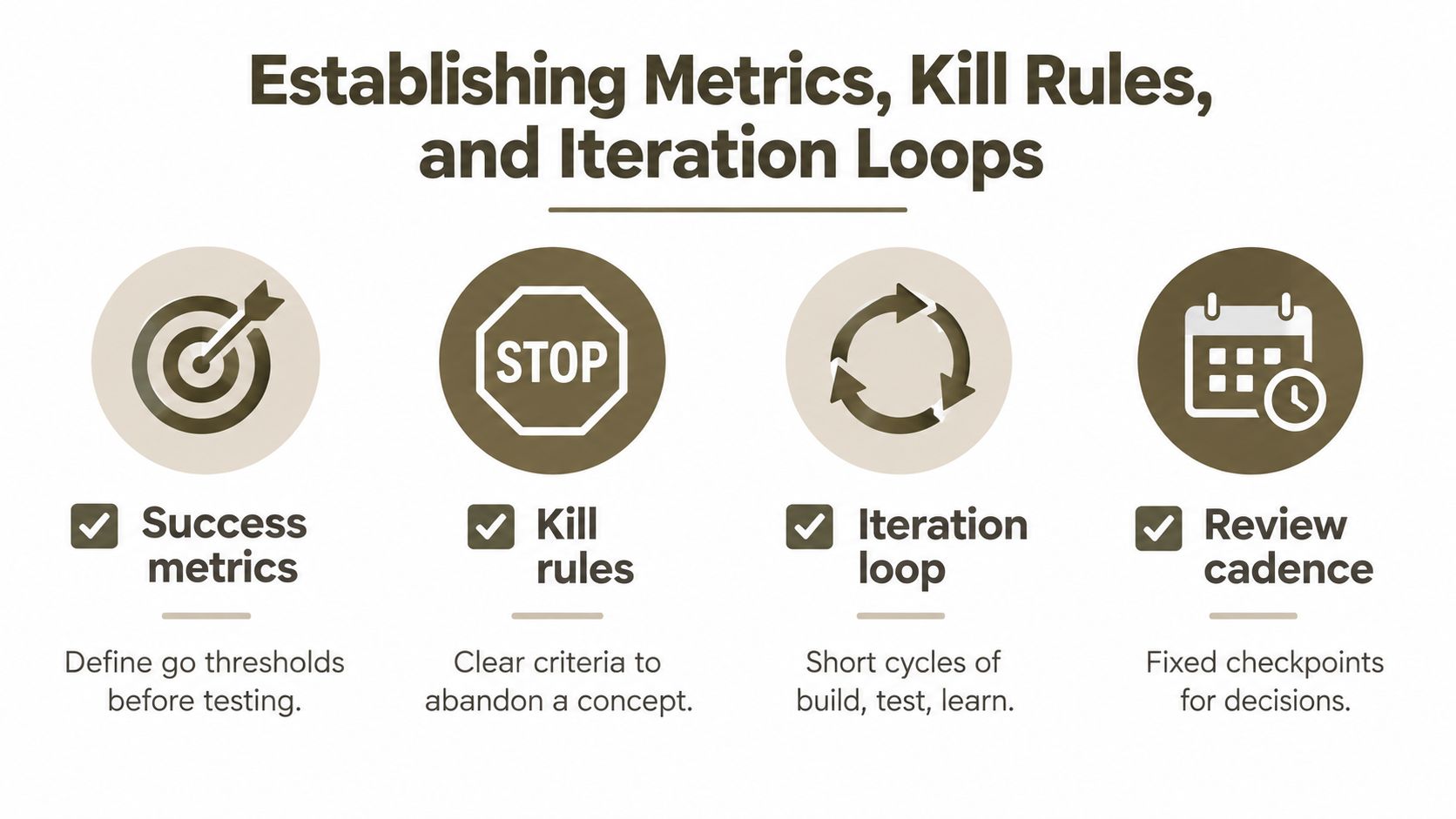
A research program needs an operating rhythm, not a pile of survey results. The team should know which signals determine advancement, which findings trigger revision, and which objections end the work. Without that discipline, every concept can survive indefinitely because someone believes another round of polish will solve the underlying problem.
Define the scorecard
Use a balanced scorecard that combines customer, commercial, and technical evidence. Purchase intent can indicate interest, but it shouldn't stand alone. Pair it with clarity, need satisfaction, distinctiveness, price-value fit, expected usage, willingness to pay, and reasons for rejection.
Add a feasibility status to every concept:
- Green: The major assumptions are supported, and no critical production objection remains.
- Amber: The concept has promise, but named questions about materials, cost, durability, supplier capability, or compliance remain.
- Red: A critical objection makes advancement irresponsible unless the concept changes substantially.
Segment every result by market, use case, and buyer type. An overall average can conceal strong rejection from the strategic segment that matters most. A concept for professional users shouldn't advance just because casual users find it attractive, and a product aimed at a price-sensitive market shouldn't rely on enthusiasm from respondents who aren't plausible buyers.
Write kill rules before the test
Kill rules should be observable and tied to action. Examples include:
- The concept fails to communicate its primary benefit without explanation.
- A strategically important segment rejects the core use case.
- The price-value relationship remains unacceptable after clarification.
- A critical manufacturing or compliance objection has no credible resolution.
- The design requires a feature set that undermines the target cost or production reliability.
These rules aren't designed to eliminate ambition. They protect the team from sunk-cost bias and force a choice between changing the concept and ending it.
Run short, evidence-based loops
A practical loop moves from qualitative discovery to concept revision, quantitative comparison, prototype interaction, and technical review. Each cycle should change a defined element, such as silhouette, material, construction, feature scope, or message. If the team changes everything at once, it won't know which intervention improved the result.
Keep a decision log. Record the hypothesis, the evidence collected, the decision, the unresolved risk, and the owner of the next action. A founder may own the commercial choice, a designer the concept revision, a sourcing lead the supplier check, and an engineer the tolerance review.
Teams planning how to launch a clothing brand can apply the same discipline to fabric, fit, trim, construction, sampling, and price decisions. The category changes, but the operating principle doesn't: advance only when the customer case and the production case support each other.
Avoiding the Costliest Concept Research Mistakes
The most damaging mistake is not a bad score. It's a team that designs the test to avoid receiving one. Over-sold stimuli, leading questions, selective recruitment, and late-stage testing can make weak concepts appear healthier than they are.
A summarized failure study attributes 73% of failures to inadequate market research, 54% to weak launches, and 49% to deficient product testing, as reported in the NPD failure analysis. These figures should be read as historical summarized findings, not as a universal diagnostic formula. They still point to a recurring pattern: teams often discover problems late because they never gave early evidence enough authority.
The failure pattern in practice
A founder sees an elegant render and asks a friendly audience whether they like it. The audience approves the look, but the test doesn't establish who would use the product, what it replaces, whether the price makes sense, or what happens when the item is handled. The design team then adds detail, sourcing identifies material problems, and the launch message promises performance the construction can't consistently deliver.
Avoid that sequence by checking five conditions:
- Representative users: Recruit people who resemble the intended buyer and understand the use context.
- Neutral stimuli: Give every concept equivalent information and presentation quality.
- Early timing: Test before tooling, detailed development, and irreversible supplier commitments.
- Complete evidence: Combine stated preference with reasons, prototype interaction, and technical review.
- Honest decisions: Give negative findings the same status as positive findings.
Don't average away rejection because the concept is strategically important. Investigate it. Sometimes the rejection reveals a solvable feature or message problem. Sometimes it proves that the opportunity depends on an assumption the team shouldn't make.
The strongest teams build status into their culture. Designers aren't punished for showing an unfinished concept, researchers aren't pressured to produce a winner, and manufacturing isn't invited only after the customer test has ended. Product concept research becomes a cross-functional decision system when every function can challenge the concept and the team has agreed in advance what evidence will change the plan.
For teams ready to connect customer evidence with AI-assisted concept development, technical specifications, and supplier handoffs, Genpire provides a workspace that turns prompts, sketches, and references into multi-view concepts and structured production assets. Visit the platform to test ideas earlier, document feasibility questions, and move only the concepts that can survive both customer scrutiny and factory reality.