Roughly 7 initial product ideas produce only 1 commercial success. The product design process steps exist to decide which ideas deserve more money, time, engineering, and factory attention before those commitments become expensive.
That ratio changes how a product team should define progress. A crowded ideation board isn't evidence of momentum if the team can't explain the target user, the commercial proposition, the production constraints, or the test that will justify moving forward. Product design is a staged funnel, and every gate should remove uncertainty.
A concept becomes valuable when it survives contact with users, materials, suppliers, quality requirements, and cost assumptions. The most dangerous gap in many workflows appears after the attractive render, when nobody has translated intent into a specification a factory can interpret consistently.
Table of Contents
- Why the Product Design Process Steps Usually Fail
- The Core Stages of the Product Design Process Steps
- How Genpire Accelerates Each Design Phase
- The Hidden Gap Between Concept and Factory
- Building a Repeatable Development Workflow
Why the Product Design Process Steps Usually Fail
The historic funnel is unforgiving. A widely cited Booz, Allen & Hamilton study found that, on average, roughly 7 initial ideas produced about 4 development projects, approximately 1.5 launched products, and only 1 commercial success. The same research tradition reported that about 46% of new-product development resources went to projects that were cancelled or failed to produce an adequate financial return. These figures are summarized in the Journal of Innovation & Entrepreneurship research review.
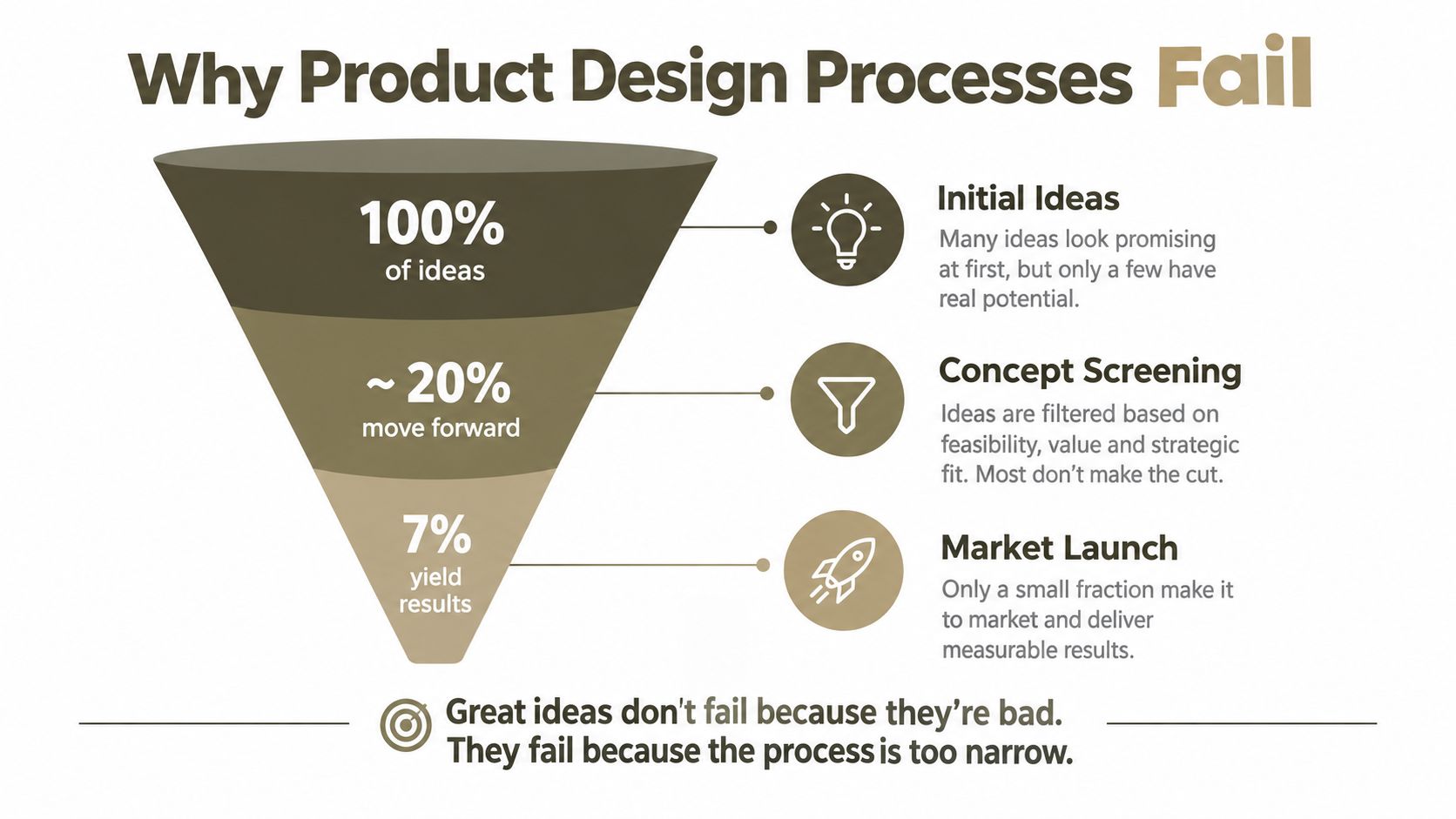
The implication is practical. The process isn't designed to protect every idea. It's designed to kill weak ideas early, while the team can still change the target customer, materials, geometry, positioning, or cost model without discarding tooling and supplier commitments.
Later research summarized in the same academic literature placed the failure rate for products reaching market at roughly 25% to 45%. A separate University of Houston review reported that between 33% and 60% of new products reaching the marketplace failed to generate their desired economic returns, while roughly 46% of development resources were devoted to unsuccessful projects. The exact range varies by study and context, but the operational lesson is consistent: a polished concept isn't proof of a viable product.
What a real gate requires
A weak gate asks whether stakeholders like the presentation. A useful gate asks whether the evidence supports a defined decision:
- User evidence: Who needs the product, what problem matters, and how will the team measure desirability?
- Technical evidence: Which materials, dimensions, components, and construction methods remain uncertain?
- Commercial evidence: What target cost, price logic, channel, and volume assumption shape the design?
- Risk evidence: Which failure modes could stop the product, and who owns each investigation?
- Decision evidence: Should the team proceed, revise the concept, or stop?
Skipping front-end validation creates false certainty. A team may approve a silhouette before checking material availability, discover a component can't be sourced after the tech pack, or learn during sampling that the construction method doesn't support the intended finish. The later each issue appears, the more people have built work around it.
Practical rule: Presentation quality can earn attention, but only measured evidence should earn the next budget commitment.
The funnel also explains why “generate more concepts” is often the wrong response to weak results. More concepts increase the screening burden unless the team has clear criteria for desirability, feasibility, viability, regulatory exposure, sustainability, and manufacturability. The objective isn't creative volume. It's a traceable reduction in uncertainty from opportunity to approved production asset.
The Core Stages of the Product Design Process Steps
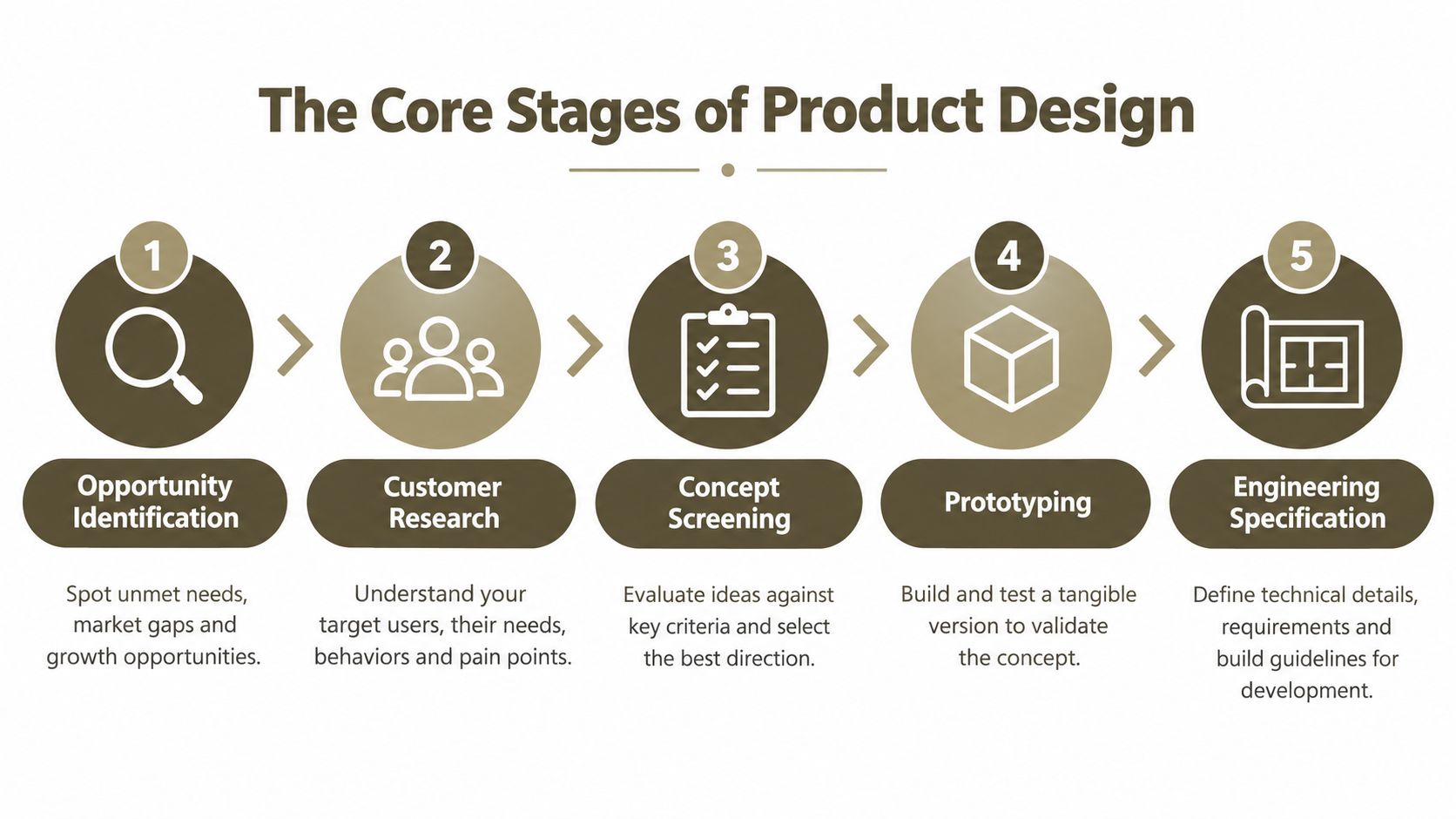
A reliable workflow connects opportunity identification, research, ideation, screening, prototyping, engineering, validation, commercialization, and post-launch review. Each stage should produce an output that the next stage can inspect, challenge, and use. The sequence below applies to consumer goods, from apparel and accessories to furniture, home products, toys, and electronics.
1. Define the opportunity and target user
Start with a specific customer problem, not a preferred shape or trend reference. Write the target segment, use context, essential job, expected experience, constraints, and business objective. User research should produce requirements that can be tested, such as fit, comfort, capacity, ease of assembly, durability, appearance, or handling.
Good practical user centered design strategies help teams keep the intended user involved instead of treating internal preference as market evidence. The output should be a concise requirements document, a research record, and an initial risk register.
2. Generate alternatives, then screen them
Generate multiple directions before selecting one. Screen each against the same criteria, including desirability, feasibility, viability, regulatory requirements, sustainability assumptions, brand fit, and manufacturing complexity.
A decision matrix is useful here, but don't let a neat score conceal weak evidence. Record why a concept passed, what remains unknown, and what test would change the decision. The approved concept should have a target cost, preliminary material direction, key dimensions, and named risks.
3. Prototype for learning
Begin with inexpensive visual, ergonomic, or dimensional models. These prototypes answer early questions about proportion, handling, fit, interaction, and appearance without pretending to prove production readiness.
Test with participants who match the intended market. Define success thresholds before the session, such as task completion, fit, comfort, defect rate, or rating targets. Unstructured opinions can reveal language and reactions, but they aren't enough to validate performance.
4. Engineer the selected design
Once the concept earns progression, convert it into a technical definition. Specify materials, components, construction, dimensions, tolerances, finishes, color references, labeling, packaging assumptions, and inspection points. Create a bill of materials and identify which details are fixed, adjustable, or still under review.
This is the handoff where many teams lose control. A sketch may communicate intent to another designer, yet remain inadequate for a supplier preparing a quote or sample. Treat the tech pack as an executable instruction set, not a visual presentation.
5. Build production-intent samples and validate
The sample must become progressively more realistic. Review critical dimensions, material behavior, assembly sequence, durability, usability, quality, safety, compliance, and manufacturability. Each loop should end with measured results, a failure-mode review, corrective actions with owners, and a revised specification.
The process should release only when critical risks have passed agreed tests, supplier quotes align with the target cost, and production-intent samples demonstrate repeatable manufacture. A successful one-off sample isn't enough.
For a broader view of how design, development, and manufacturing connect, the Genpire product development workflow provides a relevant reference point.
Commercialization then becomes a controlled release, not a leap of faith. Confirm final files, approved sample status, supplier responsibilities, quality criteria, packaging, and launch assets. After launch, compare the original requirements with customer feedback, returns, defects, and commercial performance. That review should feed the next product decision.
How Genpire Accelerates Each Design Phase
Digital acceleration works when it removes repetitive handling without removing accountability. A prompt can produce directions quickly, but a generated image doesn't establish a tolerance, prove a seam will hold, or confirm that a supplier can repeat the result. The operating principle is accelerate exploration, preserve human approval at technical gates.
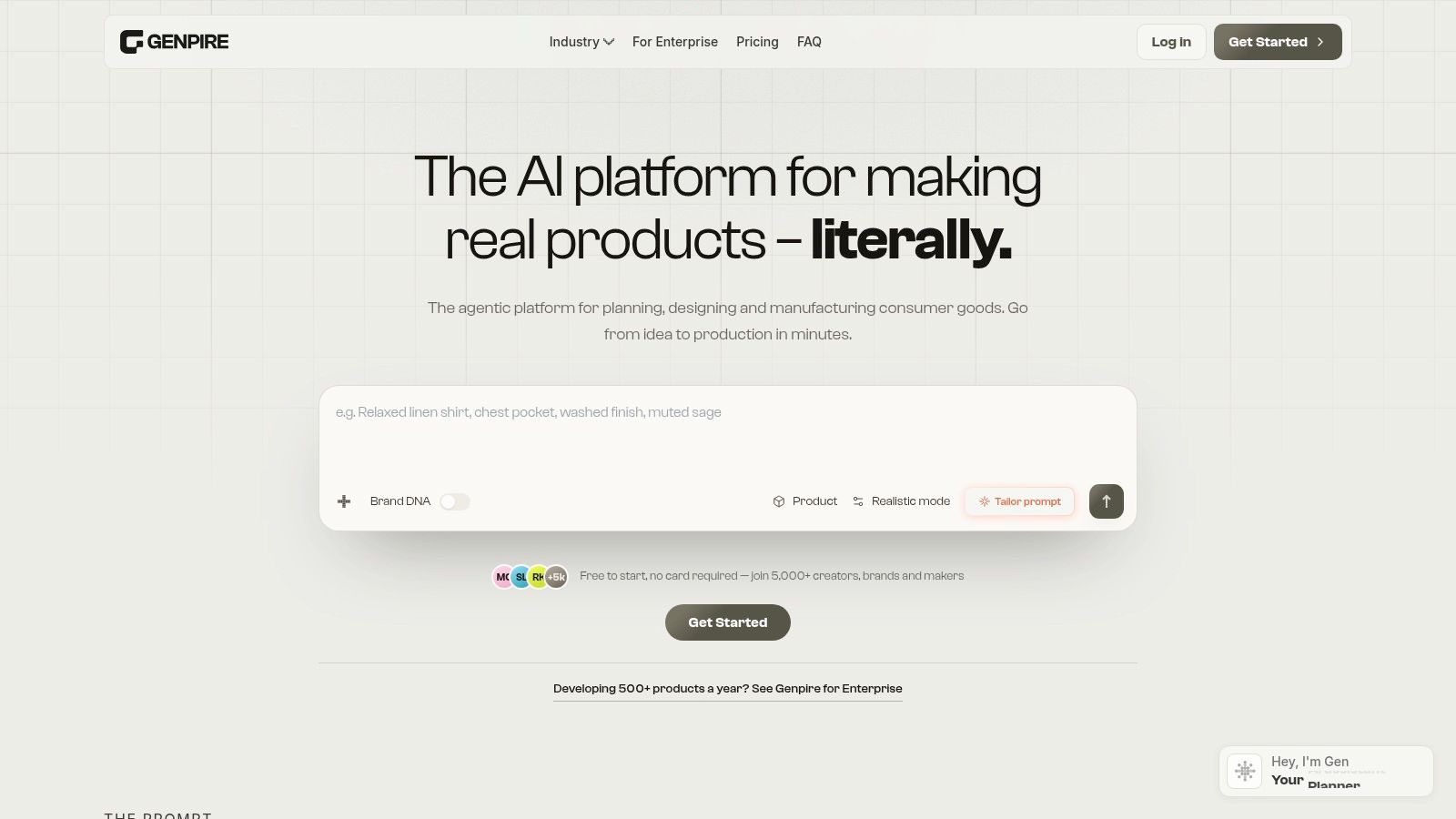
A practical workflow begins with a product description, sketch, or reference image. The team can generate multi-view concepts, compare silhouettes, explore materials and colors, and apply brand rules through stored moodboards and palettes. Genpire's AI Editor supports revisions to silhouette, material, color, and detail while retaining a record of the design direction instead of forcing the team to restart from an unrelated image.
Keep exploration separate from approval
The fastest concepting loop still needs boundaries. Store the prompt, reference, revision, selected direction, rejected alternatives, and reason for rejection. That record lets a technical designer understand how the approved form emerged and prevents a supplier from working from an outdated visual.
Use AI for tasks that benefit from breadth and repetition:
- Explore alternatives: Generate variations in proportion, color, surface treatment, and styling before committing to a direction.
- Clarify views: Produce front, side, rear, and detail views that support discussion and later specification.
- Prepare visual assets: Create virtual try-ons, editorial scenes, e-commerce flats, and advertising concepts after the product direction is approved.
- Start from structured references: Use editable blanks and sketches when a team needs a controlled base rather than unconstrained generation.
The technical transition happens in the Agentic Tech Pack workspace. The selected concept needs construction details, component breakdowns, measurements, material definitions, and related production information. Exportable SVG, PDF, and Excel files can then support design review, supplier communication, and downstream manufacturing work.
Genpire demonstrates cycle compression of 9–13 weeks and approximately 65% compared with traditional processes by integrating concepting, tech packs, RFQ, sampling, and bulk production into one workflow. That figure describes workflow compression, not permission to skip testing. A shorter route is useful only when the evidence package remains complete.
Use one record from prompt to production
The platform's value sits in continuity. A supplier should be able to inspect the approved concept, specification, revision history, comments, and sample feedback without reconstructing the decision from scattered email attachments. View-only supplier seats can support collaboration while keeping the source files controlled.
Virtual Try-On Studio and Marketing Studio address a later bottleneck. They help teams visualize products and create launch assets without waiting for a conventional photoshoot, but those assets should be generated from the approved product definition. Marketing imagery must not become the source of truth for dimensions or construction.
The Genpire workflow overview shows how these stages fit together. Teams should still assign a human owner to every gate: concept selection, material approval, technical review, sample acceptance, quality validation, and final release.
The Hidden Gap Between Concept and Factory
A render communicates appearance. A factory needs instructions.
That distinction explains why the design-to-manufacturing handoff deserves its own operating model. A recent 2025 study of 233 professionals across design, engineering, and manufacturing found that 65% identified miscommunication between design and manufacturing as a leading cause of delays, while 59% reported rework linked to design problems and 43% said development challenges caused production errors and rework. The findings are reported in Tech-Clarity's 2025 State of Product Development report.
Traditional workflows often split the evidence across disconnected tools. A designer keeps the render, a technical designer maintains a spreadsheet, a sourcing manager forwards a PDF, and a supplier asks questions in email. Each handoff can introduce a different revision, missing component, unclear measurement, or assumption about material and construction.
What a factory-ready package must answer
A supplier-ready package should answer the questions a sample room would otherwise have to ask:
- What is the product? Approved views, revision identifier, product name, category, and intended use.
- What is it made from? Material composition or specification, weight or grade where relevant, color reference, finish, trims, hardware, and packaging components.
- How is it assembled? Construction sequence, seam or joint details, stitch or fastening requirements, reinforcement, edge treatment, and assembly notes.
- What are the dimensions? Measurement points, base dimensions, tolerances, grading logic where relevant, and critical fit or functional requirements.
- What must pass inspection? Performance tests, visual standards, defect definitions, safety or compliance requirements, and acceptance criteria.
- Which version is approved? Change log, sample comments, responsible approver, date of decision, and superseded files.
The exact contents vary by category. An electronic product may require connector definitions, enclosure interfaces, and test conditions. Furniture may need joinery, load assumptions, surface treatments, and packaging protection. Apparel may need measurement points, construction callouts, trims, labels, and grading instructions.
A structured product modeling pipeline can help teams organize geometry and technical intent before the design reaches supplier review. The guide to planning a product modeling pipeline is useful when the visual model must support more than presentation.
Compare the two operating models
| Fragmented handoff | Controlled translation |
|---|---|
| Render approved without component breakdown | Concept linked to components and construction |
| Supplier receives mixed revisions | One controlled revision is clearly approved |
| Questions stay in email threads | Clarifications attach to the relevant product record |
| Sample comments aren't reflected everywhere | Corrections update the specification and change log |
| A single successful sample creates false confidence | Production-intent verification tests repeatability |
A unified workflow doesn't eliminate supplier questions. It makes them visible, assignable, and traceable. The design-for-manufacturing review should happen before quoting, then again after the first sample, because suppliers often expose constraints that weren't visible during concept work. Genpire's design-for-manufacturing approach reflects this need to connect creative intent with production requirements.
Building a Repeatable Development Workflow
A repeatable workflow is less about following a rigid ceremony than preserving evidence at every transition. Teams can use different software, review formats, and sampling methods, but the approved product must remain traceable from the initial opportunity through production and post-launch learning.
Start with a shared product record. Give the project an owner, target segment, requirements, target cost, risk register, source references, and decision history. Every generated concept, sketch, material choice, supplier clarification, sample result, and revision should connect to that record.
The working checklist
- Define the problem: State the customer, use context, unmet need, and business objective.
- Capture requirements: Convert research into measurable user, performance, quality, safety, and appearance requirements.
- Generate alternatives: Create enough directions to compare meaningful trade-offs, not just cosmetic variations.
- Screen with evidence: Score desirability, feasibility, viability, regulatory exposure, sustainability, and manufacturing risk.
- Prototype cheaply: Learn about form, fit, handling, ergonomics, and usability before committing to production-intent work.
- Specify completely: Document components, materials, dimensions, tolerances, construction, finishes, packaging, and inspection criteria.
- Review manufacturability: Ask suppliers and manufacturing specialists to challenge ambiguous or difficult details before quoting.
- Test representative samples: Use agreed acceptance thresholds and record measured outcomes, failures, owners, and corrective actions.
- Control the release: Approve one revision, archive superseded files, confirm supplier responsibilities, and release the production package.
- Review after launch: Compare defects, returns, customer feedback, and commercial outcomes with the original requirements.
The useful metric isn't how many concepts the team generates. It's how accurately the first sample reflects the approved design, how few clarification cycles the supplier needs, and how quickly the team reaches a production-ready decision.
AI introduces another control requirement. Before using an external tool with sensitive designs, review its data protection policy, access controls, retention terms, export process, and treatment of customer content. Genpire states that customer designs don't train its platform models, but every organization should assess that claim alongside its own confidentiality and intellectual-property requirements.
Process discipline also needs humility. One statistical analysis found no general correlation between having a Stage-Gate or comparable process and commercial success, while early-development attrition can reach 89%, as summarized in PMI's review of Six Sigma and business development. Gates don't rescue poor decisions. They create value only when the team brings clear requirements, honest risk assessment, measured tests, and the willingness to stop or revise a weak concept.
For consumer-goods teams, the practical shift is straightforward: stop treating the tech pack as the final decoration on a finished idea. Treat it as the shared technical contract between design, sourcing, engineering, quality, and manufacturing. That change makes AI-assisted concepting useful because the output remains accountable to evidence rather than appearance.
If your team needs to move from prompts and sketches to structured tech packs, RFQ-ready files, sampling, and production assets, Genpire brings those activities into one workflow. Visit Genpire to evaluate how a traceable concept-to-factory process could fit your next consumer product.