You've approved a pair of jeans that looks clean on the table. Then the wearer pulls on a safety boot, walks across the fitting room, sits down, and climbs a step. The hem catches on the boot collar, the back edge drags, and the denim rides up enough to expose the shaft. Nothing is wrong with the styling concept. The interface between the jean and the boot was never specified.
Table of Contents
- Why the Jean-and-Boot Pair Is a Product Problem, Not a Styling Tip
- Measuring Boot Shaft, Hem Opening, and Rise
- Choosing Between Bootcut, Straight, and Relaxed
- Material and Construction Choices That Hold Up
- Designing Around the Safety Toe and Outsole
- Why a Generic Bootcut Label No Longer Cuts It
- Spec Sheet and Rollout Checklist for a Work Boots Jeans Line
Why the Jean-and-Boot Pair Is a Product Problem, Not a Styling Tip
A wearer pulls on a safety boot, walks, sits, and climbs a step. The hem catches the collar, the back edge drags, or the denim rides high enough to expose the shaft. That failure is a product-interface problem, not a styling preference.
Work boots and jeans began as practical equipment rather than a coordinated outfit. On May 20, 1873, Jacob Davis and Levi Strauss received a U.S. patent for copper-riveted denim trousers built to withstand abrasion and hard physical work. Miners, railroad workers, farmers, and other laborers needed trousers that tolerated dirt, repeated bending, and tool-carrying strain. Work boots addressed related risks by protecting feet from rough terrain, heavy materials, and long periods of standing. Their combination later entered popular culture, while its visual identity remained rooted in function. The history of blue jeans explains why this category belongs in equipment development before lifestyle positioning.
A factory brief should start with the boot, not a denim swatch and reference image. Record shaft circumference, collar height, heel shape, outsole width, safety-toe volume, and the movements required on the job. These inputs affect the jeans pattern. A hem that clears a slim pull-on boot may fail over a broad safety toe, even when both products carry the same “work boots” label.
Practical rule: Specify the jean hem as an interface component. A fit protocol without the approval boot is incomplete.
The commercial range is broad as well. By 2022, approximately 3 billion pairs of jeans were sold worldwide, according to the documented history of jeans production and sales. That figure covers distinct use cases beneath one familiar category name. A designer developing a work boots jeans line must separate casual styling demand from the requirements of construction, agriculture, outdoor work, commuting, and general trade use.
Early validation needs the same discipline. Record customer reactions, boot compatibility, movement results, and manufacturing constraints beside each silhouette so an attractive but unbuildable product does not progress unchecked. These fashion crowdfunding insights connect product presentation with evidence that the concept can be made. During handoff, a design-for-manufacturing workflow should retain boot measurements, movement tests, and tolerance decisions instead of reducing them to mood-board references.
Measuring Boot Shaft, Hem Opening, and Rise
A reliable work boots jeans fit starts with the actual boot, not a generic category label. The objective is simple: the denim must pass over the shaft, remain stable through movement, and finish at the heel without catching or dragging.
The four-step interface test
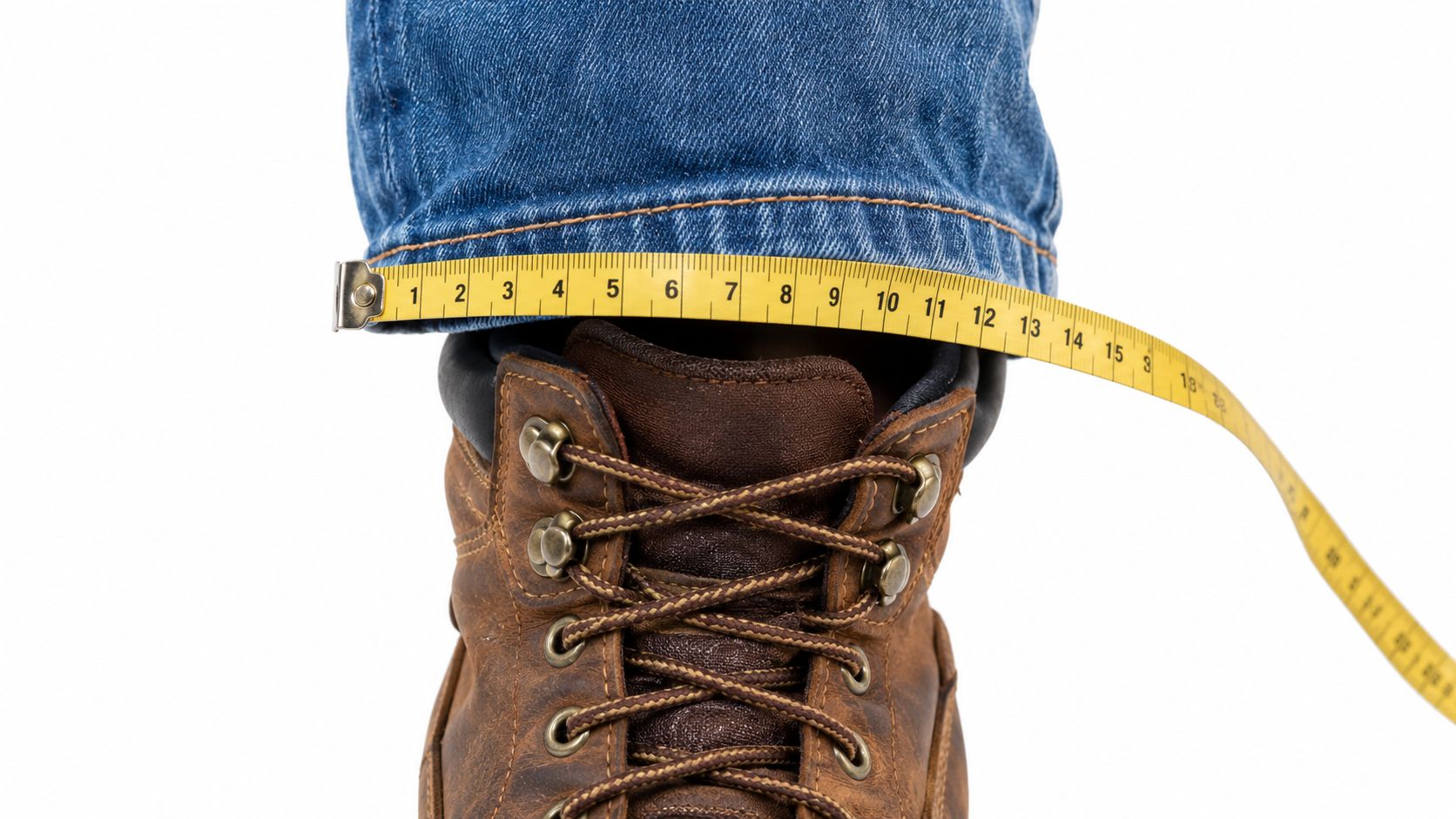
Measure the shaft. Wrap a flexible tape around the boot shaft at its widest upper point. Record the circumference of the boot that will be used for approval, not a smaller showroom sample.
Set the hem opening. Specify an opening approximately 1.5 to 2 inches wider than the shaft circumference so the denim can fall over the boot without tugging. This is a circumference comparison, not a flat-leg measurement. The pattern specification must state how the factory is measuring the hem.
Test the whole garment. Put the jeans on with the actual boot and evaluate the wearer standing, walking, sitting, and stepping onto a low stair. Check the knee-to-hem transition as well as the opening. A hem can clear the shaft while the knee restricts flexion.
Reject visible failure. Reject the pattern if the hem catches on the collar, exposes the shaft while seated, or creates excessive pooling at the ankle. The rear hem should finish around the top of the heel or slightly below it, rather than dragging on the floor. The bootcut fit guidance provides the same practical focus on shaft clearance, movement, and rear-hem position.
Rise deserves its own approval point. A mid- to high-rise pattern can reduce waistband and hem movement during physical work, but a higher rise isn't automatically better. Match the front rise and back rise to the wearer's bending posture, waistband placement, pocket access, and boot collar height. Then verify the rise on a seated body, because a sample that feels secure standing can pull across the front or expose the boot shaft when the wearer sits.
The following table turns the clearance rule into an approval aid. These are target relationships, so the final decision still belongs to the physical boot test.
| Boot shaft circumference (in) | Recommended hem opening (in) | Fit notes |
|---|---|---|
| 14 | 15.5–16 | Suitable for a relatively slim shaft, subject to collar shape |
| 15 | 16.5–17 | Check seated exposure and rear-hem position |
| 16 | 17.5–18 | Useful for many standard work-boot interfaces |
| 17 | 18.5–19 | Requires careful pooling and outsole-clearance checks |
| 18 | 19.5–20 | Consider a dedicated wider-hem block rather than a generic bootcut |
Inseam approval should happen with the intended heel and outsole, not barefoot or in a fashion shoe. A taller heel changes the apparent rear length, while a broad outsole can push the hem outward and alter the drape. Record the test boot, the wearer's activity, and the acceptable hem position in the tech pack so the factory isn't left to interpret “full length.”
Choosing Between Bootcut, Straight, and Relaxed
The right silhouette depends on the boot geometry and the movement requirement. “Bootcut” describes a visual relationship between the knee and hem, but it doesn't tell a factory how wide the knee, thigh, rise, or hem should be. Two bootcut jeans can have very different performance because their proportions and recovery differ.
| Silhouette | Typical hem opening (in) | Best paired with | Limitation |
|---|---|---|---|
| Bootcut | 16–18 for many work boots, with 17–19 often needed for taller or wider shafts | Sleek pull-on boots, cowboy-inspired boots, and moderate logger profiles | Can still catch if the knee is narrow or the hem lacks shaft clearance |
| Straight | Specified from the actual boot circumference rather than a universal label | Safety-toe boots and balanced everyday work boots | A straight hem may look clean but fail over a wide collar |
| Relaxed | Broad opening selected around the boot and intended movement | Chunky safety toes, articulated outdoor boots, and high-mobility work | Excess fabric can pool, drag, or interfere with the outsole |
Bootcut needs a real measurement
For a sleek pull-on boot, bootcut can create a clean vertical fall without looking overly wide. The pattern should still define the knee circumference, thigh ease, front rise, back rise, and measured hem opening. A narrow bootcut knee can restrict kneeling even when the hem looks generous.
The common guidance of a 16–18 inch leg opening for many work boots, with 17–19 inches for taller or wider shafts, is useful as a starting range, not a substitute for measuring the boot. The work-jeans fit guidance makes the important point that the label alone doesn't resolve the interface.
Straight and relaxed solve different problems
Straight-leg jeans suit a controlled, uniform silhouette and can work well with safety-toe footwear when the hem is drafted around the actual collar and outsole. They're easier to position across a range of outfits, but they can become restrictive at the knee if the pattern is graded from a narrow fashion block.
Relaxed jeans offer more room at the thigh and knee for squatting, climbing, and articulated outdoor movement. The trade-off is material management. Extra width can create ankle pooling, collect moisture or contamination at the hem, and obscure the outsole during a stair test. For a seasonal range, a measured bootcut block, a safety-toe straight block, and a movement-focused relaxed block are more useful than one generic “work boot jean” fit.
Material and Construction Choices That Hold Up
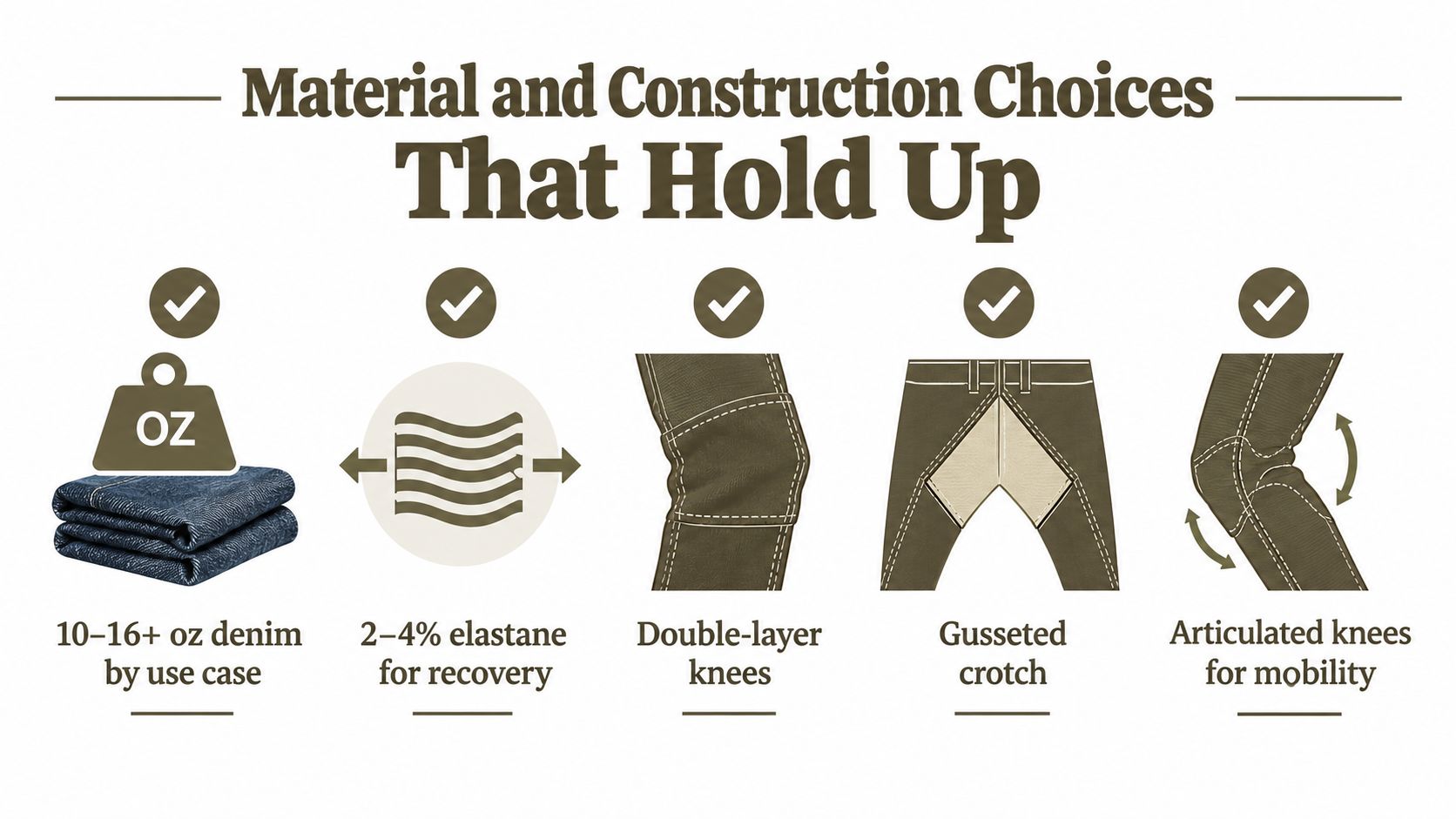
Denim weight changes more than hand feel. Lighter denim improves heat management and can reduce fatigue, while heavier denim generally gives a more substantial abrasion barrier and a sharper vertical fall. A practical range runs from 10 to 16+ ounces, selected by task, climate, and desired drape rather than by a blanket “premium” claim.
Elastane introduces a separate trade-off. A target of 2–4% elastane can provide mobility during kneeling and climbing while retaining enough structure for a controlled hem. Stretch is only useful if it recovers. Specify the fiber percentage, stretch direction, recovery expectation, and test condition. A comfortable sample that bags at the knee or hem after repeated movement isn't a successful workwear fit.
Build for the movement zone
The knee-to-crotch area carries the greatest movement burden. Double-layer knees add durability where kneeling creates repeated abrasion, but they also add bulk and can trap heat. Articulated knee panels improve flexion by allowing the pattern to follow a bent leg, although the panel position must be checked against the wearer's actual knee rather than the standing mannequin.
A gusseted crotch can reduce seam strain during climbing and squatting. It also adds sewing complexity, seam length, and potential bulk under a tool belt. The decision should be tied to the activity, not added as a generic workwear signal.
- Specify the denim by use case: Use lighter constructions for hot conditions and commuting, and heavier options where abrasion is a primary concern.
- Control stretch placement: Stretch throughout the garment improves mobility, while localized stretch panels can preserve a more structured appearance.
- Reinforce stress points: Use bartacks or bonded reinforcement at pocket corners, belt-loop attachments, and other identified high-stress areas.
- Protect the hem: A restitchable hem and durable thread make future repair more practical than a decorative finish that cannot be opened cleanly.
Cotton cultivation, dye chemistry, washing, finishing, and consumer care all influence denim's environmental burden. Widely cited assessments place the water requirement for one pair of jeans at roughly 3,781 to 10,000 liters, while one analysis attributes approximately 68% of lifetime water impact to cotton cultivation and about 23% to consumer use, as summarized in the overview of jeans production and environmental impacts. Those figures support a design approach centered on long wear, repairability, stable fit, and lower-impact finishing, rather than frequent replacement based on surface treatment.
A capable clothing manufacturing workflow should carry these decisions into the factory package. The specification needs construction callouts, material composition, seam details, reinforcement placement, wash limitations, and measurement tolerances in one controlled document.
Designing Around the Safety Toe and Outsole
Safety footwear sets the boundary conditions. The jeans shouldn't be designed to hide, compress, or interfere with the certified toe, heel, or outsole. Start by identifying the workplace hazard and the required boot marking, then test the jeans over that exact boot.
ASTM F2413 covers protective-toe footwear. The I/75 marking indicates 75 foot-pounds of impact resistance, while C/75 indicates 2,500 pounds of compression resistance. Additional codes can identify electrical-hazard and puncture-resistance properties. The safety-toe footwear guidance explains why the product label and certificate of conformance matter more than a general “safety boot” description.
Traction also needs a defined standard. The SR designation requires a whole-boot coefficient of friction of at least 0.40 on specified wet and dry surfaces, while SRO adds oily-wet performance with a minimum coefficient of friction of 0.33. The jean pattern can't create traction, but it can create interference if the hem catches the outsole, drags across the heel, or obscures the foot during movement.
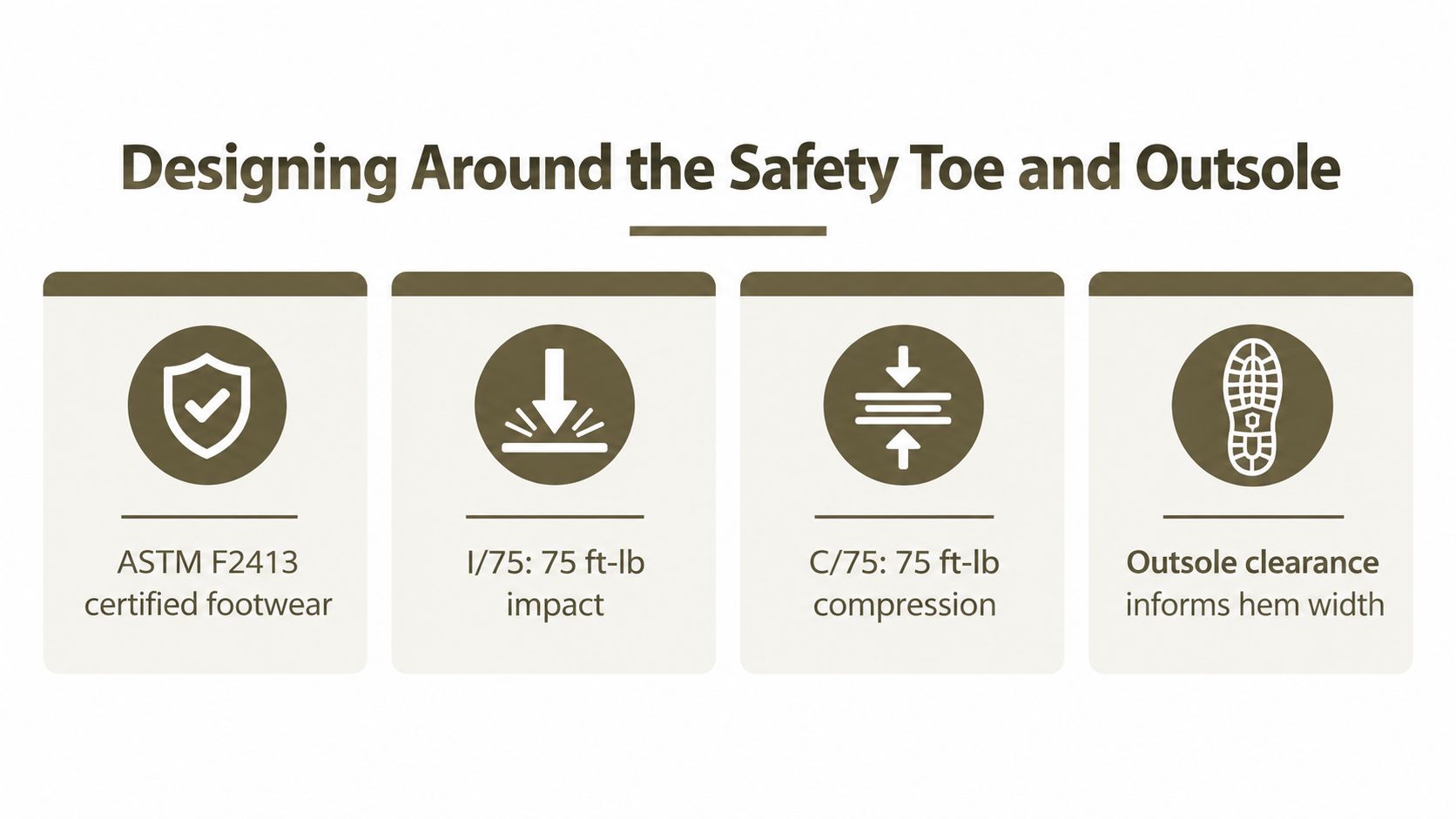
Translate the boot certification into the apparel brief
| Code | Protects against | Design implication for jeans |
|---|---|---|
| ASTM F2413 | Protective-toe footwear requirements | Test the jeans with footwear carrying the required marking and certificate |
| I/75 | 75 foot-pounds of impact resistance | Keep the hem and leg shape from interfering with safety-toe fit |
| C/75 | 2,500 pounds of compression resistance | Avoid pressure or restrictive fabric behavior around the toe and forefoot |
| EH | Electrical hazards | Treat the boot as certified protective equipment, not simply a styling reference |
| PR | Puncture resistance | Maintain clear outsole and heel movement during walking and stair tests |
| SR | Specified wet and dry slip performance | Prevent hem drag or outsole obstruction during movement |
| SRO | Specified oily-wet slip performance | Verify the jeans don't interfere with the whole-boot traction system |
Terms such as “oil-resistant” and “non-slip” are not equivalent to certified slip testing across every jobsite condition. A tech pack should require the relevant marking on the product label and certificate of conformance, then document the garment test separately. The apparel team is validating clearance and movement. The footwear certification remains the source of protective-performance claims.
Why a Generic Bootcut Label No Longer Cuts It
Bootcut has returned to fashion-led denim, and workwear-inspired styling is part of that revival. One fashion report cites a 114% increase in bootcut-jean sales by the end of 2024 and a 10% increase in interest in cowboy hats and boots compared with 2023. Those figures belong to the cited trend report, which discusses the 2025 denim direction, but the product lesson is broader: demand for the look doesn't prove that a fashion bootcut can handle work footwear.
Comfort is the counterweight. A 2025 Footwear Insight report lists comfort as the leading trait for 97% of consumers, as reported in the same trend research. That priority should change the way brands define the product. A bootcut silhouette that looks correct in an editorial image can still fail through heat buildup, rigid knee behavior, poor stretch recovery, or a hem that drags on a wet floor.
Replace the label with an activity brief
A useful SKU description says what the jeans must do:
- Hot-market work jean: Use breathable stretch denim, controlled thigh ease, and finishing that avoids unnecessary surface treatments.
- Construction jean: Prioritize abrasion resistance, reinforced knees, a gusseted crotch where needed, and a hem that stays clear of the outsole.
- Outdoor movement jean: Allow articulated knee shaping, reliable stretch recovery, and enough rise stability for climbing and squatting.
- Commuter workwear jean: Refine the silhouette and finishing while preserving the measured shaft clearance and heel position.
The category label can remain on the hangtag, but it shouldn't carry the technical burden. A factory needs the hem opening, rise, inseam, knee, thigh, fabric composition, recovery requirement, and intended boot profile. “Bootcut” is a merchandising phrase. It isn't a complete specification.
The strongest product ranges may use one aesthetic family with several functional blocks. A clean bootcut can serve lifestyle and commuting, a wider version can accommodate a broad safety toe, and a relaxed articulated version can support outdoor work. That structure gives the customer a recognizable product language without pretending that one pattern fits every boot and every climate.
Spec Sheet and Rollout Checklist for a Work Boots Jeans Line
A factory-ready brief should make the boot interface measurable before the first sample is cut. Keep the approval gates short enough to use, but specific enough that a supplier can't substitute a visually similar construction.
Fit and pattern approval
- Identify the reference boot: Record shaft circumference at its widest upper point, collar shape, heel height, outsole profile, and required safety markings.
- Set the hem target: Specify an opening approximately 1.5–2 inches wider than the measured shaft circumference and define whether the factory measures the hem flat or around.
- Lock the rise: Approve front rise, back rise, waistband position, and pocket placement while standing and seated.
- Control the inseam: Set the rear hem at the top of the heel or slightly below with the intended boot, never with a barefoot fitting.
- Test movement: Require standing, walking, sitting, squatting, kneeling, and stepping onto a low stair.
- Record rejection points: Reject catching at the collar, seated shaft exposure, excessive ankle pooling, hem drag, restricted flexion, or outsole interference.
Material and construction approval
Select the denim weight by task and climate, then specify 2–4% elastane when mobility requires stretch. Add double-layer knees, gussets, articulated panels, bartacks, or bonded reinforcement only where the activity justifies the added bulk and cost.
Run recovery checks after repeated stretching, inspect seam stress at the crotch and seat, and test the hem on wet or contaminated floors. The garment shouldn't drag into the walking surface or become unstable around the boot after movement. Confirm wash and care instructions preserve the approved dimensions.
Compliance and production control
Verify the boot's ASTM marking and certificate of conformance, and keep protective footwear claims separate from apparel claims. Confirm that the jeans don't obscure or interfere with the certified toe, heel, outsole, or traction behavior. Before bulk approval, check the label, fiber content, size set, grading, thread, bartacks, seam allowance, and hem construction against the controlled package.
For teams formalizing the handoff, spec-sheet essentials for fashion designers provide a useful reference for organizing construction details and approval information. The goal isn't a longer document. It's one version of the truth that sourcing, technical design, quality control, and the factory can read the same way.
Design for the full product life. Use restitchable hems, repairable seam construction, durable thread, and customer-facing care guidance that supports longer wear. The best work boots jeans line won't be defined by a bootcut label alone. It will be defined by a verified interface that fits the actual boot, survives the actual movement, and gives the factory no room to guess.
Genpire helps apparel teams turn boot measurements, fit decisions, and construction requirements into factory-ready concepts and tech packs. Visit Genpire to develop a work boots jeans line with controlled specifications, visual references, and production assets in one workflow.