A product launch is already under pressure when a supplier asks one apparently simple question: “What's the size of set?” The apparel factory interprets it as the number of graded samples to sew. The packaging supplier reads it as the number of inner packs per carton. Both teams follow the document they received, and both believe they've complied.
That misunderstanding is avoidable. Size of set isn't a universal count. It's a specification decision whose meaning changes across a product listing, packaging specification, pattern set, BOM, and apparel size validation. Define it loosely, and product, sourcing, and factory teams will solve different problems under the same label. Define it precisely, and the count becomes auditable from concept through production.
Table of Contents
- Why Size of Set Is the Spec Detail That Quietly Breaks Production
- Defining Size of Set and What It Is Not
- How Size of Set Changes Meaning Across Contexts
- Apparel Size Sets as Controlled Validation Samples
- Grading Continuity and Manufacturability Across Sizes
- Inclusive Sizing and the Fit-Equity Case for Set Breadth
- Complexity Costs and the Case for Smaller Sets
- Recording Size of Set in Specs and Tech Packs
- Choosing the Right Definition for Your Document
- Quick-Reference Card You Can Pin to Your Spec Template
- Frequently Asked Questions on Size of Set
Why Size of Set Is the Spec Detail That Quietly Breaks Production
The phrase usually causes trouble before anyone notices it. A founder may write “size of set: full range” in a tech pack, assuming the factory knows which sizes are included. A packaging engineer may add an inner-pack quantity elsewhere, using the same field name. A product manager then copies the number into a listing feed, where it's interpreted as the count of customer-facing variants.
The problem isn't arithmetic. It's uncontrolled meaning. A supplier can't approve a sample, plan materials, or build packaging against a term that has no stated unit, scope, or approval rule.
Start by identifying the document's job. Ask whether the count governs:
- A commercial offering, such as the sizes a shopper can select.
- A production validation, such as graded apparel samples.
- A physical pack, such as units inside one carton.
- A component group, such as pieces or options in a BOM.
Then write the count beside its unit and governing rule. “Seven graded apparel samples for style X” is actionable. “Size of set: seven” isn't.
Practical rule: If two suppliers could read the field differently without violating the wording, the specification isn't finished.
Use the same discipline applied to broader tech pack mistakes that cause factory sample rejection. The objective is simple: make every team count the same thing before sampling, quoting, and production planning begin.
Defining Size of Set and What It Is Not
Size of set is the defined count of like items grouped for one specification, production run, or commercial offering. The count must follow a stated rule. It shouldn't be an estimate, a synonym for “range,” or a number copied from another document.
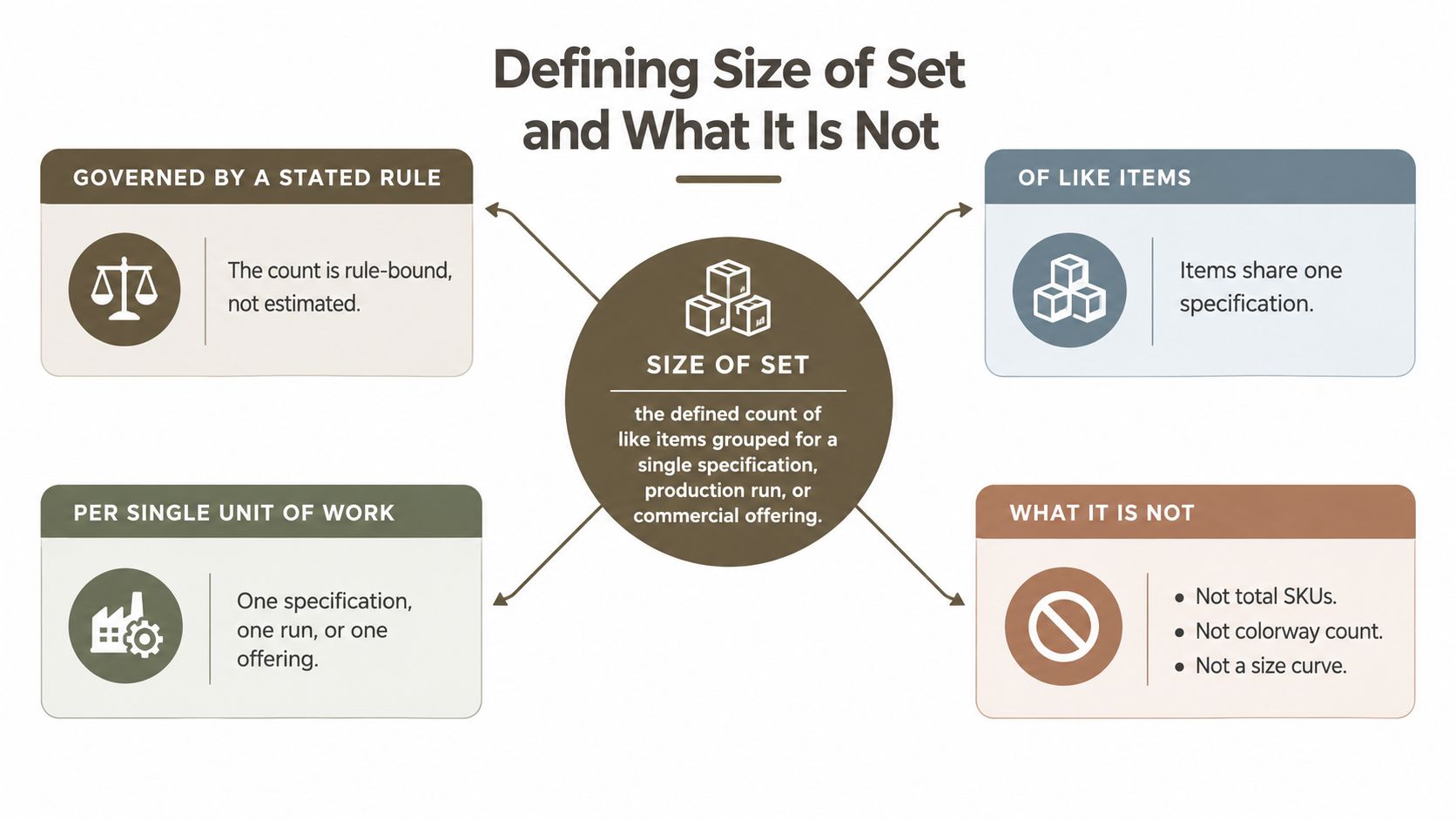
Keep these neighboring terms separate:
- Size range is the span covered, such as the smallest through largest label offered or tested.
- Size scale is the label system itself, whether numeric, alphabetic, regional, or brand-specific.
- Grade rule is the dimensional increment applied between adjacent sizes.
- SKU count is the number of sellable variants created by combinations such as style, color, size, or pack configuration.
- Size of set is the count governed by the document's stated purpose.
Consider a shirt offered in four colors and several sizes. Its size range describes the labels. Its grade rule describes how the pattern changes between those labels. Its SKU count may include every color-size combination. Its size of set could mean the physical samples used to validate grading, the customer-facing size variants, or the units in a shipping pack.
That's why replacing one term with another creates silent errors. A product listing can use size of set to mean selectable sizes, while a packaging specification uses it to mean units per inner pack. The number may be correct in both places and still refer to entirely different objects.
How Size of Set Changes Meaning Across Contexts
The fastest way to prevent confusion is to attach the phrase to the document context. A count has no operational meaning until the team knows what it counts and who will approve it.
| Context | What size of set counts | Typical unit |
|---|---|---|
| Product listing | Customer-facing size variants offered for one product | Size options |
| Packaging and inner packs | Units grouped inside one sellable or shippable pack | Finished units per pack |
| Pattern piece set | Graded pattern pieces prepared for one style and size | Pattern pieces by size |
| BOM | Components, options, or colorways assigned to one finished article | Components or options per article |
Product listings
For a product listing, the count describes the shopper's available choices. If a jacket is offered in a defined group of sizes, the listing should identify the size labels and market system, not merely state “full size set.” The listing count must align with inventory and variant records, but it doesn't prove that every size has been technically validated.
Packaging and inner packs
Packaging uses a physical count. “Six units per inner pack” tells the packaging supplier how many finished products belong together. It doesn't describe the apparel size range, the number of carton styles, or the number of packaging components.
Pattern piece sets
A pattern piece set counts the pieces required to construct a style, with the relevant size or grading scope stated. A supplier needs to know whether the instruction concerns one base-size pattern, a graded production set, or the pieces used across multiple construction options.
BOMs
A BOM may use the term for components or options bundled into one finished article. A necklace BOM, for example, could distinguish the chain, clasp, pendant, label, and packaging insert. The count here is not a customer-facing size count unless the BOM explicitly defines size variants.
Cross-context documents need explicit labels. Write “apparel size set”, “pattern piece set”, “inner pack quantity”, or “BOM component count” instead of relying on the unqualified phrase.
Apparel Size Sets as Controlled Validation Samples
An apparel size set isn't a visual check of one approved sample. It's a controlled validation sample across the intended size range. Under ISO 8559-2's framework for clothing size designation, sizing starts with the wearer's body dimensions, with primary and secondary dimensions distinguished from garment measurements.
That distinction belongs in the tech pack. For every size, record:
- Target body dimensions, using the selected measurement system.
- Garment points of measure, with named locations and measurement conventions.
- Tolerance, including the acceptable deviation for each point.
- Grade rules, showing how dimensions progress between sizes.
- Fit comments, including corrections, restrictions, and approval status.
The size range should reflect the intended market population and figure profile. The methodology in ISO 8559-1 and ISO 8559-3 provides a basis for building body-measurement tables and intervals, so a brand shouldn't select a size curve merely because a previous style used it.
The worksheet is the control point
Measure every physical sample on the same standardized worksheet. Classify each deviation instead of writing a general comment such as “looks tight” or “needs more room.”
Use three practical classifications:
- Pattern or grading error, where the drafted dimensions or grade increment are wrong.
- Construction variation, where sewing, seam allowance, pressing, or assembly changes the result.
- Fabric behavior, where relaxation, stretch, recovery, wash, or finishing affects the measurement.
Review high-risk dimensions directly, including chest or bust, waist, hip, shoulder, armhole, sleeve length, rise, inseam, and garment length. Overall appearance still matters, but it can't replace point-by-point control.
A pattern maker can use Genpire's sample-making services alongside the brand's own measurement worksheet and approval process. For a useful reference on translating fit intent into product development, review Presidio's work for Negative Underwear, then document the measurable decisions in your own tech pack.
Approve the base size for design intent, but approve the boundary sizes for production confidence.
Grading Continuity and Manufacturability Across Sizes
A base sample can fit well while the size set fails. The failure may appear as an abrupt shoulder change, an armhole that becomes difficult to sew, a sleeve that loses balance, or a fabric panel that behaves differently at the edge of the range. The size set's job is to expose those problems before bulk production.
A single universal grade rule is technically inappropriate. ASTM maintains separate body-measurement tables for populations and figure types including adult women's misses, petite, and maternity, adult men's short, regular, and tall, and boys' regular, slim, and husky. Those distinctions show why grade increments must follow the selected demographic, size architecture, and product category, as reflected in the ISO 8559-2 sample and sizing framework.
Build the set around risk
Use this workflow:
- Approve one base size. Lock its points of measure, construction, fabric, and fit intent.
- Document every grade increment. Record the change at each point, not just the overall size label.
- Produce a representative physical set. Include the base size and the smallest and largest production sizes.
- Expand testing when risk is high. Evaluate every size for complex shaping, stretch-sensitive fit, molded components, footwear lasts, or other high-risk constructions.
- Check adjacent progression. Compare each size with its own tolerance and with the expected change from neighboring sizes.
That final comparison is essential. A sample can fall inside its individual tolerance and still expose an inconsistent grade jump. If one size advances differently from the surrounding sizes, the factory may face a pattern, construction, or comfort problem that a single-size review would miss.
Manufacturability belongs in the approval record too. Note seam construction, operator feasibility, fabric relaxation, wash or finishing effects, and any handling issue that changes across the range. Release the final graded measurement chart, pattern version, sample photographs, correction history, and approval status by size.
Inclusive Sizing and the Fit-Equity Case for Set Breadth
Treating size of set as an assortment-count problem misses the commercial decision. In apparel, the breadth of the set signals whether the brand designed for real customers or just enlarged a base pattern and changed the label.
Research from the University of Nevada, Reno on inclusive sizing reports that extended sizing, including ranges such as 00–32 or XS–4XL, improves perceived inclusiveness, trust, willingness to pay, and purchase intent, including among shoppers who don't personally need extended sizes. The same research notes that more than two-thirds of American women wear sizes outside many retailers' standard ranges.
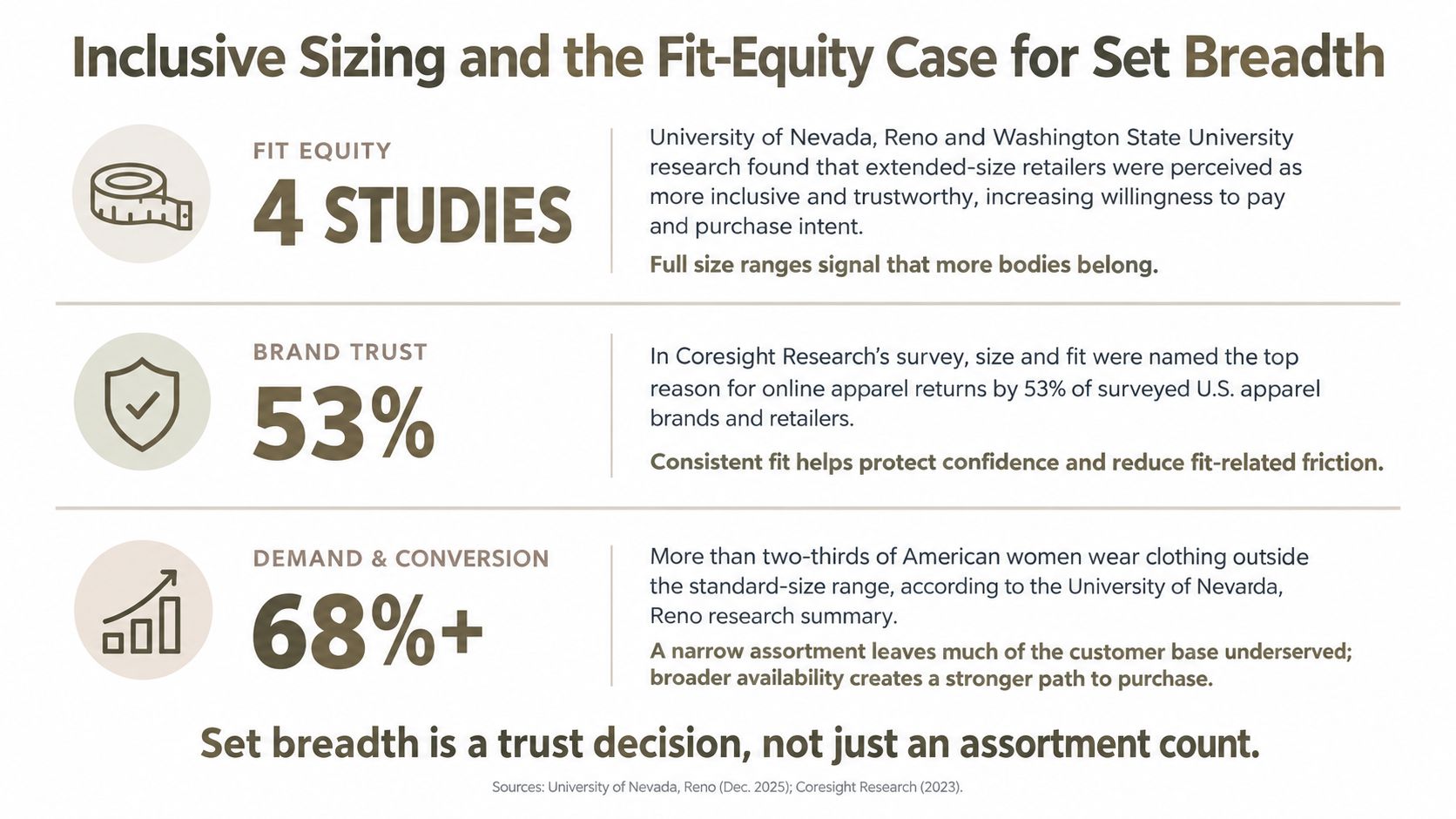
The hard question isn't just how many labels to include. It's which sizes need distinct proportions, where a graded-up block stops reflecting the target body, and which construction details must change to preserve comfort and appearance.
Breadth needs technical intent
A broader set creates value only when the added sizes are developed and validated properly. A nominally extended label with unchanged proportions can damage trust more than a clearly defined, narrower range. Technical designers should therefore connect each size decision to:
- Body profile, not just the next label in a sequence.
- Garment balance, especially at bust, hip, shoulder, rise, and armhole.
- Fabric response, including stretch and recovery.
- Channel and region, because sizing systems and customer expectations differ.
Inclusive assortment can strengthen a brand's wider appeal and price power, not only its incremental unit sales. The available evidence is primarily U.S.-focused and apparel-specific, so teams should adapt the architecture by region, category, body shape, and channel rather than treating one range as universal.
Complexity Costs and the Case for Smaller Sets
More variants create more work. Every added size, color, pack format, or channel-specific version can require additional sampling, materials, inventory decisions, tooling, inspection, and supplier coordination.
McKinsey's complexity analysis estimates that consumer-goods complexity can cost U.S. food-and-beverage manufacturers as much as $50 billion in gross profit (McKinsey's complexity research). The same source describes a North American business unit whose SKU count rose 66% in three years, driven largely by line extensions, new pack sizes, and channel-specific products.
A separate 2025 study across 34 UK and U.S. categories found that assortment-size changes had only weak relationships with brand penetration and market share, while showing a weak positive relationship with loyalty, as summarized in the same McKinsey source.
The operational conclusion is clear: don't expand a set because visual variety feels like growth. Rank each proposed variant by:
- Demand coverage, or the customer need it serves.
- Manufacturability, including shared construction and component reuse.
- Margin, after sampling and operational costs.
- Inventory exposure, including slow-moving sizes or options.
- Fit or quality risk, particularly at boundaries and complex constructions.
Ask for the smallest set that covers meaningful customer needs. A smaller, well-validated set is easier to source and more credible than a broad set that the factory can't execute consistently.
Recording Size of Set in Specs and Tech Packs
Write the count where the next team will use it, not only where the original decision was made. The spec should state the number, unit, scope, and approval rule in plain language.
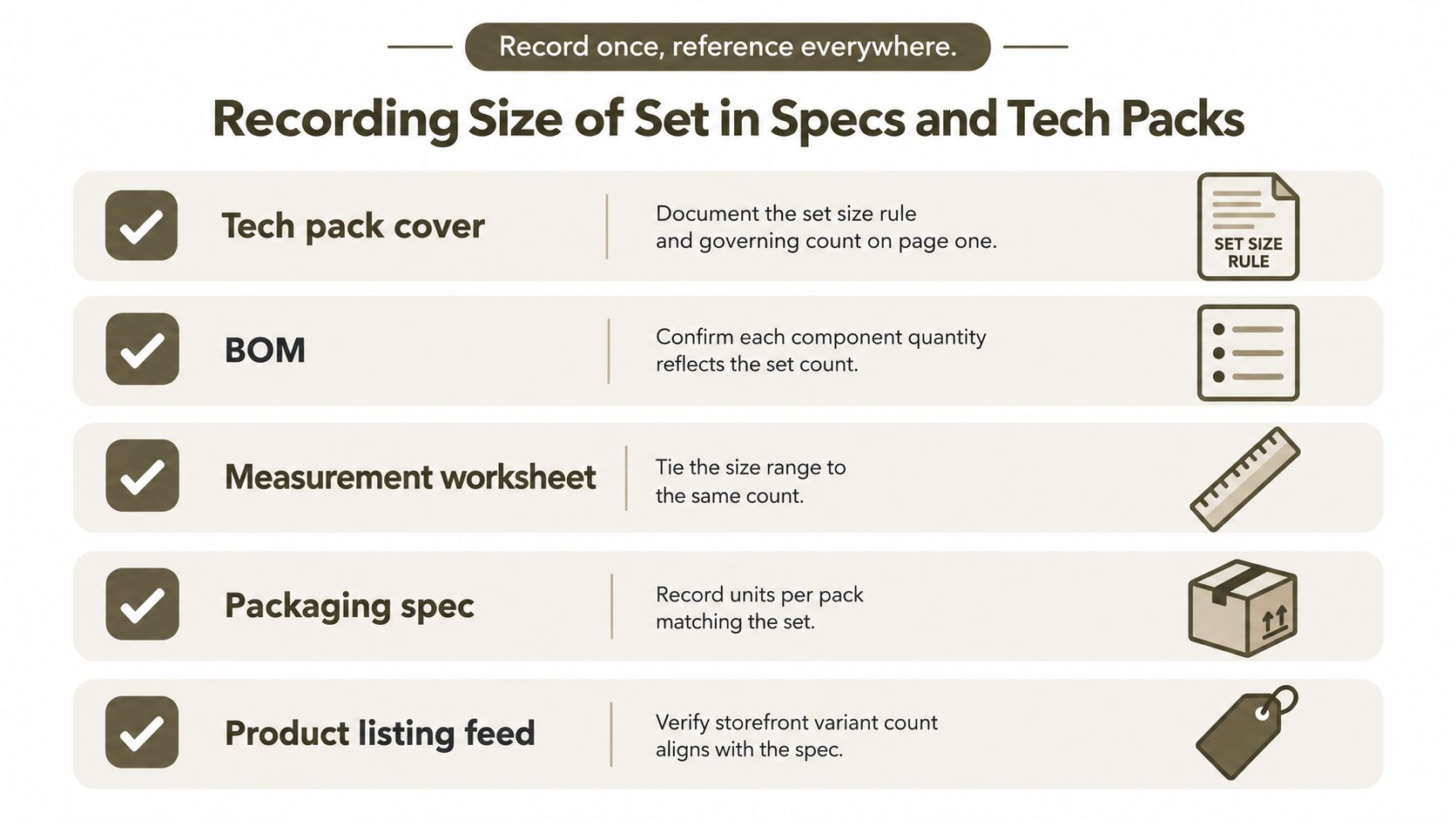
Use this recording checklist:
- Tech pack cover: State the governing count on page one, such as “apparel size set: seven graded samples for style X.”
- BOM: Identify whether the count refers to components, options, colorways, or finished articles.
- Measurement worksheet: Tie the size range to the same count and record every point of measure, tolerance, and grade increment.
- Packaging specification: Use “inner pack quantity” or “carton quantity” when counting finished units.
- Product listing feed: Record the customer-facing variant count separately from the physical validation set.
Approval status belongs beside the count. Mark each apparel size as approved, conditional, rejected, or pending, and attach the correction history. Don't let “approved” on the base size imply approval for the boundaries.
Structured exports reduce email handoffs and version drift because the factory receives the same measurement chart, BOM, packaging instruction, and sample status that the internal team approved. A tech pack template from Genpire can provide a structured starting point, but the brand still owns the governing definitions and product-specific construction notes.
If a PIM or e-commerce platform has its own “size of set” field, map it explicitly. Label the downstream field as a listing variant count, preserve the technical count in the source specification, and prevent the platform's terminology from overwriting the factory definition.
Choosing the Right Definition for Your Document
Use the document's purpose to select the count. Don't force one field to serve every workflow.
| Context | Definition to write | Count method | Approval signal |
|---|---|---|---|
| Apparel grade sample | Physical samples validating the intended size range | Count approved samples by size | Technical designer and fit approval |
| Packaging inner pack | Finished units grouped in one pack | Count units inside the pack | Packaging engineer and pack-out approval |
| Pattern piece set | Pattern pieces required for the style and grading scope | Count pieces by style and size scope | Pattern review and construction check |
| BOM option set | Components or options assigned to one finished article | Count components or selected options | Technical and sourcing sign-off |
For apparel, the measurable signal is the approved measurement worksheet and boundary-size review. For packaging, it's the confirmed pack-out, labeling, and physical fit. For patterns, it's the complete piece list and version-controlled grade. For a BOM, it's component quantity, option logic, and assembly compatibility.
Mixed-document rule: label every count with its unit, such as “apparel size set: seven graded samples” and “inner pack: six units per carton.”
That wording removes the ambiguity without requiring the reader to infer which number governs which operation.
Quick-Reference Card You Can Pin to Your Spec Template
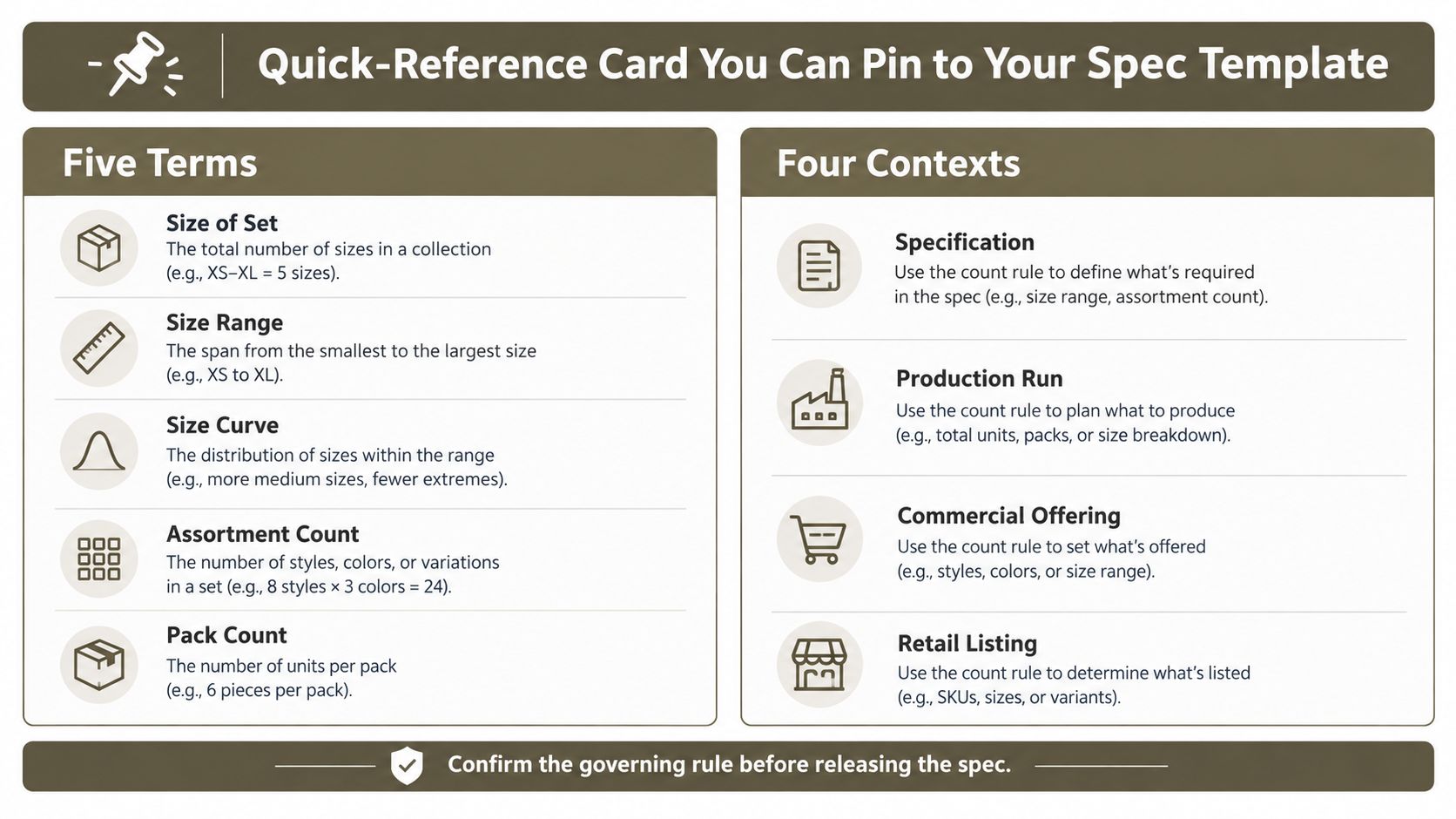
Five terms
- Size of set: Defined count under a stated rule.
- Size range: Span of sizes covered.
- Size scale: Labels assigned to those sizes.
- Grade rule: Dimensional change between sizes.
- SKU count: Sellable combinations.
Four contexts
- Product listing: Customer-facing size options.
- Production run: Samples or units validated for manufacture.
- Packaging: Units grouped per pack.
- BOM: Components or options per finished article.
Before releasing any document, answer three questions: What's being counted? What's the unit? Who approves it? Warning signs include a count that changes between documents or missing tolerances for boundary sizes.
Size of set is whatever the specification says it is, so the specification must say so explicitly.
Frequently Asked Questions on Size of Set
Who owns the definition?
The technical designer usually owns an apparel grade-sample definition. The packaging engineer owns an inner-pack definition. Product and sourcing teams should review the commercial and operational consequences, but ownership must be named.
What happens when the brand and factory disagree?
Pause approval and compare the written field, unit, and document context. The brand should issue one corrected definition, update dependent documents, and record the change rather than allowing an email interpretation to become the production rule.
When must a set be re-approved?
Re-approve it whenever the base size, grade rule, fabric behavior, construction, component, or packaging configuration changes. Carryover is acceptable only when the governing inputs remain unchanged and the previous approval is traceable.
How should regional sizing work?
Keep the commercial size labels region-specific where necessary, but preserve the body-measurement basis, garment points of measure, and grade logic for each market. Don't merge different size architectures into one unexplained count.
Genpire helps teams turn product concepts into structured tech packs with measurement specifications, component details, and production assets that suppliers can review in one workflow. Visit Genpire to define size sets clearly before sampling and keep the approved specification aligned through production.