You send the same product concept to three factories, expecting three useful sample quotes. Instead, one supplier returns a single unit price, another includes freight and tooling without separating them, and the third substitutes a material without mentioning it. The figures look different, but the scope is different too. You aren't comparing factories. You're comparing interpretations.
A sample request quotation should prevent that problem. It isn't merely a request for a prototype price. It's a controlled handoff from product definition to supplier evaluation, with enough technical and commercial detail for every factory to quote the same work. That means separating development charges from sample costs, documenting assumptions, controlling revisions, and deciding which approvals require a physical sample.
Table of Contents
- Why Sample Request Quotations Often Fail
- How to Structure a Sample Request Quotation
- Understanding Sampling Costs and Lead Times
- Leveraging Genpire Outputs to Streamline Your RFQ
- Digital-First Sampling and Sustainability Considerations
- Final Checklist for Your Next Sample Request Quotation
Why Sample Request Quotations Often Fail
A buyer sends a sketch, reference images, quantity, and delivery date. Three factories may respond quickly, yet each can answer a different question. One assumes a stock fabric, another prices custom hardware, and a third excludes packaging and courier delivery. The resulting figures look comparable only because the assumptions remain hidden.
That gap starts with small technical ambiguities. Fabric weight, colour standard, measurement basis, revision allowance, testing, and packaging can each change the sample scope. A low figure may reflect fewer services rather than lower manufacturing cost. Digital product images can help suppliers review the intended appearance, but they cannot replace dimensions, tolerances, or component specifications.

The hidden cost of an incomplete brief
A vague request pushes technical decisions into sampling, when changes consume more time and money. A factory may select a visually similar zipper, alter a seam allowance for its machinery, or treat a tolerance as flexible. The sample can look acceptable in photographs while failing a fit test, dimensional check, or component review. Many such failures begin with specification gaps, as explained in this breakdown of why factory samples get rejected due to tech pack mistakes.
Treat the RFQ as a technical package, not a short email. A foundational study of multi-item business RFQs received 825 usable responses and found an average of 249 individual items per request, although more than three-quarters of bundles contained fewer than 100 items. Direct materials accounted for 58.7% of requested items, indirect materials and maintenance, repair, and operating goods for 24.8%, and services for 7.5%. These figures come from research on multi-item requests for quotation. These figures reinforce a practical point: professional sourcing requests contain many coordinated requirements, not one isolated price.
Practical rule: If two suppliers can reasonably interpret your request differently, the document is not ready for comparison.
Why the cheapest quote is often misleading
A low sample quote often hides scope differences. One supplier may include only the prototype unit. Another may include pattern engineering, setup, testing, courier fees, and a defined feedback round. Request each cost separately, or the cheaper quote may only postpone the bill.
Commercial terms create another comparison problem. Different Incoterms, currencies, freight arrangements, duties, or payment milestones can change the apparent price before a purchase order is placed. Packaging has the same effect. A folded product in a polybag is not equivalent to a retail-ready carton with protective inserts.
Digital assets can reduce avoidable sampling work when they show colour, construction, and component relationships clearly. They work best alongside a controlled specification, so every supplier evaluates the same product definition and revision. Before sending an RFQ, use this tech-pack checklist before you send. The purpose is straightforward: expose each supplier's assumptions before production time and cash are committed.
How to Structure a Sample Request Quotation
Build the document as four connected layers. The first identifies the commercial request, the second defines the product, the third separates the costs, and the fourth forces the supplier to disclose constraints. A factory should be able to answer every field without guessing.
Start with the commercial identity
Give the product a unique identifier, revision number, requested sample quantity, destination, currency, and required Incoterm. Include the date issued and the response deadline. If the supplier receives a revised specification later, issue a new revision rather than replacing an attachment without notice.
The destination matters because freight and delivery conditions affect the actual cost. The currency matters because exchange assumptions can obscure comparisons. The Incoterm matters because a factory price without a clear responsibility for freight, insurance, customs, or delivery isn't a complete commercial offer.
Attach a complete technical baseline
The supplier should receive the bill of materials, drawings or measurements, material and finish requirements, tolerances, packaging requirements, quality standards, testing obligations, and sample approval gate. Include construction details that photographs can't communicate, such as seam types, reinforcement locations, hardware specifications, stitch density, edge treatment, assembly sequence, and component relationships.
For apparel, distinguish body measurements from finished measurements and identify grading or size requirements. Accurate size charts help prevent a factory from building from inconsistent measurement references. For accessories, furniture, or electronics, use the same discipline for dimensions, component interfaces, finishes, and functional criteria.
A supplier shouldn't need to infer whether a color is approximate, whether a tolerance is critical, or whether packaging is part of the approval.
Separate every meaningful charge
Never ask only for a single sample price. Request separate line items for:
- Prototype or sample unit: State the quantity and what the unit includes.
- Pattern, tooling, and setup: Identify one-time engineering, molds, fixtures, or programming.
- Materials: Show custom materials, minimum purchase quantities, substitutions, and remnants.
- Testing and inspection: Specify required tests and whether laboratory or in-house work is included.
- Freight and packaging: Separate courier charges, export packaging, retail packaging, duties, and other logistics.
- Revisions: State included rounds and the charge for additional changes.
- Production pricing: Request unit prices at the relevant volume breaks if the sample may proceed to bulk.
This structure prevents a blended figure from concealing material, labor, and setup assumptions. It also lets you compare a digital-first path, one physical prototype, and a conventional multi-round development path without treating them as identical services.
Require written assumptions and constraints
Ask the supplier to state exclusions, minimum order quantity, sample and production lead times, quotation validity, payment terms, available capacity, material substitutions, and dependencies. Require the factory to flag anything it can't meet before accepting the request.
A useful comparison sheet should normalize every response into the same fields. Add a should-cost view where possible, then review the variance rather than choosing the lowest headline number.
| Component Category | Required Details |
|---|---|
| Product identity | Product code, revision, description, sample quantity |
| Technical definition | BOM, drawings, measurements, materials, finishes, tolerances |
| Quality control | Standards, tests, inspection method, approval gate |
| Commercial terms | Currency, destination, Incoterm, payment terms, quote validity |
| Cost breakdown | Sample, tooling, setup, materials, testing, packaging, freight |
| Production assumptions | MOQ, volume pricing, capacity, lead time, substitutions |
| Change control | Included revisions, extra revision fees, approval record |
Procurement teams can monitor quote turnaround time, quote completeness rate, variance from should-cost, supplier lead-time adherence, and total RFQ cycle time. A practical supplier-participation benchmark targets more than 60%, with 60% to 80% classified as good, above 80% as best-in-class, and below 40% as below average in the cited procurement guidance from Fabcon's contract manufacturing quote guidance.
Understanding Sampling Costs and Lead Times
A sample isn't a miniature bulk order. It carries development work that disappears or spreads across production volume later. Pattern engineering, machine setup, low-volume material purchases, special handling, and inefficient labor all sit inside the prototype process.
That cost structure explains why a sample can look expensive beside an eventual production unit. One apparel-development benchmark estimates sample unit cost at roughly two to five times the eventual bulk unit price, because the sample absorbs these low-volume and development costs. The benchmark is documented in this sample cost and development guide.
Price the sample as a gated process
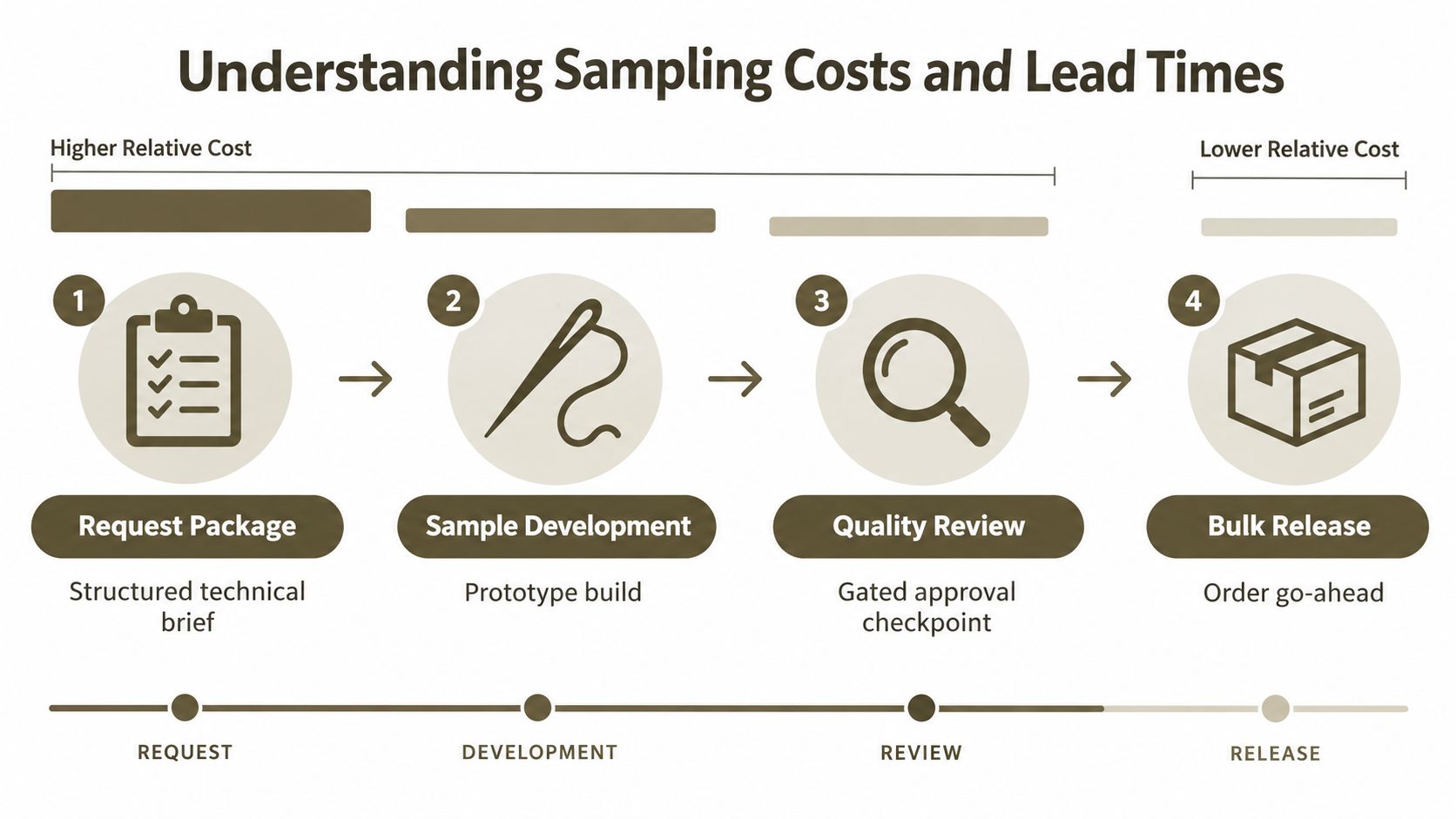
A reliable workflow has four gates:
- Request package: The supplier confirms that the technical files, materials, measurements, and commercial terms are complete.
- Prototype development: The factory builds the sample against the controlled specification and records any unavoidable deviation.
- Quality review: The buyer checks fit, dimensions, function, color, construction, and workmanship against explicit criteria.
- Bulk release: The approved pre-production or “gold” sample becomes the physical reference for production.
Each gate should have an owner and a decision record. Sending scattered feedback through several email threads creates version drift. Instead, consolidate comments into one revision list, identify the affected component or measurement, and issue a controlled update.
Set expectations before the order
A standard sample can take 5 to 10 days after the factory receives all materials and the technical package. Each revision commonly adds another 7 to 10 days, and two rounds typically require about 3 to 5 weeks, according to the same apparel-development benchmark. These timelines depend on material availability, factory capacity, technical completeness, and the scope of the change.
Your quotation should therefore ask:
- Included revisions: How many rounds are included, and what counts as a revision?
- Material handling: Can the supplier substitute materials, and must substitutions receive written approval?
- Sample criteria: Which dimensions, tests, color checks, and functional checks determine acceptance?
- Logistics: Are courier charges, export packaging, duties, and insurance included or separate?
- Development fees: Are pattern, tooling, or engineering fees refundable against a production order?
- Approval status: Does the approved sample become the production reference, and how is it stored and identified?
Approving from photos alone is risky for fit, hand feel, color under real lighting, component function, and workmanship. A physical review is often necessary, but it should be purposeful. Don't order repeated samples just because the original RFQ failed to define the acceptance criteria.
For buyers comparing development partners, Genpire's sample-making services can fit into a workflow where the sample request, specification, and review remain connected. The operational principle is more important than the tool: every sample charge and lead-time promise should map to a defined gate and deliverable.
Leveraging Genpire Outputs to Streamline Your RFQ
A supplier quotes accurately when the supplier can see what must be built, how it should be measured, which components are mandatory, and what counts as approval. The useful output isn't only a polished product image. It is a coordinated set of views and specifications that removes interpretation from the request.
Start by creating the product concept from text, sketches, or reference images. Use multi-view visuals to show front, back, side, detail, and construction intent. Then turn the approved direction into a technical package with component breakdowns, materials, measurements, finishes, and revision identifiers.
Keep the quote tied to the specification
A practical RFQ workflow looks like this:
- Prepare the product baseline. Store the product identifier, revision, BOM, visual references, measurements, tolerances, and packaging requirements together.
- Mark approval-critical details. Identify the dimensions, materials, finishes, colors, and functions that require physical validation.
- Export for the supplier. Use PDF for a controlled reading copy, SVG where scalable technical artwork is useful, and Excel for component or cost data that suppliers need to review.
- Send one controlled package. Give each factory the same revision and the same quotation form.
- Normalize the responses. Transfer every supplier's figures into one comparison sheet, preserving assumptions and exclusions beside the prices.
- Record feedback against the product. Keep supplier comments, revised files, and sample approvals attached to the relevant version rather than distributed across inboxes.
Brand DNA can help keep generated concepts aligned with stored palettes, moodboards, and aesthetic references. An AI Editor can support controlled changes to silhouette, material, color, or detail, while manual overrides remain important when a technical decision must be exact. Virtual Try-On Studio outputs can help evaluate visual direction before committing to a physical prototype, although they don't replace physical checks for hand feel, fit, color, or workmanship.
Use the platform for continuity, not just speed
Genpire integrates concepting, tech packs, RFQ, sampling, and bulk into one continuous workflow. Its factory-ready outputs include construction and component details intended to reduce misreads and rework, and it supports exports to SVG, PDF, and Excel for downstream manufacturing. It works across consumer categories without requiring CAD expertise, and its demonstrated cycle compression is 9 to 13 weeks, approximately 65% compared with traditional processes, as described in the platform information.
That capability is most useful when the RFQ changes. If a pocket, outsole, clasp, housing, or packaging component is revised, the buyer should update the controlled package and make the change visible to every supplier. A faster workflow that sends stale files faster won't solve the sourcing problem.
Supplier collaboration also works better when factories can view the same approved information without creating parallel copies. Free view-only supplier seats, unified files, and factory commenting can reduce email handoffs and version drift. The resulting quotation still needs human review, especially for assumptions, exclusions, capacity, and commercial terms.
Digital-First Sampling and Sustainability Considerations
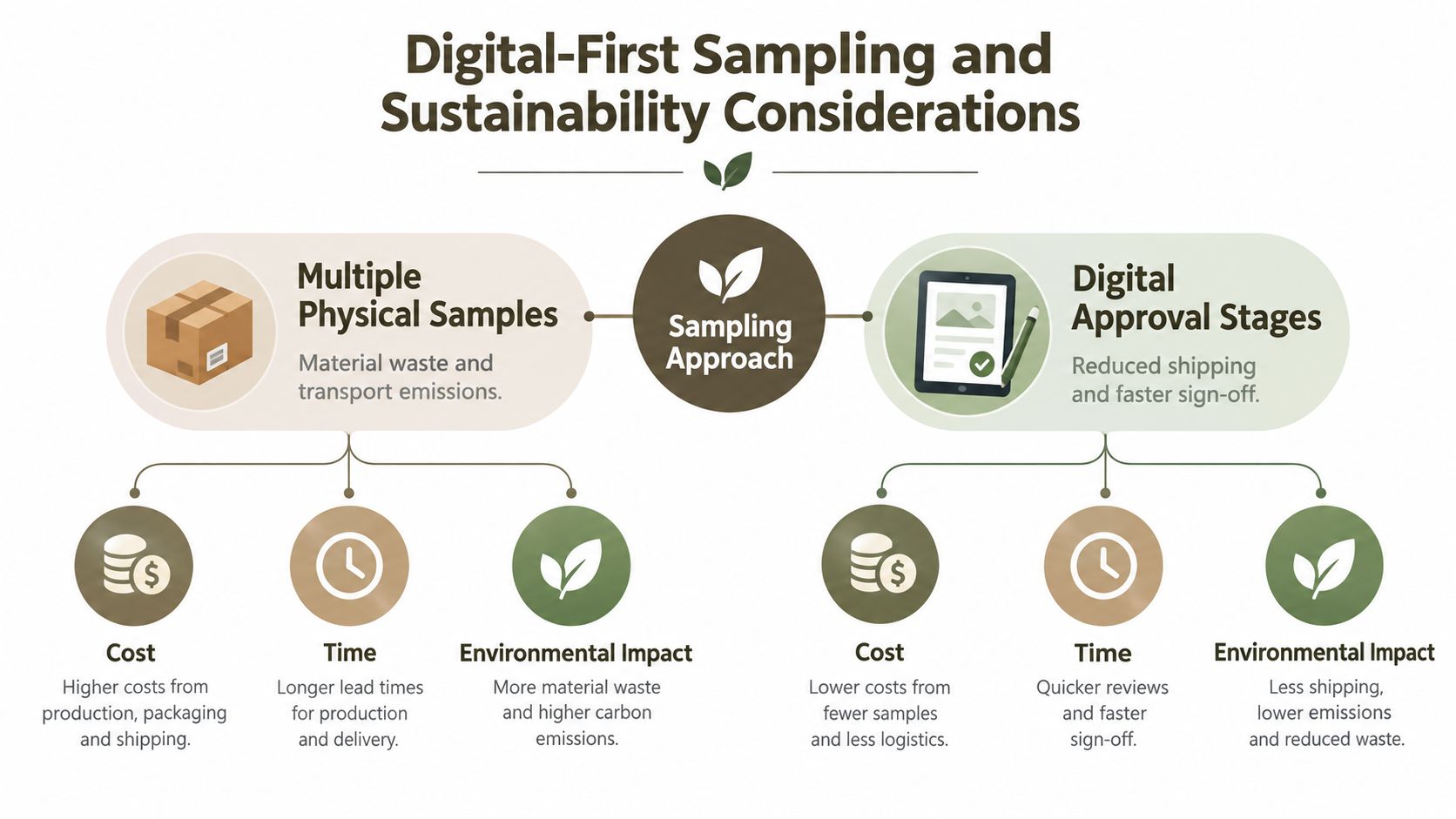
Physical samples answer questions that digital assets can't fully settle. They reveal hand feel, drape, fit, color under real lighting, component movement, material interaction, and factory workmanship. But requesting several physical rounds before resolving basic design or construction questions wastes time, shipping, materials, and supplier capacity.
A digital-first approach doesn't mean eliminating physical validation. It means using the cheapest reliable approval method for each decision. Multi-view visuals and annotated technical files can resolve silhouette, placement, proportion, color direction, component layout, and many packaging questions before a prototype is made.
Match the approval method to the risk
Use digital review for decisions that depend primarily on visual or documented information. Reserve physical sampling for decisions where touch, fit, function, color behavior, or workmanship determines acceptance.
- Digital approval: Silhouette, artwork placement, colorway direction, component position, packaging graphics, and annotated construction intent.
- One physical prototype: Fit, hand feel, dimensional accuracy, material behavior, hardware function, assembly quality, and workmanship.
- A second physical round: A material change, unresolved fit issue, failed functional test, significant construction revision, or a decision that cannot be validated digitally.
- Gold sample approval: The final physical reference after deviations are resolved and the specification is frozen.
The Council of Fashion Designers of America reported that 90% of surveyed designers aimed to minimize the number of samples produced, 85% aimed to minimize sample packaging, and 86% aimed to reuse, recycle, upcycle, or donate samples after events in its 2025 sustainability report. Those goals align with a stronger procurement practice: request fewer samples, but make each one answer a specific unresolved question.
Footwear shows why the issue deserves attention. Industry coverage reports an average of 13 samples per shoe design and estimates roughly 26 million physical footwear samples annually, while digital sampling can reduce sample-production and shipping costs by more than 60%, as summarized in the same CFDA-linked evidence. The figures shouldn't be treated as a reason to skip physical validation. They support quoting multiple paths so the buyer can see the trade-off among cost, lead time, shipping, revision count, and quality risk.
Keep sustainability operational
Track sample purpose, revision reason, material usage, packaging, courier method, and end-of-life destination. A simple financial classification can help assign development fees, freight, and prototype costs consistently, much as how a chart of accounts works helps teams organize financial categories. The point is not to create accounting complexity. It is to prevent sample waste from disappearing inside a general development budget.
Ask each supplier to quote a digital-first path, a single-prototype path, and a multi-round path. Require each option to show what is included and what cannot be validated without a physical unit. That turns sustainability from a broad aspiration into a sourcing decision with visible trade-offs.
Final Checklist for Your Next Sample Request Quotation
Before sending the request, check the document as if you're the factory receiving it for the first time. Could a technical manager identify the exact product, revision, materials, measurements, acceptance criteria, and commercial scope without a follow-up call?
Use this final review:
- Product identity: Product code, revision, description, sample quantity, destination, currency, and Incoterm are present.
- Technical package: BOM, drawings, measurements, tolerances, finishes, construction details, packaging, testing, and quality standards are attached.
- Cost visibility: Sample, tooling, setup, materials, testing, freight, packaging, duties, revisions, and production pricing are separate.
- Supplier disclosure: MOQ, assumptions, exclusions, substitutions, capacity, lead times, payment terms, and quote validity are written down.
- Approval control: The request defines the review gate, included revisions, deviation process, gold sample, and change-order method.
- Comparability: Every factory receives the same revision and returns the same fields in the same currency and delivery basis.
- Digital-first option: Visual decisions are resolved digitally where appropriate, while fit, hand feel, function, color, and workmanship receive physical validation.
- Compliance record: Product-specific testing and regulatory requirements are documented. A general Labs USA compliance checklist can help organize compliance questions before they become late-stage sample changes.
- Measurement: Track quote completeness, response time, should-cost variance, sample lead-time adherence, and the full cycle from BOM release to award.
A sample request quotation succeeds when it produces comparable offers, not merely fast replies. The buyer's job is to make scope visible, separate one-time development from repeatable production cost, and create an approval record that protects the bulk order.
Genpire connects product concepting, factory-ready tech packs, RFQ preparation, sampling, and bulk production in one workflow, with structured construction and component details for supplier review. Build a controlled sample request quotation and compare development paths through Genpire.