Beautiful concepts don't survive production by accident. A consumer product succeeds when its creative intent remains intact through material selection, construction, supplier interpretation, inclusive use, and production QA. That's why the strongest product design best practices work as one operating system, not as disconnected tips.
The workflow should move in a deliberate order: establish constraints and brand intent, test feasibility, explore controlled variants, document the design, collaborate with suppliers, validate the result, and learn from what happens after release. Stage-Gate, formalized in the early 1990s and published by Robert G. Cooper in 2010, provides a useful foundation because it separates discovery and scoping from development, testing, and launch while encouraging inexpensive research before heavy investment (Stage-Gate product development process).
Tools such as Genpire are most useful when they reinforce those decisions. They can turn prompts, sketches, and references into concepts, multi-view visuals, and factory-ready specifications, but they don't replace factory validation or accountable human approval. A useful risk lens is PFMEA for critical assets, especially when a small specification error could become a production failure.
Table of Contents
- 1. Design for Manufacturing Optimization
- 2. Brand DNA-Driven Design Consistency
- 3. Rapid Prototyping and Iteration Cycles
- 4. Integrated Technical Specification Standards
- 5. Visual Communication and Multi-View Design Documentation
- 6. Material and Sustainability-First Design
- 7. Cross-Functional Collaboration and Supplier Integration
- 8. Data-Driven Design Decision-Making
- 9. Modular and Scalable Design Architecture
- 10. Accessibility and Inclusive Design Principles
- 10-Point Product Design Best Practices Comparison
- Turn the List Into a Release-Ready Workflow
1. Design for Manufacturing Optimization
A product shouldn't reach the factory as a visual promise that someone else must decode. Design for Manufacturing, or DFM, brings factory capability, material behavior, construction methods, tolerances, and cost constraints into concept development instead of treating them as late-stage corrections.
Apple's tightly integrated design and manufacturing specifications illustrate the principle at a large scale. IKEA applies a related logic through modular, assembly-conscious products. The practical lesson is simpler for smaller teams: ask whether a factory can make the product consistently before the team becomes attached to its most difficult detail.
Genpire's design-to-production workflow can support this transition by keeping product concepts, construction details, and production assets connected. An agentic tech-pack workspace can help generate component breakdowns and manufacturing notes, but the factory still needs to confirm that those instructions match its equipment and processes.
Put feasibility into the first review
A useful DFM checkpoint asks:
- Material behavior: Will the chosen material stretch, warp, crack, shrink, or change finish during production?
- Construction method: Can the supplier execute the seam, joint, closure, trim, or assembly detail with its available equipment?
- Tolerance control: Which measurements can vary, and which ones must remain tightly controlled?
- Handoff format: Will the supplier receive structured specifications in formats it can use?
Document approved materials, finishes, tolerances, and construction preferences in the brand's working standards. Share early concepts with target factories, collect objections before finalization, and revise the design while changes are still inexpensive.
Practical rule: Treat factory feedback as design input, not as a final-stage rejection.
2. Brand DNA-Driven Design Consistency
A recognizable product line needs more than a logo. It needs repeatable decisions about silhouette, proportion, color, finish, materials, hardware, and visual restraint. Brand DNA turns those decisions into usable constraints, so a designer or AI system can explore new products without losing the identity that makes the range coherent.
Nike's recurring Air technology and Swoosh integration, Muji's restrained approach across categories, and Dyson's combination of engineering cues with distinctive forms all show how product details can carry brand meaning. The point isn't to imitate those companies. It's to define the small set of choices your own team must protect.
Start with three to five core design principles, written clearly enough to guide a review. “Minimal” is too vague. “Low visual noise, matte surfaces, concealed branding, and rounded transitions” gives a team something it can inspect.
Create a working design language
Build the system around:
- Approved references: Keep a library of silhouettes, finishes, materials, and details that already fit the brand.
- Controlled variation: Define what designers may change freely and what requires brand-owner approval.
- Visual review: Compare every new concept against the Brand DNA before discussing personal preference.
- Governance: Revisit the system as the brand evolves, but don't change core rules to justify every passing trend.
Genpire's Brand DNA tools can hold moodboards and palettes, while its AI Editor can revise colors, materials, and details with manual override. That combination works best when the team uses AI to explore within a defined language rather than asking it to invent the brand from scratch.
The checkpoint is straightforward. Before a concept moves to specification, a reviewer should be able to explain which brand principles it expresses and where it intentionally departs from them.
3. Rapid Prototyping and Iteration Cycles
Speed doesn't come from skipping decisions. It comes from making smaller decisions earlier, then discarding weak directions before they consume development capacity.
Rapid prototyping lets a team compare multiple interpretations of one brief. A footwear designer might explore changes in upper geometry, sole proportion, material blocking, and closure treatment before selecting a direction for sampling. Figma's collaborative workflow demonstrates the value of fast shared iteration in digital design, while luxury and sportswear teams often use internal concept studios to evaluate several directions before committing.
Genpire's prototype-to-production workflow can help teams generate and revise concepts from prompts, sketches, or references. The same visual discipline also matters when teams create launch assets with an AI video generator app. Marketing speed shouldn't outrun specification accuracy.
Use gates instead of endless exploration
A practical sequence is:
- Concept gate: Approve the silhouette, intended user, use case, and commercial role.
- Material gate: Confirm the material direction, finish, color, and supplier feasibility.
- Documentation gate: Generate multi-view visuals and the technical specification package.
- Validation gate: Compare the sample or prototype against the approved intent.
Don't generate variations without recording why one direction survived and another failed. Otherwise, the team revisits old ideas, contradicts earlier feedback, and mistakes novelty for progress.
The best prototype is not the most polished image. It's the version that exposes an important decision while the team can still change it.
4. Integrated Technical Specification Standards
A tech pack is not administrative paperwork added after the “real” design work. It's the bridge between intent and execution. If the document omits material composition, measurements, construction sequence, color references, packaging, or quality requirements, the factory must fill the gaps through interpretation.
That ambiguity can be expensive in consumer-goods development. One industry guide estimates that a single tech-pack error can create sample revisions costing about $200 to $500 each and add one to two weeks per revision cycle (fashion tech-pack error guidance). Those figures are benchmarks from the cited guide, not a universal cost model, so teams should also track their own revision history.
Make the specification part of design
Build the tech pack as the design changes, not afterward. A strong package should connect:
- Product definition: Style name, version, intended use, and approved views.
- Materials: Composition, finish, color, certification, and supplier notes.
- Measurements: Size or dimension tables, tolerances, grading logic, and critical points.
- Construction: Stitching, joints, seams, hardware, assembly, and finishing instructions.
- Quality control: Inspection points, acceptable variation, packaging, and labeling requirements.
Genpire's agentic tech-pack workspace can help generate structured construction details, with PDF and Excel exports for downstream partners. Version the document alongside the design, and invite suppliers to review it before sampling. A factory that can comment on the same controlled file is less likely to work from an outdated attachment.
5. Visual Communication and Multi-View Design Documentation
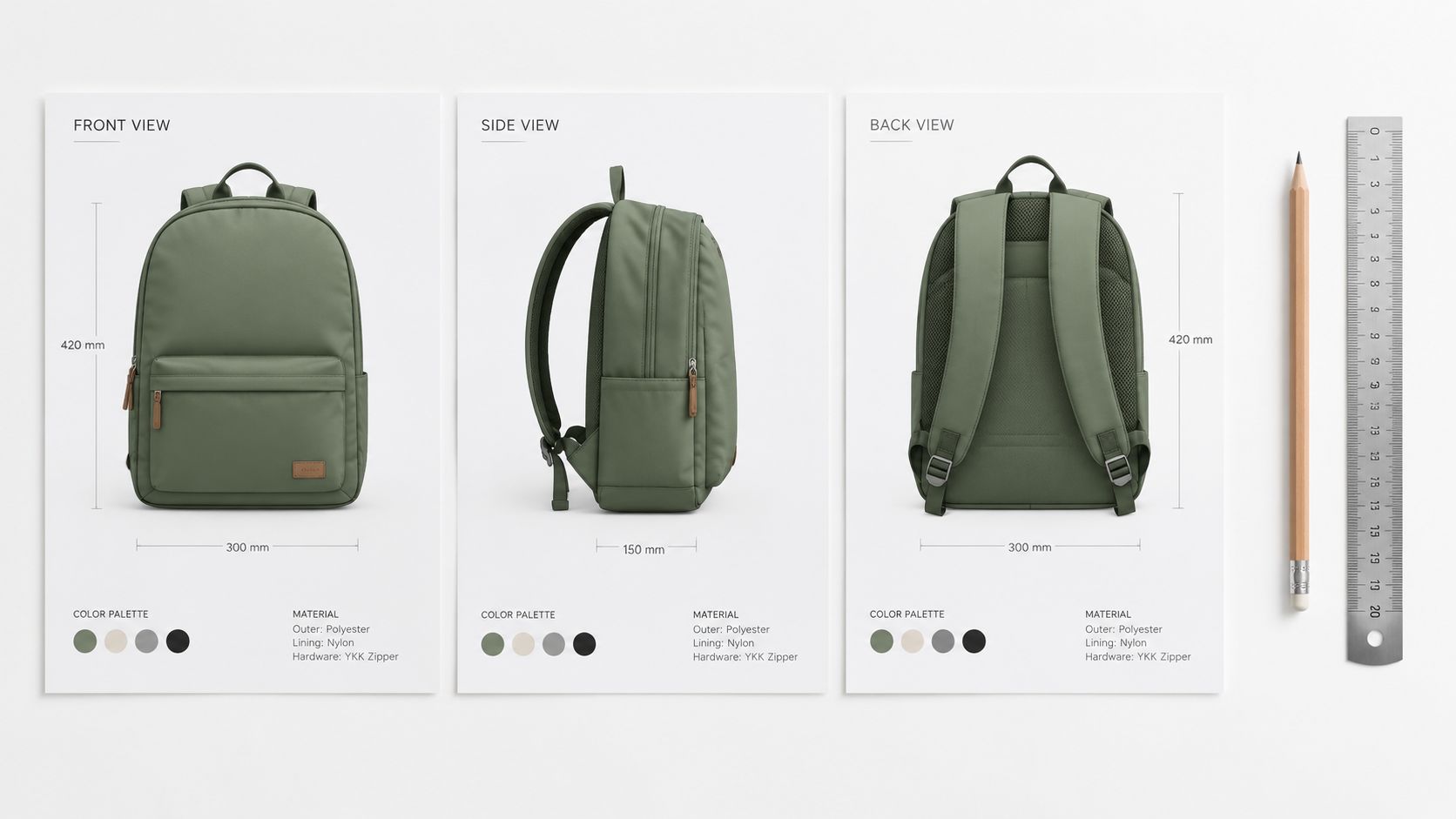
A front view can make a product look complete while hiding the decisions that determine whether it can be made. Manufacturers need to understand the back, side, underside, interior, closures, joins, and details that a hero image leaves out.
Hermès relies on detailed product documentation to preserve craft and consistency across categories. IKEA's assembly and isometric views show how multiple perspectives can turn a complex object into a shared reference. The same principle applies to an apparel style, backpack, piece of furniture, toy, or electronic accessory.
Build a view set that answers factory questions
For every product, decide which views are mandatory. Include front, back, side, detail, and functional views where relevant. Pair aesthetic renders with technical sketches, measurements, material callouts, and enlarged views of high-risk construction points.
Keep lighting, scale, background, and naming consistent across the set. If one view shows a strap attached at a different point from another, the document creates a new problem instead of solving one.
The checkpoint is a visual consistency review. A designer, technical owner, and factory liaison should be able to inspect the views and identify the same product without relying on a verbal explanation.
6. Material and Sustainability-First Design
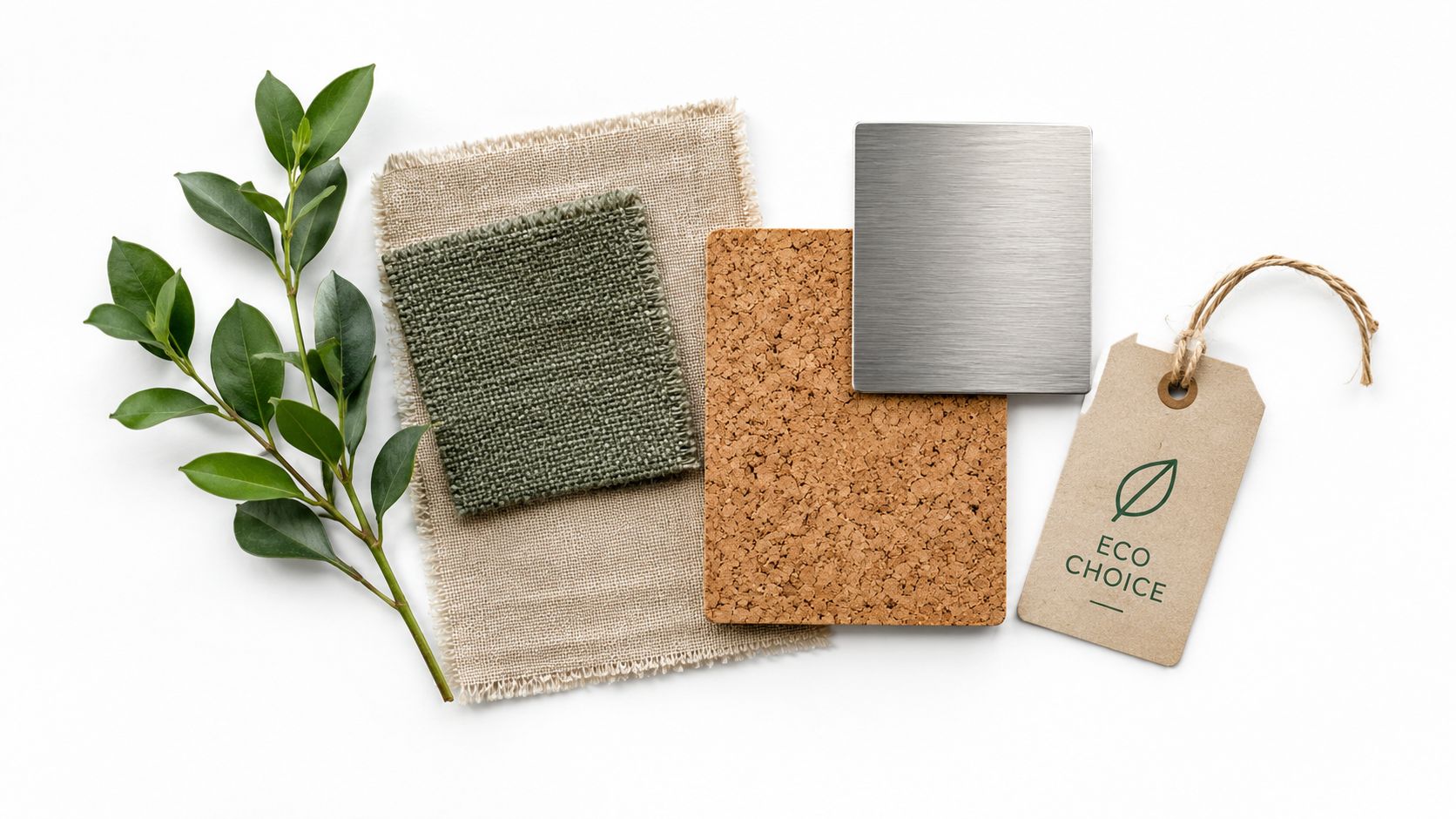
Material choice shapes appearance, durability, feel, weight, sourcing, production behavior, and end-of-life options. Choosing it after the silhouette is approved often forces compromises. Choosing it early lets the team design around what the material can do.
Patagonia's material transparency, Allbirds' carbon-focused product communication, Stella McCartney's use of lower-impact alternatives, and Everlane's cost transparency all demonstrate different ways brands make material decisions visible. Those examples don't prove that one material strategy fits every category. They show that material logic can become part of product value rather than a hidden procurement decision.
Specify the evidence, not just the adjective
“Sustainable” isn't a sufficient material callout. Record the actual composition, source, certification, durability expectation, care requirement, recyclability, and disposal limitation where those details are known.
Useful checks include:
- Performance: Does the material withstand the product's actual use conditions?
- Supply: Can the factory source it consistently in the required color, finish, and quantity?
- Lifecycle: What happens during use, repair, reuse, recycling, or disposal?
- Documentation: Can the supplier provide the certification or traceability evidence being claimed?
Teams can use sustainable product design with AI to explore material directions and communicate selected requirements, but AI-generated suggestions still need supplier verification. For electronics and other complex categories, sustainable electronics production insights can add useful context around material recovery and manufacturing responsibility.
7. Cross-Functional Collaboration and Supplier Integration
Design, engineering, sourcing, manufacturing, QA, and marketing often optimize for different risks. Designers protect intent. Sourcing protects availability and margin. Factories protect process reliability. QA protects consistency. A product moves forward when those perspectives meet early enough to change the design.
Nike's connection between global design activity and supply-chain partners, Adidas's digital collaboration efforts, and unified PLM practices in contemporary apparel all point to the same operating requirement: teams need shared information, not a chain of disconnected handoffs.
Define ownership before feedback begins
Assign named owners for the design direction, tech pack, supplier relationship, and quality review. Then establish decision gates for concept, specification, sampling, and production. Each gate should record the decision, the person accountable for it, unresolved risks, and the version that was approved.
A unified workspace can keep design files, specifications, comments, and changes together. Genpire supports supplier participation through view-only seats, which can let external partners review the current material without giving them unnecessary editing access.
Weekly supplier meetings can help, but meetings alone don't create accountability. The durable record is the approved file and its change history.
“If a supplier's comment changes the product, the change must change the controlled specification too.”
That rule prevents the common failure where a factory follows an approval discussed in a call while production still references an older document.
8. Data-Driven Design Decision-Making
Intuition is useful for generating a direction. It's weak as the only basis for repeating one. Product teams should connect design attributes with customer behavior, commercial performance, manufacturing results, and post-launch feedback.
A fashion team might compare return reasons with fit, fabric weight, closure type, and size range. A furniture team might connect warranty issues with joint construction. An accessories team might examine whether a material change affects perceived quality, returns, or margin. The point is not to reduce design to a spreadsheet. It's to make assumptions visible and testable.
Create a feedback loop that designers can use
Track outcomes at the level of decisions:
- Commercial signal: Review sales velocity, margin, and demand by variant where the data is reliable.
- Customer signal: Code reviews, returns, support messages, and fit complaints against product attributes.
- Production signal: Record sample revisions, defects, yield issues, and supplier explanations.
- Decision signal: Note which assumptions held, which failed, and what the next brief should change.
Quantitative methods such as surveys, conjoint analysis, concept testing, alpha and beta testing, and multivariate techniques can support validation alongside qualitative research (research across the product-development lifecycle). The trade-off is that data can describe what happened without explaining why. Pair behavioral evidence with interviews, observation, or usability sessions before changing a core design principle.
Hold retrospectives after release, not only after a failed launch. A product that sells can still reveal avoidable quality or accessibility problems.
9. Modular and Scalable Design Architecture
Modularity is attractive because it promises more product variation from fewer underlying decisions. IKEA's furniture systems and LEGO's interlocking bricks make the logic obvious. In footwear, a shared last can support multiple uppers and material treatments. In consumer electronics, a common enclosure or internal platform can support a family of products.
But modularity isn't automatically efficient. A module earns its place only when its reuse outweighs the cost of tooling, inventory, compatibility management, and design compromise.
Design the platform before the variants
Begin with core modules and define their interfaces. For a bag, that might mean a body, strap system, closure, and hardware family. For furniture, it could mean panels, connectors, and interchangeable storage elements. For footwear, it might include the last, outsole, and fit-critical components.
Document compatibility directly in the tech pack. Record which parts can be mixed, which combinations require new testing, and which dimensions cannot change. Store reusable silhouette templates and editable blanks so designers can start from controlled foundations rather than recreate common geometry.
A modular review should ask:
- Compatibility: Do the parts fit across every planned combination?
- Quality: Does variation create weak points or inconsistent appearance?
- Economics: Does reuse reduce complexity, or does it add tooling and inventory burden?
- Brand coherence: Do the variants still belong to the same product family?
Genpire's Brand DNA-guided generation can help explore variations while preserving shared visual cues. Human review remains essential because a visually compatible variant may still be impossible or inefficient to manufacture.
10. Accessibility and Inclusive Design Principles
Inclusive design begins before the first render. For consumer goods, it includes sizing, body variation, grip, reach, weight, color perception, closure force, readability, cultural context, and the different ways people use a product.
Nike's adaptive footwear, Tommy Hilfiger's adaptive clothing, Apple's built-in accessibility features, and broader inclusive sizing efforts show that accessibility can shape both function and product communication. Those examples shouldn't become a shortcut for claiming inclusivity. A team must test whether its own product works for the people it intends to serve.
Turn inclusion into an approval gate
Write inclusive requirements into the brief and Brand DNA. Define size coverage, fit assumptions, color checks, ease-of-use expectations, and any relevant accessibility constraints before the team evaluates visual polish.
Use diverse bodies, ages, and contexts in visualization and review. Check colors with color-vision simulation, but don't treat simulation as user testing. Invite people with relevant lived experience to inspect prototypes, try closures, assess comfort, and explain where instructions or proportions fail.
For apparel, a single model image can conceal grading or fit problems. Use multi-view visuals and size-specific documentation to show how the product changes across bodies. For home goods and electronics, test grip, reach, force, contrast, and feedback under realistic conditions.
A product passes this checkpoint only when inclusive findings are resolved or consciously accepted with a documented reason. Accessibility isn't a marketing layer applied after approval. It's part of product quality.
10-Point Product Design Best Practices Comparison
| Practice | Implementation complexity | Resource requirements | Expected outcomes | Ideal use cases | Key advantages |
|---|---|---|---|---|---|
| Design for Manufacturing (DFM) Optimization | High, early factory integration and engineering input | Factory expertise, material/process data, DFM tools, engineering time | Lower tooling & production costs; fewer rework cycles; faster time-to-market | High-volume or cost-sensitive products; complex assemblies | Reduces cost; improves manufacturability; more consistent quality |
| Brand DNA-Driven Design Consistency | Medium, initial documentation and governance | Brand guidelines, moodboards, asset library, governance process | Consistent brand across portfolios; faster on‑brand concepting | Multi-category brands; rapid scaling; distributed design teams | Scales identity; reduces subjective reviews; speeds concept alignment |
| Rapid Prototyping and Iteration Cycles | Low–Medium, process discipline required to manage iterations | Rapid visualization tools (AI/3D), stakeholder time, iteration gates | Faster decisions; more explored directions; earlier validation | Early-stage concepting; time-sensitive launches; exploratory design | Speed of iteration; more options; early risk reduction |
| Integrated Technical Specification Standards | High, detailed documentation and team training | Spec templates, PLM/tech‑pack tools, quality standards, training | Fewer sampling rounds; reduced factory misinterpretation; audit trail | Complex supply chains; remote manufacturing; regulated products | Clear factory instructions; standardized communication; traceability |
| Visual Communication & Multi‑View Documentation | Medium, consistent rendering and detail standards | Illustration/3D tools, multi‑view templates, QC processes | Eliminates ambiguity; faster sampling; better marketing assets | Products needing precise form/fit; distributed teams; marketing alignment | Removes misinterpretation; consistent visuals; cross‑team clarity |
| Material & Sustainability‑First Design | Medium–High, supply chain coordination and verification | Sustainable material library, sourcing data, certification tracking | Lower environmental impact; longer product life; stronger brand trust | Sustainable brands; regulated markets; premium/lifecycle-focused products | Environmental differentiation; compliance; long‑term cost benefits |
| Cross‑Functional Collaboration & Supplier Integration | Medium, governance and tool adoption required | Unified workspace, role permissions, change management, supplier seats | Faster decisions; fewer handoff errors; earlier supplier input | Distributed organizations; complex supply chains; multi‑stakeholder projects | Reduces version drift; increases transparency; faster alignment |
| Data‑Driven Design Decision‑Making | High, data infrastructure and analytics capability | Analytics tools, historical sales/returns data, data science skills | Higher hit rates; optimized margins; informed trade-offs | High‑SKU portfolios; fast‑fashion; revenue‑driven strategies | Predictive insights; risk reduction; measurable accountability |
| Modular & Scalable Design Architecture | Medium, upfront platform design and standards | Component libraries, compatibility specs, supplier alignment | Lower tooling costs; rapid SKU expansion; simplified assembly | Product lines with many variants; mass‑customization; inventory optimization | Economies of scale; faster expansion; simplified QA |
| Accessibility & Inclusive Design Principles | Medium, diverse testing and standards integration | User testing across groups, accessibility standards, design adjustments | Broader market reach; fewer returns; improved usability for all | Consumer products targeting diverse users; regulated markets | Expands customer base; improves UX; regulatory alignment |
Turn the List Into a Release-Ready Workflow
The ten practices become more useful when treated as a sequence with explicit checkpoints. Start by defining the user, use case, constraints, and Brand DNA. Record the materials, functional requirements, visual principles, inclusion requirements, and commercial role before concept generation begins. This gives designers a decision framework instead of a moodboard that everyone interprets differently.
Next, test manufacturing feasibility early. Ask target suppliers about materials, equipment, construction methods, minimum requirements, tolerances, and quality risks. Use that input to remove fragile details or redesign them before the team invests in detailed development. Stage-Gate's separation of discovery, scoping, development, testing, and launch is valuable here because it prevents early uncertainty from being hidden inside expensive downstream work (Cooper's Stage-Gate framework).
Then explore controlled variants. Generate alternatives around a defined brief, document why each direction advances or stops, and use approval gates for concept, material, and specification decisions. Rapid iteration is productive when the team is narrowing uncertainty. It becomes wasteful when designers keep producing options without a decision owner.
The final release review
Before sampling or bulk production, review the complete package rather than approving the hero image alone:
- Design intent: Does the approved specification still express the original product purpose and Brand DNA?
- Materials: Are composition, finish, source, certification, care, and lifecycle notes documented?
- Measurements: Are tables, tolerances, grading, and critical dimensions complete?
- Construction: Can the supplier understand every join, seam, component, closure, and finishing instruction?
- Compatibility: Do modular parts, hardware, packaging, and accessories work together?
- Supplier understanding: Has the factory reviewed the current version and resolved open comments?
- Inclusive use: Have size, fit, color, comfort, reach, grip, and diverse-user concerns been tested?
- Version status: Are renders, sketches, tech packs, samples, and approvals aligned to one revision?
- Export completeness: Are the required PDF, Excel, SVG, or other production assets present and readable?
After release, feed outcomes back into the next brief. Review customer feedback, returns, quality defects, production yield, supplier revisions, and commercial performance. Continuous research works best when it runs before code or production begins, through concept and usability validation, and after launch rather than appearing as a single feedback event (continuous product research guidance).
The difficult part of user-centric design is execution. Teams can claim to listen while relying on assumptions, internal advocacy, analytics theater, or launch-and-leave habits. A useful critique of that gap highlights accessibility neglect and weak post-launch discovery as recurring blind spots (why user-centric products still fail).
AI deserves the same discipline. Its value is strongest when it helps teams explore, compare, revise, and organize early decisions. Recent analysis suggests that value can become inconsistent or negative for experienced practitioners during implementation, where noise, rework, and loss of agency can outweigh speed (2026 analysis of AI in product design). Use automation where it reduces repetitive work, then keep human approval and factory validation responsible for what gets made.
Genpire can connect concept generation, Brand DNA, multi-view documentation, technical specifications, exports, and supplier comments in one workflow. That can reduce version drift, but the platform should support a disciplined operating system rather than become a substitute for one. The release standard remains clear: the product must be understandable, manufacturable, inclusive, validated, and traceable from brief to production.
Use Genpire to turn product ideas, sketches, and references into on-brand concepts, multi-view visuals, factory-ready tech packs, and coordinated production assets. Visit Genpire to connect design decisions, supplier feedback, validation, and handoff in a workflow your team can review before production begins.