It's 4:47 on Friday afternoon. The design lead is comparing a factory's revised bill of materials with the version in the shared drive, while three Slack threads from merchandising ask slightly different questions about the same trim. A junior designer is still waiting for a confirmed Pantone reference, and tooling has already started on a component whose dimensions changed that morning.
Nobody in this scene is necessarily working slowly. The schedule is slipping because decisions arrived without owners, constraints surfaced after the design appeared finished, and the latest specification no longer matches the file the factory used. Project management for design is less a Gantt-chart exercise than a handoff-friction and rework-reduction discipline.
Table of Contents
- The Real Reason Design Projects Slip Schedule
- Setting Up the Brief, Scope, and Working Roles
- Planning Milestones, Deliverables, and Review Cycles
- Tech Packs and Spec Handoffs That Prevent Rework
- Tooling, AI Workflows, and Collaboration Patterns
- KPIs and Retrospectives That Improve the Next Cycle
- A Reference Timeline You Can Adapt Today
The Real Reason Design Projects Slip Schedule
The usual explanation is convenient: design took too long, or the factory missed its date. In practice, the delay often starts earlier, in a brief that described the desired product but not its boundaries. The team explored attractive directions without a shared definition of target cost, materials, performance, or the decisions that were already closed.
The next failure is role ambiguity. Product assumes design owns the final specification. Design assumes sourcing will flag an unavailable fabric. Engineering expects product to approve a dimensional change, while merchandising treats an open question as permission to keep selling the original concept internally. Every unresolved handoff creates another interpretation of the work.
Practical rule: If two people can reasonably believe they approve the same decision, nobody owns that decision.
Material constraints create a second wave of disruption. A concept may look viable until sourcing checks minimum order requirements, dye-lot limitations, supplier capabilities, or tooling access. When those facts appear after a form or colorway has been approved, the team doesn't make one small adjustment. It updates renderings, technical drawings, BOM entries, samples, packaging, and sometimes the commercial story.
Rework enters through the gaps
The schedule logic behind modern project management was shaped by dependency-heavy methods such as the Critical Path Method and Program Evaluation and Review Technique, developed in the late 1950s. Those methods matter because product work still depends on activities happening in sequence or in parallel, from design decisions through engineering, sourcing, manufacturing, and launch. The history of project management also records the 1969 founding of the Project Management Institute, which helped standardize language around scope, schedule, cost, and risk.
Late issue detection is especially expensive. A classic product-development benchmark places rework discovery time between one-quarter and three-quarters of the scheduled duration of the original design effort, as documented in this project-management rework study. The exact lesson isn't that every project will follow one ratio. It's that review timing determines whether a defect remains a cheap drawing change or becomes a factory interruption.
Research on design-heavy delivery also describes rework consuming up to two-thirds of project effort, with large companies reported as spending about 70% to 80% of development time reworking designs in some environments. Those benchmarks appear in this research on design rework. The response isn't more status meetings. It's a brief that limits interpretation, named owners who resolve decisions, early constraint checks, and gates that prevent incomplete work from moving downstream.
Setting Up the Brief, Scope, and Working Roles
Good setup produces artifacts, not enthusiasm. Start with a one-page brief that states what the product is, who it serves, the target cost band, the required performance, the launch context, and how the team will judge a successful outcome. Add explicit non-goals, such as excluded materials, unsupported variants, or features reserved for a later release.
That brief should settle the first chain of decisions:
- Product definition: Describe the customer problem and the product promise in language that design, engineering, sourcing, and merchandising can all use.
- Success criteria: Define the decisions the team must make, from form and CMF through manufacturability, compliance, packaging, and commercial readiness.
- Scope boundary: Record what this cycle won't solve. A new colorway, accessory, or construction detail can turn a focused program into a second product.
The second artifact is a lane map. Assign a named owner to industrial design, CMF, mechanical engineering, sourcing, and product. The owner doesn't perform every task, but that person resolves comments, keeps the working file current, and escalates a conflict before it reaches a factory.
Make approval visible
A short setup memo should include a working RACI snippet. Name who approves specifications, who can request changes, who supplies information, and who is consulted without becoming a blocking reviewer. Keep the list short. If everyone is an approver, the team has created a queue rather than governance.
Write the change rule beside the RACI. A change after concept freeze should require a reason, an owner, an affected deliverable, and a decision date. For teams that need a more formal approach to containing expanding requests, resolve scope creep in strategy offers useful context on turning ambiguous additions into explicit decisions.
Treat the brief as a working contract, not a wish list. A wish list encourages people to interpret missing information in the direction they prefer. A contract makes the cost of changing that interpretation visible.
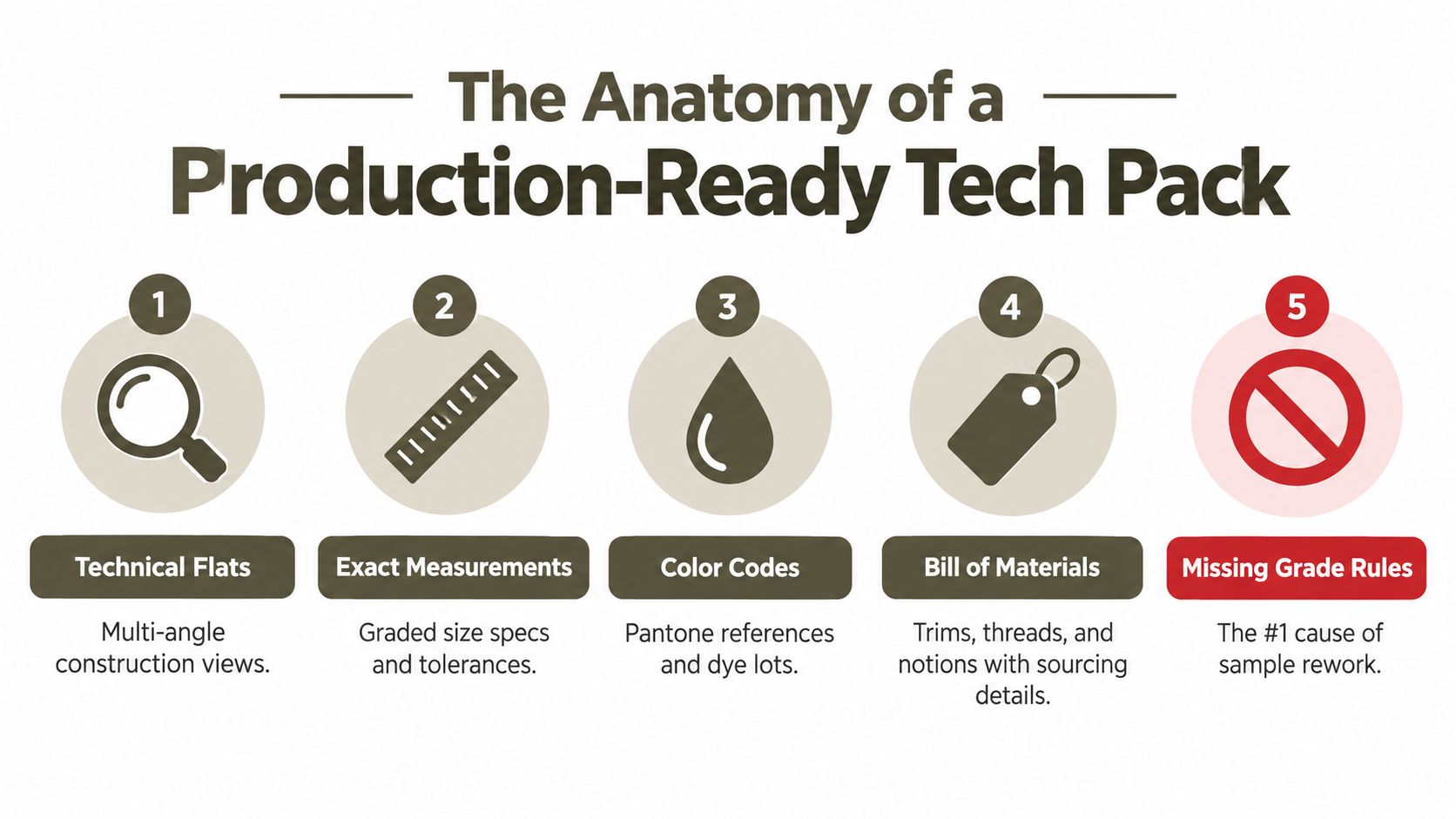
The tech pack becomes much easier to manage when the setup memo already identifies who owns each input. A technical designer can own measurements, a sourcing lead can own supplier confirmation, and product can own the commercial decision. That separation prevents a late comment from becoming an untraceable group opinion.
Planning Milestones, Deliverables, and Review Cycles
A useful schedule follows irreversible decisions, not calendar activity. For a consumer product, I use four gates: concept freeze, design freeze, tech-pack freeze, and pre-production sample. Each gate has one locked deliverable, a defined reviewer group, and a short decision window.
Concept freeze means the team has selected the direction, not merely admired it. The deliverable should include the chosen concept set, an initial costed BOM, key dimensions, intended materials, and known risks. Design freeze locks the 3D form, CMF direction, and engineering assumptions. Tech-pack freeze locks the measurement and tolerance specification, construction notes, BOM, supplier references, and revision status. The pre-production sample gate confirms the golden sample and its QA criteria.
| Stage Gate | Locked Deliverable | Required Reviewers | Typical Duration |
|---|---|---|---|
| Concept freeze | Chosen concept set with initial costed BOM | Product, design, sourcing, engineering | One review window |
| Design freeze | Finalized form, CMF direction, and material decisions | Design, engineering, product, sourcing | One review window |
| Tech-pack freeze | Measurement, tolerance, construction, BOM, and revision pack | Technical design, factory, engineering, QA | One review window |
| Pre-production sample | Golden sample with QA criteria and approved comments | Product, design, factory, QA | One review window |
Give every gate a veto
Invite only people who can identify a blocking risk or make the decision. Product can veto a direction that misses the brief. Engineering can veto a form that can't meet performance requirements. Sourcing can veto an unavailable or commercially unrealistic material. A reviewer who has no veto, approval, or information role belongs in the written update, not necessarily in the meeting.
A workable fourteen-week shape gives early exploration room, then protects the handoff. Use the first two weeks for scope and role confirmation, the next three for concepts, the following three for finalist form and sample inputs, then reserve time for factory quote, material confirmation, and pre-production review. Build a deliberate buffer between tech-pack freeze and tooling kickoff. That is where small inconsistencies usually appear, and the buffer lets the team correct them before the factory treats the file as production truth.
The production planning guide is a useful reference when translating these gates into factory-facing dependencies. The important principle is simple: an open review thread isn't a milestone. A signed-off deliverable is.
Tech Packs and Spec Handoffs That Prevent Rework
A production-ready tech pack answers the questions a factory would otherwise ask through scattered email. It should contain technical sketches with callouts, flat sketches for each colorway, measurement specs with tolerance bands, a BOM tied to approved suppliers, construction notes, packaging dielines, and compliance markers where relevant.
The file also needs revision discipline. Every page should identify the product, version, date, owner, and status. A factory shouldn't have to guess whether a PDF attachment or a spreadsheet in a shared folder is the latest authority.
What belongs in the handoff
A strong pack connects visual intent to measurable execution:
- Technical views: Show construction from the angles needed to interpret seams, joins, closures, hardware, and finish.
- Measurement table: State points of measure, units, target values, and tolerances. “Standard fit” isn't a usable instruction.
- BOM: Identify every material, trim, thread, component, finish, supplier, and approval status.
- Construction notes: Explain operations that a drawing alone can't communicate, including sequence, reinforcement, and acceptable variation.
- Packaging and compliance: Include dielines, labels, markings, testing requirements, and market-specific instructions where applicable.
The rework calculation is straightforward: hours spent × loaded rate × rounds. If a team spends twelve hours on a correction round, the loaded rate is the internal or blended cost of that work, and the factory needs three rounds, the calculation makes the consequence visible without pretending that every project has the same financial profile.
A weak process waits for the first sample to reveal fit comments. A stronger process gates sampling behind a signed specification, then uses the sample to validate execution rather than discover basic omissions. The stricter process can feel slower at the beginning, but it protects the critical path from repeated interpretation.
For teams formalizing this transition, mastering design handoff for startups provides practical context on moving design intent into development without losing decisions. A related explanation of what a tech pack includes can help new teams define the minimum handoff standard.
A short video can also help teams align on the relationship between planning, specification, and production decisions.
The most expensive handoff isn't the one with the largest file. It's the one where the factory has to infer which parts are approved, which are provisional, and which changed after the last sample.
Tooling, AI Workflows, and Collaboration Patterns
AI can compress the distance between a rough idea and a reviewable artifact. It can't replace approval of measurements, materials, construction, or factory capability. The practical comparison is not “old tools versus magic.” It's a question of where automation removes clerical delay and where it creates a new verification burden.
| Workflow Stage | Traditional Stack | AI-Augmented Stack | Cycle Time Impact | New Failure Mode |
|---|---|---|---|---|
| Concept exploration | Figma, Illustrator, reference folders | Generative moodboards, prompt-based concepts, AI image editing | Faster option generation and comparison | Attractive concepts may ignore manufacturability |
| Specification drafting | Spreadsheets, PDFs, manual callouts | AI-assisted spec text and technical annotation | Less repetitive documentation | Hallucinated measurements or incomplete notes |
| BOM review | Airtable, Excel, email checks | Automated cross-checks against structured components | Faster inconsistency detection | Incorrect matches can create false confidence |
| Version handoff | Drive folders, Slack, email | Version-controlled workspace with comments and approvals | Fewer duplicate files and threads | Teams may trust a draft marked incorrectly |
| Launch imagery | Manual retouching and photoshoot planning | AI scenes, flats, and editorial variations | Faster visual production | Rendered details may differ from approved product |
Use AI where the output is inspectable
Moodboarding is a good use because the team can compare options quickly and reject weak directions. Drafting repetitive spec language can also help, provided a technical owner checks every value against the source drawing and approved material. Image cleanup, colorway exploration, and BOM cross-checking are similarly useful when the source data is structured.
AI introduces failure modes that traditional tools make less likely. A generated technical sketch can imply a seam that the factory can't produce. A draft measurement table can contain a plausible but invented value. A material suggestion can look right in a render while conflicting with available supplier capabilities.
The faster the tool creates a draft, the more disciplined the team must become about what makes that draft authoritative.
The stack works best when one person owns each handoff, reviews happen asynchronously against a decision deadline, and the team maintains a red list. The red list contains items that block sampling, such as an unconfirmed material, missing tolerance, or unresolved compliance requirement. Nice-to-haves stay visible but don't compete with blockers.
Platforms such as Genpire combine prompt-based concepts, technical visuals, structured tech-pack workflows, supplier collaboration, and exports for downstream manufacturing in one environment. Teams should still verify generated outputs against approved product decisions and factory constraints. For a practical look at connecting generative work to production documentation, see this AI product design workflow from prompt to production.
KPIs and Retrospectives That Improve the Next Cycle
A useful dashboard tells you whether the next gate is safe. It doesn't reward the team for producing more files or attending more meetings. Track measures that expose incomplete decisions, recurring clarification, and the amount of work pushed backward from one stage into another.
Use a pass or fail definition at each gate:
- Spec completeness at tech-pack freeze: Pass only when every required component, measurement, tolerance, supplier reference, construction note, and revision marker is present and reviewed.
- Rounds to sample approval: Count the formal sample cycles required before the sample meets the agreed criteria.
- On-time milestone rate: Mark a gate on time only when the locked deliverable is approved by its deadline.
- Change requests between gates: Record requests that alter an already approved deliverable, with a reason and owner.
- Rework hours per SKU: Log hours spent correcting a released or reviewed design rather than creating planned work.
Make the retro about decisions
A retrospective should not become a general complaint session. Bring the gate record, change log, sample comments, and time entries, then ask four questions:
- What blocked the freeze?
- Which specification gap caused the sample round?
- Which decision aged poorly, and what information was missing when the team made it?
- What single rule would have prevented the delay?
The answers should produce one change to the operating system, not a page of aspirations. That might be a mandatory material feasibility check before design freeze, a factory reviewer at tech-pack freeze, or a rule that no Slack comment changes a specification without an update to the source file.
The reliable predictor isn't a busier dashboard. It's the discipline of refusing to enter the next stage until the current one passes its gate.
A Reference Timeline You Can Adapt Today
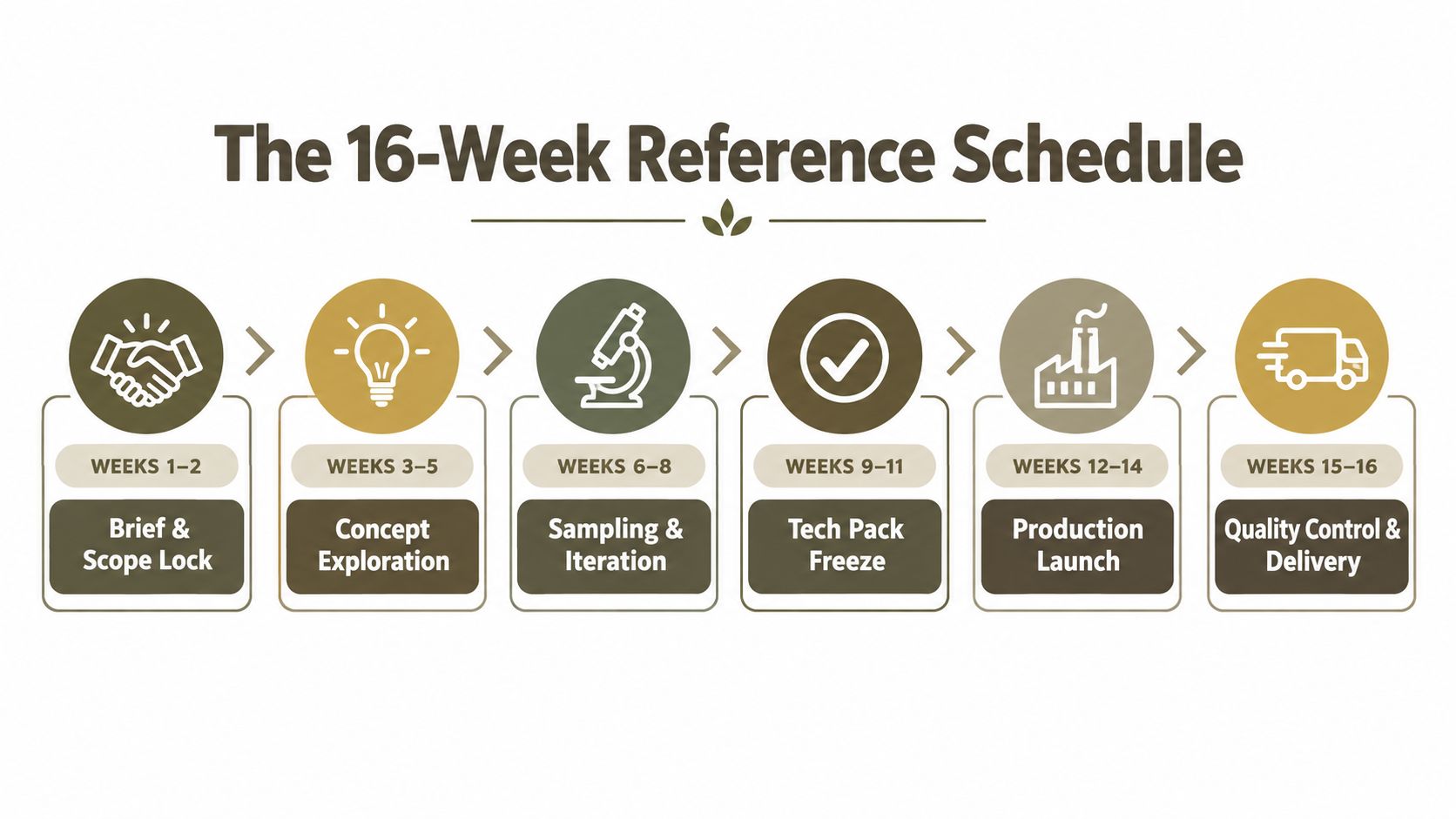
Use a sixteen-week reference schedule when the product needs concept exploration, supplier confirmation, sampling, and production preparation. The exact shape changes by category, but the decision logic remains stable.
- Weeks 1 to 2: Lock the brief, scope, roles, and non-goals. Product approves the setup memo. Cost of change is low.
- Weeks 3 to 5: Explore concepts and hold internal review. Product and design select the concept set, while sourcing flags material risks. Cost of change is rising.
- Weeks 6 to 8: Develop finalist CAD or technical visuals, source sample materials, and draft the tech pack. Design and engineering own the working files. Cost of change is moderate.
- Weeks 9 to 10: Confirm factory quote assumptions and materials. Sourcing and the factory resolve feasibility questions. Cost of change is high if the form changes.
- Weeks 11 to 13: Review pre-production samples, capture fit or construction comments, and sign off the specification. Product, design, technical design, factory, and QA approve the release.
- Weeks 14 to 16: Prepare production, confirm labeling compliance, and book shipment. Operations owns readiness, while QA protects the golden sample standard. Cost of change is highest.
Soft goods often need more attention on fit, grade rules, tolerances, and material behavior. Hard goods shift more risk toward CAD, engineering validation, tooling, and component interfaces. AI-assisted rendering and spec drafting can compress parts of the exploration and documentation work, but they don't remove factory validation or approval responsibility.
Keep one habit above all others: a 30-minute Friday status check tied to the next milestone. Review the locked deliverable, unresolved red-list items, owner, decision deadline, and the one risk most likely to force rework. That small meeting earns its place because it turns drift into an explicit decision before the drift reaches the factory.
Genpire gives design and manufacturing teams a connected workspace for turning prompts, sketches, and references into product concepts, technical specifications, supplier-ready files, and production assets. If your team is losing time between concept approval and factory clarification, visit Genpire to evaluate a workflow that keeps those handoffs in one controlled system.