An RFQ process typically follows six to eight formal steps, from defining requirements and preparing the request through supplier selection and purchase-order conversion, while commercial turnaround may range from 24 to 72 hours for straightforward work to 1 to 2 weeks for technically detailed requirements (Infor procurement guidance). An RFQ isn't just a pricing exercise. It's a controlled handoff from requirements definition to supplier comparison, and the technical accuracy of the packet determines whether every bid afterward is useful.
The familiar failure happens after the send button. You wait for responses, open the files, and find three different interpretations of the same garment. One supplier has priced the nominated fabric, another has assumed a substitute, and a third has left packaging, labeling, or delivery terms outside the quote. The numbers may look precise, but they aren't comparable.
That problem usually starts before supplier outreach. A successful RFQ freezes the product definition, standardizes the response format, and preserves the approved information after award. The workflow below treats those controls as the work behind the visible RFQ process steps.
Table of Contents
- Why Your RFQ Fails Before It Starts
- The End-to-End RFQ Workflow for Apparel
- Documents That Make or Break Your RFQ
- RFQ Timelines and Response Rates
- How Genpire Integrates Into the RFQ Process
- Common Failure Points and How to Avoid Them
- Accelerating Your Sourcing Cycle
Why Your RFQ Fails Before It Starts
A sourcing manager can send an RFQ to capable factories and still receive unusable bids. The common cause isn't supplier incompetence. It's an ambiguous starting brief.
Consider a cotton jersey top with a basic sketch, a fabric name, and a target delivery month. One factory may assume a particular fabric weight, another may quote its standard composition, and a third may interpret the delivery date as factory dispatch rather than arrival at the nominated location. If the stitch construction, testing requirements, packaging, and quantity breaks aren't defined, each supplier is answering a different question.
Procurement guidance identifies incomplete specifications as a source of non-comparable quotations and recommends freezing requirements before sending the request to a qualified shortlist (Zycus RFQ glossary). That sequence matters. A buyer who sends an unfinished brief to more suppliers doesn't create better competition. They create more versions of the same misunderstanding.

The warning signs appear early
Look for these defects before outreach:
- Unresolved measurements: The base size, grade rules, tolerances, or measurement points aren't approved.
- Open material choices: The brief names a broad fabric category but not the construction, composition, finish, or approved substitute rule.
- Mixed commercial assumptions: Some costs are quoted per unit, others by carton, shipment, or development stage.
- Uncontrolled revisions: Design, technical, and sourcing teams are working from different files.
- No response template: Suppliers can omit the very fields you need for evaluation.
The practical fix is a short internal gate. Confirm the specification, quantity, delivery location, timing, packaging, compliance requirements, and evaluation criteria before the RFQ leaves the business. A structured process then turns the supplier response into evidence rather than interpretation.
Practical rule: If two factories could read your packet and make different products without either one being obviously wrong, the RFQ isn't ready.
The End-to-End RFQ Workflow for Apparel
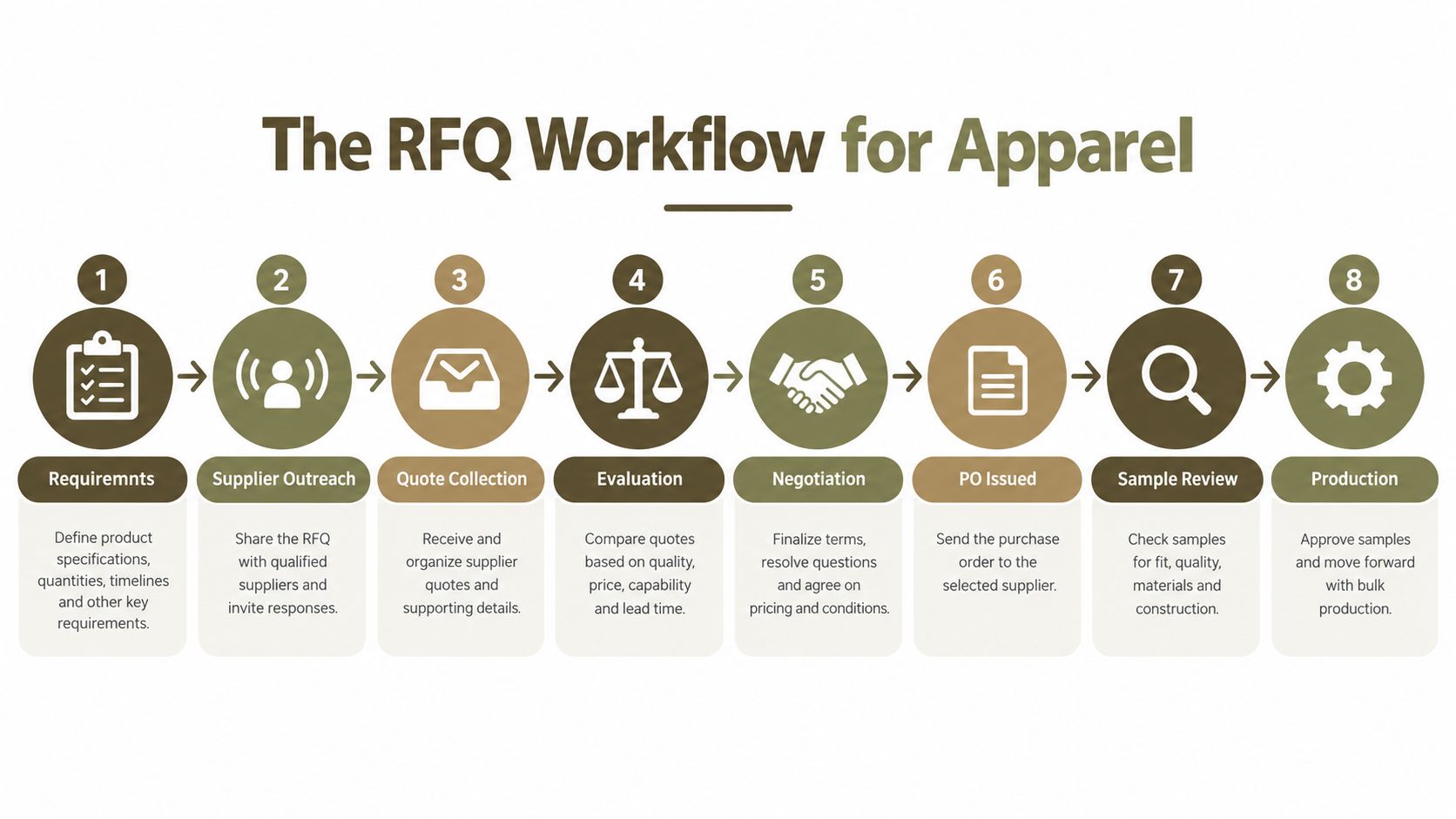
A healthy RFQ lifecycle can be mapped as a sequence of milestones. SAP lays out the workflow in seven steps, while Microsoft compresses the operational tasks into three actions, sending the RFQ, registering bid replies, and transferring an accepted bid into a purchasing document (SAP sourcing guidance). The labels differ, but the control points are consistent.
Define the requirement. Confirm the product, construction, quantities, delivery destination, timing, quality expectations, and commercial conditions. Technical and merchandising stakeholders should resolve open decisions here, not during quote comparison.
Prepare the RFQ packet. Assemble the tech pack, BOM, graded measurements, artwork, packaging instructions, compliance checklist, commercial terms, and supplier response template. Include the exact revision identifier for every controlled file.
Qualify the shortlist. Invite suppliers that can make the product, meet the required standards, support the target volume, and deliver to the relevant market. A broad list isn't automatically a strong list. Capability and reliability determine whether a low quote is usable.
Issue the RFQ consistently. Send the same scope, deadline, question process, and response format to every shortlisted factory. If one supplier receives a clarification, distribute the clarification to all participating suppliers.
Collect and normalize quotations. Check that every supplier has responded to the same line items. Separate unit price, tooling, sampling, packaging, freight assumptions, duties, payment terms, minimum order quantities, and lead times instead of comparing a single headline figure.
Evaluate and clarify. Score the offers against predetermined criteria. Investigate omissions, substitutions, unusual lead-time promises, and terms that could change the landed cost or production risk.
Negotiate and award. Negotiate only after the comparison is clean. Select the best acceptable offer, document the decision, and issue the purchase order or agreement with the awarded specification attached.
Transfer the award into production control. Lock the approved supplier, revision, price basis, delivery commitment, and required samples. The RFQ isn't complete if the purchase order points to an outdated tech pack.
The supplier submission stage is where technical accuracy becomes visible. If the inputs aren't fixed, evaluation becomes a debate over assumptions. Teams that want to improve repeatability should also track procurement KPIs with templates so they can record response quality, clarification volume, award timing, and post-award changes.
For product teams still building their supplier network, how to find a manufacturer should be treated as a qualification task, not a substitute for a structured RFQ. The right factory still needs the right information.
Documents That Make or Break Your RFQ
The RFQ packet should make the quote easy to complete and difficult to misinterpret. A supplier can't price accurately from a polished sketch if the construction, components, dimensions, and commercial boundaries remain undefined.
The technical core
The tech pack communicates how the product should be made. It should identify construction details, seam and stitch requirements, artwork placement, materials, trims, finishes, tolerances, and approved references. A tech pack checklist before you send can help the team verify that the document is complete before suppliers receive it.
The BOM converts the design into a component list. Include the main material, lining, thread, labels, buttons, zippers, elastics, packaging components, and any special treatments. Without it, a factory may exclude small but material costs or make an unapproved substitution that creates a misleadingly low quote.
The graded spec sheet defines how measurements change across sizes. Include the base size, points of measure, grade rules, tolerances, and any fit-critical dimensions. A supplier who quotes from a single sketch may price the sample accurately while leaving production assumptions unresolved.
Commercial and compliance controls
The compliance checklist should state testing, restricted-substance, labeling, documentation, audit, and social-compliance expectations relevant to the order. Don't bury these requirements in an email. Put them in a controlled section that suppliers must acknowledge.
A useful response template forces like-for-like answers:
| Quote field | Required supplier response |
|---|---|
| Product line | Price by style, color, and size basis |
| Materials | Confirm nominated material or list each proposed substitute |
| Components | Price every BOM item and identify exclusions |
| Packaging | State packaging unit, materials, and labeling assumptions |
| Delivery | Give lead time, shipping point, and delivery basis |
| Commercial terms | State payment terms, minimums, validity, and included charges |
| Exceptions | List every deviation from the RFQ |
The buyer should freeze the packet before sending it, then record any approved clarification as a new controlled revision. That discipline prevents a factory from quoting revision A while the internal team evaluates against revision B.
RFQ Timelines and Response Rates
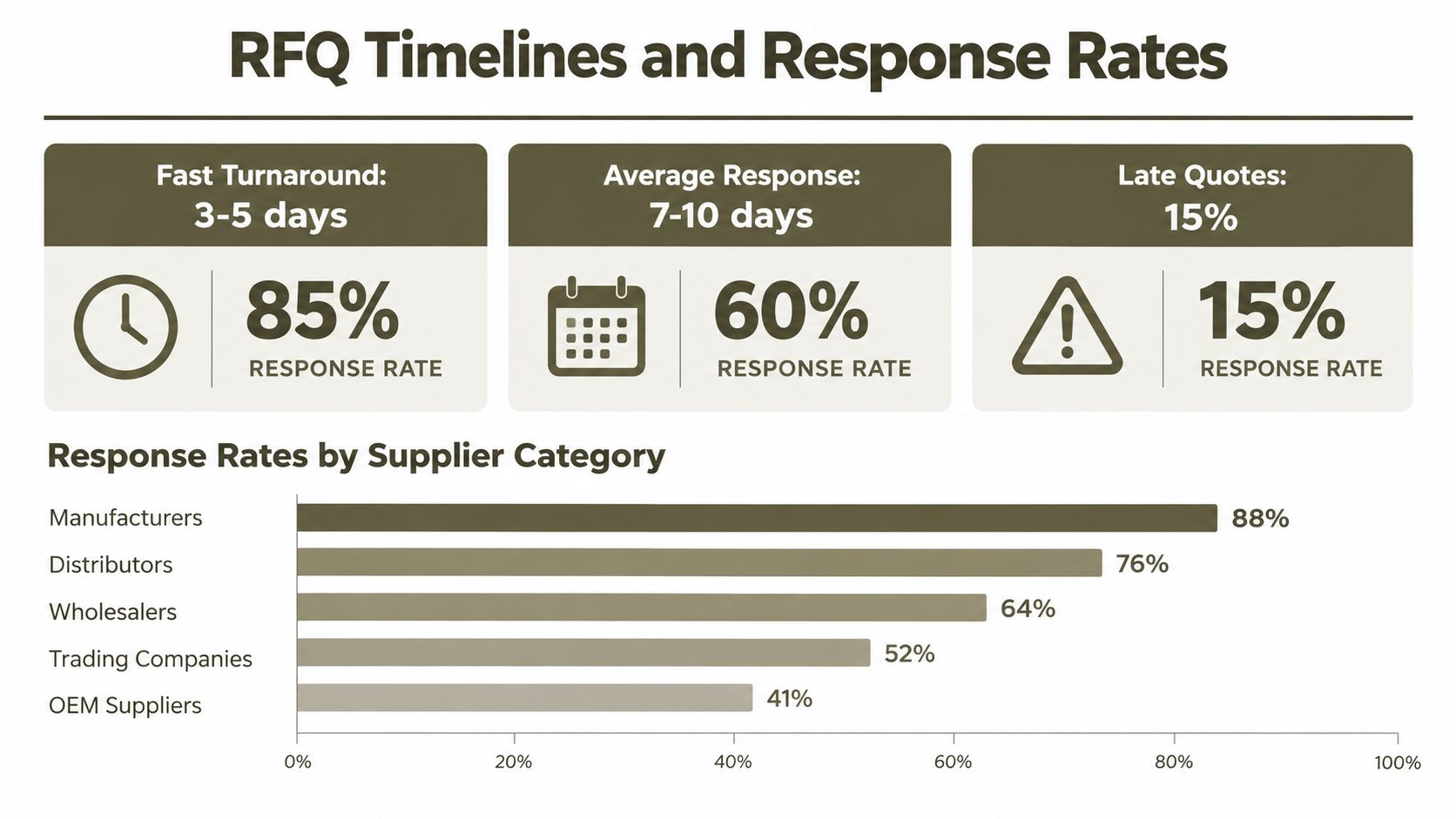
A supplier can return a quote quickly and still leave you with an unusable comparison. The deadline must reflect how much interpretation the packet requires. A standard commercial request may receive 24 to 72 hours, while a technically detailed RFQ may need 1 to 2 weeks. Public-sector requests commonly allow 2 to 4 weeks, partly because formal notice requirements extend the process, as described in Infor RFQ process guidance.
For apparel, a short window suits a repeat style with stable materials and a known supplier. It creates risk for new construction, custom trims, complex grading, or a first-time factory relationship. Suppliers may submit provisional assumptions, omit line items, or rush clarification instead of building a price that can survive award and handoff.
One procurement playbook reports response rates of roughly 60% to 75% for well-written RFQs and about 25% to 35% for messy RFQs, while recommending 5 to 7 business days for standard products and 10 to 14 days for custom or complex requirements (ProcIndex RFQ email guidance). The practical objective is a comparable quote, not just a fast reply.
Set the deadline around the work suppliers must complete:
- Simple repeat order: Use a short window only when the specification and supplier context are stable.
- New or technical product: Allow time for material checks, capacity review, and internal costing.
- Freight-sensitive order: Require separate product and logistics assumptions, then review guidance on evaluating shipping cost estimates.
- Development-linked request: Match the quote deadline to the sample and production plan in the fashion production timeline from sketch to first sample.
Before award, normalize units, inclusions, lead-time definitions, and exceptions across every response. Then carry the accepted quote into the purchase order and development file. That post-award transition prevents a low, ambiguous quote from becoming a higher production cost later.
How Genpire Integrates Into the RFQ Process
The most useful RFQ improvement happens between design intent and supplier-ready data. A sourcing team may have a strong concept, yet still lose time translating sketches, references, revisions, and component decisions into a packet that several factories can interpret consistently.
Genpire can sit in that preparation layer as one workflow option. It converts prompts, sketches, and reference images into product concepts, multi-view visuals, technical sketches, and structured specifications. Its tech pack workspace supports construction details and component breakdowns, with exports to SVG, PDF, and Excel for downstream manufacturing use.
That output can support the RFQ steps without replacing procurement judgment. The sourcing lead still decides which suppliers qualify, which substitutions are acceptable, how offers should be weighted, and whether the quoted delivery promise is credible.

The handoff needs structure
A connected workflow is valuable when it preserves the relationship between the product and the quote. The working file should carry:
- Product identity: Style, color, size range, and approved reference images.
- Technical definition: Construction, measurements, materials, trims, and packaging.
- Commercial request: Quantity, delivery details, target terms, and required response fields.
- Supplier feedback: Clarifications, exceptions, substitute proposals, and approval decisions.
- Award record: Selected supplier, final quotation, approved revision, and purchase-order basis.
This structure addresses a common post-award problem. Newer procurement guidance highlights the need to keep engineering revisions, approved vendor mapping, and supplier-ready templates aligned after the RFQ is sent (AuraVMS procurement bottlenecks). A quote isn't executable merely because a supplier has been selected. The awarded data must remain connected to the version that production will use.
Common Failure Points and How to Avoid Them
Most RFQ failures are ordinary, preventable errors. The expensive part is that they surface late, after the team has invested time comparing bids or approving a supplier.
Revision drift
A designer changes the sleeve construction after the RFQ goes out. The technical designer updates the PDF, but the BOM remains unchanged. The supplier sees an email attachment, while the purchase order references the earlier file.
Use a revision register with the file name, owner, approval date, and status. When a change affects price, lead time, material, or compliance, issue it formally to every bidder and require written acknowledgment.
Unpriced assumptions
Factories often flag uncertainty through exclusions rather than direct refusal. A quote may omit packaging, testing, development charges, special finishes, or freight. Treat every blank as a question, not as zero.
Ask suppliers to complete a response checklist:
- Scope: Confirm every style, color, size, and quantity basis.
- Materials: Identify nominated materials, substitutions, and minimums.
- Construction: Confirm critical sewing, finishing, and inspection requirements.
- Packaging: State carton, polybag, labeling, and packing assumptions.
- Delivery: Specify production lead time, shipping point, and delivery basis.
- Commercials: State payment terms, quote validity, minimum order quantities, and exclusions.
- Exceptions: List any deviation from the RFQ rather than hiding it in notes.
Post-award contamination
The award should create a clean production record. Archive losing bids, preserve the comparison, map the approved supplier to the awarded product, and attach the final technical revision to the purchase order. Guidance on RFQ bottlenecks also emphasizes time tracking by phase and connecting sourcing records to downstream procurement and supplier-performance data (AuraVMS workflow guidance).
The handoff is part of the award. If production can't identify the exact quoted scope, procurement hasn't finished.
Accelerating Your Sourcing Cycle
A sourcing cycle stalls after the RFQ is sent when suppliers interpret the same product differently. Speed improves when the specification is fixed, every supplier uses the same response sheet, and revisions remain traceable. Fewer ambiguities mean fewer clarification emails and a cleaner comparison.
Assign ownership before requests go out:
- Requirements owner: Confirms the product definition and closes technical gaps.
- Packet owner: Checks the tech pack, BOM, measurements, compliance documents, and commercial template.
- Supplier owner: Qualifies the shortlist and manages equal communication.
- Evaluation owner: Normalizes quotations before negotiation and records exceptions.
- Production owner: Converts the award into an executable purchase and manufacturing record.
The last role protects the handoff. Teams can select a supplier quickly, then lose time when the selected quote, approved sample, engineering revision, and purchase order disagree. Keep the post-award file as the controlled source of truth, with one owner resolving conflicts. Guidance on RFQ bottlenecks also recommends tracking time by phase and connecting sourcing records with procurement and supplier-performance data (AuraVMS workflow guidance).
An integrated workflow can connect concept development, specifications, supplier requests, sampling, and bulk production. Genpire's publisher describes demonstrated cycle compression of 9 to 13 weeks and approximately 65% compared with traditional processes, although those figures are product-specific claims. The practical lesson is narrower and more useful: factory-ready information reduces the rework that makes RFQs feel slow (Genpire).
Before sending the next request, verify three points:
- Are suppliers quoting the same product?
- Can evaluators compare every material and commercial assumption?
- Can production identify the awarded revision without searching email?
If any answer is no, correct the packet before pursuing another quote. The strongest RFQ process ends with comparable bids and a production record that the factory can execute.