A pattern maker converts a garment concept into precise, production-ready pattern pieces a factory can cut, sew, and repeat.
The familiar advice to “send your sketch to a manufacturer” skips the work that makes the sketch usable. A drawing can communicate a beautiful silhouette without explaining how the sleeve attaches, how the fabric behaves, or whether the garment will fit beyond the sample size. A pretty drawing is a starting point, not a production instruction.
For a founder, the important question isn't who can draw the templates. It's who will translate the design into workable construction, test that interpretation, and take responsibility for correcting it before bulk cutting.
Table of Contents
- What a Pattern Maker Actually Owns
- How a Flat Pattern Builds a Garment
- Skills Tools and the Numbers on the Pattern
- From Design Handoff to the Factory File
- Hand Drafting CAD and AI Side by Side
- Three Garments and a Production-Ready Test
- Choose a Pattern Path Before You Sample
What a Pattern Maker Actually Owns
A pattern maker owns the geometry that turns design intent into a garment. Working from a sketch, measurements, or an existing sample, they develop flat components such as fronts, backs, sleeves, collars, waistbands, pockets, facings, and linings.
Those pieces contain more than outlines. They carry seam allowances, grainlines, wearing ease, notches, closure positions, and the rules used to develop other sizes. The U.S. Bureau of Labor Statistics defines fabric and apparel patternmakers as workers who “draw and construct sets of precision master fabric patterns or layouts” and notes that they may also mark and cut fabric.
Who owns what from sketch to cut
Small brands often hire someone who performs several jobs. That's workable, but the responsibilities still need names.
| Role | Owns | Does not own | Typical output |
|---|---|---|---|
| Pattern maker | Piece geometry, ease, grain, notches, grade rules, master pattern | Brand look and the sewing of bulk units | Graded pattern set and construction logic |
| Fashion designer | Sketch, silhouette, mood, fabric direction | Seam engineering and size math | Design sketch and references |
| Technical designer | Fit standards, spec measurements, sample comments | Drafting every piece from scratch in many teams | Measurement spec and fit notes |
| Sample maker | Sewing the trial garment to the pattern | Changing grade rules unless asked | Sewn sample and construction feedback |
| Factory cutter | Marker efficiency and cutting the lay | Inventing new pattern shapes | Cut bundles ready to sew |
These are accountability boundaries, not rigid job descriptions. A freelance pattern maker might also lead fittings and sew samples. A factory might employ a technical team that combines several responsibilities.
The risk appears when everyone assumes someone else has made a decision. If the designer requests a relaxed shirt, the technical designer establishes its measurement targets, and the pattern maker distributes the necessary room through the actual pieces. The sample maker shouldn't have to invent that room while sewing.
Translation includes technical judgment
So, what is a pattern maker beyond someone who draws clothing templates? They're the specialist who decides how the design can exist in the chosen material and construction process.
That may mean proposing a different opening so a garment can pass over the wearer's head, changing a facing so it stays inside, or questioning a pocket that would pull a lightweight front out of shape. They protect the design by identifying where its current interpretation won't work.
Ownership rule: Name the person who can approve a pattern change. Otherwise, a helpful alteration in the sample room can become an undocumented production decision.
A useful brief gives that person enough information to interpret the design. A useful release process gives the brand evidence that the interpretation works.
How a Flat Pattern Builds a Garment
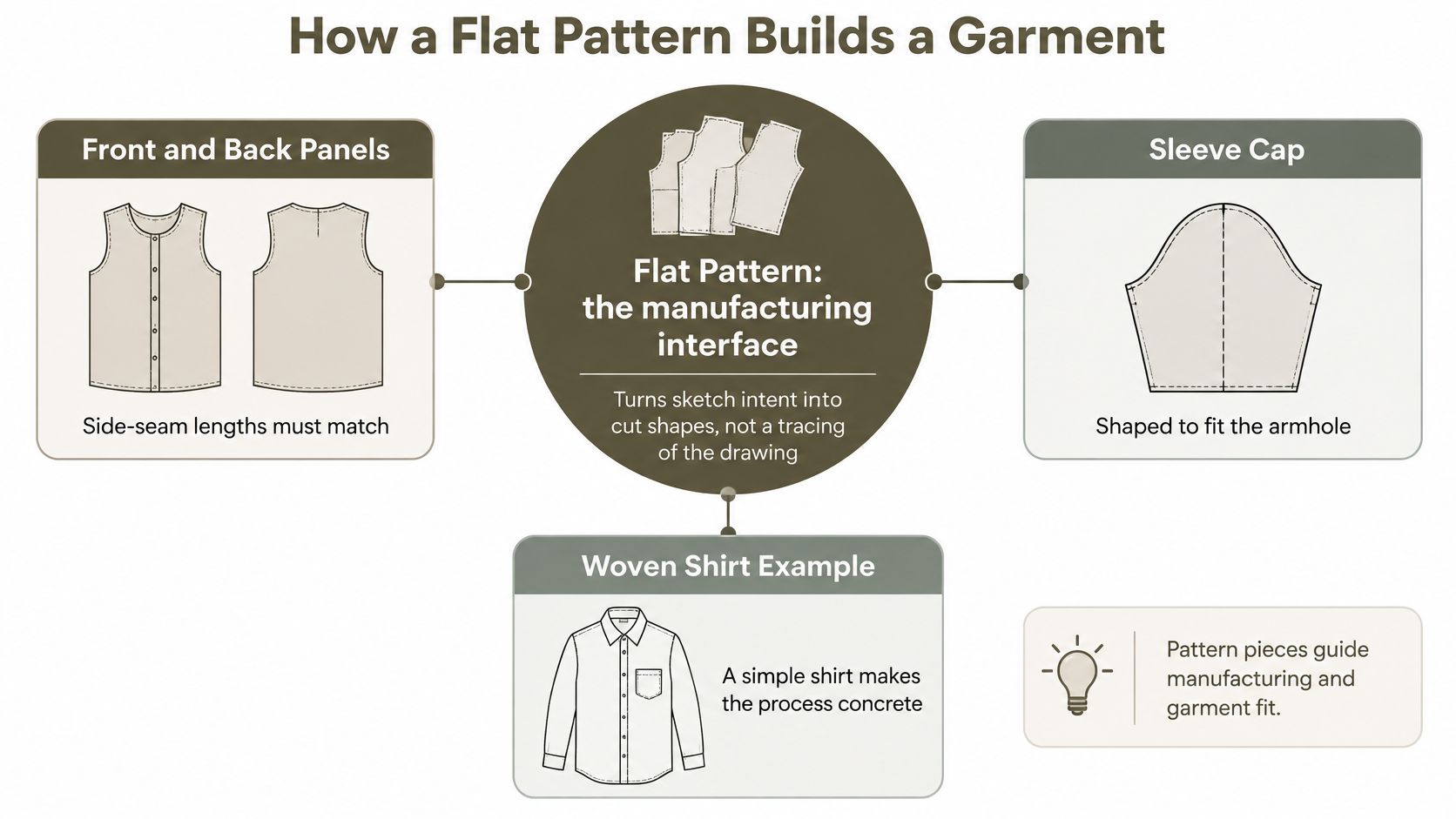
Say your sketch shows a woven shirt with a crisp collar, shaped sleeves, and a curved hem. The drawing shows the appearance, but the pattern maker must resolve the relationships between every connecting edge.
The front and back side seams need compatible sewing lengths. The sleeve cap must fit the armhole with the amount and placement of ease intended for that sleeve. Ease isn't an accidental mismatch. It's a deliberate relationship that the sample maker must be able to sew.
The diagram shows how those separate shapes become a connected garment.
Every dependent piece needs an answer
If the neckline changes, the collar stand and collar need checking. A facing must follow the edge it supports, while a lining needs enough freedom for the shell to move properly. Fitinline's guide to garment grading explains the importance of preserving these component relationships as patterns develop across sizes.
Notches identify matching locations. Balance marks help establish alignment. Grainlines tell the cutter how to orient each piece on the cloth, which influences how the finished shirt hangs.
Fabric changes the solution. Cotton poplin can support a crisp collar; stretch jersey needs a different approach to wearing room and edge recovery. Bias-cut cloth can lengthen as it hangs, so a hem that looks level immediately after sewing may need reassessment.
For an accessible look at how local alterations affect connecting pieces, the Cobra DTF guide to pattern resizing is useful alongside a practical adjustment exercise. Treat resizing as a construction problem, not just a smaller outline.
What the designer needs to hand over
Before drafting starts, assemble a brief that answers the questions the sketch can't:
- Design reference: Supply front and back views, detail drawings, or a reference sample.
- Base size and intended fit: Identify whose body or measurement standard you're designing for, and describe the desired silhouette.
- Actual fabric: Provide a swatch with stretch direction, weight, and relevant handling information.
- Trims and closures: Identify zippers, buttons, elastic, interfacing, and hardware.
- Construction and production method: Explain required finishes and whether the style is intended for individual making or factory production.
The Vocational Training Council's pattern-maker occupation profile describes responsibilities that include interpreting designs, developing patterns, testing prototypes, and documenting production information.
The pattern maker should question missing or contradictory instructions rather than guess. The working loop is interpret, draft, sample, fit, revise, then release.
Skills Tools and the Numbers on the Pattern
Pattern making combines spatial judgment with measurement control. A strong practitioner can look at a flat shape and anticipate where the sewn garment will pull, fold, stand away, or restrict movement.
That ability develops through related skills, not software commands alone. The person drafting your shirt needs to understand both the body inside it and the operations used to assemble it.
The skills behind a reliable pattern
- Spatial reasoning: Translate body volume and movement into flat shapes, darts, curves, and seams.
- Arithmetic: Calculate dimensions and distribute changes without distorting the intended proportions.
- Fabric knowledge: Anticipate stretch, recovery, drape, shrinkage, and the effect of grain direction.
- Sewing knowledge: Recognize whether a seam can be reached, turned, pressed, and finished using the intended equipment.
- Fit judgment: Distinguish useful wearing room from excess fabric, and diagnose the cause of drag lines rather than removing them.
Seam allowance, wearing ease, and tolerance are different controls. Seam allowance is the material outside the stitching line; ease is room relative to the body; tolerance is the permitted deviation from an approved measurement.
As working examples rather than universal standards, an apparel-production reference available through PubMed Central describes a serged seam around 3/8 inch (1 cm), a hem around 1 inch (2.5 cm), and quality-control tolerances of approximately ±1/2 inch for major body measurements and ±1/8 to ±1/4 inch for smaller details.
The operation, fabric, and product determine the correct specification. A tolerance isn't permission to draft inaccurately, and a seam allowance shouldn't be copied from an unrelated garment.
Tools serve different purposes
Paper, pattern card, a straight ruler, a set square, and French curves are enough to develop and examine a basic block, the underlying shape from which a style is built. Walking adjoining seam lines together on paper helps reveal incompatibilities before fabric is cut.
For a hands-on learning project, a home sewist's guide to trouser drafting from B-Sew Inn can make the relationship between body measurements and garment shape more tangible. The exercise is useful even if you later hire a specialist.
Digital pattern systems help maintain pieces, graded size nests, and cutting layouts. Physical and virtual samples serve a different purpose: evaluating what those shapes become when assembled.
A precise coordinate isn't proof of a comfortable garment. The tool can preserve the number; a person still has to judge the result.
The practical deliverable is a controlled specification containing base measurements, piece identification, allowances, grain direction, matching marks, and revision information. Without that control, an accurate draft can still become the wrong production version.
From Design Handoff to the Factory File
A factory needs more than a pattern attachment. It needs an agreed package that connects the cut shapes to materials, measurements, stitching, and approval status.
The process illustration gives the broad route from design intent to a repeatable cut.
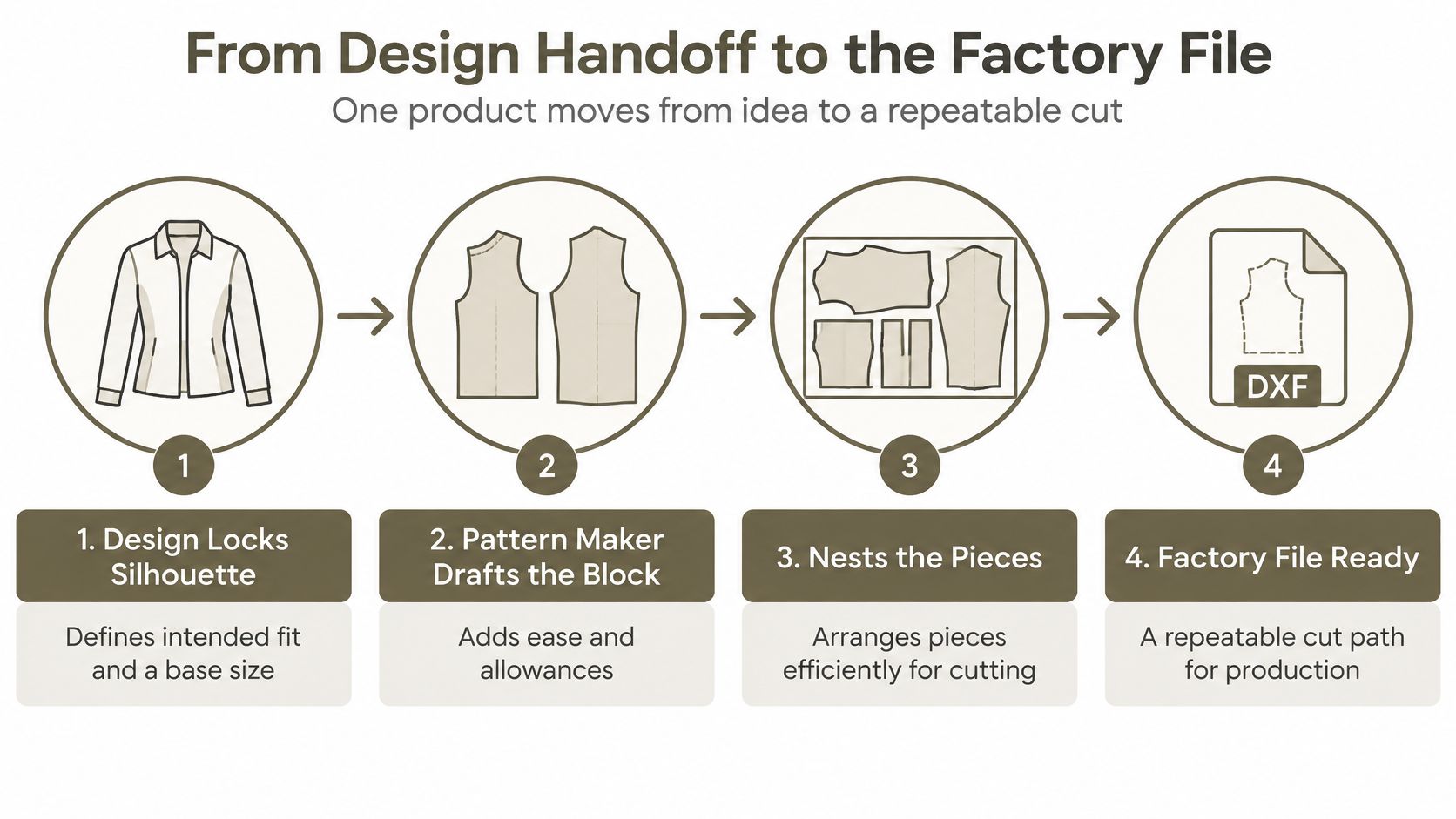
Keep an artifact at every handoff
Approve the design brief. Lock the silhouette, intended fit, fabric direction, and base size sufficiently to begin development. The output is an annotated design, not an unresolved collection of references.
The pattern maker drafts or adapts the block, develops the style pieces, and adds the necessary allowances and markings. The output is a versioned base pattern; preliminary size development can follow, but the complete grade shouldn't be treated as approved before fitting.
Assemble the tech pack. Combine the pattern reference with a bill of materials, measurement chart, stitch details, and construction notes. This explanation of what a tech pack contains helps distinguish the instruction package from the pattern geometry itself.
A sample room cuts and sews the trial using the specified materials or clearly documented substitutes. The output is a labeled sample with construction observations.
Turn fit comments into revisions. Replace “the sleeve feels wrong” with an observation such as restricted forward reach, then record the agreed pattern correction. The outputs are updated pieces, revised specifications, and an approval record.
Release the approved pattern files, size information, and cutting marker for bulk. A marker is the cutting layout, not the same thing as a graded nest showing related pattern sizes.
Separate personal fitting from production sizing
Made-to-measure adjusts a pattern for an individual. Production grading applies documented dimensional rules across a standardized size range.
The latter isn't a percentage enlargement. Body shape, posture, movement, and fabric recovery affect where changes belong. The My Next Move profile for fabric and apparel patternmakers describes work involving size-specific patterns, dimensions, material stretch, and sample adjustments.
Specify the measurement system and the method used to measure each point. That lets another factory reproduce the instructions rather than reinterpret them.
For an additional visual reference on the development process, watch the following video.
Keep factory comments attached to the controlled file rather than scattered through rewritten email specifications. For approval documentation, you can create an apparel proof signoff form using Dirt Cheap Product, Inc.’s resource as a starting point, then distinguish artwork approval from pattern, fit, and construction approval.
Hand Drafting CAD and AI Side by Side
The method used to prepare a pattern matters less than whether the output answers the production questions. Paper can produce an excellent garment. A polished digital file can still contain incompatible seams.
The useful comparison is therefore not old versus new. It's which tool supports the task, and who checks its output.
Hand, CAD, and AI pattern making compared
| Method | How the pattern is made | Strength | Limit | Best when |
|---|---|---|---|---|
| Hand drafting | Paper, rulers, and curves from a body block | Tactile understanding and low setup cost | Slow to grade, mark, and share | A one-off, a toile, or learning the craft |
| CAD pattern making | Digital block, grade rules, and a marker | Repeatable sizes and material-efficient layouts | Still needs a person to judge fit | A size run headed to a factory |
| AI-assisted workflow | Prompt, sketch, or reference into specifications and a tech pack | Faster preparation without CAD fluency | Specifications aren't necessarily cuttable patterns or fit approval | Early concepts through a reviewed factory specification |
Hand drafting makes relationships visible. You can fold a dart, compare adjoining edges, and physically change a curve. Its limitations become more noticeable when a team needs to update an entire size range and exchange revisions with an overseas factory.
CAD makes those repeated operations easier to control. A pattern maker can preserve the master, apply documented grade rules, and prepare layouts without redrawing every piece. The operator still needs to understand why each point moves.
AI assistance isn't the same as pattern engineering
An AI-assisted workflow can help a founder organize a concept into technical views, materials, measurements, and construction instructions. But a tech pack isn't automatically a cut-ready pattern set. Confirm which artifact the workflow produces and who will develop or verify the actual pieces.
A useful comparison of CAD alternatives for fashion designers should be read with that distinction in mind. Concept visualization, specification writing, pattern drafting, and fit simulation solve different problems.
For example, a virtual shirt may look plausible while the proposed sleeve restricts forward reach. A generated pocket position might appear balanced in the base size but become awkward after grading. Those are review tasks, not reasons to discard digital assistance.
Tool-selection test: Choose the workflow that gives your next collaborator an editable, understandable deliverable, not merely an attractive preview.
Pattern making remains a distinct technical occupation. In May 2019, U.S. fabric and apparel patternmakers had estimated employment of 5,870 and a mean annual wage of $52,740, according to the Bureau of Labor Statistics occupational figures.
Those historical figures aren't a current hiring forecast. They help establish that pattern making is a specialized production discipline, not another name for fashion illustration or sewing-machine operation. Digital assistance changes how the work is performed; it doesn't remove the need to assign responsibility for the result.
Three Garments and a Production-Ready Test
The pattern maker's contribution becomes easier to recognize when you look at a garment that almost works. The sample may be wearable and still contain a problem that will become expensive across a production run.
A development workspace brings together the evidence needed to diagnose those problems: garments, technical drawings, body forms, and the patterns themselves.
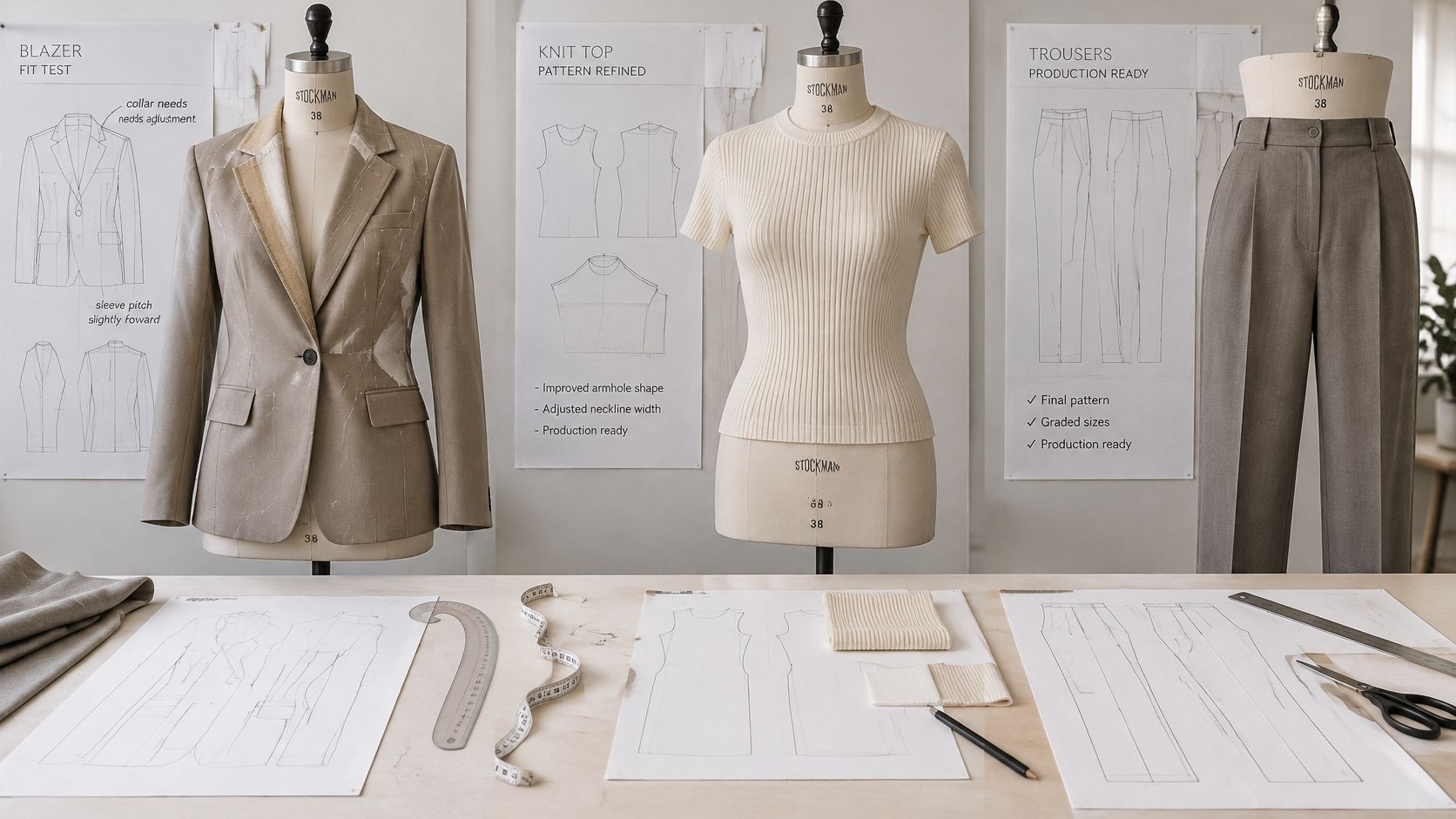
A blazer, a jersey dress, and a tote
The custom blazer looks sharp on a hanger, but the collar lifts away from the neck during fitting. The pattern maker investigates upper-body balance, shoulder shape, and collar relationships rather than shortening the visible gap. If the sleeve twists, they examine sleeve pitch and arm position; the lining must accommodate the corrected shell.
The stretch jersey dress fits at the waist but collapses around the bust and rides upward during movement. The answer isn't automatically to make everything tighter. The pattern maker checks stretch direction and recovery, then adjusts the distribution of ease, shaping, and length, using negative ease only where the material and design support it.
The simple tote seems less demanding because it doesn't fit a body. Yet inconsistent strap attachment positions can change how it hangs, while an unclear turning opening or hardware sequence can force different sample rooms to improvise. The pattern maker establishes attachment marks, compatible panels, and a workable assembly order.
In each case, the pattern correction should address a diagnosed cause. Moving a seam until the sample looks acceptable isn't enough if nobody records what changed.
The release test
Before approving bulk cutting, require evidence for each item:
- Named base size: The approved sample corresponds to an identified measurement standard.
- Written grade rules: Size changes are documented and checked for the intended range.
- Material-specific allowances: The pattern reflects the actual fabric and finishing operations.
- Construction notes: Closures, pocket positions, hardware, and assembly requirements are explicit.
- Relevant-size fitting: Samples have been evaluated where size-related risk is greatest.
- Compatible seams and marks: Joining edges and notches agree with the intended sewing method.
- Revision history: Everyone can identify the approved pattern, specification, and sample.
A printable PDF alone doesn't pass this test. Virtual evaluation can help identify issues, but before bulk production, confirm the construction and intended fit in a sewn sample.
Use the fashion production timeline from sketch to first sample to place those checks in your development schedule. Run the next style you care about through the release list before authorizing cutting.
Choose a Pattern Path Before You Sample
Hire or contract a pattern maker when your style has a size range, demanding fit, or fabric behavior you don't yet understand. Learn a basic block yourself when you're developing a personal sample and want to participate more confidently in fittings. Choose an AI-assisted specification workflow when your immediate gap is turning a concept into an organized factory brief.
Those choices can work together. Learning enough to describe a fit problem doesn't require you to become the production pattern maker, and preparing specifications digitally doesn't mean accepting them without review.
Match the route to the missing deliverable
- You have a sketch but no construction solution: Brief a pattern maker with the design, material, intended fit, and production requirements.
- You have a pattern but no approved sample: Arrange sample construction and a documented fitting before expanding development.
- You have scattered references but no usable brief: Organize the design into technical views, measurements, materials, and construction instructions first.
For that last route, we generate factory-ready tech packs from a prompt, including measurements, a bill of materials, construction notes, and a manufacturer match. Our workflow moves from concept generation and visual editing through the AI tech pack, an RFQ to vetted manufacturers, sample ordering, approval, and bulk production.
Factories can comment directly on the same file the designer finished, avoiding a separate retranslation of the brief. That helps preserve decisions, but it doesn't turn specification generation into fit approval.
Keep judgment with a named person
A pattern maker or technical reviewer still needs to own feasibility, ease, and the sewn result. Before commissioning work, agree whether the deliverable includes the base pattern, grading, sample revisions, editable files, and production release.
This week, write the base size, fabric, and intended fit directly on your sketch. Use that packet to brief a pattern maker or prepare the tech pack, then order a sample before committing to bulk.
Genpire helps turn prompts, sketches, and references into technical specifications and a connected path to sampling and manufacturing. Visit Genpire to prepare your next garment brief, connect with a manufacturer, and put a sample through review before approving production.